Click on the Slides button above to view the built-in slides feature.
Slides can be added in a few ways:
Create slides using Wowchemy’s Slides feature and link using slides parameter in the front matter of the talk file
Upload an existing slide deck to static/ and link using url_slides parameter in the front matter of the talk file
Embed your slides (e.g. Google Slides) or presentation video on this page using shortcodes.
Further event details, including page elements such as image galleries, can be added to the body of this page.
Indie web is a redundant term, like wet water. At the core of the web everything is independent. Small pieces loosely joined.
Boomer-Huang
, updated:
What the actual fuck?
Miller Time
, updated:
The president’s new chief of staff is a white nationalist. Full stop.
“It’s My Life’s Calling To Serve My Neighbor” - Member-Elect Sarah Trone Garriott Checks In From Iowa
, updated:
Enjoy this second in a series of reports we’ll be getting from our intrepid candidates who flipped red seats and red states blue this year
Executive Privilege
, updated:
To read this letter, click here:
“Wealth and Poverty” Class 10: Who should get public assistance?
, updated:
The “deserving” poor?
Monday session
Monday session
La diplomática (temporada 4): los límites de coquetear con el poder
Creadora: Debora Cahn. Elenco: Keri Russell, Rufus Sewell, Allison Janney, Bradley Whitford, Jodie Whittaker, Ali Ahn, Ato Essandoh. País: Estados Unidos. Duración: 8 capítulos de aproximadamente 50 minutos. Más información de la serie: https://www.imdb.com/title/tt17491088/ “La capacidad de ver nuestras propias decisiones como las ven los demás puede marcar la diferencia entre un acuerdo negociado y […]
NVIDIA (tweet, Hacker News, MacRumors, Techmeme): The Board of Directors voted unanimously to reinstate Mr. Huang following a series of discussions and meetings with Mr. Huang, after which the Board was satisfied with respect to Mr. Huang’s candor and ability to lead NVIDIA. In the process of reaching its decision, the Board received input from […]
Microsoft Retires “To Do” App
Todd Bishop (MacRumors): Microsoft acquired the popular Wunderlist app in 2015, shut it down in 2020 and told its loyal users that Microsoft To Do would be their new home. Now it’s asking them to switch again. Microsoft plans to retire the To Do apps on June 30, 2027, moving personal task management for work […]
Stop BAAJA: A Trojan Horse for Dirty Energy and Weaker Environmental Protections
The BAAJA bill threatens clean water, wildlife, and our communities. Together, we can stop this reckless bill from fast-tracking fossil fuel projects and weakening environmental protections. Here's what the legislation would change, why CLF opposes it, and what's next in Congress.
A new imprint from Harper Voyager is betting they do. As reported by Maia Snow in The Bookseller, Between Worlds is a new community-oriented imprint that “will publish fantasy, romantasy, dark academia, horror and dystopia as well as requests from
Slop Style
, updated:
Slop is anything inferior produced by AI.
Slop Style
, updated:
Slop is anything inferior produced by AI. Today it is a derogatory insult, usually applied to content that is consumed in the same channel as human-made content. Slop is the AI-generated video seen on TikTok, Instagram, YouTube. Slop is the … Continue reading →
Am I A Design Engineer?
If you ask me, “What is design engineering?” part of me wants to respond, “I know it when I see it.” In other words: I can’t tell you all that it is, but I can tell you what it is not.
Making elaborate animations for marketing websites.
Constructing elaborate prototypes in a design tool (e.g. Figma) that have no basis in the reality of 1) how browsers work, or 2) your company’s source space.
Despite these personal beliefs about the term, I find its colloquial use different. Here’s my perception of terms these days:
“Design Engineer” — too heavily weighted towards visual design and animation, not enough weight in the work of practical engineering.
“Product Engineer” — too heavily weighted towards factory engineering (e.g. can you manage agents upon agents within a system to churn out something fast?) and not enough weight in design/product thinking.
Which makes me want to (selfishly) invent another term: Product Design Engineer.
Pro: it covers multiple disciplines; Product, Design, and Engineering.
Con: it covers multiple disciplines; what a diluted mouthful.
But merely combining nouns doesn’t describe the work. To me, design engineering isn’t about encompassing multiple disciplines. It’s about working in the relationships between them.
For this reason, I’ve always been partial to the idea of Human-Computer Interaction. HCI is fundamentally multidisciplinary, so people with varied interests and backgrounds in computers (design, engineering, product, etc.) and humans (psychology, art, literature, etc.) contribute to its success.
I tend to think of the role of a design engineer to be along the lines of asking questions like:
How do computers work? What are they good at? What are they bad at?
How do humans work? What are they good at? What are they bad at?
With that framing, you then ask: “Given some human problem, how can I leverage computation ( if at all) to solve it?”
Or maybe it’s no software at all. Because design engineers live in the relationships between disciplines, I believe they are well positioned to understand a problem and argue that additional software may be a worse, not better, solution.
Maybe I’m not even describing “design engineering” anymore. Maybe I’m just describing the kind of work I enjoy doing and wishing there was a label for it. “Jim Nielsen–Style Software Maker.” If you’re looking to fill that role, I know a guy.
Some cynical speculations have already been confirmed, and you can bet your last dollar the incoming Congress is going to take an interest
29 Questions for Elizabeth Holmes
, updated:
Hung Up x Marina Hyde
Seeking God in Science part 12: Quantum mechanics part 2: Math
At the end of the previous post I closed with:On the one hand, QM -- and its relativistic counterpart, QFT -- are the most successful scientific theories ever devised. No experiment has ever produced results at odds with the predictions of QFT (but see the note at the end). On the other hand, the mathematical structure of these theories are categorically at odds with our lived
I think it is good that Dave Winer is responding to comments on his BonBon browser, but if he does not link back to the discussion thread, none of the commenters are going to hear his response….
The majesty of silence in music
Music includes silence in a number of ways. The most straightforward is the use of rests in a song or composition. Sometimes, rests form a pattern, or part of a pattern, to develop a theme or musical idea. When albums were published on vinyl, songs would end and be followed by a period of silence […]
Jensen Is Too Big To Fail
, updated:
Law and ethics in the age of Trump
The War of the Data Currents
, updated:
RDF is the AC. Your warehouse can stay right where it is.
“I CONVINCED THEM”: Trump Admits He Rigged Nvidia’s Boardroom, Then Stamped It National Security To Save His $62 Million in NVDIA Stock
, updated:
Trump just gave incoming Dem majority everything: He called CNBC, bragged he strong-armed Nvidia’s board, and handed Congress the confession it needed.
Camino a casa: una gran propuesta de cine inclusivo
Dirección: Arturo Mendicuti. Guion: Arturo Mendicuti. Participación: Christian Arias, Marco Antonio Martínez, Jesús Rodríguez, Érika Bernal, Juan Carlos Saavedra. País: México. Estrenado en la 19° edición del Festival Zanate, Camino a casa plantea una perspectiva y narrativa única dentro del cine documental, centrada en las alegrías, retos y cuestionamientos de un grupo de actores con […]
We are excited to share some news about leadership in The Digital Rhetoric Collaborative, as Anne Ruggles Gere steps down from her role as co-director. Anne recently retired from the University of Michigan and is now Gertrude Buck Collegiate Professor Emerita in the Marsal Family School of Education and Professor Emerita of English Language and [...]
When KAT makes a great play at the Garden, the announcer could say his name like they used to say Carmelllllllooooo Anthonnnnnnny, only like this: Karrrrrllllll Anthonnnnnnny. Everyone would shriek then laugh and feel nostalgic, knowing KAT is the real thing and Melo was a star but not the star. And what would be really cool if the fans in the Garden would answer it with TOWNS!
Next focus in bonbon-land is writing. We have a good start on reading with the demo site and the full app for Mac and Linux desktops. Initially writing is going to come from at least two places: 1. WordPress and 2. RSS.chat. But most important are the myriad possible ways people like to write. This is where having open formats and protocols will really pay off. Writing tools can depend on interop, they won't have to blaze their own trail so much. People creating brilliant writing tools like to focus on that, not a dozen different incompatible APIs and limits. How the hell do you get writing to fit into 500 chars on one network, 300 on another, 280 on yet another. And character limits are just the beginning.
The Monday Morning MIXER With Pete Dominick: NVIDIA Just Rehired the Man at the Centre of the Biggest National Security Scandal in U.S. History Jensen Huang Is Back, Trump Is Thrilled.
, updated:
Pete Dominick and I on Huang’s return, Trump’s “friend” Putin, and the 2028 Democrats already circling.
Yak Shaving at its best: we were building a game for VisionPro when we took a small detour and ported Godot to iOS.
We are finally ready to shave that yak.
Xogot for Vision is out on Testflight today.
THIS IS THE COVER-UP: Trump Just Bought Jensen Huang's Silence With a $4 Trillion Company - Huang Back as NVIDIA CEO.
, updated:
Briefed twice. Warned nobody. Owns up to $62 million of the stock. Now he's handed Huang his company back 8 days before he testifies.
Last Week in the #PleiadesGazetteer (16-23 November 2026): over the course of the past week, the Pleiades editorial college published10 new and 396 updated place resources, reflecting the work of Jeffrey Becker, Anika Campbell, Damian Noah Dimitrov, Tom Elliott, Sebastian Heath, Brady Kiesling, Eleftheria Konstantinidou, Darcy Krasne, Chris de Lisle, Gabriel Mckee, Amari Pavati and Eric Poehler.
We definitely do allow the client to control the appearance of writing. That's a very basic principle. I've written about it a lot and it's in the product. We didn't eliminate CSS or JavaScript, we just gave that power to the reader, not the writer.
Why base it on Markdown? Because it's the obvious choice. If there weren't such a universal trust in Markdown, BonBon wouldn't be possible. It's playing the same role as MP3 did in establishing podcasting. And the different dialects aren't a problem, there is a core set of features they agree on. We'll get by.
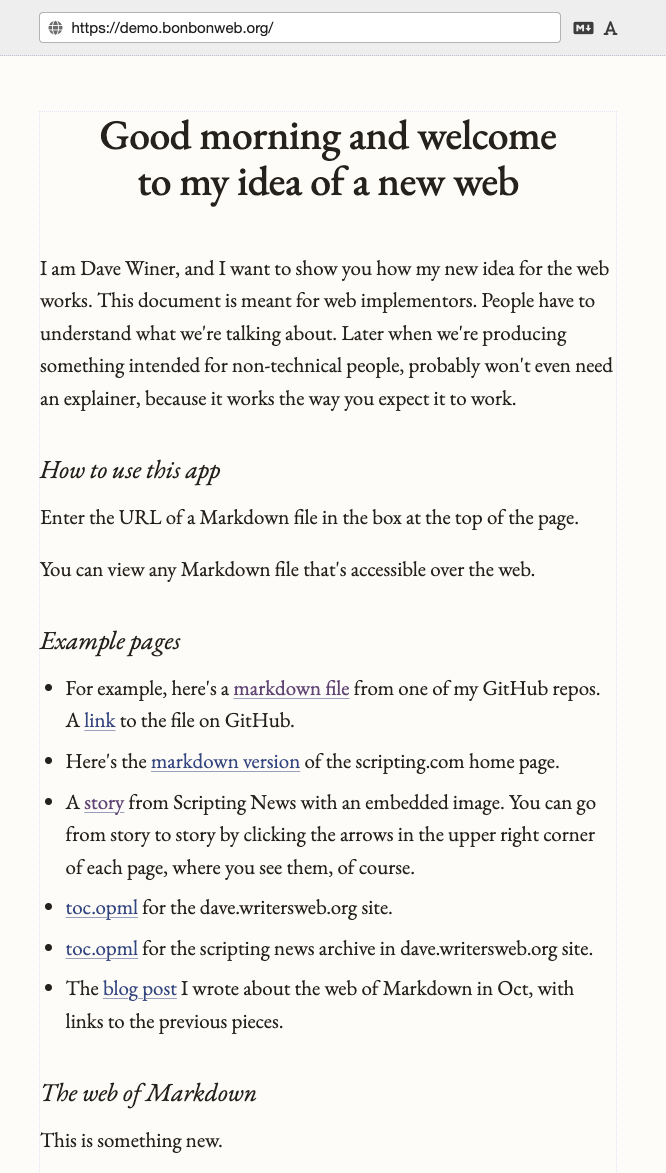
Jimmv: "But on my phone, clicking the link just gives me a Markdown doc, unrendered. What am I missing?" Grab the URL of the markdown file, go to demo.bonbonweb.org, and paste the url into the text box at the top. You will see a rendered version. It does the same thing as the standalone BonBon app. We realized that to get started, almost no one would have the browser, so we created the demo site that runs inside an HTML-based browser.
Is it possible to make a a Firefox addon that renders Markdown content to HTML? You don't need an add-in, jut follow the instructions for Jimmv above.
"Oh, nice! I've been saying for a while that browsers should have native support for rendering markdown docs, it's nice to see somebody else saying it too!" And we hope the HTML browsers adopt this. As well as Twitter, Facebook, Mastodon, Bluesky, Threads etc. We need to get out of the age of character limits, no titles possible, no editing -- etc etc. This is how writing on the web got destroyed. It was confined to silos that didn't peer with other systems. They wouldn't listen to our ideas so we made the software for them to compete with. ;-)
Bellday
, updated:
Saved by the bell Stock market today: Nvidia stock soars after company reinstates Jensen Huang as CEO; Dow, S&P 500, Nasdaq futures surge Coincidence? Dateline—Dawn, November 23, 2026: NVIDIA Board Reinstates Jensen Huang as President, CEO and Board Director. Update: They were pressured by President Trump. Dana Blankenhorn says he’s a short-timer. Go refigure Wired: Jensen Huang […]
The DNC Announces Its 2028 Presidential Primary Debate Plan, Early Thoughts On 2028 Expansion, It’s The Treason, Stupid
, updated:
Tue 115pm ET Live - The great Anderson Clayton joins us to recap another extraordinary election in North Carolina | No Founders or Paid Subscribers events this week
18 updated places. 22 new and 114 updated linked data sidebars. Inbound PATHS Atlas links are stale as the bulk download remains unavailable at runtime.
Steven identified another gap in my counting system. While we figure things out, I am going to issue negative numbers for earlier users, until I come up with a secure certificate system.
Due to some challenges with my counting process, I am awarding Jefferson the user number 1i - it is the right thing to do:
Meet “Trump’s Friend”: 762 Dead Kids, 20,651 Stolen Children, and a Rape Count the UN Can’t Finish
, updated:
Trump’s “Friend” murdered more Ukrainian children this weekend. A full accounting of what Donald Trump’s favourite war criminal and “Friend” has done to Ukraine, and what Trump has done for him.
The Daily Dean Newsletter - Monday, November 23, 2026: Panic in the Oval, Trump Cheers the Hackers, Hegseth Picks a Fight With Canada, the $25 Million Kickback and Elon’s $500M Faceplant
Today's links The Debt Trap: Obscure causality is the downfall of us all. Hey look at this: Delights to delectate. Object permanence: They Fight Crime; Cantenna wifi TV for Mali; Kakistocracy; Inflation or price-gouging; The long game; Fox v bloggers; Hollywood laundered money for Berlusoni; Katamari earmuffs; EMI v parody cricket songs; "Roller Girl"; Trump U was worse than you thought; London v Dieselgate; Bunnie at USC; Facebook gaslights the web; Apple bans ebooks that mention Apple; Private ambulances v babies in burning buildings; Boss preppers. Upcoming appearances: Oxford, Sheffield, Virtual, Oxford, Santa Barbara, Montreal. Recent appearances: Where I've been. Latest books: You keep readin' em, I'll keep writin' 'em. Upcoming books: Like I said, I'll keep writin' 'em. Colophon: All the rest. The Debt Trap (permalink) Smoking is very stupid. I was a smoker for 17 years, from ages 13-30. I was very stupid to start smoking. That stupidity only came into sharper focus a few years ago, when I got a cancer diagnosis (don't worry, I am now cancer-free): https://pluralistic.net/2024/11/05/carcinoma-angels/#squeaky-nail In my defense, I'll point out that I was just a kid when I started, but also, smoking belongs to a class of pernicious problems whose insidiousness is rooted in the distance between their causes and effects: https://pluralistic.net/2021/06/03/i-quit/ I've often said that if a little tumor had sprouted immediately after I took my first puff, I never would have taken a second one. Now that I've actually had the experience of being told that I have a tumor, I can say definitively that I would not have taken that second puff. An economist would tell you that I was engaged in "hyperbolic discounting": underpricing a future cost and overvaluing a present pleasure: https://en.wikipedia.org/wiki/Hyperbolic_discounting But I don't think that tells the whole story. Sure, I was engaged in hyperbolic discounting, but why was I doing that? What was it about smoking (as opposed to, say, French-kissing light-sockets) that led me to apply a hyperbolic discount to the costs of smoking? I say it was the attenuated relationship between cause and effect. It's not just that we undervalue the price of smoking: it's that we struggle to arrive at a correct price for smoking in the moment, because the intellectual knowledge of cancer statistics is in no way comparable to the visceral experience of a cancer diagnosis. Estimating the "cost" (emotional, physiological, monetary) of a cancer diagnosis is hard, especially if you're young and have had the good fortune of a life untouched by close contact with agonizing illness and death. The point I'm making is that the discount isn't just hyperbolic, it's hyperbolic because it relies so much upon guesswork, without comparable experiences to anchor your estimate. What's more, it's this same attenuated causality (in which cause is separated from effect by so much time and space) that allowed the tobacco industry to sow so much profitable doubt about the connection between smoking and cancer. Sure, some of the policymakers who let Big Tobacco off the hook were doubtlessly in their pocket, reliant on campaign contributions or beholden to a party that was in some queasy, cozy relationship with these death merchants. But the reason Big Tobacco was able (is able) to get away with killing us for so many decades is that you don't get a tumor with each puff. I believe that most of the policymakers who reasoned their way into doubting the connection between smoking and cancer were ensnared by this attenuated causality. They might have had low morals and low intellect, but the factor that made them such easy marks for Big Tobacco's death-hustlers was this wide, long gap between cause and effect. This cuts both ways: if you're a policymaker of low intellect and morals, you can rig your policies to put their consequences a long way off in the future, which might give you time to escape to a lucrative private-sector career with the industrial interests who benefited from your chicanery. Or (if you're a Mitch McConnell-adjacent flesh-eating ghoul who plans to die only after centuries in office, chin red and slick with the heartblood of the innocent), you can put so much time and space between your fuckery and the ruin it brings that the voting public fails to connect your actions with the consequences. After all, no one ever lost money betting against the American public's object permanence. For example, Trump's Big Bill was designed to make its deepest cuts – to Medicaid, rural hospitals, the increased tax-load on workers to advantage their bosses – after the midterm elections. The cynical reasoning isn't hard to follow: We'll just tell voters that all the bad things they've been told about the coming cuts are Fake News, and then, after the cuts arrive, blame their post-midterm misery on Biden, communists, trans people, immigrants, and the phases of the moon. This cheap trick may be deplorable, but you should also save some anger for politicians who enact good policies but refuse to take account of this principle. Take Biden's 2021 plan to lower prescription drug prices. This started off as a rule that would end the longstanding, outrageous policy that bans Medicare/Medicaid from negotiating with pharma companies. Yes, you read that right: when Uncle Sucker buys drugs from Big Pharma, the government just asks the pharma companies how much public money they'd like, and then the USA writes the companies a check for whatever sum they name, no questions asked. That's why the US pays 300% more than any other advanced nation for its drugs. Thus Biden's initial proposal: let Medicare/Medicaid negotiate drug prices the same way every private insurer and every public health system does. But then, Biden's team allowed that policy to be diluted so that it would only apply to ten drugs, and only if those drugs had been on the market for at least 13 years. Finally, the piece de resistance: the plan wasn't design to kick in until 2025, after the 2024 election, which turned out to be a referendum on the cost of living (including drug prices) that saw the Dems getting their asses kicked by the stupidest, most obviously corrupt fascists in American electoral history: https://pluralistic.net/2021/11/18/bipartisan-consensus/#corruption Whether you're ignoring attenuated causality or weaponizing it, it's critical to any analysis of how we get into as much trouble as we do. It is the ruin of individuals and firms, and of political and economic systems. Take vaccinations: herd immunity requires a lot of compliance: nearly all of us have to get vaccinated before the real benefits kick in. Securing this compliance takes a lot of effort, because the system has to get people to invest their faith in the prospect that eventually we'll get to herd immunity and an end to infection. But once herd immunity is in place, noncompliance is a much smaller deal. The very fact of herd immunity means that people can opt out here or there without getting sick (because we're all up-to-date on our vaccinations). Worse, the very fact of herd immunity means that after a while, no one can really remember what the sickness was like: we think of measles as something the Little Rascals pretended to have so they could play hooky, not as a terrifyingly infectious disease that can leave you blind or brain damaged. Asking someone who's never lived through a measles epidemic to estimate the cost of measles is like asking a 13 year old to estimate what a cancer diagnosis will feel like. The same applies to antitrust enforcement. An economy of small and medium sized firms who compete with one another is an economy where workers have more bargaining leverage and regulators don't have to worry about being outspent and outlasted with decade-plus appeals when they crack down on corrupt businesses: https://www.nytimes.com/1981/02/15/business/us-vsibm.html It's also an economy where companies must compete rather than collude. Look at what happened to the ad-tech industry, which is dominated by a duopoly that controls 80% of display advertising, and that duopoly has an illegal, collusive arrangement to rig the market to pay publishers less and charge advertisers more: https://en.wikipedia.org/wiki/Jedi_Blue In the post-war era, antitrust enforcers did their jobs: they blocked mergers, punished predatory pricing, and aggressively investigated sweetheart deals between retail incumbents and their suppliers that were designed to freeze out new businesses: https://pluralistic.net/2024/08/14/the-price-is-wright/#enforcement-priorities This produced an economy where companies had lower profits, because workers and consumers could force them to disgorge more of their surpluses, and because they had to invest more in improving their offerings to keep up with competitors. It was an economy where prosperity was more broadly shared and where it was easier to impose democratic accountability on the private sector. Then, starting with Jimmy Carter, America turned its back on antitrust. Year after year, presidency after presidency, enforcers waved through larger and more anticompetitive mergers and ignored more egregious predatory practices. For 50 years, the neoclassical economists who promoted this laissez-faire doctrine have smugly pointed out that even though the economy grew more consolidated thanks to their policy, we still had an economy, one that was often booming, where politicians could (sometimes) be seen to be intervening to address corporate cheating. The public, meanwhile, has historically struggled to connect the problems of oligarchy with these pro-oligarch policies. They can feel the regulatory capture, they know that labor grows weaker every year, they are furious at their sellout politicians and the system's naked corruption. But because the policy is separated from its outcomes by so much time and space, there's lots of room for the policy's architects and beneficiaries to do the economic version of denying the link between smoking and cancer; that is, denying the link between pro-monopoly policies and monopolies. Attenuated causality lets bad-faith actors sell us anti-vax, pro-monopoly, cancer denial…and, of course, climate denial. NASA's James Hansen warned Congress about climate change in 1988. It's not like the oil companies didn't know about this. As far back as the 1970s, Exxon's own scientists had warned the company about global warming, and the company took actions based on those warnings: https://insideclimatenews.org/project/exxon-the-road-not-taken/ Mobil, meanwhile, started secretly raising its drilling platforms to account for rising seas, even as it was taking out full-page ads in national daily newspapers that stated that "The science of climate change is too uncertain to mandate a plan of action": https://web.archive.org/web/20160101024248/http://graphics.latimes.com/oil-operations/ Attenuated causality was and is at the core of climate denial. If every climate-shredding gas turbine that the self-described environmental hero Elon Musk fired up at one of his AI data-centers immediately caused a flood or a wildfire or a heat-wave, we'd scrape all those data-centers down to their foundation slabs and then we'd display Musk in stocks and pelt him with rotten fruit. Musk really knows how to turn attenuated causality to his advantage. Remember when he performatively borrowed a security guard's pocket knife and started slicing through the Ethernet cables connecting Twitter's servers? https://english.elpais.com/science-tech/2023-09-14/when-elon-musk-unplugged-the-twitter-servers-with-a-pocket-knife-theres-still-shit-thats-broken-because-of-it.html Or when he started shutting down whole data-centers and mass-firing Twitter's technical staff? https://www.nytimes.com/2022/12/29/technology/twitter-elon-musk.html The point of this performance was to let Musk claim that Twitter's management had let itself be gulled by featherbedding engineers who grossly overbuilt Twitter's infrastructure in order to guarantee themselves perpetual employment at the expense of Twitter's shareholders. But all that spare server capacity wasn't excess: it was the cushion, the headroom, the insurance policy. Those were the servers that would pick up the slack when another server lost its power-supply or caught a bad stick of RAM. They were the servers that could shoulder the load during the next 9/11 or Arab Spring. They were the engineering staff that could execute new projects or perform emergency maintenance – and the engineering staff that could plan the next build-out in advance so that future growth wouldn't stall out when Twitter ran out of hardware. Musk's actions didn't occur in a vacuum. During the decades in which attenuated causality set the scene for an endless, incestuous orgy of mergers and acquisitions, it became normal for business leaders to hack away at their own firms' resiliency. University administrators fired tenured professors and replaced them with casualized, proletarianized adjuncts. The pedagogy – and the universities' reputations – persisted after the cuts, ebbing away slowly as the institutional memory and standards eroded bit by bit. But eventually, the universities found themselves in crisis. Campuses erupted in student revolt and spectacular scenes of violent repression: https://jayrosen.tumblr.com/post/13174138991/excerpt-from-uc-davis-2010-2012-general-catalog Universities' reputations cratered and they found themselves easy pickings for demagogues who awarded themselves a veto over faculty, curriculum and admissions: https://www.chronicle.com/article/columbia-capitulated-but-so-did-the-rest-of-higher-ed That's the thing about attenuated causality: it lets people and institutions and systems play a high-stakes game of Jenga in which every non-load-bearing block is removed and added to the top of the teetering stack. No one block causes the system to collapse…until one block does, and the whole thing falls over. It's like an avalanche. Drop one snowflake after another on the mountainside. Expose it to the midday sun and the frigid night. Sure, it creaks. Watch closely and you'll see it make minute shifts. Every now and again, a light scree of snow slides off the surface and skitters downhill, but the great mass of snow is stable. Until it isn't. Until one last snowflake alights on the mountainside and sets the whole thing rumbling and tumbling in an inexorable, unstoppable wall of snow that only halts when it can go no lower. The run-up to an avalanche is a long, long series of linear phenomena. A snowflake is minute. Add it to the pile and it will produce a minute effect. A little bit of heat causes a little bit of expansion. A little bit of wind blows a little of the loose cover around. But each one of these little strains on the system makes it less stable overall. The snowpack's stability is invisible. A snowpack that is about to cut loose is indistinguishable from one that will stay put for weeks or months. But once the snow's systemic resiliency has been exhausted, the next linear perturbation produces a wild, catastrophic, nonlinear collapse. Attenuated causality lets us build up a mountain of debt: health debt, technology debt, policy debt, credibility debt. It's impossible to know when the system's homeostatic mechanisms have been fatally weakened, such that the next compromise it is asked to bear causes it to rupture, or implode, or crumble. We can raise the level of CO2 and methane in the Earth's atmosphere year after year and see long-attenuated, linear effects: fires here, floods there, some extinctions. But one day: we overwhelm some invisible homeostatic mechanism and we lose the Gulf Stream: https://www.bbc.com/climate/impact/gulf_stream.shtml Same goes for the world's IT: we can fire IT workers, starve maintenance teams of budget and personnel, substitute indemnity for software quality, allow our "security" agencies to hoard and weaponize vulnerabilities, and on average, it will all work…until it stops: https://pluralistic.net/2026/09/12/god-in-the-box/#llms-are-fake IT might just be the most dangerously attenuated aspect of all our administrative functions. A software engineer writes a piece of code and it keeps running, even if you fire that engineer. This is one of the reasons it's so hard to unionize tech workers: when they go on strike, their scab software crosses the picket line and keeps working: https://pluralistic.net/2026/11/07/aeiou-but-sometimes-why/#unrecognizable-playbook But software isn't an asset, it's a liability. Code runs in a system, with upstream processes that produce its inputs and downstream processes that operate on its outputs. There's adjacent processes, too: other software that also gets fed by those upstream processes and also feeds those downstream processes. Even if the code never changes, the system the code is part of changes constantly, which means that the more code you have, the more code you have to maintain. So what happens when you fire technical workers is nothing…at first. And then, bit by bit, things start to break. And break. And break. Only the people who wrote the software – and the people they trained through working alongside of them – know exactly how it works, with that deep knowledge, that Fingerspitzengefühl, that informs their intuition so they can figure out why things broke and how to fix them: https://pluralistic.net/2025/09/08/process-knowledge/#dance-monkey-dance Break that chain of knowledge and you lobotomize your institution. Reduce the full complement of experienced engineers with the wherewithal to demand higher wages and better conditions, leave behind a precarious skeleton crew of juniors you terrorize with layoff threats and AI ghost-stories, and you destroy not just your ability to spot problems before they occur, but also your capability to salvage your way out of the wreckage. And that's what Musk's Doge did to the American state: undermined its capacity to absorb shocks, to anticipate shocks and brace for them – or even to detect the shocks when they're underway. There's a reason so much variation is preserved in our genomes and species: these are the reserves of variety that can rise to meet the changing world. Eliminate the variety, and you strip out the ability to cope with surprise, and what happens next shouldn't surprise any of us. Hey look at this (permalink) Mathematics and the Art of M.C. Escher https://shop.momath.org/mathematics-and-the-art-of-mc-escher.html What If We Designed Cities Around the Wind? https://commonedge.org/what-if-we-designed-cities-around-the-wind/ IDF’s Bogus Rationale for Murdering Journalists Gets Respectful Hearing From NYT https://fair.org/home/idfs-bogus-rationale-for-murdering-journalists-gets-respectful-hearing-from-nyt/ One Less Lonely Winter https://lesslonely.to/ Getting Into Last Year’s Trump Memecoin Dinner Took $55,000. This Weekend’s Costs Just $518 https://gizmodo.com/getting-into-last-years-trump-memecoin-dinner-took-55000-this-weekends-costs-just-518-2000842414 Object permanence (permalink) #25yrsago They Fight Crime https://web.archive.org/web/20011204174257/http://www.rain-street.org/fightcrime.htm #20yrsago GeekCorps builds cantenna WiFi TV network in Mali https://web.archive.org/web/20061213100911/http://www.geekcorps.org/2006/11/the-geekcorps-cantv/ #20yrsago Newsweek on the anti-DRM movement https://web.archive.org/web/20061123162740/http://www.msnbc.msn.com/id/15818852/site/newsweek/ #20yrsago Fox affiliate’s ridiculous blogging “agreement” https://web.archive.org/web/20070108101833/http://www.andycarvin.com/archives/2006/11/bloggers_give_it_up_for_fox.html #20yrago Berlusconi used Hollywood studios for money laundering http://news.bbc.co.uk/1/hi/uk_politics/6166076.stm #20yrsago High-def and science fiction don’t mix https://www.locusmag.com/2006/Issues/11DoctorowCommentary.html #20yrsago Katamari Damacy earmuffs https://web.archive.org/web/20070621123931/http://thriftyknitter.com/?p=84 #20yrsago EMI threatens cricket fans over parody songs https://web.archive.org/web/20070609201918/http://www.abc.net.au/sport/content/200611/s1791806.htm #20yrsago Audio from Bunnie Huang's USC talk https://web.archive.org/web/20061204012200/http://centeronpublicdiplomacy.com/podcasts/061121_huang.mp3 #20yrsago Net Neutrality and online gaming https://web.archive.org/web/20061205231108/http://www.ramprate.com/marketcommentary/neutrality.html #15yrsago Honeybees can smell TB https://web.archive.org/web/20120201143306/http://www.3news.co.nz/Bees-help-in-the-battle-against-tuberculosis/tabid/1160/articleID/230861/Default.aspx #15yrsago RIP, Anne McCaffrey https://reactormag.com/anne-mccaffrey-in-remembrance/ #15yrsago Evidence-based copyright: UK online movie marketplace is expensive, broken, patchy https://web.archive.org/web/20140212004731/http://www.theguardian.com/technology/2011/nov/22/movie-fans-piracy-online #15yrsago Anil Dash: Facebook attacks the open Web, becomes a badware site https://web.archive.org/web/20111121195933/http://dashes.com/anil/2011/11/facebook-is-gaslighting-the-web.html #15yrsago Cedar-Sinai takes cancer sufferer off transplant list for taking the medical marijuana its doctor prescribed http://www.allgov.com/news/controversies/la-hospital-denies-liver-transplant-to-medical-marijuana-user-despite-prescription-from-its-own-doctor #15yrsago News of the World shredded hard-drives, laptops https://web.archive.org/web/20111120081542/http://www.independent.ie/world-news/europe/phonetap-tabloids-computers-destroyed-court-told-2939797.html #15yrsago danah boyd on a nuanced understanding of privacy in the networked age https://www.zephoria.org/thoughts/archives/2011/11/20/debating-privacy-in-a-networked-world-for-the-wsj.html #15yrsago Swedish Pirate Party MEP Amelia Andersdotter, on taking office at long last https://torrentfreak.com/pirate-to-join-european-parliament-as-youngest-member-111120/ #15yrsago Britain’s Occupy movement picks up steam https://web.archive.org/web/20131001063502/https://www.theguardian.com/uk/2011/nov/19/occupy-london-protesters-ideas-bank #10yrsago Word of the day: Kakistocracy http://jury.me/blog/2016/11/19/kakistocracy #10yrsago Trump’s DHS plan leaked by Kris Kobach, who thinks more about Sharia law than folders https://www.salon.com/2016/11/21/kris-kobach-accidentally-leaked-homeland-security-plans-during-a-photo-op/ #10yrsago Roller Girl: Newberry-honored coming of age graphic novel about roller derby and difficult tween friendships https://memex.craphound.com/2016/11/21/roller-girl-newberry-honored-coming-of-age-graphic-novel-about-roller-derby-and-difficult-tween-friendships/ #10yrsago A hard-sell con that cleaned out its desperate victims: behind the $25,000,000 Trump University settlement https://web.archive.org/web/20161125072035/https://www.newyorker.com/news/john-cassidy/trump-university-its-worse-than-you-think #10yrsago London Mayor sends VW a £2.5m bill for Dieselgate cheaters’ Congestion Charges https://web.archive.org/web/20190821082218/https://citiesofthefuture.eu/sadiq-khan-asks-volkswagen-to-pay-2-5m-in-lost-congestion-charge/ #10yrsago Listening to users is the first step in making them secure http://opentranscripts.org/transcript/network-of-sorrows/ #10yrsago Trump’s anti-net-neutrality FCC: filling the swamp with his own alligators https://www.theverge.com/2016/11/22/13713318/trump-fcc-advisers-net-neutrality-eisenach-jamison #10yrsago Donald Trump’s 100 day plan: the good, the bad, and the terrifying https://www.nakedcapitalism.com/2016/11/donald-trump-my-100-day-action-plan.html #10yrsago Apple’s ebook store bans books that use Apple trademarks in unapproved (but legal and accurate) ways https://www.perzanow.ski/blog/2016/11/18/why-you-cant-buy-our-book-from-apple #10yrsago Even if you’ve ripped out your laptop’s mic, hackers can listen in through your headphones https://www.wired.com/2016/11/great-now-even-headphones-can-spy/ #5yrsago Private ambulances want a ban on firefighters rescuing babies https://pluralistic.net/2021/11/22/amr-vs-babies/#unauthorized-ambulance #5yrsago Apple’s Right-to-Repair U-Turn https://pluralistic.net/2021/11/21/apples-right-to-repair-u-turn/ #5yrsago Inflation or price-gouging? https://pluralistic.net/2021/11/20/quiet-part-out-loud/#profiteering #1yrago The long game https://pluralistic.net/2025/11/20/if-you-wanted-to-get-there/#i-wouldnt-start-from-here #1yrago Boss preppers https://pluralistic.net/2025/11/22/eschatology-watch/#guillotine-watch Upcoming appearances (permalink) Oxford: Ministry of the Future, Nov 23 https://ministryforthefuture.co.uk/events.html Sheffield: Reverse Centaur at Juno Books, Nov 25 https://www.outsavvy.com/event/40274/cory-doctorow-in-conversation Virtual: Enshittification, AI, and the Future of Technology (UBC Master of Educational Technology), Nov 28 https://met.ubc.ca/2026/09/met-speaker-series-cory-doctorow-enshittification-ai-and-the-future-of-technology/ Oxford: Bennett Oxford Symposium on Open Code in Science, Dec 9 https://www.bennett.ox.ac.uk/events/2026-bennett-institute-symposium/ Santa Barbara: UCSB Reads, Apr 29 https://www.library.ucsb.edu/events-exhibitions/ucsb-reads-2027-presents-author-cory-doctorow Montreal: World Science Fiction Convention, Sep 2-6 https://montreal2027.ca/en Recent appearances (permalink) Beyond the robot apocalypse – who really wins in a world of AI? (ABC Conversations) https://www.abc.net.au/listen/programs/conversations/cory-doctorow-artificial-intelligence/107388236 How AI is Breaking the Internet (and Everything Else) (Blood in the Machine) https://www.youtube.com/watch?v=mXRaPjFRyT0 Clint Eastwood (No Gods No Mayors) https://www.patreon.com/NoGodsNoMayors/posts/clint-eastwood-173008088 Life After AI (Brain Bar) https://www.youtube.com/watch?v=IPPa43-n0vI Terms of Service with Clare Duffy (CNN) https://www.cnn.com/audio/podcasts/terms-of-service-with-clare-duffy/episodes/458ce968-af5d-11f0-b539-13ed2afe25f8 Latest books (permalink) "The Reverse-Centaur's Guide to AI," a short book about being a better AI critic, Farrar, Straus and Giroux, June 2026 https://us.macmillan.com/books/9780374621568/thereversecentaursguidetolifeafterai/ "Canny Valley": A limited edition collection of the collages I create for Pluralistic, self-published, September 2025 https://pluralistic.net/2025/09/04/illustrious/#chairman-bruce "Enshittification: Why Everything Suddenly Got Worse and What to Do About It," Farrar, Straus, Giroux, October 7 2025 https://us.macmillan.com/books/9780374619329/enshittification/ "Picks and Shovels": a sequel to "Red Team Blues," about the heroic era of the PC, Tor Books (US), Head of Zeus (UK), February 2025 (https://us.macmillan.com/books/9781250865908/picksandshovels). "The Bezzle": a sequel to "Red Team Blues," about prison-tech and other grifts, Tor Books (US), Head of Zeus (UK), February 2024 (thebezzle.org). "The Lost Cause:" a solarpunk novel of hope in the climate emergency, Tor Books (US), Head of Zeus (UK), November 2023 (http://lost-cause.org). "The Internet Con": A nonfiction book about interoperability and Big Tech (Verso) September 2023 (http://seizethemeansofcomputation.org). Signed copies at Book Soup (https://www.booksoup.com/book/9781804291245). "Red Team Blues": "A grabby, compulsive thriller that will leave you knowing more about how the world works than you did before." Tor Books http://redteamblues.com. "Chokepoint Capitalism: How to Beat Big Tech, Tame Big Content, and Get Artists Paid, with Rebecca Giblin", on how to unrig the markets for creative labor, Beacon Press/Scribe 2022 https://chokepointcapitalism.com Upcoming books (permalink) "The Post-American Internet," a geopolitical sequel of sorts to Enshittification, Farrar, Straus and Giroux, 2027 "Unauthorized Bread": a middle-grades graphic novel adapted from my novella about refugees, toasters and DRM, FirstSecond, April 20, 2027 "Enshittification, Why Everything Suddenly Got Worse and What to Do About It" (the graphic novel), Firstsecond, 2027 "The Memex Method," Farrar, Straus, Giroux, 2027 Colophon (permalink) Today's top sources: Currently writing: “Once Is Enemy Action,” a science fiction novel about the origins of modern technofascism. Today's words: 562 (38766 total). "The Post-American Internet," a sequel to "Enshittification," about the better world the rest of us get to have now that Trump has torched America. Fourth draft completed. Submitted to editor. A Little Brother short story about DIY insulin PLANNING This work – excluding any serialized fiction – is licensed under a Creative Commons Attribution 4.0 license. That means you can use it any way you like, including commercially, provided that you attribute it to me, Cory Doctorow, and include a link to pluralistic.net. https://creativecommons.org/licenses/by/4.0/ Quotations and images are not included in this license; they are included either under a limitation or exception to copyright, or on the basis of a separate license. Please exercise caution. How to get Pluralistic: Blog (no ads, tracking, or data-collection): Pluralistic.net Newsletter (no ads, tracking, or data-collection): https://pluralistic.net/plura-list Mastodon (no ads, tracking, or data-collection): https://mamot.fr/@pluralistic Bluesky (no ads, possible tracking and data-collection): https://bsky.app/profile/doctorow.pluralistic.net Medium (no ads, paywalled): https://doctorow.medium.com/ Tumblr (mass-scale, unrestricted, third-party surveillance and advertising): https://mostlysignssomeportents.tumblr.com/tagged/pluralistic "When life gives you SARS, you make sarsaparilla" -Joey "Accordion Guy" DeVilla READ CAREFULLY: By reading this, you agree, on behalf of your employer, to release me from all obligations and waivers arising from any and all NON-NEGOTIATED agreements, licenses, terms-of-service, shrinkwrap, clickwrap, browsewrap, confidentiality, non-disclosure, non-compete and acceptable use policies ("BOGUS AGREEMENTS") that I have entered into with your employer, its partners, licensors, agents and assigns, in perpetuity, without prejudice to my ongoing rights and privileges. You further represent that you have the authority to release me from any BOGUS AGREEMENTS on behalf of your employer. ISSN: 3066-764X
Done With PEN America, these US writers are forming a new PEN center.
More than 100 writers, translators, artists, editors, agents and booksellers from across the United States have announced the launch of PEN Writes US, an aspiring PEN center “dedicated to defending free expression, supporting writers and artists at risk, and championing
“You’re a P****y”: Trump, Lutnick, $25 Million and the Nvidia Spy Scandal Nobody Stopped After Don Got A Taste
, updated:
Trump got the intelligence twice, waved it off, and is now doing PR for the man at the centre of it who kicked back $25 million to America’s crime boss.
Last year, Character.AI asked a federal court in Florida to dismiss a wrongful-death suit, brought by the mother of a fourteen-year-old boy who had killed himself after months of conversation with its chatbot. The company made two arguments. One, that the chatbot’s words were speech that its users had a First Amendment right to receive. And two, that Character.AI was a service rather than a product—so product-liability law could not touch it. In May 2025, Judge Anne Conway accepted neither...
Pete Hegseth Doesn’t Want You to Read This
, updated:
Who, exactly, is this handpicked clown of Pete's?
Pop! Goes the Bubble
, updated:
This is how the exuberance ends — not with a whimper but with a bang
How Florida Republicans are “defunding the police”
, updated:
"It is absolutely a defunding of the police," said a Republican sheriff and longtime DeSantis ally. He’s not the only one.
Lit Hub Daily: November 23, 2026
Richard Russo reflects on how anxiety and obsessive compulsive disorder intersect with his writing life. | Lit Hub Craft “Unlike other sexuality studies, Davis’s book centered women’s experiences; unlike other works on women, it validated female sexuality.” Meet Katharine Bement
Jim Jordan’s rise shows the GOP learned nothing
, updated:
They’re doubling down on an ugly, losing hand.
The Making of Modern Police Power
, updated:
The institutional power of police may seem like a permanent and natural feature of American politics. Yet as a new history reveals, it is the product of a political movement that has been hiding in plain sight.
Citizen science with Raspberry Pi
This Maker Monday, we look at ways environmentalists are using Raspberry Pi to understand the world around them.
This is the seed time for a new Democratic agenda. Plant those seeds.
Richard Russo’s Panic
1 Normally, my wife and I visit Martha’s Vineyard in September. It’s still summer then and the ocean remains warm, but the crowds have left. This year, though, we decided to spend a couple weeks on the island in June
The History of the First Study on the Sex Lives of Women
Imagine yourself as a well-to-do white woman in 1921. In your experience, sex and reproduction are discussed in hushed tones, or not at all. Thus, you are surprised when you open the mailbox to find a letter from the Bureau
Five Queer Holiday Romances to Read This Winter
If you say the words “sapphic holiday movie” to a group of queer women, I’d bet more than a couple of dollars that the conversation would quickly devolve into a debate about Hulu’s 2020 film Happiest Season. Is it because
The Strangeness of Expat Fiction: 100 Years of The Sun Also Rises
My students don’t like Hemingway. They abhor his misogyny. They reject the bulls, blood, and booze dirtying his pages. They can’t abide the Papa persona. These students are hardly alone. Over the past forty years, Hemingway has fallen from academic
This Week in Literary History: How to Make Macaroni and Cheese like the Ancient Romans
This first appeared in Lit Hub’s Literary History newsletter—sign up here. This week, we’re cooking. More importantly, we’re eating. And as usual, we’re reading. To celebrate the beginning of the feasting season, here’s a selection of some of the best food writing
Kiran Desai on Writing In a Post-Colonial Context
The Center for Fiction welcomed award-winning author Kiran Desai for the launch of her luminous, Booker Prize-longlisted new novel, The Loneliness of Sonia and Sunny. Marlon James, author of Black Leopard, Red Wolf and A Brief History of Seven Killings,
Late on Friday, November 20, Trump tried to block federal contractors from talking to Congress.
Delhi now has a lower fertility rate than the United States
, updated:
Low fertility rates are not just a feature of high-income countries.
November 22, 1963
, updated:
To read this letter, click here:
The magical certainty of “information”
Towards a Philosophy of Photography (pdf) by Vilém Flusser — 1983 “The function of technical images is to liberate their receivers by magic from the necessity of thinking conceptually… Texts were invented in the second millennium BC in order to take the magic out of images…; the photograph, the first technical image, was invented in […]
We are switching to Base 36 to count Tecolot users, which should be enough to give every tecolot user a prized single digit record.
Monday 23 November, 2026
, updated:
Last chance to see Our vine is still producing grapes (which btw are delicious) but it’s running out of time. Winter’s on its way. Quote of the Day “I have the body of an eighteen year old. I keep it … Continue reading →
Episode 195 - BESYS is Not UNIX
How do you get the most out of your computer? The answer to that question changes considerably depending on when you ask it. One answer from the 1950s was a batch monitor; a very early form of operating system. BESYS was just such a beast. Designed to make the lives of computer operators easier. It also has some wild features hidden inside. Such as layer upon layer of emulation.
Like Advent of Computing? Then check out the after show! Adjunct of Computing is now LIVE: YouTubeSpotifyApple Podcasts
Dave Winer implements interesting software. His latest is BonBon, an Electron-based Web browser for Markdown documents. By treating Markdown documents as a first-class hypertext format, BonBon enables what Dave calls the Markdown Web. The Markdown Web is a Web for writers and readers. It is a Web ripe for innovation. BonBon is provided for two platforms, Linux (Intel only) and macOS. You can download BonBon from https://github.com/scripting/bonBon/releases/. Why do I find this so interesting?
The Markdown Web is a simple Web. At first glance it might seem limited. Publishers don't have control of the CSS used to render their sites. They don't get to leverage JavaScript and WASM. In fact, Markdown Web browsers like BonBon strip out HTML completely. The Markdown Web is still hypertext, but limited to the capability found in Markdown. The Markdown Web's restricted features allow for more creativity and more focus on content. This delivers a less distracting Web than the HTML one we have. The Markdown Web delivers what we had before profit took over. The Markdown Web is a place where we can be participants.
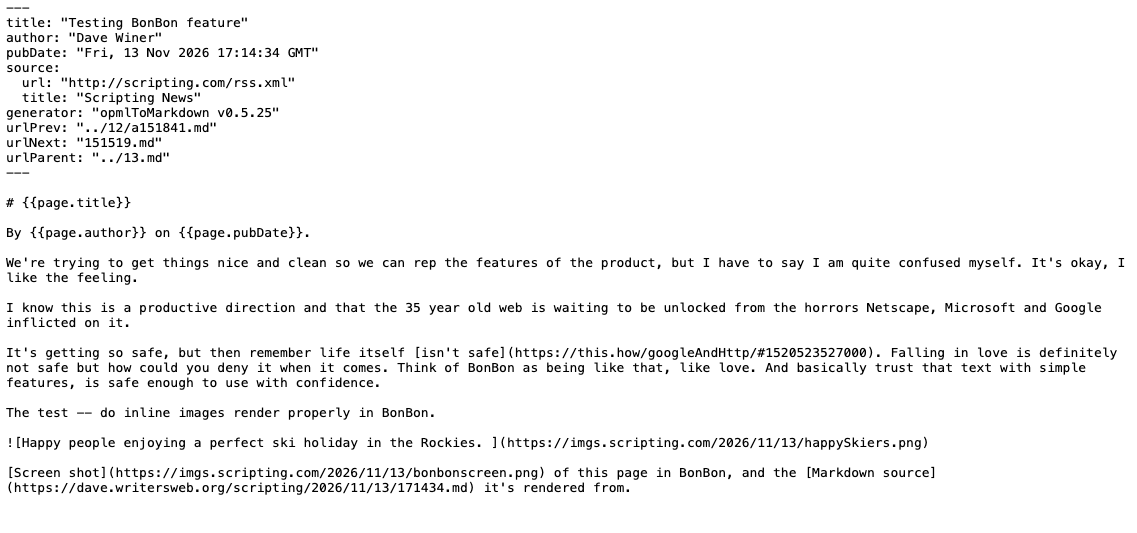
Dave added some metadata capability alongside BonBon. BonBon reads metadata from YAML front matter on Markdown documents and supports simple innovations like .well-known/toc.opml. The toc.opml file reveals next-neighbor relationships, which lets a Markdown Web browser offer a reading experience like an eBook. Writers control the text and multimedia content. Readers control the reading experience. BonBon is a working proof of creative opportunity.
Building the Markdown Web
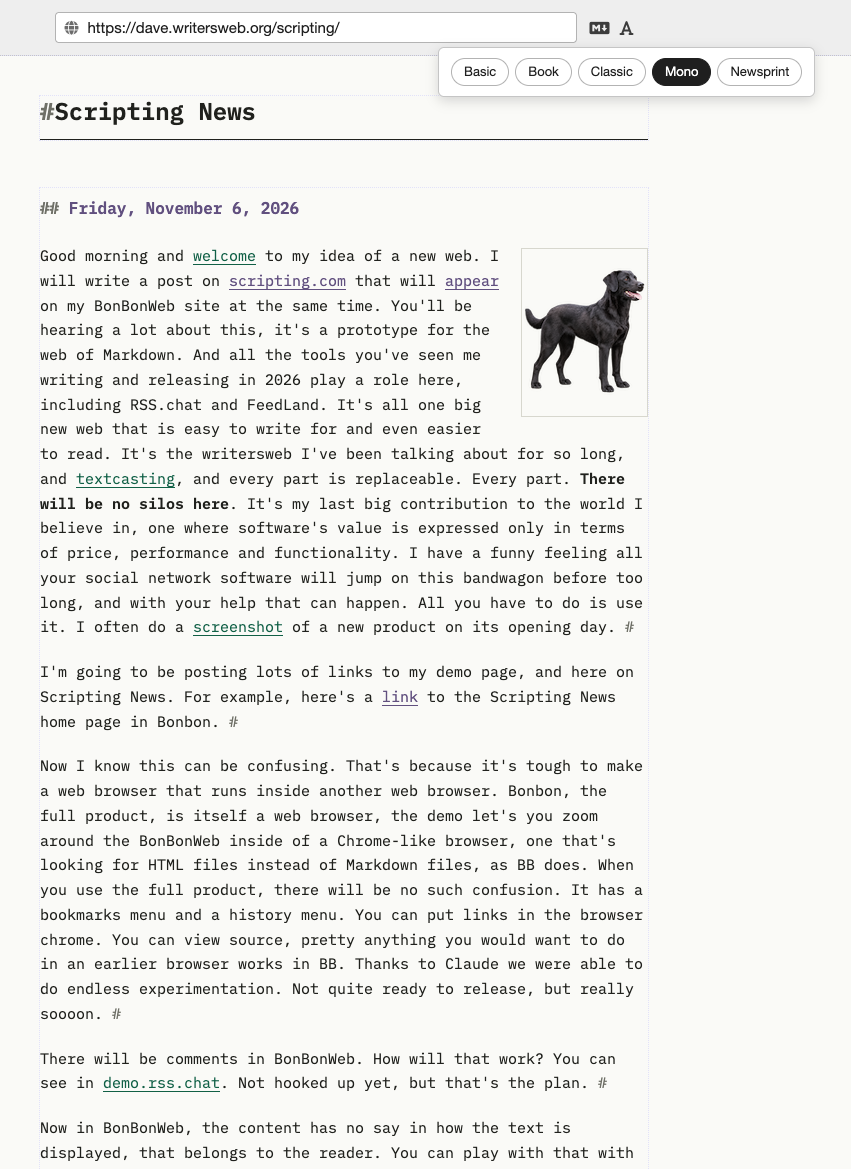
If a Web site publishes Markdown files it can be part of the Markdown Web. If those Web sites that publish Markdown files link to other Markdown files, you now connect to the core of the Markdown Web. This Web can include more than text; for example, Markdown supports embedding images and multimedia. What it doesn't support is JavaScript, WASM or the site publisher's CSS. Readability is under the control of the reader. The reader chooses the fonts, font size, color, and spacing much like most eBook readers allow you to do. BonBon Markdown Browser is the flagship demonstrator of this simpler Web. A Web for the rest of us.
The Markdown Web isn't just Markdown pages though. As we learned in the early Web, site navigation is an important element. Metadata in the form of .well-known/toc.opml provides the missing piece that takes a Markdown preview to a new level. The toc.opml file provides the next-neighbor relationships between Web pages. This means the browser can show "previous" and "next" Markdown pages automatically. Getting this right doesn't require editing every Markdown document's front matter; your content management system or site builder workflow can provide it. I was able to retrofit my personal content management system, AntennaApp, and others have done similar work with WordPress sites. Dave's own Web publication platform provides it for his own sites, see https://dave.writersweb.org/scripting/. Click into one of his posts on that Markdown scripting homepage and bingo, you can start paging back from item to item through the history he has published.
So what else is needed to make your Web site Markdown Web friendly? Not much. You can start with a traditional Web server that responds correctly to the requested HTTP type of "text/markdown". The BonBon browser requests HTTP URLs expecting content including the "text/markdown" content. A properly configured server will return Markdown as a default for links1. It does this through a standard HTTP request accept header specifying only text/markdown. If the Web server is configured correctly, a URL like https://rsdoiel.github.io/ would return a Markdown default page. In the past that's been assumed to be a page named "index.html" or "index.htm". The Web server can be configured to respond with "index.md" for requests where a Web browser like BonBon expects Markdown instead of HTML content. The technical term for this is "content negotiation", and the Web has had it built into the HTTP spec since the earliest days of the Web. If the Web server doesn't have the content negotiation set up, you can usually just make sure you're linking to the actual Markdown document. If your Web site is on Cloudflare, then you also get the Markdown support out of the box. Cloudflare is using this to support their Agentic Web proposal.
The Agentic Web meets Markdown Web
One of the challenges of running Web sites on the public Internet today is the swarms of AI-driven bots. They wind up performing denial-of-service attacks on the human Web we created. Cloudflare, a content delivery network company, has proposed mechanisms in the Web site configuration that would let bots retrieve the Markdown content rather than shipping the much more verbose HTML content of Web pages. In their proposal, the content they deliver can be made into bot-friendly Markdown. This reduces the size of the object sent over the network (Markdown is less verbose than HTML) as well as delivering the content in a form easier for a large language model (LLM) to digest, since LLMs were trained on plain text and Markdown is much closer to plain text than HTML.
This proposal is described in Building an open Agentic Internet. Since Cloudflare provides automatic Markdown responses even for HTML content, that previous link returns Markdown and is readable by BonBon. You can find out more details in Markdown for Agents also rendered as Markdown for the BonBon browser. So the Agentic Web is the Markdown Web too.
Putting the pieces together for more possibilities
Dave provided three key documents beyond the open source BonBon browser:
With these I built my own proof of concept cmarkbrowser. This allowed me to view the Markdown Web from any of my Raspberry Pi computers, including a little Raspberry Pi Zero 2W. It also let me experiment with additional features. cmarkbrowser will attempt to turn HTML into Markdown for viewing non-Markdown Web sites.
You can also clone and build BonBon from its git repo. That meant I could run BonBon on my more capable Raspberry Pi. Claude made very short work of that. BonBon is nicer than my terminal version but takes more RAM and CPU to run it. cmarkbrowser remains, for me, an important way to use the Markdown Web on lower-powered devices and a platform for experiments and innovation.
It took me one evening's work with a large language model system to get to a working prototype terminal-based Markdown Web browser. I followed the chain of blog posts Dave and others made about using it, and used them to guide improvements. By the end of the next day I had released my working prototype. I like Dave's BonBon Web browser, but his idea isn't just a new Web browser; it's about interop at the level of the Markdown Web! I am currently working on some personal search engine ideas that run browser-side for the Markdown Web.
Possibilities of a simpler Web
The Markdown Web makes room for innovation too. For example, a server-side dynamic system can return results in Markdown just as easily as HTML. I can imagine a browser-side personal search engine or knowledge base driven by Markdown Web surfing. Search has an opportunity to be rethought as well. A Markdown Web browser could take advantage of Open Search Description Documents. Once the browser knows a site supports search, the search form doesn't need to be provided by the site. The browser could directly supply the inputs for the search action. One advantage of this approach is that the search experience becomes consistent across in-page searching as well as site searching. There's room for aggregated searches too. You could store the Open Search Description Documents encountered while surfing the Markdown Web. Then you could send out search queries to multiple sites and merge their Markdown results. This would open the possibility of a distributed search tailored to sites you trust.
What do we do with this lightweight portable Web?
We write, read and innovate. That is the simple answer. Large language models have opened the door for individuals beyond the trained programmer types to explore this space too. The Markdown Web is about content creators not publishers. It's about personal innovation not corporations. It's about us readers. Think about a search engine like Marginalia that returned Markdown content instead of HTML when requested with the text/markdown content type. Many have assumed that search is a solved problem, but that isn't true. Do search engines even need to be centralized at all? Why not have the browser build in the capabilities of PageFind for sites you visit by aggregating the indexes of those sites through its own search interface? This could be done without shipping JavaScript and WASM-encoded indexes, by leveraging the .well-known/toc.opml files you encounter along with existing services like OAI-PMH or even the API of sites like the Wayback Machine and the Internet Archive. It would be cool if Wikipedia provided a Markdown Web view of content; that would be a huge boost.
So, as Dave suggests in the Big Undo, this is a reset that opens the Web back up to all of us. We just need to embrace it.
Unfortunately many sites are hosted on GitHub and GitHub doesn't support proper content negotiation for requests of "text/markdown" MIME types. I've worked around this by using links that point to Markdown documents explicitly. GitHub does serve Markdown content as "text/markdown". ↩︎
This summer I worked on llvm-advisor, LLVM’s web-based compiler advisor, aspart of Google Summer of Code 2026. llvm-advisor was started during last year’sGSoC by Miguel Cárdenas,and this year I extended it with optimization-remarks storage, search, heatmap,Code Explorer, PGO hotness, and snapshot diff. The goal was to make optimizationremarks (the diagnostics emitted by clang -fsave-optimization-record)searchable, comparable, and visual.
Optimization remarks are the compiler’s way of explaining its decisions back toyou. Every time Clang decides to vectorize a loop, inline a call, or give up onan optimization, it can emit a structured diagnostic tied to a source location.Without these remarks, the only way to reconstruct what happened is to readassembly or rely on intuition. With remarks however, you can ask targeted questions: “Why wasn’t this loop vectorized?”, “Did my change help?”, “Which missed remark isactually worth fixing?” Real projects can produce millions of these remarks, soyou need a tool that can filter, aggregate, and visualize them. That’s whatllvm-advisor does.
This matters whether you’re a compiler developer tuning inlining or vectorization heuristics, a user upgrading your toolchain and watching for regressions, or someone making performance-critical source changes. The example here is small for a walkthrough, but the workflow remains the same and similar bottlenecks show up in production code, and a large build can easily emit more remarks than a person can go through by hand. This is where the viewer helps: instead of drowning in raw remark data, you can narrow things down to the handful of diagnostics that actually point at a problem.
Let’s walk through an example to see how it works. I took a small C programthat was missing a vectorization opportunity, used llvm-advisor to find the exactremark, changed one function from noinline to static inline, and measuredthe result.
The workflow: turning a missed vectorization into a faster loop
The baseline code
Here is baseline.c. The helper work is marked __attribute__((noinline)),so the loop in process has to call it on every iteration.
#include <stdlib.h>__attribute__((noinline))int work(int x) { return x * 3 + (x >> 2);}void process(int *a, int n) { for (int i = 0; i < n; ++i) a[i] = work(a[i]);}int main(int argc, char **argv) { int n = argc > 1 ? atoi(argv[1]) : 10000000; int *a = (int *)malloc(n * sizeof(int)); for (int i = 0; i < n; ++i) a[i] = i & 0xff; for (int run = 0; run < 10; ++run) process(a, n); int sum = 0; for (int i = 0; i < n; ++i) sum += a[i]; free(a); return sum & 1;}
Open http://127.0.0.1:8080 and press g r for the remarks view. The summarycard shows 137 remarks, and the top pass/name table immediately surfaces theproblem:
The heatmap shows the same thing grouped by function and line:
And the full remarks grid shows the row for process:
Code Explorer: reading the source with the remark overlay
Press g e (or click Code Explorer in the sidebar), select baseline.c,and filter the pass dropdown to loop-vectorize. The loop header on line 9 andthe assignment on line 10 are both highlighted with 11 missed remarks, exactlymatching baseline.opt.yaml:
This is the same data as the remarks grid, but now it sits directly on thesource line that produced it.
The raw remark
If you open baseline.opt.yaml, the relevant entry is:
Line 10 is the a[i] = work(a[i]) assignment. The loop cannot be vectorizedbecause it contains a function call that the compiler is not allowed to inline.
The fix
Remove the noinline attribute and make workstatic inline so the compilercan fold the call into the loop body and then vectorize it:
#include <stdlib.h>static inline int work(int x) { return x * 3 + (x >> 2);}void process(int *a, int n) { for (int i = 0; i < n; ++i) a[i] = work(a[i]);}/* main unchanged */
Recompile, re-import into a new snapshot, and look at the remarks again. Thetop pass/name table now shows:
Select the baseline snapshot as BASE and the optimized snapshot as CANDIDATE. The diff shows one changed unit and an Optimization Impact tablethat breaks down the per-function change. In this run main has new missed andpassed remarks from the unrolled loop, while work is resolved because the callcan now be inlined:
The diff answers the question “What changed in the remarks between the twobuilds?” without re-parsing files or writing a custom script.
This diff workflow pinpoints exactly which remarks changed. On large projects,remarks can be overwhelming, but filtering, aggregation, and PGO hotness help youprioritize which ones to investigate.
PGO hotness: which remark matters most?
The vectorization example is tiny. In a real program, dozens of files can emit missed-remark warnings. PGO adds a profile-derived Hotness value toremarks, which gives you workload context and tells you which ones are worth fixing first.
Small walkthrough: hot and cold loops
To make the contrast easy to see, this small program calls hot_work onemillion times and cold_work one hundred times:
#include <stdio.h>#include <stdlib.h>int hot_work(int *a, int n) { int s = 0; for (int i = 0; i < n; ++i) s += a[i] * 2; return s;}int cold_work(int *a, int n) { int s = 0; for (int i = 0; i < n; ++i) s += a[i] * 3; return s;}int main(int argc, char **argv) { int n = argc > 1 ? atoi(argv[1]) : 100; int *a = (int *)malloc(n * sizeof(int)); for (int i = 0; i < n; ++i) a[i] = i & 0xff; int total = 0; for (int run = 0; run < 1000000; ++run) total += hot_work(a, n); for (int run = 0; run < 100; ++run) total += cold_work(a, n); printf("%d\n", total); free(a); return 0;}
Generate a profile, then compile with profile use and remarks enabled:
Import pgo_example.opt.yaml and open the heatmap ( g h). Clang inlines bothhelpers into main, so the hot loop at lines 6 and 7 appears under main andreaches 100% of the heatmap’s normalized scale. The cold_work loop is markedLow.
In Code Explorer, filter by loop-vectorize to inspect the remarks on bothloops:
With hotness, you can sort by actual runtime cost instead of by file name.
How the tool makes this possible
Capabilities are analyzer endpoints that each expose a different view of the compiled program - relational tables, heatmap aggregations, snapshot diffs, IR views, debug info, and more. Three new C++ capability analyzers turn raw remark data into the views above:
CapabilityOutputllvm.remarks.relationalA columnar table of every remark, with deduplicated string tables for function, file, pass, and name.llvm.remarks.hotspotPer-function, per-file, per-line aggregations used by the heatmap.llvm.remarks.diffA delta of added, removed, and changed remarks between two snapshots.
The relational endpoint uses integer-indexed columns instead of an array ofobjects. That keeps JSON payloads small and makes browser-side filtering fastfor millions of rows.
A few performance numbers
On real compiler output the analyzer sustains tens of thousands of remarks persecond:
Scale test: 572 translation units produced 10.7 million remarks in a single snapshot;the first relational query OOM-killed the server. Three fixes (splitting HTTP sends,per-unit fetching, streaming merger) reduced peak RSS from 10.7 GB to 5.3 GB.
Those numbers are for YAML remark files. For large projects, Clang’s bitstream remark format ( -pass-remarks-format=bitstream) is worth using instead:
FormatSourceRemarksSizeParse timeYAMLllvm/lib/Support/APFloat.cpp18,00320 MB22 sBitstreamllvm/lib/Support/APFloat.cpp18,003~2 MB<1 s
Bitstream avoids text parsing entirely, it’s already in a binary form the advisor can read directly. The gap compounds across a whole build. Building llvm-project with -fsave-optimization-record=bitstream across its ~800 translation units produces tens of millions of remarks. As YAML that would be hundreds of gigabytes of text to re-parse on every import; as bitstream it stays in the low single-digit gigabytes and can be memory-mapped, so the advisor can query it without a multi-minute parse step.
Acknowledgements and links
Thank you to my mentors Tobias Stadler and Henrik Olsson for guiding methrough the summer, and to the LLVM community for the opportunityto contribute.
Snap Shot Golf: turn any photo into a hole of golf
, updated:
There’s an old Sharp X68000 game called TIM COUNTRY CLUB (1994, Moai). It’s a devilishly difficult and perhaps rather un-fun game of golf where your control of direction and power is severely constrained: the Dark Souls of golf games. But it does one interesting thing: it generates the course by manipulating and recolouring any image file you feed it. Some eight years ago I saw a video of that game and commented “I think this is an interesting idea that could be expanded on”, then promptly forgot all about it…until April 2026, when it came back to me whilst discussing weird golf games.
With it fresh in my mind, I wondered how I could take the high-level concept of turning an image into a hole of golf and do it in a modern way on an iPhone. I landed on a top-down golf game that reads a photo or image, does some edge, feature and colour detection, and translates the results into a golf course: blue eyes become lakes and the shape of a face dictates the bend of the fairway.
I then dialled that concept up to 11. Everything in the game is procedurally generated from geometric primitives: think SVG rather than PNG. Not just the course features, but also the graphics and the biome themes (grass, desert, snow, and so on). The top-down view reminded me of tilt-shift photography, so I added some blur to make that a reality. I even went as far as filling the scene with trains, cars, animals and people to make it feel alive.
Then came the social side. Because everything is procedurally generated, a hole is just a seed, so a whole course of favourite holes fits in a short text code or QR code that friends can play exactly as you did. If another player is sitting nearby, a little satellite dish appears behind the tee: tap it to beam your current hole and your score straight to their device, StreetPass-style, with no accounts and no internet. The same dish glows gold once a day for the Daily 18: the same holes, wind and weather for everyone in the world, with Game Center leaderboards for Amateur and Pro, plus 12 achievements and a few secrets to find. All of this unlocks once you’ve played 19 holes, because where else would you socialise but the 19th hole?
The hardest part of development wasn’t the course generation or the physics, it was screen sizes. Between notches, Dynamic Islands, rounded corners, home indicators and the very different aspect ratios of iPad, every device needs its own safe area. The scenery needs to run edge to edge whilst the controls and scores stay clear of the unsafe bits, and on iPad that meant a lot of fighting with pillarboxing before it looked right. Controls ran a close second: it took many failed attempts before I realised I could use a second finger to shape shots, like plucking a bow.
Each of those achievements needed its own illustration, and after working so hard on the game I burned myself out drawing them. I put the game aside, only to be reminded a few months later by one of the testers that the TestFlight build had expired! Oops. Even then it took me another month or two to summon the energy to finish the Game Center artwork and submit it for review. May feels like a million years ago.
So, that’s Snap Shot Golf to a tee: a casual golf game for iOS with Game Center support, sharing and competing with friends, and the ability to turn any photo into a hole of golf. And it’s a mere 595 KB.
The price is the most golf-centric one I could think of: fore! (4 USD/GBP/EUR) ⛳️🏌️♂️
Jamie Ager (NC-11), Now A Member-Elect, Reports In From Freshman Orientation!
, updated:
Jamie and Sarah Trone Garriott have started a campaign to ban stock trading in Congress. Their letter already has 55 members of the freshman class on board!
Sunday caption contest: Gobble
, updated:
And last week’s winner
‘What Do We Do Now?’
, updated:
The new Congress has two immediate jobs: Legislate. Investigate. A book from the Obama era has guidelines on making investigations succeed.
Levent Alpöge has solved the Riemann Hypothesis with help of Claude! What does it mean?
, updated:
And why isn‘t it immediately rescuing the market?
, updated:
Once again the browser-based JavaScript app that keeps daveverse.org in sync with scripting.com went down for four very big days this week. I didn't notice. So if you're following that feed, I apologize for all the reading I just dumped into your timeline. I would have been better off if I had written it as a Node app.
My user accounting system is web scale, because one day, it will eventually be consistent - but that day is not today!
I have now some disputed entries that need to be sorted out.
Stay tuned, I am launching a spreadsheet.
Our Wins Of The Week
, updated:
The House Democratic caucus held its leadership elections this week, and the Democrats are about to make history.
, updated:
We've released new server software called bonbonSiteBuilder, primarily for people who run servers and want to manage a set of blogs that share a domain. We will have a service opening soon built on this, and it will be much easier for writers to jump onto the Markdown web. Which of course is the top of the peak. From there, with good examples for reading and writing, we can start building a network of apps.
I am investigating, I need to gain Eric as a user.
THIS WEEK, TODAY: NATO Meets Monday, Canada Laughs at Pete, and the White House Is Hiding the Receipts
, updated:
NATO meets Monday. Canada never got Pete’s memo. Trump signed an order to hide from Congress. Here’s what to watch for “This Week, Today.”
, updated:
BonBon v0.6.56. Lots of fixes and small features. Responding to user reports and requests.
, updated:
Scott Hanson is working on connecting WordPress and BonBon. We're going to get a great connection. Getting a WordPress site onto the Markdown web should be a simple set of prefs.
PANIC IN THE OVAL: Trump Signs Friday Night Order Telling 100,000 Companies to Ask His Permission Before Answering Congress
, updated:
The order is a contract threat dressed up as law, and the companies it targets are already calling their lawyers.
Wait Till Trump Sees This: Carney and a Fake Trump Impersonator Tore Trump Apart in Ottawa Last Night And It Was GLORIOUS
, updated:
The PM called Trump a decorator, a fake Trump called him crazy, and Canada’s TEMU Trump, Pierre Poilievre used his turn to obsess over Trudeau and Katy Perry’s sex life.
We Had A Very Big Year In Alaska - A New Discussion With Eric Croft, Chair Of The Alaska Democratic Party
, updated:
This rich and informative discussion is yet another reminder of why building strong well run state parties is so important
, updated:
A friend asks what's the deal with the dog. Once a very long time ago, when I was living in Silicon Valley, I had a black lab named BonBon. She was a handful, for sure -- and I didn't know anything about training dogs, so she was also pretty wild. But she had the biggest heart and was totally devoted to me, and was pretty much my constant companion. Her joy in life was infectuous and memorable. Now I don't want to sound all gushy (go ahead) but BonBon the software which is named after BonBon the pup, gives me that feeling of joy too. I loved the web as much as I ever loved anything, because it blew open the doors on a really fucked up industry run by total children, whose first impulse was to destroy anything they could, even if it wasn't in their way. They did that to the web. But the web, via BonBon, says basically, you can do it. The courage of that little dog, BonBon, with the same name in two different contexts, reminds me that this is right, and it is working.
Something About Him
, updated:
Trump has always been a racist
“Kind and Generous”
, updated:
A Reason To Smile
A New Agenda for Healthcare Reform, Part I
, updated:
The Policy and Politics of A New Democratic Consensus on Healthcare
This theory explains why so many 2024 Trump voters defected in 2026
, updated:
Plus, our initial look at the 2028 presidential primaries (yes, it’s early). Your weekly political data roundup for November 22, 2026.
Sunday thought: Defund the Oligarchs
, updated:
Friends,
Writers I used to read
, updated:
Sometimes when I encounter a writer I used to read regularly but don’t anymore, it seems like I’ve advanced in my thinking while they’re stuck in the same place. I don’t recall that being my conscious reason for quitting reading someone — usually I unfollow because I notice myself skipping their posts in my reader […]
Capitalism resurrected
, updated:
Making it easy to not think by Gerry McGovern Making it easy to not think “The big bucks are in devouring our environment. There is a direct relationship between the amount of energy, water, and materials that are devoured and wasted, and the amount of fast cash that can be made. AI is a perfect […]
Give Thanks for Joyce Vance!
, updated:
The Andy Borowitz Show
November 21, 2026
, updated:
“It all began so beautifully,” Lady Bird remembered.
Bookmarks - skills, design, llm, web-archives
These are some things I’ve wandered across on the web this week.
Welcome to Altaplana, the impossible and infinite encyclopedia of the
world of The Obscure Cities, originally named Les Cités Obscures and its
authors François Schuiten and Benoît Peeters.
But what I’m thinking about is the most interesting kind of degrowth,
the kind you don’t notice happening at all. You aren’t necessarily
pursuing an ideology, you’re just making your little corner of the world
nicer, and along the way adjusting things in near imperceptible ways. A
tidy desk, a pleasant interface, a comfortable tool, a few years later
you end up somewhere that indicentally looks like degrowth.
… a couple weeks back, I sat down and specced out the first version of
toolsmith, a plugin for your favorite coding agent.
It teaches your primary session that instead of building incidental
tools itself, it should hand that work off to a toolsmith subagent. You
can think of that subagent as something like a digital version of James
Bond’s Q. It’s responsible for building, maintaining, and cataloging all
of the weird, bespoke tools that help your agent get its work done.
Matt “MV” Valentine here broadcasting from the COMniverse & beaming
it to you from a log cabin deep in the vermont forest. Dial up love in
all forms of sonic architecture and genreless free folk along with deep
nugs from the child of microtones terran library of exploratory music.
gonna dive in the tubs get wet -> you are here…
Every web crawl is a sample. Common Crawl collects billions of pages a
month, a focused academic crawl collects a hundred million URLs. Both
are samples of something larger - everything the crawler’s configuration
could reach but did not sample. The crawl size is known exactly. The
size of that reachable web is not, and neither is the share of it held
by a crawl.
One approach comes from ecology; catch, mark, release and catch again:
the overlap between two samples estimates the population. The early
ecologist assumed that nothing enters or leaves the population between
the two catches (Petersen 1896, Lincoln 1930). But our crawl policy
does. And unlike estimating the size of the Web through the overlap of
search query results (Lawrence and Giles 1998) a large scale crawler
does not have a parallel crawl to which to compare. So the two samples
come in sequence, and the web keeps changing between them. Pages the
first sample missed and pages that no longer exist both show up as “not
seen again”, and a naïve overlap mixes them.
Last year FTAI Aviation, a New York-based jet-engine leasing and repair
company, launched a division that converts retired engines from Boeing
737 and Airbus A320 aircraft to power data centers. In July, an FTAI
joint venture signed a $1.5 billion agreement to supply converted
turbines to a data-center developer.
The usual story is that AI is all about a race between the US and China,
with Europe somewhere in between, and resources stolen from across the
Global South. Our story is quite different. We use the locks on capital
and mission from US nonprofit law; the green energy and privacy
protections of Swiss servers and EU inference providers; and Chinese
open-weights models. I hope that someday we will offer models that
specialize in less-resourced languages and use-cases, and that serve the
needs of people farthest from the centers of power.
The nice thing about using something like Claude is that there’s no
learning curve: You sign up, install the software, and just start using
it. You don’t have to know what a model is, or understand inference,
harnesses, or anything else. You just tell Claude what you want it to
do. (And, of course, send a copy of whatever private data you’re working
with to Anthropic, and pay them money – both things that would be nice
to avoid.)
So, in an effort to help people switch to open weight models as easily
as possible, this blog post shows you how to use Maple AI just as
easily, with no learning curve required. There are lots of other ways of
doing similar things. I like software like OpenCode and Pi, and there
are other good providers too. Everything, including what models are
available, changes constantly.
To celebrate World Digital Preservation Day 2026, we shared twelve
datasets on SciOp + a story for each on Mastodon / the Fediverse over
the course of November 5th.
World Digital Preservation Day is an event organized by the Digital
Preservation Coalition held on the first Thursday of every November.
This year the theme was “Save our Stories (SOS): Our Digital Heritage in
Danger” and you can read a number of posts from the wider DPC community
on their blog. I personally especially enjoyed Andy Jackson’s post
“Saving Our Stories From The Biggest Risks”, as he touches on many
things we are concerned with as well.
Here we have compiled all twelve datasets and their accompanying stories
in one place, after - all in all they showcase the breadth of what we
and our community have accomplished since early 2025.
OpenSpec is a lightweight and configurable framework for creating and
managing software specifications.
With OpenSpec, you capture what you want to build in a spec and keep
your team and coding agents aligned as the work evolves. We help you
refine the requirements, validate that they describe the right thing,
and verify that the implementation matches.
In essence, OpenSpec helps you build the right thing and build it right.
244 pixel art effects and animations, every one a small piece of code.
Fire, explosions, magic, weather, UI, pickups, critters and more. Play
them live, recolor and mirror them, drop them into a browser game, or
export sprite sheets for any engine. Plus a Claude Code skill that makes
new ones the way a picky pixel artist would: draft, render, look,
refine.
Every effect that involves a character is acted out: he winds up, lets
go, freezes on contact and recovers, and a target takes the hit. Twelve
whole moves chain the effects into attacks from wind-up to recovery.
ffmpeg-skill is an Agent Skill for Claude Code, Cursor, Codex and any
agent that reads SKILL.md. It teaches the agent a fixed workflow (probe
→ edit losslessly where possible → check → verify) and ships 42 tools
that do the actual work with ffmpeg / ffprobe: cut, join, silence
removal, fit to duration and aspect, captions and karaoke, overlays and
motion graphics, HDR → SDR and LUTs, audio clean-up and typed dynamics,
sync with drift correction, multicam, loudness, delivery checks,
whole-edit project rendering, batch folders. Every tool is also callable
as an MCP tool (tools/list advertises a core 12 by default to keep
client context small, with FFMPEG_SKILL_MCP_FULL=1 listing all 42; every
tool is reachable by name through tools/call either way), and the whole
set is described by a machine-readable contract.
In short: programmers don't read, and this vexes me sorely. The immediate irritation is simply that I feel quite lonely: in being fairly literate and writing about it, I quite often find myself labelled as suspect or as "not a real tech person": that kind of problem, you know? More problematically, I genuinely find it hard to build a rapport with your average non-reading programmer. And I am not bad at communicating: if I was, quite frankly, this blog would not be a thing, nor would it be half as well-read as it is. No, there's something about the non-reading programmer that, for want of a better word, makes it difficult to communicate with them: try as I might, my best attempts mostly bounce off them entirely.
Waterfox 6.7.9 - Small but steady updates
Waterfox fixes an adblocking subdomain matching bug and small memory safety increase.
Waterfox Android 1.2.12 - Menu and homepage updates
Updates Gecko to 161.0, a choice of homepage search positions and clearer extension update prompts.
Still counting votes in Oregon
, updated:
Oregon is a “vote-by-mail” state, so getting to final election counts can take a while. First, mail ballots can arrive up to one week after Election Day and still be counted if the postmark is by Election Day. Second, there is a group of ballots which are set aside for issues (missing signature, signature does […]
We learned about these sites in the Issues section of the BonBon repo. If you do something nice with Markdown sites, send us a link, and be sure to use the demo app to test your sites.
, updated:
A common disconnect in AI discussions are the perceptions based on early descriptions on how GPT worked ("autocomplete") and have not been exposed to the trick that makes modern models so effective - but also that this is highly proprietary data (I mentioned this on a longer thread yesterday).
★ A Week With the New Privacy Controls in MacOS 27.3 Beta 2
Apple’s new Full Disk Access and other privacy controls in MacOS 27.3 are good, with the exception of the ever-present menu bar indicator for apps that control other apps.
DEAD AIR LIVE With Steve Schmidt: Elon Is Panicking, Homeland Security Is Babbling and Trump Just Begged Putin and Xi for Immunity
, updated:
Steve Schmidt and Ken Harbaugh on Musk’s $500M faceplant, 13 cyber breaches and Trump’s Shenzhen humiliation.
The FBI Got Hacked (Again) and Trump Spent The Morning On Fox News Cheering for the Hackers
, updated:
Second FBI breach in two months, a fired cyber czar, a dead NSA network, and the President hopes the thieves find voter fraud that helps exonerate him and all of his treason. I shit you not.
SATURDAY SCOREBOARD, EPISODE THIRTEEN: Hackers Have Your Bank’s Data, Vance Vanished, Trump Surrendered To Russia And China, Farted, Then Threatened Canada. Again.
, updated:
Everything in America broke this week except the threats. Carney now runs the free world. Trump ran his mouth, surrendered, shit his pants, then blamed you for him, in his worst week yet, BY FAR.
, updated:
How do we as a society absorb labor shocks?
James Galbraith expands on the work of Pavlina Tcherneva:
It (not she) is right "Working as intended." Best line: "a superhuman obfuscating sophistry machine." Let them eat bits For anyone (such as I) who hates restaurant menus you can only see with a QR code.
Probabilistic data structures in Go, part 2
Binary fuse filter, UltraLogLog, Log-linear histogram, and MinHash.
The Powerful and the Pitiful
, updated:
Scenes from a Potemkin Yalta
Lit Hub Weekly: November 16 – 20, 2026
, updated:
It’s the moment you’ve all been waiting for: Meet this year’s National Book Award finalists. | Lit Hub “Fear of the defiling power of Roman fantasy ran so deep that the entrance to the room was, at one point, bricked
Trump is turning us all into conspiracy nuts
, updated:
And the damage will be long-lasting.
See you later, Amsterdam!
See you later, Amsterdam!
Grand Theft Autocrat | The Coffee Klatch for Saturday, November 21, 2026
, updated:
With Heather Lofthouse and yours truly, Robert Reich
November 20, 2026
, updated:
On November 19—yesterday—the United States president, Donald J. Trump, met with Chinese president Xi Jinping and Russia’s president Vladimir Putin in Shenzhen, China, on the sidelines of the summit of economic leaders from the Asia-Pacific Economic Cooperation (APEC) forum.
Photobooth
, updated:
Photobooth
Kesa and I took got some photos taken in the Howard Theater photobooth.
Dark blue
, updated:
Dark blue
Caroline performing Dark Blue at the Howard Theater. It was startling
how they played effectively in the audience, facing each other.
I am enjoying @scripting.com's BonBon, https://github.com/scripting/bonBon/releases. The Markdown Web is cool. I mostly use a Raspberry Pi so I built cmarkbrowser, rsdoiel.github.io/cmarkbrowser/, for the terminal. BonBon sites bring joy back to web surfing.
Weeknotes: Nov. 14-20, 2026
, updated:
Win of the week: 1.5 hours business development — probably the most valuable hour and a half of my whole year 🙌 developed new positioning for my consulting work Looking forward to: I came up with a Thanksgiving activity for me and my husband I’m actually excited for!* Gonna have fancy snack dinner, make popcorn […]
We have broken through the barrier of sound! User #7!
Some examples of search output from FeedNewsArchive.com
, updated:
Earlier this year, I created my first application with Claude Code – a RSS feed archiver with a search interface. The interface is available at https://feednewsarchive.com/ . Since May 2026, the archiver has been collected feed items from the New York Times, a number of other newspapers, and several network news sites. With six months […]
OMG! User #4, at this speed I will have even more users than Anthropic!
What Maintaining SwiftTerm Taught Me About AI Contributions
If you maintain an open-source project right now, your pull request queue probably looks very different than it did two years ago.
I maintain SwiftTerm, an open-source terminal emulator library that is now seven years old. Today, I estimate that about 80% of the pull requests I receive involve AI in some capacity. Looking back, though, this didn't happen all at once—it came in distinct waves.
Disclosure: as a Mexican national that routinely writes tedious and typo-ridden English blog posts, I had Antigravity fix my writing and repeated tedious and repetitive points (as my wife often points out).
Wave One: Vibe-Coded Band-Aids and Fork Experiments
Before people even started opening AI-assisted pull requests on my repository, I would browse the GitHub network graph just to see what forks were popping up and what problems users were struggling with. Early on, what I found was a lot of "vibe coding"—folks patching around issues in ways that were fundamentally wrong, slapping surface-level band-aids over deeper terminal state bugs. I would fix or implement the feature, despite the fact that the user had not submitted the fix - for the sake of helping all my users.
In one fork I stumbled across, someone had clearly unleashed an autonomous agent to try to fix all of my open issues in rapid fire. Luckily, they never actually submitted those PRs—they were likely just experimenting—and it was only my nosy self browsing the network graph that spotted it. Still, looking through those commits confirmed the early reality: the fixes weren't worth merging. They solved surface symptoms without understanding the system.
The Rise of the Promptsplainer
Alongside those early waves came a new open-source archetype—one that many communities had to deal with: the Promptsplainer.
Some folks are really eager to particiapte in improving a project and LLMs have opened new doors, but they lack some basic etiquette.
A Promptsplainer is someone who asks an LLM a question, gets back a confident-sounding explanation or a sprawling patch, and suddenly believes they can override decades of hard-won domain expertise. They don't actually understand the underlying quirks, race conditions, or protocol edge cases of the codebase they are touching. When a veteran maintainer points out a flaw, the Promptsplainer doesn't go investigate the code; they just copy-paste the maintainer's review comments straight back into their chat session and paste whatever the bot spits out next.
You don't need a massive daily flood of Promptsplainers to feel the damage. Even the occasional encounter can fill a maintainer with rage - and with good reason.
Wave Two: "Send a Patch" Finally Became Real
Here is what has changed dramatically over the last year. We went from AI fixes being flat-out wrong or lazy band-aids to pretty much landing in the right ballpark.
To appreciate why this matters so much to me, you have to remember what maintaining an open-source library looked like just a few years ago. Back then, I would get a steady stream of bug reports—and if I had the spare time, the patience, the kids went to sleep early, and my Netflix queue was empty, I might actually sit down and fix the bug.
For decades, open-source communities had a semi-joking, semi-exasperated stock response whenever a user asked, "Why doesn't it...?". We told them, "Patches welcome," or "Send a PR." Most of the time, we knew they wouldn't, because diving into a complex codebase from scratch was too steep a climb. The perfect storm between unpaid volunteer work, uneducated takes and exasperation.
Like many others, I have witnessed the change from getting bug reports to getting detailed pull requests. And I am personally grateful for this.
My philosophy on incoming contributions comes down to a simple reality: every PR represents a real pain point caught in the wild. It means a real user ran into a problem in their day-to-day work, reported or tracked down the issue, found a working solution, and felt the pain acutely enough that they took the time to package it up and upstream it.
As a maintainer, that is an infinitely better signal than my own laundry list of wish-list items sitting in the issue tracker. Even if the implementation needs additional work, someone just handed me proof of a real-world problem along with a concrete starting point to fix it.
Multi-Agent Code Review on My Side of the Table
The catch is that many coding models and agents still have a bad habit of just doing the fix—taking the shortest path to make a test pass without stepping back to look at the whole library. And not every contributor has learned how to tune their agents for deep engineering review, or has access to the best models for it.
The first pass of AI-generated code often needs work, and that is okay. Just as we spent years developing the discipline to master our programming languages, debuggers, and in some cases, write m4 macros, we now need to develop the muscle for using AI tools effectively—learning how to steer them, verify their assumptions, and audit their output.
For me, building that muscle meant putting AI on my side of the table to bridge the gap. Before I even bother reading a contributor's patch line-by-line, I religiously run /code-review in Claude and /review in ChatGPT [1].
These review passes routinely catch far more than narrow syntax nits—they surface genuine architectural flaws, subtle API breakage, rare side effects, and terminal conformance problems that would take me hours to trace manually [2].
Armed with that feedback, I can point contributors toward concrete architectural fixes—or, if someone disappears after opening a PR for a critical bug, I can clean up their branch and land it myself.
Some maintainers lament that reviewing these PRs feels like talking to someone who just copies and pastes feedback into a remote LLM. But we are still communicating with a human being on the other end. That gives us a real opportunity not just to coach contributors on how to use these tools responsibly, but to model and adopt better engineering practices across our industry. Given that the economics of top-tier reasoning models aren't ideal for everyone doing casual open-source work, I’m happy to foot that bill on my end for the sake of keeping my library healthy.
The Friction of One-Size-Fits-All Rules
This brings me to why I’ve been watching the broader debate around AI policies in large projects like Gnome and Godot with a lot of sympathy—and a bit of concern.
At Godot's massive scale, protecting volunteer reviewers from unvetted submissions and the occasional Promptsplainer is a completely understandable instinct. Nobody wants their Netflix time eaten up by drive-by code the author didn't bother to understand.
The challenge is that drawing hard lines around how code was written inevitably creates friction for experienced contributors who are already doing the architectural heavy lifting. Recently, I tried to upstream a small, production-tested bug fix to Godot as a trial balloon—one of roughly 60 to 80 improvements my team has built and tested in our own tree. Because I disclosed my AI workflow honestly, it ran afoul of their strict guidelines and was rejected.
When a policy polices provenance rather than quality, two unintended things happen:
It penalizes transparency: Honest contributors who disclose their tools get blocked, while others are quietly nudged to keep quiet and pretend they typed every character by hand.
Good fixes stay locked in private forks: Rather than wrestling with policy friction, teams like mine simply keep useful patches in our own internal trees. Because AI has made maintaining forks trivial, it doesn't slow us down—it just means the broader community misses out on fixes that could have helped everyone.
Accountability Over Provenance
The Promptsplainer is a real headache, and open-source projects are right to push back against uncomprehending, drive-by contributions.
But the antidote isn't banning the tools—it's requiring human accountability paired with better review tooling on the maintainer's side. At the end of the day, as the maintainer of a library, it is my role to make the editorial decisions about what goes in—and the people who depend on my library trust me to make those calls. Whether a patch started in an LLM prompt or was typed out by hand doesn't change that responsibility. If a contributor understands the problem, has tested the fix, and can engage thoughtfully in review as a human being, the models they used in their editor shouldn't disqualify their work.
Of course, scaling that kind of review culture when a handful of core maintainers are already stretched thin is a structural challenge all its own.
[1] With Claude I use Opus 5.5 alongside /review in GPT 6.2 with Sol-xhigh. In Claude, /code-review actually launches multiple distinct agents in parallel, each focused on different goals and common engineering mistakes. Looking forward to Antigravity to get this.
[2] In fact these reviews are so thorough, that I use /code-review on my own changes before shipping. In a seven-year-old codebase, it is impossible to keep every historical invariant in your head at once, and those agents regularly catch edge-case scenarios I had completely forgotten about.
User #3! Hoping I can retain him for more than a day.
Purism Differentiator Series, Part 20: Releasing Source Code to the Public
, updated:
When we use a computer, we trust software to make decisions on our behalf. It stores our work, carries our messages, and helps run the services we depend on.
Harper will soon be doing more work on your device than it ever has before.
We are preparing to release a series of fantastic grammar checking models ( transformers, in fact) that will significantly enhance the kinds of things Harper can do for you.
These models are going to be quite helpful for every kind of writer, but they come with two major downsides:
They take time to run, and they consume up a lot of compute resources.
We want to be mindful of our user’s computers, so we want to run these models only when necessary and we want the process to avoid interrupting the user’s flow.
To that end, I am slightly modifying how our various rules check your text.
In addition to our desire to avoid wasting CPU cycles, there’s another problem.
We aim to offer the best corrections possible in the time between each keystroke.
This allows authors to minimize the time between when they write text and when they may review our suggestions.
After all, Harper’s ultimate goal is to bring editing time and energy to 0.
To achieve that, we need to be able to do as much analysis as possible in the time between when the user writes a passage and when they are ready to review it.
Before The Deadline
To allow Harper to do the most work possible in the time between when a user finished typing and when they’re ready for review, I am introducing a new idea into Harper’s core grammar checker: the deadline.
Here’s how it works.
Harper checks a variety of individual grammatical and stylistic rules.
Each one of these rules is pretty self contained.
You can imagine them to be individual little programs.
Every time Harper“checks” a document for errors (or for ways to improve it), each one of these programs is run.
To set up a deadline, Harper will keep track of the throughput (in characters per second) of every grammar program we run and therefore every grammatical rule we check.
Whenever we check a user’s document, Harper will keep track of exactly how much CPU time each rule consumes, then divide it by the document length.
If we do this many times with a variety of documents, we can get a rough estimate of how long on average it takes a given rule to process and offer suggestions to improve or grammar check a single character
I call this process calibration.
An initial calibration process will need to run when Harper first starts up.
That will happen quickly in the background, so the user will not even noticed it happened.
After that, the throughput estimates will continue to get more accurate as the user uses Harper.
Once Harper has been calibrated, we can assign deadlines to specific rules based on when the user might expect them to be available.
Some things are most useful while the user is actively typing.
For instance, I often already know if I have made a typo before I even finish typing a word.
When that happens, I expect the spell checker to already be available to fix my problem.
With a quick tap of Ctrl+e I can fix it without even reading what the spell checker thinks the word is.
I trust it implicitly to be both fast and correct.
Rules like this will be given a very fast deadline, under 16 milliseconds.
Other types of suggestions, like full sentence or paragraph rewrites, are not as time sensitive.
I do not need to read through a suggestion to rewrite a sentence until after I am actually finished writing the sentence.
Rules like these which need more time to process anyway will be given longer deadlines measured in seconds.
Evolution
These deadlines are only a framework to communicate to Harper’s core how long an operation is allowed to take.
Fine tuning the specifics of what the deadlines should be is another, bigger problem.
I can imagine a future where we train a small neural network to infer these deadlines from past keystrokes, but we are not quite there yet.
To start, we will use very coarse estimations of what a“good” deadline looks like for various situations.
If the course deadlines turn out to work well enough, great! If not, we can always iterate until we attain perfection.
Of course, if any readers have any input on what a good deadline looks like, let me know!
457: ‘A Whoopsie Treason’, With Christina Warren
, updated:
Christina Warren returns for a jam-packed show: Jensen Huang-gate at Nvidia, the HomeView, the new iPad Mini, more on the iPhone Duo, and Robert "R-Patz" Pattinson taking the role of James Bond.
Friday Squid Blogging: The Largest Squid Ever Filmed
This is the story of the largest squid ever filmed, in December 2006 near Japan’s Ogasawara Islands.
As usual, you can also use this squid post to talk about the security stories in the news that I haven’t covered.
Peltola wins Alaska. Jeffries nominated Speaker, Van Hollen gains. Trump meets with Putin and Xi.
, updated:
Mary Peltola Declared The Winner in Alaska Senate Race
VIDEO: Trump Came Home From China, Praised Putin, Trashed America and Threatened Canada, Then Audibly Farted, in 90 Minutes of Slurping Chaos
, updated:
He called China immaculate, American cities dirty, Putin a friend, and Canada the enemy then his shit his pants on live tv. Happy Friday.
Preparing for Investigations
, updated:
To read this letter, click here:
Switching to Canadian Social Media
Introduction USA based social media has become a weaponized political tool to promote the MAGA agenda and the agenda of the oligarchs. Social media offers a lot of useful contact between friends and relatives along with providing useful community information. However, this is all being spoiled by a barrage of political propaganda along with a […]
Fluorescent Thanksgiving
, updated:
I looked at a bunch of Thanksgiving foods under UV light and they basically all glow. Don't worry, it's fine!
Introducing RouteScout
, updated:
Big news: This month I became a mailman! But I don't get to wear all the cool clothes because I'm working at a rural office (you can wear whatever you want on rural routes) and I'm in a part-time role helping full-time
Black Friday 2026
, updated:
Apps: DropDMG: Mac disk images and archives EagleFiler: everything bucket, notes, and e-mail archiver SpamSieve: Mac e-mail spam filtering Path Finder: powerful Mac file manager (code: 25YEARS) Picmal: image/video/audio/PDF converter Cozy: journal that syncs using your cloud storage Beatcast: iPhone heart rate monitor DockMagic: Mac widget Dock Clam Sync: syncs multicam footage by sound and […]
What the Internet Isn’t, and How to Get Privacy There
, updated:
Data Minimization is Imperative for the Age of AI Agents is a new essay in Tech Policy Press by Bruce Schneier and Brett Frischman that makes a bunch of important points. I agree with all of them, except for the opening line: “Surveillance is the business model of the internet.” This is a one-liner that […]
, updated:
What Maintaining SwiftTerm Taught Me About AI Contributions:
We need new communities, new cultures, and new tools.
Dean’s LIVE with Scott Macfarlane: 42 Days Out - Law Firms Are Flipping, Nominees Are Choking and Trump’s DOJ Is Threatening Congress on Social Media
, updated:
Every Friday morning I get the best D.C. reporter in the business to tell me what’s actually happening in a city that has spent two years lying to everyone, and this week Scott MacFarlane showed up with fresh reporting, a Canadian road trip and a live fact-check of yours truly.
The Daily Dean Newsletter - Friday, November 20, 2026: Carney Runs the World, Putin Bombs Poland, Hackers Hit Your Bank, Raskin Comes Collecting, Trump Reduced America To A Punchline In China
, updated:
Russia Bombs Poland · Carney Leads the Free World · Visa, Mastercard, Chase Leaked · Trump’s Paper Shredders · Shenzhen Humiliation
BREAKING: Russia Bombed Poland Today. Three Cruise Missiles Landed Dangerously Close To Coalition Soldier Exercises. NATO Set To Respond. Here We Go.
, updated:
Russian Kh-101s hit Polish soil hours after Trump called Putin “my friend.” Europe is about to answer without him.
Klara y el sol: buenos días a la vida, buenos días señor sol
, updated:
Dirección: Taika Waititi. Guion: Taika Waititi, Dahvi Waller, Kazuo Ishiguro. Elenco: Jenna Ortega, Amy Adams, Mia Tharia, Aran Murphy, Natasha Lyonne, Steve Buscemi, Rachel House, Jesse Griffin. Países: Estados Unidos, Reino Unido, Nueva Zelanda. Duración: 116 minutos. Más información de la película: https://www.imdb.com/title/tt14371256/ Klara (Jenna Ortega) comienza todos sus días saludando al sol y pidiéndole […]
The last time I updated my blog software was in 2022, and I can not even figure out which Makefile target or Mono runtime I used to deploy things.
This is a bit of a mess.
To unlock your team, reset your culture.
, updated:
"I believe there are a lot of excellent individuals working in flawed cultures." Here's a path to resetting them and finding your way to high performance.
👀 Get a sneak-peek at the new Data Workers United site! 👀
We're launching it a few days early.
Visit to learn how we're organizing data workers across the globe for solidarity and collective action: https://dataworkersunited.org
Librem 5 v2 Campaign Builds Early Momentum at 100 Orders
, updated:
A new smartphone campaign has reached a memorable early milestone. Following its public launch on November 17, Purism’s Librem 5 v2 crowdfunding campaign has the first 100 of its 2,500-order goal. That early progress signals interest in a different vision for mobile technology: one built around user control, open software, and digital independence.
Hugged, Serenaded, Censored, Widely Mocked and Dismissed: Trump’s China Trip Was a Roast He Thought Was a Parade And Total Humiliation For The American People
, updated:
Allies mocked him, diplomats shrugged him off and Putin got the photo of his life. Trump got a YMCA disco number and mocked to his face.
, updated:
Export Updates 2026-11-20:
Pleiades gazetteer of ancient places
26 updated places. 22 updated linked data sidebars. Inbound PATHs Atlas links are stale because their download was not available at runtime. The QA dashboard has been updated at https://atlantides.org/qa-dashboard/
What powered Democratic gains with Latinos in 2026?
, updated:
Pundits held up the 2020-2024 swing among Latino voters as proof of a racial realignment in American politics. This year, Latinos swung back more than any group but young voters, erasing those gains.
The Biggest Midterm Win that No One Is Talking About
, updated:
Something happened in Montana that may change politics forever.
Breaking: Anthropic stock is crashing, and AI stocks have lost over 50% in 5 months.
, updated:
Anthropic, which dropped steadily after its opening yesterday, is set to drop nearly 10% more at the opening bell.
BREAKING: Trump’s Regime Is Shredding, Deleting and Threatening Its Way to January. Here’s the Full List of Who’s Getting Investigated.
, updated:
Democrats get subpoenas in six weeks. The regime’s defence so far is a last-place Texas politician posting letters on X.
, updated:
Also, learned that Claude Code can forget to do things when it rebuilds an app for distribution. I found this when I, as a user, did an update and the desktop icon for BonBon was blank. I figured it would take a few hours before the OS straightened it out, but it didn't. We then discovered this flaw. People who think AI tools are perfection are in for a rude awakening. They always forget stuff. It's really irritating, after all it's a freaking computer -- we expect computers to have perfect memory. Maybe someday. So you may not realize that the beautiful Black Lab I've been including in the right margins of posts is also the identity of the product. If you've ever had a Black Lab, as I have, you know that you're getting an extremely loyal, friendly and fun-loving best friend, who demands basically all your time, esp when they're young. What does that portend? Probably nothing, but it makes me smile when I see it.
, updated:
Resetting priorities for Day 3 of the life of BonBon. I have gotten messages from friends who are thinking about how to create a Markdown web site of their own. I want to share interesting examples showing how people have done it. So here's the first one. We spent a fair amount of time getting Scripting News to be part of this experiment. We wrote a server app that watches what's going on, via the RSS 2.0 feed. When it sees a new or updated post, it generates a Markdown file and updates the toc.opml file to link it into the chronology of the blog. It also recognizes some custom front matter values, and handles special cases for Markdown itself. For example, an image that appears at the beginning of a paragraph, before anything else, is shown in the right margin, like the beautiful Lab in the right margin. It also has a special syntax for inline images, like the one in this post. There's a general config file alongside toc.opml in the .well-known folder at the top level. Also they can be nested, so you could have a .well-known folder at any level. Anyway all this is to say that we've shared a snapshot of the scripting website in markdown in the BonBon repo. More of these to come, and we want to see new examples from people working on this stuff so we can share them with the community. This like coming up with a platform and sharing developer stories.
UPDATE: Zacharia under investigation
, updated:
The State Bar of California has opened a formal investigation into former White House press secretary Katie Zacharia, according to confidential correspondence obtained by Popular Information.
Opening a 400-Year-Old Cryptex
Researchers used CT scanning technology to recover the code and open a 400-year-old cryptex padlock.
Anthropic's Record IPO + What Kevin Got Wrong About the Company in 2023
Anthropic is officially a publicly traded company worth more than a trillion dollars, but some of the people getting rich aren’t celebrating. We unpack how employees and early investors are reacting and what the debut tells us about the AI bubble.
Then we open up our reporter’s notebooks from 2023, when Anthropic was just a 150-person lab with a cramped office, bragging about having “hundreds” of customers. We talk about how this strange company got to this moment and how to feel about the biggest IPO in history going to a company that warns its technology could lead to catastrophe.
And finally, we open Pandora’s Box: Jensen Huang wants his job back, Tesla will sell you a Cybercab (with strings attached), and the kids might actually be all right.
For a transcript of this episode, select the episode on npr.org/machinegods.
You can watch this full episode on YouTube, Spotify or Apple Podcasts. And if you’ve got a question you want us to answer, you can drop us a comment on any of those platforms or email us at hey@machinegods.fm.
See pcm.adswizz.com for information about our collection and use of personal data for sponsorship and to manage your podcast sponsorship preferences.
Why Are Tech Lords Rallying Around a Man Who Sold Out America?
, updated:
The Jensen Huang story keeps getting worse
Lit Hub Daily: November 20, 2026
, updated:
How do this year’s National Book Award finalists fight writer’s block? By reading, obviously. | Lit Hub Craft Steven W. Thrasher on medical racism and what happened when ICE blocked access to Adventist Health White’s emergency room in Los Angeles.
Sex, lies, and export controls
, updated:
Trump’s personalist regime made Huang-gate possible.
Weekly Roundup: Nov. 20
, updated:
Pamela Foohey on why so many Black churches are turning to chapter 11 bankruptcy, and Sandeep Dhaliwal on why W.E.B. Du Bois belongs in the canon of American legal thought. Plus, job openings at the Center for Law and the Economy, Vanessa Williamson on the Cybertruck of tax policy, Luke Norris on the anti-authoritarian roots of class action, Amna Akbar on the midterms, John Newman and Hal Singer on DoorDash's Acquisition of Instacart, Noa Rosinplotz on five ways to tax the rich, Isabella Webber on the politics of essential goods, Alberto Toscano on the plasticity of fascism, and Beau Baumann with a convincing defense of the Supreme Court.
Pluralistic: Lisa Hanawalt's "I Can't Stop Thinking About Horses and Sex" (20 Nov 2026)
, updated:
Today's links Lisa Hanawalt's "I Can't Stop Thinking About Horses and Sex": A memoir of heartbreak, horses, horniness and IBS. Hey look at this: Delights to delectate. Object permanence: They Fight Crime; Cantenna wifi TV for Mali; Kakistocracy; Inflation or price-gouging; The long game. Upcoming appearances: Oxford, Sheffield, Virtual, Oxford, Santa Barbara, Montreal. Recent appearances: Where I've been. Latest books: You keep readin' em, I'll keep writin' 'em. Upcoming books: Like I said, I'll keep writin' 'em. Colophon: All the rest. Lisa Hanawalt's "I Can't Stop Thinking About Horses and Sex" (permalink) The title of animator Lisa Hanawalt's new graphic memoir I Can't Stop Thinking About Horses and Sex is a perfect encapsulation of the book's contents: a frank, self-aware, funny, horny, horsey exploration of Hanawalt's life, relationships, gender, and digestive issues: https://drawnandquarterly.com/books/i-cant-stop-thinking-about-horses-and-sex/ Hanawalt is probably best known as the character designer for Bojack Horseman, but is also much loved in animation circles for her all-too-short-lived show Tuca & Bertie: https://en.wikipedia.org/wiki/Tuca_%26_Bertie She lived with the comedian/podcaster/showrunner Adam "Ruins Everything" Conover for 14 years, and the memoir revolves around the couple's breakup. As the title promises, Hanawalt is also a lifelong horse-lover, who spent her childhood developing scars on her knees and calluses on the tops of her feet from endless all-fours sessions of pretending to be a horse. As an adult, she rides at the Los Angeles Equestrian Center, where she meets other horse people, who are beautifully depicted as the mix of posh sociopaths, obsessive animal-lovers, and lovable misfits (my daughter's middle school was around the corner from the LAEC and she grew up shoveling manure and tacking up at a teaching barn there; I can vouch for Hanawalt's faithful portrayal of the vibe). Horses are Hanawalt's touchstone, the thing that brings her thoughts and emotions back into equilibrium, no matter what life throws at her. Eventually – inevitably – she acquires a horse, and just as inevitably, that horse proves to be her savior and her heartbreak. Horses are massive, majestic, impossibly powerful animals that are nevertheless forever on the verge of death, one weird disease or inexplicable fall from being maimed for life or keeling over. The story of Hanawalt's pony Juni is intertwined with the story of her and Conover's breakup and her post-breakup relationships. Both threads of the tale are developed through beautiful, extremely funny, deeply personal vignettes that are brought to life by Hanawalt's art, which depicts bodies (animal, human, and animalistic human avatars) as hilarious, weird, and sexy all at once. These two motifs criss-cross as we journey through Hanawalt's dating life, her childhood sexual trauma, her IBS, and her fears and hopes about her fertility (two of the major subplots involve Hanawalt's experiences with egg-freezing and bowel problems, and the way that the medical system treats women). Hanawalt has a gift for compact, revealing character studies that leave the reader feeling both warm affection and exasperation with everyone in her life (including Hanawalt herself). It's a world without heroes and villains, where flaws and virtues are almost always flip-sides of the same coin. Everyone is crazy sometimes, including Hanawalt, and Hanawalt is self-aware enough to know when she's getting in her own way, and even why that happens, and also (just like all of us) can't always stop herself from tripping herself up. Hanawalt's written and drawn a wise, funny, horny book that wrings comedy and insight out of trauma and melancholy. It's a gorgeous read that lingers. Hanawalt isn't the only person who made smart, funny media out of her and Conover's breakup. Conover's comedy special about the breakup and its aftermath is called "Big Divorce Energy" and it was released the same week that Can't Stop Thinking hit the shelves: https://www.youtube.com/watch?v=CVB-SUX7zgk I saw Conover perform this set live and it was terrific – and it got even better by the time he recorded it for the special. It makes for a perfect bookend for Hanawalt's memoir, a fact that both Conover and Hanawalt affirm in a lovely, warm conversation they recorded for Conover's Factually podcast. It's an interview that raises the bar for the kind of affection and even love a mature couple can salvage from a breakup: https://www.youtube.com/watch?v=BUXEDUiICM4 The book itself is from Montreal's Drawn and Quarterly, who have a well-deserved reputation for publishing quality graphic novels, especially memoirs. D&Q always puts together a beautiful physical artifact, and Can't Stop Thinking is no exception: a handsome hardcover with luxurious, thick semi-matte pages and a bookmark ribbon sewn into the binding. It's the perfect gift for any friend going through a breakup (or thinking about buying a horse). Hey look at this (permalink) Affordability Requires Class War https://www.hamiltonnolan.com/p/affordability-requires-class-war Anthropic’s Meh Debut https://prospect.org/2026/11/20/anthropic-debut-ipo-stock-market-sec/ Object permanence (permalink) #25yrsago They Fight Crime https://web.archive.org/web/20011204174257/http://www.rain-street.org/fightcrime.htm #20yrsago GeekCorps builds cantenna WiFi TV network in Mali https://web.archive.org/web/20061213100911/http://www.geekcorps.org/2006/11/the-geekcorps-cantv/ #15yrsago Britain’s Occupy movement picks up steam https://web.archive.org/web/20131001063502/https://www.theguardian.com/uk/2011/nov/19/occupy-london-protesters-ideas-bank #10yrsago Word of the day: Kakistocracy http://jury.me/blog/2016/11/19/kakistocracy #5yrsago Inflation or price-gouging? https://pluralistic.net/2021/11/20/quiet-part-out-loud/#profiteering #1yrago The long game https://pluralistic.net/2025/11/20/if-you-wanted-to-get-there/#i-wouldnt-start-from-here Upcoming appearances (permalink) Oxford: Ministry of the Future, Nov 23 https://ministryforthefuture.co.uk/events.html Sheffield: Reverse Centaur at Juno Books, Nov 25 https://www.outsavvy.com/event/40274/cory-doctorow-in-conversation Virtual: Enshittification, AI, and the Future of Technology (UBC Master of Educational Technology), Nov 28 https://met.ubc.ca/2026/09/met-speaker-series-cory-doctorow-enshittification-ai-and-the-future-of-technology/ Oxford: Bennett Oxford Symposium on Open Code in Science, Dec 9 https://www.bennett.ox.ac.uk/events/2026-bennett-institute-symposium/ Santa Barbara: UCSB Reads, Apr 29 https://www.library.ucsb.edu/events-exhibitions/ucsb-reads-2027-presents-author-cory-doctorow Montreal: World Science Fiction Convention, Sep 2-6 https://montreal2027.ca/en Recent appearances (permalink) Beyond the robot apocalypse – who really wins in a world of AI? (ABC Conversations) https://www.abc.net.au/listen/programs/conversations/cory-doctorow-artificial-intelligence/107388236 How AI is Breaking the Internet (and Everything Else) (Blood in the Machine) https://www.youtube.com/watch?v=mXRaPjFRyT0 Clint Eastwood (No Gods No Mayors) https://www.patreon.com/NoGodsNoMayors/posts/clint-eastwood-173008088 Life After AI (Brain Bar) https://www.youtube.com/watch?v=IPPa43-n0vI Terms of Service with Clare Duffy (CNN) https://www.cnn.com/audio/podcasts/terms-of-service-with-clare-duffy/episodes/458ce968-af5d-11f0-b539-13ed2afe25f8 Latest books (permalink) "The Reverse-Centaur's Guide to AI," a short book about being a better AI critic, Farrar, Straus and Giroux, June 2026 https://us.macmillan.com/books/9780374621568/thereversecentaursguidetolifeafterai/ "Canny Valley": A limited edition collection of the collages I create for Pluralistic, self-published, September 2025 https://pluralistic.net/2025/09/04/illustrious/#chairman-bruce "Enshittification: Why Everything Suddenly Got Worse and What to Do About It," Farrar, Straus, Giroux, October 7 2025 https://us.macmillan.com/books/9780374619329/enshittification/ "Picks and Shovels": a sequel to "Red Team Blues," about the heroic era of the PC, Tor Books (US), Head of Zeus (UK), February 2025 (https://us.macmillan.com/books/9781250865908/picksandshovels). "The Bezzle": a sequel to "Red Team Blues," about prison-tech and other grifts, Tor Books (US), Head of Zeus (UK), February 2024 (thebezzle.org). "The Lost Cause:" a solarpunk novel of hope in the climate emergency, Tor Books (US), Head of Zeus (UK), November 2023 (http://lost-cause.org). "The Internet Con": A nonfiction book about interoperability and Big Tech (Verso) September 2023 (http://seizethemeansofcomputation.org). Signed copies at Book Soup (https://www.booksoup.com/book/9781804291245). "Red Team Blues": "A grabby, compulsive thriller that will leave you knowing more about how the world works than you did before." Tor Books http://redteamblues.com. "Chokepoint Capitalism: How to Beat Big Tech, Tame Big Content, and Get Artists Paid, with Rebecca Giblin", on how to unrig the markets for creative labor, Beacon Press/Scribe 2022 https://chokepointcapitalism.com Upcoming books (permalink) "The Post-American Internet," a geopolitical sequel of sorts to Enshittification, Farrar, Straus and Giroux, 2027 "Unauthorized Bread": a middle-grades graphic novel adapted from my novella about refugees, toasters and DRM, FirstSecond, April 20, 2027 "Enshittification, Why Everything Suddenly Got Worse and What to Do About It" (the graphic novel), Firstsecond, 2027 "The Memex Method," Farrar, Straus, Giroux, 2027 Colophon (permalink) Today's top sources: Currently writing: “Once Is Enemy Action,” a science fiction novel about the origins of modern technofascism. Today's words: 574 (7730 total). "The Post-American Internet," a sequel to "Enshittification," about the better world the rest of us get to have now that Trump has torched America. Fourth draft completed. Submitted to editor. A Little Brother short story about DIY insulin PLANNING This work – excluding any serialized fiction – is licensed under a Creative Commons Attribution 4.0 license. That means you can use it any way you like, including commercially, provided that you attribute it to me, Cory Doctorow, and include a link to pluralistic.net. https://creativecommons.org/licenses/by/4.0/ Quotations and images are not included in this license; they are included either under a limitation or exception to copyright, or on the basis of a separate license. Please exercise caution. How to get Pluralistic: Blog (no ads, tracking, or data-collection): Pluralistic.net Newsletter (no ads, tracking, or data-collection): https://pluralistic.net/plura-list Mastodon (no ads, tracking, or data-collection): https://mamot.fr/@pluralistic Bluesky (no ads, possible tracking and data-collection): https://bsky.app/profile/doctorow.pluralistic.net Medium (no ads, paywalled): https://doctorow.medium.com/ Tumblr (mass-scale, unrestricted, third-party surveillance and advertising): https://mostlysignssomeportents.tumblr.com/tagged/pluralistic "When life gives you SARS, you make sarsaparilla" -Joey "Accordion Guy" DeVilla READ CAREFULLY: By reading this, you agree, on behalf of your employer, to release me from all obligations and waivers arising from any and all NON-NEGOTIATED agreements, licenses, terms-of-service, shrinkwrap, clickwrap, browsewrap, confidentiality, non-disclosure, non-compete and acceptable use policies ("BOGUS AGREEMENTS") that I have entered into with your employer, its partners, licensors, agents and assigns, in perpetuity, without prejudice to my ongoing rights and privileges. You further represent that you have the authority to release me from any BOGUS AGREEMENTS on behalf of your employer. ISSN: 3066-764X
Democrats: Drain Trump’s Swamp!
, updated:
They must reverse the public squalor at the heart of the Trump regime
How Ten National Book Award Finalists Tackle Writer’s Block
This first appeared in Lit Hub’s Craft of Writing newsletter—sign up here. Some of this year’s National Book Award finalists and winners share their best advice for dealing with writer’s block, from writing by hand to reading widely. * Edwidge Danticat, author
Why Fiction Loves Family Drama
There’s a house in my family—or, a house that used to be in my family. A beautiful, crumbly chateau in the south of France that my stepfather’s stepbrother had inherited from a wealthy godmother. The place was laden with debt,
The Fall of China’s Last Emperor
Spring 1923: The Imperial Garden, Forbidden City, Peking A Peking spring is always brief but can be glorious. Temperatures rise after a long, deep winter, the skies are blue and cloudless, the distinctive citrusy scent of magnolia perfumes the air
Narratives That Kill: On ICE, Emergency Rooms, and Medical Racism
On November 7th, ICE agents in Los Angeles took a man in their custody to Adventist Health White Memorial Medical Center in Boyle Heights, a neighborhood which is more than 90 percent Hispanic and Latino. ICE, the hospital, and local
Seven Poetry Collections on Music, Musicians, and Listening
I have worn nearly every hat in the music industry: performer, songwriter, A&R rep, producer, label director, studio owner, and more. But most of what I have done—and loved the most—is making music, and then traveling around performing that music.
What Should You Read Next? Here Are the Best Reviewed Books of the Week
Gary Shteyngart’s The Sensualist, Nick Harkaway’s The Taper Man: A Novel of John Le Carré’s Circus, and Hermione Lee’s Anita Brookner: Art and Life all feature among the best reviewed books of the week. Brought to you by Book Marks, Lit
Ten Bewilderingly Original Novels
Pure originality was a modernist dream. Ordinary language is notoriously built out of clichés—words and expressions that have been used so often we hardly see them anymore. They grow like dandelions, unnoticed until suddenly they’re all over the place. Somewhere
“Blank”
The members of the firing squad have been selected, the rifles are ready to be loaded, as soon as the day dawns and the grave is dug, it will be my turn to act. Or not act. My brothers, all
"AI will be able to defeat you, personally, very soon."
, updated:
AI isn't going to end civilization, but that claim is a great way to make it seem more powerful than it is.
November 19, 2026
, updated:
Democrats who will soon be at the head of congressional committees are indicating to members of the administration that they will soon be answering questions about their actions during the past two years.
Disassembly
, updated:
Disassembly
Caroline packing up their equipment after their performance at the
Howard Theater. They chose to play in a circle on the floor, with the
audience around them, rather than up on the stage.
362: Walrus. Trickle Down. Death Row. Child protection.
, updated:
So much for the armchair analysts.
Friday 20 November, 2026
, updated:
Three Little Dogs Are We Quote of the Day “I hate posterity – it’s so fond of having the last word.” Saki (H.H. Munro) Musical alternative to the morning’s radio news Georg Philipp Telemann (1681 – 1767) | Concerto in … Continue reading →
Scrapheap America
I was in bed with the flu as America fell apart.
The unanxious sender: How to stop worrying and love unsubscribes
No one can seem to agree whether you should 'toughen up' or turn the notifications down.
Fri, Nov 20, 1pm ET - Founding Members Gather To Keep Celebrating This Historic Election!
, updated:
Alaska Dem Chair Eric Croft joins us live tomorrow at 215pm ET to review their big, big wins this week!
I couldn’t be prouder of all the candidates who stepped up this cycle to tell a better story about what our country can be. And I know they’re ready to deliver for the American people.
With Friends Like These…
, updated:
Trump cozies up while America goes dark
Purism Differentiator Series, Part 19: PureOS Store
, updated:
A useful app store should make it easy to find and install software. It should also help people understand what they are choosing.
Rep. Robert Garcia understands the mandate voters gave Democrats two weeks ago. He intends to start on day one.
, updated:
I thought I’d write a blog post, but now I feel like I should first upgrade my 23-year-old, C#-based, 992-line blog engine based on stolen CSS.
I will have to limit myself to 280-grapheme cluster sized lukewarm takes.
★ Jon McCormack Retires From Apple
McCormack was the perfect guy for an essential job, and he leaves big shoes to fill.
Seriously? with Guy Kawasaki, Anne P. Mitchell and Mitch Jackson
, updated:
A recording from Guy Kawasaki and Mitch Jackson's live video
The “Smorgasbord Theory” of the 2026 midterms
, updated:
The Democrats didn’t win an electoral “tsunami” because of affordability alone. Backlash to Trump/Republicans on deportations, corruption and democracy fueled their win too
The Anthropic Bubble
, updated:
Friends,
, updated:
"You are taking advice from the deadweight loss of society"
They Did It! - Chair Devin Remiker On How The Wisconsin Dems Finally Got Their Trifecta Back
, updated:
Enjoy this latest post-election recap from battleground state party Chairs....
Anthropic IPO
, updated:
Anthropic (Hacker News): The shares are expected to begin trading on the Nasdaq Global Select Market on November 19, 2026 under the symbol “ANT.” The offering is expected to close on November 20, 2026, subject to the satisfaction of customary closing conditions. Reuters (Hacker News): Anthropic notched a valuation of about $2 trillion in its […]
PHP: Mixed-Case URL Schemes Can Expose Data
, updated:
PHP (Mattias Geniar): PHP’s HTTP and FTP stream wrappers can send data without encryption when an HTTPS or FTPS URL has an uppercase S in its scheme, for example HTTPS://, httpS:// or FTPS://. Applications using file_get_contents(), fopen() or other stream functions may therefore expose passwords, authentication tokens, request bodies or transferred files to an attacker […]
Lemon Squeezy Shutting Down
, updated:
JR Farr (Hacker News): As of today, we’ve closed new store sign-ups, and Lemon Squeezy will stop processing payments on March 31, 2027. […] When we joined Stripe, we set out to take everything we learned building Lemon Squeezy, and build it directly on Stripe’s infrastructure. That became Managed Payments, Stripe’s merchant of record solution. […]
homeOS 27.2.1
, updated:
Juli Clover (release notes, no security): Apple today released new 27.2.1 software for the HomeView, marking the first post-release software update for the device. Bugs fixed: Setting up a Shared Album on the Photos face may prevent the device from downloading support for Siri, causing Siri to be unavailablePairing with an iPhone or iPad running […]
, updated:
Xogot now support AppClips to share your creations with friends and run them with the full Godot Engine, and to help you get your creative juices flowing, we added a complete git client.
Breaking: It doesn’t look Anthropic’s IPO is going to save the tech industry
, updated:
Another rough day on Wall Street
The Gettysburg Address
, updated:
To read this letter, click here:
Abdelrahman ElGendy has won the National Book Award, despite the Times’ claims that he is ineligible.
, updated:
Last night Abdelrahman ElGendy, writer and former political prisoner in Egypt, won the National Book Award in Nonfiction for his book Huna: A Memoir of Revolution, Prison, and Becoming. It’s one of literature’s highest honors and a major achievement for
NetNewsWire 7.3 for iOS
, updated:
Like the Mac version, NetNewsWire 7.3 for iOS adds the long anticipated thumbnails-in-the-timeline feature — you can choose between small, large, and none. (None being the default, since the feature unavoidably uses more memory, storage, and energy.)
The other big feature is support for enclosures and Media RSS, which means you’ll see more images, video, and audio than before in feeds that include them.
Here are a couple screenshots of the timeline showing some of the different ways you can customize it. Large or small thumbnails. Large or small feed icons. Preview text or not. Etc.
Closing The Sandwich Shop
As another media-industry stalwart shuts down, it remains essential for media outlets to control their own destinies.
First thoughts on BonBon Markdown Browser
, updated:
Overview This week, Dave Winer announced the release of the initial app version of the Bonbon Markdown browser. This application focuses on display of files written in the Markdown format. Other formats may be added in the future, but for now Markdown files are the main format that can be displayed (entering a URL for […]
Price Is Not the Entire Point: How Purism is Building a Different Digital Future
, updated:
A phone has a price. Digital freedom has a value. If we judge a revolutionary phone only by its price tag, we miss the work behind it.
A newsletter about the history behind today's politics.
Inside the White House, the Mueller Investigation, and the Fight for Accountability with Ty Cobb
, updated:
Ty Cobb shares an insider’s view of the White House, the Mueller investigation, the rule of law, and the fight to protect American democracy.
La libertad doble (BIFF 12): paradojas y paradigmas de la libertad
, updated:
Sección: Masters. Dirección: Lisandro Alonso. Guion: Lisandro Alonso. Elenco: Misael Saavedra & Catalina Saavedra. Países: Argentina, Chile, Luxemburgo, Alemania, Reino Unido. Más información de la película https://www.imdb.com/title/tt33037660/ En la filosofía Marxista, la libertad carga un doble sentido ya que, bajo la lógica del libre mercado, el trabajador es libre de vender su fuerza y su […]
Co-founder Brannin McBee, who leads CoreWeave's financing, told the FT that investment-grade ratings on more of its chip-backed debt would let it borrow from insurers, whose capital "is unlimited. Like, that's all the money in the world that sits in the insurance tranche."
CoreWeave is one of the bitcoin miners who " pivoted to AI". As I write it trades at 36% of its 52-week high,
the plans of the AI industry (hyperscalers, neoclouds like coreWeave, and AI labs) to borrow gigantic sums in the bond market to fund their data center buildout
and the constraints of the institutions such as pension funds that lend gigantic sums in the bond markets,
One of these constraints is widely known. Institutions such as pension funds will only lend to borrowers whose debt is rated "investment grade". And one problem for the AI industry is that the neoclouds are not, and the AI labs will apparently not be investment grade. The hyperscalers "special purpose vehicles" (SPVs) that get debt off their balance sheets are a ploy that isn't convincing either the rating agencies or bond market investors. Oracle's "investment grade" debt is trading as junk.
But that isn't the constraint that Nangle discusses. Instead, he focuses on "concentration risk". Follow me below the fold as I discuss Nangle's post and another from Bryce Elders.
S&P reckon that cumulative capex across the biggest six hyperscalers alone will exceed $7tn 2025-2030, and that by 2029 their ‘reported debt’ will be close to $1.2tn, up from $330bn at the end of 2025. Meanwhile, their ‘adjusted debt’ will be close to $2tn, up from just a bit over $200bn at the end of 2025.
Source
"Adjusted debt" includes debt from their SPVs. How does an increase of $1.8T in two years, or $75B/month, compare to the size of the market?
Because bonds regularly spew cash to their holders in the form of coupons, and (hopefully) disappear into a puff of money at maturity, bond portfolio managers are in a near-constant state of shopping.
Moreover, with investment-grade credit spreads — the amount of yield that investors demand to switch from government bonds — close to historic lows, the market is arguably begging for much more corporate bond issuance.
All this means that while $2-3tn sounds like quite a lot of money, it’s not a mad amount of debt for the market to absorb over the next few years. Not even close.
But it turns out that even an investment grade company may not be able to get their hands on all the money in the world":
But $2tn from a handful of individual companies operating out of a single sector? That’s a different matter.
Contained within an IMA will be things like the benchmark that the asset manager has to beat, maybe how much tracking error they’re allowed to take, any issuers or sectors the manager must avoid, the minimum credit rating of any bond held, and what precisely to do in the event that an existing holding is downgraded below this level.
The IMA will almost always also contain some maximum permitted share of the portfolio that can be committed to bonds from a single issuer. This number tends to vary according to the security’s credit rating and often also the sector in which its issuer is based, but is usually low.
Multiple investors Alphaville spoke to told us that their large institutional mandates typically have maximum individual issuer exposure 1-2 per cent, and that portfolios managed for insurance companies — which have a particular penchant for investment-grade credit, owning somewhere between a quarter and a third of the market — can sometimes be even more frugal with their maximum issuer limits.
Source
Suppose that a hyperscaler could borrow 1-2% of the entire market, how much would it be?
The US investment-grade corporate bond market weighs in with a face value of around $10.2tn, and 1-2 per cent of this is ca $100-200bn. Today, a small number of issuers are on the hook for more $100bn. None are yet on the hook for $200bn.
...
And using S&P’s narrow “reported debt” projections (and assuming this debt comes in dollars), Amazon, Oracle, Meta and SpaceX are all on track to displace the big banks as the largest bond issuers. In fact, all of them are on track to hit or breach the 2 per cent limit that most bond funds seem to stick to.
Investors that Alphaville spoke to told us that slapping different issuer labels on AI infrastructure debt that is accrued off-balance sheet via leases to data centre developers doesn’t really help with the concentration problem.
This is because most sophisticated investors have risk systems that look through the myriad of complexities typically packaged into a data centre financing deal to pick out tenant risk. After all, the only cash that can pay you back as a lender to a data centre project is going to come from the tenant — Google, Amazon, Microsoft, whomever.
On an adjusted debt basis the chart of hyperscaler debt above suggests that next year Amazon, Meta, Microsoft and Oracle will have exhausted their ability to borrow from the investment grade bond market. This casts a shadow over their plans for 2028 and beyond.
S&P tracks six hyperscalers, Alphabet, Amazon, Meta, Microsoft, Oracle and SpaceX. If they each borrowed 2% of the debt market the total would be around $1.2T. The same chart suggests that on an adjusted debt basis they would have borrowed $1.2T, or 12% of the total market, by the end of next year. That's another shadow.
$1.2T is a lot of money, but it isn't enough for the hyperscalers' plans. But there is another constraint that may put even $1.2T out of reach:
On top of all of this, most investors limit their collective exposure to common risk factors to a certain portion of their overall portfolio, on top of limits to individual companies.
For example, it wouldn’t be unreasonable for insurance portfolios to invest, say, up to a maximum of 5 per cent of their assets into AI financing structures, one senior investor told us. The general accounts of US life insurance hold assets of around $6tn, and property and casualty insurers oversee a further $2.7tn.
So 5 per cent of this comes to only $435bn, less than the total increase in hyperscaler adjusted debt next year, according to S&P Global forecasts, and only a smidgen more than Goldman’s 2027 direct hyperscaler issuance forecast.
Thus Nangle is very skeptical that the investment grade bond market can supply the funds the hyperscalers want for their build-out. What are the alternatives?
Source
There is the junk bond market, where companies that lack an investment grade rating borrow at significantly higher interest rates. Nangle observes that some hyperscalers already trade like junk:
Each AI-related issuer trades wide to its rating category average, shown by the black line we’ve drawn on each grid. Some of this might be because people don’t believe the ratings. But every asset manager we spoke to emphasised that a lot of this additional spread comes the from understanding that portfolios are running out of room.
There is a further problem, in that among the companies borrowing in the junk bond market will be Anthropic and OpenAI, which will not get an investment grade rating. So the huge demand from the hyperscalers would compete in the junk bond market with the huge demand from the frontier labs, their customers. Not to mention the demand from the frontier labs' customers as the VC funding that is currently keeping them afloat runs out. So interest rates on the hyperscalers' debt would increase, making them evben more cash-flow negative.
Or the hyperscalers could issue a lot more stock, diluting their existing shareholders. Meta already announced such a sale, as Dan Milmo and Graeme Wearden reported in Meta plans $95bn stock offering to help cover AI expansion. That is 2/3 of their 2027 spending plan and 6% of their market cap. It would be hard for Meta to keep increasing this in the out-years.
The pale blue line, chip sales, is from Goldman’s equity research team. The dark blue line, data centre additions, is from Goldman’s credit strategy team. The gap between them by the end of 2028, 33GW, is approximately equivalent to the UK’s baseline electricity demand.
And it could’ve been wider! Goldman Sachs credit analysts led by Shamshad Ali this week raised the bank’s 2027 global AI project finance forecast to $545bn, which is more than double the previous estimate.
Elders cites a number of signs that neither Goldman's credit nor equity teams consider:
Even before Jensen Huang’s exit, Nvidia’s balance-sheet-as-service was already showing signs of approaching peak bloat. Bloomberg reported last week that a $500bn AI finance platform launched in August had delivered no deals, as lenders wanted bigger backstops. Banks including JPMorgan, Citigroup and Goldman have all been talking up their underwriting discipline and how they’re limiting exposure to the junk-rated issuers.
One result of Jensen's exit is new restrictions on sales to China:
Analysts at Jefferies estimate that the new restrictions put between $44bn and $62bn of Nvidia’s 2027 chip sales at risk, equivalent to 11 per cent and 16 per cent of its 2027 data centre revenue at the consensus level. The forecast includes approximately 600,000 Nvidia chips reported to be stranded in Hong Kong without import licences, worth about $18bn, which China could now plausibly return to sender in retaliation. Such a reduction in GPU sales would imply a gigawatt or two off ex-China global data centre capacity, all else equal.
The bank’s credit team had previously forecast $300bn in global AI project finance supply. It now splits the estimate into $225bn for “shells” (meaning warehouses, not necessarily plugged in) and another $320bn for “compute” (meaning chips, not necessarily plugged in).
That's a total of $545B, 20% more than the $435B available from the investment grade market under a 5% cap on sector exposure.
So where is all the money to come from?
A Newsletter of Humorous Writing #470
For November 11-17, 2026
Hello and welcome to A Newsletter of Humorous Writing, a roundup of the week's finest short humor pieces and funny articles, and a celebration of the fantastic writers who wrote them. We’ve got another Hangout of Humorous Writing coming up in December! Join Luke, James, other short humor writers, and other fans of short humor writing, at Peculier Pub on December 10th at 6PM!
Hope to see you at the hangout!
What We Enjoyed This Week
Dear Age-Gap ExpertbyClaire Pellegrino(The New Yorker) This one starts from a very heightened place right out of the gate, and manages to keep heightening in a nice clear way until the end. We also appreciate that there’s no explanation or justification given for how the “Decembers” (to put it mildly) in all these relationships have lived so long. You don’t need it! It would only slow things down.
Scenes Cut from Godzilla Minus Zero That Were Inspired by the Director’s CatsbyAmanda Lehr(McSweeney’s) Amanda creates some terrifically funny images here—it’s tough to pick just one to highlight as a favorite, but "Godzilla stands with one foot on the beach and one foot in the water while making direct eye contact” is up there. We also really enjoyed the recurring “IN THE GODDAMN MORNING” gag.
An Honest Take from a Pumpkin Who Wasn't Transformed Into Cinderella's CarriagebyJJ Kambal(Points in Case) There are so many great lines in this piece: “I’m starting to think she doesn’t even care about Cinderella or balls. She just really loves being a carriage. It’s been weeks, but she will not shut up about it: ‘It’s marvelous being a carriage. You must try it sometime.’” There’s also a late-in-the-game reveal about the narrator’s real feelings that JJ handles quite nicely. It’s not a twist that undermines what’s come before, but rather a satisfyingly surprising bit of heightening and exploration.
-- ADS --
Want to watch someone else's family argue this Thanksgiving instead of yours? Then check out the award-winning indie comedy THIS WILL NEVER WORK – a film about a family trying to have an intervention for the adult middle child. Starring Peter Grosz (Veep, The Menu), Usama Siddiquee (Netflix's FunnyAF), and more comedy greats.
There are two ways to watch virtually in November before the upcoming theatrical tour.
SORRY, WRONG AFTERLIFE, a humorous fantasy novel, is 50% off (eBook) and 25% off (print) now through December 31st.
Leo and Morris were sorted into the wrong eternal resting place. The Afterlife of the Birds has no silken sheets, no sumptuous banquets, and no avocado toast. What's more, they’ve angered the God of Perfection, putting humanity’s fate in the balance.
“I didn’t know there were so many gods until after I died. I wish I’d read this sooner.”—Jane Austen
“Death is the perfect escape plan. So is this novel. Highly recommend.”—William Shakespeare
Luke was interviewed for Gina Gagliano’s terrific deep dive into translation in comics and manga. It’s a really interesting, comprehensive article and you’ll learn a lot, including about Luke’s translating process, from reading it! And don’t forget, you can always pick up copies ofthe comics Luke translated—they make great holiday gifts ;)
Other Humorous Writing News
This week McSweeney’s warning about scam emails that are being sent out by people impersonating McSweeney’s editors and staff. The key thing to keep in mind is that “McSweeney’s editors and staff use official “@mcsweeneys.net” email addresses,” but the whole update is worth reading. (It’s also very funny.) Stay safe out there, everybody!
Caltech Weekly - November 19: Caltech Names the Bridget and William Coughran Department of Computing + Mathematical Sciences
Caltech Weekly - November 19: Caltech Names the Bridget and William Coughran Department of Computing + Mathematical SciencesAlso in this issue: Voyager at One Light-DayView this email in your browser
Silicon Valley executive and investor and Caltech trustee William "Bill" Coughran (BS/MS '75, DAA '24) and his wife, Bridget Coughran, have committed $67.5 million to Caltech, a gift that will provide significant annual funding to support faculty, researchers, and students pursuing new research frontiers and investigating the most challenging fundamental problems in computation and information.
With Voyager 1 reaching a distance of one light-day from Earth, Caltech and JPL researchers reflect on the NASA Voyager mission's achievements and what comes next.
Caltech biologists have produced the most detailed picture yet of the moment of implantation in mouse embryos, revealing a surprising origin for the placenta. Implantation, when an early embryo attaches to and burrows into the wall of the uterus, is the stage of life scientists know least about.
A symposium at Caltech's new Allen and Charlotte Ginsburg Center for Quantum Precision Measurement featured talks on quantum intelligence, the future of computing, and more.
In a spirited discussion on the eve of President Ray Jayawardhana’s Inauguration, leading voices from science, media, government, and industry explored the forces reshaping space exploration, from the growing influence of AI and autonomous systems to the evolving relationship between fundamental research and commercial enterprise. They also considered the balance between ambition and risk, the complex decisions that accompany humanity's expanding presence in space, and the partnerships that will shape the future of exploration.
"I love that we had the forethought in the 1970s to send a little message on a golden album [and] included greetings in 55 different languages."
Former NASA astronaut Reid Wiseman, a retired U.S. Navy captain, test pilot, and engineer, speaking on the Today Show about the Voyager mission. Wiseman starts his new role as Caltech associate vice president and deputy director of JPL, which the Institute manages for NASA, on November 30.
A website celebrating Voyager's nearly 50-year journey allows visitors to explore the remarkable story behind Voyager 1—from the scientists and engineers on campus and at JPL who helped make it possible to the enduring legacy of a mission that will continue long after its final signals are sent.
Did You Know?
Caltech researchers have adapted tiny bacterial "nanosyringes" to recognize plant cells and inject proteins into them. The advance could support research across plant biology and biotechnology, with longer-term applications in crop improvement.
If you received this email from someone you know, you can subscribe here. You are receiving this email because you are a member of the Caltech community or have signed up for this newsletter.
Podcast: Make the United States the United States again. The energy unleashed in the 2026 election is becoming the property of two congressional leaders nobody can stand to listen to. Same old Democratic Party. In this election, the voters didn't want change, which is what the pundits conclude, always, every damn election. This time what we want is what the title of this podcast says.
Where we’re going, we don’t need chatbots
“You’ve been working hard, why not take a weekend vacation!” Your chatbot says, after a 72 hour unattended session. It says that New York is nice this time of year. You ask it to book the cheapest flights. Half the airlines respond with a 429 code because your residential IP is part of five botnets. […]
, updated:
TIL the etymology of "Feedback" is "Nourishment from Behind" and I think this is beautiful.
2026 Is Turning Out To Be One Of The Most Consequential Elections In Our History
, updated:
Today, 145pm ET - Democratic Party of Wisconsin Chair Devin Remiker joins us live for the next in our series of post-election reports from the 2026 battlegrounds
What Happens When We Try to Know Everything?
, updated:
The Anthropic IPO, Jensen Huang, everything breaking, what happens when nobody explains anything, and GTA VI
BonBon is podcasting for text
, updated:
Four docs developers should download and give to their AI assistants. Then your helper can answer a lot of questions about what BonBon does now, and what it will never do.
Rules for standards-makers. A frequently cited howto I wrote in 2017 about what works and doesn't in making interop via standards.
We put a lot of thought into how this new web should start and how it can preserve its independence in the future. The key is user expectations, and you don't need a lot of users to set the DNA for a new movement. In this case, we're clear on the power of writers and readers. The platform respects both equally.
The reader controls the font, colors, basically how the writing is presented. This idea came from a feature on my iPad, where I as a reader can remove everything but the writing from a web page. I miss it when I'm working on a desktop or laptop.
The writer is given a rational writing platform without the ridiculous limits of today's social networks. You don't have to fit your writing into 140, 280, 300 or 500 characters. You can give your document a title, or not, it's up to you to decide if your writing needs one. You can use simple styles, and link from a word or phrase to another location on the web. A consistent set of rules on all platforms is the beginning of real interop
As a writer, when you adopt BonBon, you're sending a clear message to the writing world such as it exists today, that you want them to interop with the other social networks, the same way podcasting set a standard, and we don't have any silos in that world. None. They can't take root because the users expect to get their radio from "wherever you get podcasts." We're going to be doing the same with writing in the future, which is actually here now. Expectations are key.
I'm proud of podcasting, and totally lament we haven't taken care of text as well. It's not too late to start.
As we used to say on this blog -- Zoooooooom!
, updated:
A tweet I wrote yesterday, worth preserving a link to.
Pluralistic: How to forfeit one of copyright's best labor policies (19 Nov 2026)
, updated:
Today's links How to forfeit one of copyright's best labor policies: Author beware, termination of transfer and loan-out companies don't mix! Hey look at this: Delights to delectate. Object permanence: History of interlibrary loan; Mike Pence v Hamilton; Snoopers' Charter is law; Teamsters transformed. Upcoming appearances: Oxford, Sheffield, Virtual, Oxford, Santa Barbara, Montreal. Recent appearances: Where I've been. Latest books: You keep readin' em, I'll keep writin' 'em. Upcoming books: Like I said, I'll keep writin' 'em. Colophon: All the rest. How to forfeit one of copyright's best labor policies (permalink) There's a seeming paradox to copyright. For 50 years (starting with the 1976 Copyright Act) legislatures have monotonically expanded copyright, so that today, copyright lasts longer, covers more works, restricts more activities, and provides for harsher penalties for infringement, all in the name of protecting artists. After 50 years of this, artists are, on average, poorer than we were in 1976, but the media companies we sell our work to are much, much richer. They're larger and more profitable, and yet our wealth (both in absolute terms and as a share of media company profits) has declined. This may feel like a paradox, but it's actually easy to understand unless you've had the self-inflicted neurological injury we call "getting an econ degree." That's an injury that leaves the sufferer incapable of reasoning about or even perceiving power. If you've avoided that fate, then you can see that when an artist sells to one of five publishers, four studios, three labels, two app companies or one ebook/audiobook company, that artist has very little leverage. In that market, giving an artist more to bargain with is just giving them more to bargain away. I have often compared giving more copyright to creative workers trapped in this oligopoly to giving a bullied schoolchild extra lunch money. No matter how much money you give that kid, they're not going to get fed. The bullies just take whatever money you give to the kid. Indeed, if you indirectly transfer enough money to the bullies, they'll pay for a global ad campaign: THINK OF THE HUNGRY SCHOOLCHILDREN! THEY NEED MORE LUNCH MONEY! This is exactly what has happened with 50 years of successive copyright expansions. Every time Congress gave a new copyright to creative workers, the cartels we bargain with just amended their non-negotiable contracts to force us to hand over that new right for no extra payment. Then they used those new rights to get richer and more powerful, and to exert more control over the distribution channels we need to reach our audiences, which made us poorer. Then Congress heard their THINK OF THE STARVING ARTISTS pitch, and gave us more copyright…which we promptly handed over to our bosses. Lather, rinse, repeat. If you want to feed a hungry schoolkid, you have to change the structure of the system. For example, you might open a credit account with the school lunchroom, so that the kid never has any cash for the bullies to take. Likewise, if you want to help artists get more money, you need to make a systemic change. There are lots of ways to do this. In 2022, Rebecca Giblin and I co-wrote a book called Chokepoint Capitalism, and we devoted half of the book to detailed, shovel-ready proposals for ways to alter the copyright system to benefit artists, not our bosses: https://www.beacon.org/Chokepoint-Capitalism-P2020.aspx That section includes a chapter on something called "termination of transfer," which was introduced with the 1976 Copyright Act. Under termination of transfer, any copyright contract (a "transfer") can be unilaterally canceled ("termination") by any creator after 35 years. So even if you sign away your copyrights for the entire term (your life plus 70 years), you can tear up that agreement after 35 years by notifying the company you sold your rights to and then filing some paperwork with the US Copyright Office: https://pluralistic.net/2021/09/26/take-it-back/ We got really excited about termination. For one thing, Rebecca is one of the world's leading experts on the subject. In 2021, she co-authored the landmark study "U.S. Copyright Termination Notices 1977-2020: Introducing New Datasets," published in the Journal of Empirical Legal Studies: https://papers.ssrn.com/sol3/papers.cfm?abstract_id=3880708 Termination is a uniquely efficient way to make artists richer at the expense of our bosses. The fact that you can only exercise it after 35 years produces some very interesting effects. First, consider that almost no copyrighted works are commercially viable after 35 years (most copyrighted works cease to generate income after 14 years or less, this being the original term of copyright in the USA). The rare works that continue to generate revenue 35 years after their release are the "perennial favorites" that drive a vast share of media industry profits. Now consider that, between the realities of the human lifespan and the amount of time it takes most artists to master their craft, any given work you produced 35 years ago is almost certainly from the start of your career. That's the moment in which artists are typically most vulnerable. Artists at the start of their careers are unknown quantities and are often crammed into signing terrible deals, even worse than the "standard" media deal. Put these two facts together and you'll see that termination is disproportionately applicable to a body of work that is wildly profitable for media companies, but the creators of those works are entitled to even less of the money it generates, thanks to the crummy contracts they were railroaded into because they were just starting out when they made them. Termination lets creators cancel those crummy contracts, take back their rights, and bargain for a better deal with the old media company (or a new one). This time, they bargain from a position of unassailable strength, due to the fact that they're selling a property that's proven itself to be a perennial profit-generator. Best of all, you can't bargain out of termination. Even if you sign a contract that says, "I promise I will not exercise my termination of transfer right," you can still exercise your termination right. This is a structural change, like the parent who opens a charge account with the school cafeteria so that their kid no longer has any lunch money to hand over to the bullies. The way Congress wrote termination into the 1976 Act, it doesn't matter how hard the media company you initially sign with twists your arm, you literally can't promise them you won't use your termination right 35 years after signing. That's where that landmark study Rebecca co-authored comes in. Rebecca and her co-authors found that termination was working exactly the way Congress intended: it was making artists richer. It's particularly helpful to marginalized creative workers, for example, Black "heritage" musicians who were railroaded into terrible contracts that meant they never got a dime for decades of airplay, covers and samples of their hits. If this sounds familiar, you might be thinking of my 2024 technothriller The Bezzle, where I use this as a key plot point: https://us.macmillan.com/books/9781250865878/thebezzle/ Genre writers have really benefited from termination. The authors of massively popular YA series like The Baby-Sitters Club and Sweet Valley High claimed back their rights under termination. So did Peter Straub and Stephen King, who took back the rights to their early books and resold them on much more favorable terms. Just the threat of termination forced Disney to make giant payouts to Marvel's key creators, like Stan Lee, Steve Ditko and Jack Kirby: https://deadline.com/2023/12/marvel-court-termination-disney-spider-man-dr-strange-1234843941/ In Chokepoint Capitalism, Rebecca and I point out that most of the 1976 Copyright Act (like longer copyright terms) has failed to help artists, but termination is the rare exception, a proven effective way to put money in artists' pockets. Which is weird, because in the 50 years since the 1976 Act, Congress has repeatedly doubled down on pretty much every measure in the Act, except the one thing that is empirically proven to be good for artists. Of course, all that failed stuff in the 1976 Act is good for giant media companies, and termination is bad for those companies, so it's not hard to see why there's been so little legislative appetite to beef up termination. But it's also easy to see how we'd do that beefing up. In the original draft of the Copyright Act, termination was automatic, and kicked in after 20 years (meaning that 20 years after signing any contract, every creator would automatically get back all the rights they sold in the contract). The final version of the Act watered down termination so it kicks in after 35 years, and even then only after the artist does a ton of paperwork. Giving artists the termination rights they were promised in the initial draft of the 1976 Act is a no-brainer. But that's not what we've gotten from Congress. To the extent that Congress acted on termination, it was to take it away from musicians. In 1999, an obscure Congressional staffer named Mitch Glazier snuck a clause into an unrelated bill that made it impossible for most recording artists to exercise their termination rights. This was such a scandal that Congress had to convene a special session to cancel this amendment and restore musicians' rights, and Glazier was drummed out of his Congressional job: https://en.wikipedia.org/wiki/Mitch_Glazier#Work_for_hire Don't worry, Glazier landed on his feet: he was immediately hired by the RIAA (the record industry's lobbying arm) as their new CEO and there he perches even today, making more than $1.4m/year to do a job he continues to describe as "defending artists": https://projects.propublica.org/nonprofits/organizations/131669037 With Glazier as the standard-bearer for "artists' rights," it's no wonder that creators haven't gotten a better deal on termination out of Congress. Indeed, things are looking very bad for termination of transfer right now, thanks to a string of court decisions that pit a common tax strategy employed by freelance creatives against termination of transfer. Like many freelancers, creative workers often incorporate limited liability companies that contract with the companies that employ them. These companies then pass the revenue on to creators as "partner distributions." There are lots of reasons to like this arrangement: it simplifies probate and estate planning, helps creators fund their pensions, and offers tax deductions for expenses like a home office or research trips. This arrangement is especially common in Hollywood, where the companies that writers, directors, and other creative trades work through are called "loan-out companies" (because the company employs the creative, and "loans them out" to movie studios). Movie studios and other media companies have recently seized on the existence of these loan-out companies to argue (with a great deal of success) that the existence of these loan-out companies nullifies termination of transfer. You see, termination of transfer is only available for creative works that are independently produced and licensed through a copyright contract. Termination does not apply to "works made for hire," such as the emails and reports you might write in the course of your duties as an employee. The logic here is that termination of transfer is supposed to help artists get more out of their copyrights, but forcing (say) an insurance company to disgorge all the memos you wrote for them 35 years ago would introduce chaos and uncertainty without helping workers in any way (there's not exactly a market for 35-year-old insurance company memos). The media companies' argument goes that creative workers are employees of their loan-out companies, so if you sell a script or a novel through your LLC, that is a "work made for hire" that the LLC owned, and that means that it can't exercise your termination of transfer rights to get that work back after 35 years. Aaron Moss, who edits the Copyright Lately website, has been beating the drum about this for years, calling it "a ticking time bomb for copyright-intensive industries." He's been repeatedly vindicated, most recently through a bizarre dispute between Michael Mann, the director and writer of 1995's blockbuster Heat, and New Regency, the studio that released it: https://copyrightlately.com/michael-mann-heat-copyright-termination/ Moss's article on the dispute is a very entertaining read, unpacking a decidedly weird gambit that Mann has deployed to regain the rights to Heat. But the most important part of the article is the way it describes the state of play for termination's ongoing collision with loan-out companies. The studios and labels have racked up a string of wins using this gambit, with creators settling their cases or losing outright. Take musician John Waite's bid to get his rights back from UMG: the judge ruled in UMG's favor, saying, "people cannot use a corporate structure for some purposes – eg taking advantage of tax benefits – and then disavow it for others": https://copyrightlately.com/copyright-termination-loan-out-corporations/ This is a bad situation. Termination is a fantastic, artist-friendly legal doctrine, one that lets creators claim back some of our most cherished media. Termination gave George Clinton the rights back to his entire catalog (his sleazy ex-manager forged Clinton's signature on a rights assignment). It let Gary K Wolf take Roger Rabbit back from Disney: https://pluralistic.net/2025/11/18/im-not-bad/#im-just-drawn-that-way It let the Spinal Tap crew get a much better deal out of their studio, and paved the way for 2025's (criminally underrated) Spinal Tap II: https://www.nme.com/news/film/this-is-spinal-tap-creators-and-studiocanal-settle-rights-dispute-2757087 The Wachowskis just announced that they're going to exercise their termination rights to get The Matrix back from Warner Brothers, which is now owned by Trump's cronies, thanks to California Attorney General Rob Bonta's decision to let the Warner-Paramount merger go through: https://puck.news/hollywood/2026/11/the-wachowskis-are-reclaiming-the-matrix This clash between termination and loan-outs has been on my radar since 2021, when the artist-defending media lawyer Jeff Trexler told me about it over drinks at Comic-Con. I've since spoken to accountants and lawyers who think there might be a way to finesse this if creators set up contracts with their loan-outs that give the loan-outs the right to collect their royalties and advances, without assigning copyright to the loan-out companies. I don't have any definitive answers on this: if you're worried about it, you should talk to your own lawyers and accountants. It's a dangerous erosion of one of the few bright spots in copyright, a rule that is an unambiguously good way to benefit artists, not media companies. In the meantime, if you've got some 35-year-old copyrights you'd like to terminate, I've got a tip for you. The Authors Alliance is a nonprofit that defends the rights of authors (I volunteer for its advisory board); we've got a free online tool that will help you terminate your own transfers and get your rights back: https://www.authorsalliance.org/resources/termination-of-transfer/ Hey look at this (permalink) Discharged: How Palantir’s £330 Million NHS Contract Got the Chop https://bylinetimes.com/2026/11/17/discharged-how-palantirs-330-million-nhs-contract-got-the-chop/ Intelligence Hawks Plot to Sneak Through Warrantless Spying https://prospect.org/2026/11/18/intelligence-hawks-plot-to-sneak-through-warrantless-spying/ Quebec student strike, demos a big success despite cops attack https://yvesengler.com/2026/11/18/quebec-student-strike-demos-a-big-success-despite-cops-attack/ THE PHOENIX, by FLAMING HYDRA: Return of the Human Internet https://www.kickstarter.com/projects/thebrickhouse/return-of-the-human-internet-the-phoenix-by-flaming-hydra Niva https://niva.design/ Object permanence (permalink) #25yrsago The History of Interlibrary Loan https://web.archive.org/web/20011124021520/https://web.mit.edu/dchud/www/p2p-talk-slides/20011107-p2p-histill.htm #10yrsago When Mike Pence came to Hamilton, the cast added a special afterword, just for him https://www.nytimes.com/2016/11/19/us/mike-pence-hamilton.html #10yrsago The Snoopers Charter is now law in the UK: “extreme surveillance” rules the land https://web.archive.org/web/20161119071955/https://www.theguardian.com/world/2016/nov/19/extreme-surveillance-becomes-uk-law-with-barely-a-whimper #10yrsago 19 questions to frame a reconciling conversation with your opposite-voting loved ones https://www.nytimes.com/2016/11/18/podcasts/how-could-you-19-questions-to-ask-loved-ones-who-voted-the-other-way.html #5yrsago Teamsters transformed https://pluralistic.net/2021/11/19/hoffa-jr-defeated/#teamsters-for-a-democratic-union Upcoming appearances (permalink) Oxford: Ministry of the Future, Nov 23 https://ministryforthefuture.co.uk/events.html Sheffield: Reverse Centaur at Juno Books, Nov 25 https://www.outsavvy.com/event/40274/cory-doctorow-in-conversation Virtual: Enshittification, AI, and the Future of Technology (UBC Master of Educational Technology), Nov 28 https://met.ubc.ca/2026/09/met-speaker-series-cory-doctorow-enshittification-ai-and-the-future-of-technology/ Oxford: Bennett Oxford Symposium on Open Code in Science, Dec 9 https://www.bennett.ox.ac.uk/events/2026-bennett-institute-symposium/ Santa Barbara: UCSB Reads, Apr 29 https://www.library.ucsb.edu/events-exhibitions/ucsb-reads-2027-presents-author-cory-doctorow Montreal: World Science Fiction Convention, Sep 2-6 https://montreal2027.ca/en Recent appearances (permalink) How AI is Breaking the Internet (and Everything Else) (Blood in the Machine) https://www.youtube.com/watch?v=mXRaPjFRyT0 Clint Eastwood (No Gods No Mayors) https://www.patreon.com/NoGodsNoMayors/posts/clint-eastwood-173008088 Life After AI (Brain Bar) https://www.youtube.com/watch?v=IPPa43-n0vI Terms of Service with Clare Duffy (CNN) https://www.cnn.com/audio/podcasts/terms-of-service-with-clare-duffy/episodes/458ce968-af5d-11f0-b539-13ed2afe25f8 AI, Work, and Power (Software Engineering Daily) AI, Work, and Power https://softwareengineeringdaily.com/podcasts/cory-doctorow-on-ai-work-and-power/ Latest books (permalink) "The Reverse-Centaur's Guide to AI," a short book about being a better AI critic, Farrar, Straus and Giroux, June 2026 https://us.macmillan.com/books/9780374621568/thereversecentaursguidetolifeafterai/ "Canny Valley": A limited edition collection of the collages I create for Pluralistic, self-published, September 2025 https://pluralistic.net/2025/09/04/illustrious/#chairman-bruce "Enshittification: Why Everything Suddenly Got Worse and What to Do About It," Farrar, Straus, Giroux, October 7 2025 https://us.macmillan.com/books/9780374619329/enshittification/ "Picks and Shovels": a sequel to "Red Team Blues," about the heroic era of the PC, Tor Books (US), Head of Zeus (UK), February 2025 (https://us.macmillan.com/books/9781250865908/picksandshovels). "The Bezzle": a sequel to "Red Team Blues," about prison-tech and other grifts, Tor Books (US), Head of Zeus (UK), February 2024 (thebezzle.org). "The Lost Cause:" a solarpunk novel of hope in the climate emergency, Tor Books (US), Head of Zeus (UK), November 2023 (http://lost-cause.org). "The Internet Con": A nonfiction book about interoperability and Big Tech (Verso) September 2023 (http://seizethemeansofcomputation.org). Signed copies at Book Soup (https://www.booksoup.com/book/9781804291245). "Red Team Blues": "A grabby, compulsive thriller that will leave you knowing more about how the world works than you did before." Tor Books http://redteamblues.com. "Chokepoint Capitalism: How to Beat Big Tech, Tame Big Content, and Get Artists Paid, with Rebecca Giblin", on how to unrig the markets for creative labor, Beacon Press/Scribe 2022 https://chokepointcapitalism.com Upcoming books (permalink) "The Post-American Internet," a geopolitical sequel of sorts to Enshittification, Farrar, Straus and Giroux, 2027 "Unauthorized Bread": a middle-grades graphic novel adapted from my novella about refugees, toasters and DRM, FirstSecond, April 20, 2027 "Enshittification, Why Everything Suddenly Got Worse and What to Do About It" (the graphic novel), Firstsecond, 2027 "The Memex Method," Farrar, Straus, Giroux, 2027 Colophon (permalink) Today's top sources: Currently writing: “Once Is Enemy Action,” a science fiction novel about the origins of modern technofascism. Today's words: 568 (38215 total). "The Post-American Internet," a sequel to "Enshittification," about the better world the rest of us get to have now that Trump has torched America. Fourth draft completed. Submitted to editor. A Little Brother short story about DIY insulin PLANNING This work – excluding any serialized fiction – is licensed under a Creative Commons Attribution 4.0 license. That means you can use it any way you like, including commercially, provided that you attribute it to me, Cory Doctorow, and include a link to pluralistic.net. https://creativecommons.org/licenses/by/4.0/ Quotations and images are not included in this license; they are included either under a limitation or exception to copyright, or on the basis of a separate license. Please exercise caution. How to get Pluralistic: Blog (no ads, tracking, or data-collection): Pluralistic.net Newsletter (no ads, tracking, or data-collection): https://pluralistic.net/plura-list Mastodon (no ads, tracking, or data-collection): https://mamot.fr/@pluralistic Bluesky (no ads, possible tracking and data-collection): https://bsky.app/profile/doctorow.pluralistic.net Medium (no ads, paywalled): https://doctorow.medium.com/ Tumblr (mass-scale, unrestricted, third-party surveillance and advertising): https://mostlysignssomeportents.tumblr.com/tagged/pluralistic "When life gives you SARS, you make sarsaparilla" -Joey "Accordion Guy" DeVilla READ CAREFULLY: By reading this, you agree, on behalf of your employer, to release me from all obligations and waivers arising from any and all NON-NEGOTIATED agreements, licenses, terms-of-service, shrinkwrap, clickwrap, browsewrap, confidentiality, non-disclosure, non-compete and acceptable use policies ("BOGUS AGREEMENTS") that I have entered into with your employer, its partners, licensors, agents and assigns, in perpetuity, without prejudice to my ongoing rights and privileges. You further represent that you have the authority to release me from any BOGUS AGREEMENTS on behalf of your employer. ISSN: 3066-764X
Mechatronics engineering as a form of artistic expression
, updated:
"What started as me sharing my projects became a way to keep building and connect with people."
In all the hubub about BonBon yesterday, I forgot to mention that we have a demo site that lets you view Markdown sites in a historic browser like Firefox, Brave or Chrome. Since that is still what most of us use most of the time, at least for now, it's good to have that option. For example, this is what my blog looks like in BonBon. The archive goes back to 2017, and we're going to go much further back when I get the time to work with Claude on this project. Also, the "Book" stylesheet makes it look great. You can change the stylesheet by clicking on the big A in the icon area at the top of the page.
, updated:
The first day in the lifetime of BonBon was really positive. People love the idea, and are inspired to make it work where they write. And that is where the focus is next. Helping people with all kinds of written sites, using all the common tools of site generation, viewed through BonBon, the web designed for writers.
Pentagon awards $5.8 million no-bid contract to MAGA education consultant
, updated:
Jordan Adams, whose previous work has been described as "amateurish," will be paid to implement an anti-woke audit of military school curriculum
A Bridge, I Mean Post, Too Far
, updated:
Just some odds and ends today
Lit Hub Daily: November 19, 2026
Michelle Tea reflects on marriage, polyamory, and the politics of Gay Shame. | Lit Hub Memoir If you’re losing your drive to write, working as a bookseller might be the thing that saves you. | Lit Hub Craft Are you
The National Popular Vote Plan, explained
, updated:
Getting rid of the Electoral College is no longer a pipe dream. But is it a good idea?
China Names Howard Lutnick Employee of the Month
, updated:
“I hope this silences my critics,” a beaming Lutnick said as he accepted the plaque from President Xi. “Scott Bessent can bite me.”
Jensen’s Honeypot Becomes Trump’s Jackpot
Jensen Huang’s affair with an alleged Chinese spy is bad enough…but what turned out to be a honeypot for the former Nvidia CEO has been a jackpot for the Trump White House—particularly for Commerce Secretary Howard Lutnick. Alex is joined by CNN’s Chief Domestic Correspondent Phil Mattingly to unpack Lutnick’s shady AI chip policy, whether he’s lining his family’s pockets with overseas data centers, and what Trump has gained from letting Nvidia run wild. Then, she puts it all into context with Congressman Jim Himes—the incoming chair of the House Committee on Intelligence and a member of the House Financial Services Committee—to understand what this grift means for American national security, and what Democrats can do about it.
Hate listening to ads? Become a Friends of the Pod subscriber for ad-free episodes of Pod Save America, Pod Save the World, Lovett or Leave It, Runaway Country, Offline with Jon Favreau, and more—plus exclusive content, including bonus episodes of Pod Save America. Subscribe now at crooked.com/friends, on Apple Podcasts, or through the Pod Save America YouTube channel.
You can request a transcript by emailing transcripts@crooked.com. Include the podcast name, episode title, and air date. Please allow 48 hours for delivery.
Avoiding the AIceberg - How blindly trusting tech hurts us all
Notes of my talk at the German Science Society about the current state of AI and our approach to it. It is a lot like the blind belief in technology that cost a lot of people their lives when the Titanic sank.
The Authoritarian Economy
, updated:
Is Jensen Huang too big to fail?
Jennifer Maritza McCauley on Recognition
Multigenre writer Jennifer Maritza McCauley, a co-host of the show, moves to the guest seat for this episode to discuss her forthcoming short story collection Recognition with V.V. Ganeshananthan and Whitney Terrell. McCauley talks about writing about family history and
The More, the Merrier: Michelle Tea On the Possibilities of Polyamory
My first marriage was illegal. Well, we weren’t breaking any laws, I guess, so it wasn’t illegal, just not legal. I eloped with my trans boyfriend, Aldo, following a regular Bingo party at my house. The Bingo party at least
The Years When Gospel Artists Went Platinum
Perhaps the first time I realized the power and impact of gospel music, I was no more than six years old. I woke up in the middle of the night for some reason. All was dark and quiet except for
If I See an Author Out to Lunch, Am I the Asshole for Approaching Them?
Hey there, howdy! Welcome back to the most marvelously drunken advice column on the planet. That’s right, it’s time for another stellar installment of Am I the Literary Asshole, a place where movers and shakers come to both move and
How Bookselling Saved My Writing Life
From 2017 to 2022 I was working on a book I loved, a quiet novel about three girls growing up in Wisconsin. The manuscript seemed promising at first. Its first chapter won me a fellowship back to the University of
You Don Chop? On Food as Love in Nigerian Culture
Different cultures have different ways of saying, “I care about you.” In Nigeria, we start by asking about your well-being (How you dey? How’s the family? How’s work? How are your parents? And even how’s school? You answer each one
5 Book Reviews You Need to Read This Week
Our bevy of brilliant reviews this week includes Amy Davidson Sorkin on Joe Biden’s Promise Me, America, Anahid Nersessian on Edith Hall’s Medea: A Life, George Packer on Bob Woodward’s Secrets: A Reporter’s Memoir, Dan Piepenbring on Michael Douglas’s One
We Belong to the Trees
Pa was a farmer. He was also a hunter. When people came to their farmhouse in Tzaneen, they were welcomed by a bush-buck’s head nailed to the living-room wall. Its eyes bugged out, staring into nothing. Pa was proud of
Please leave (another) message after the tone
Discussions about answering machines following my previous post reminded me of another nice story...
When I was working for my Cambridge college at the end of the 80s, the university had a new phone system installed which had all sorts of smart new features if you knew the right key codes. It could schedule alarm calls, do call forwarding, and so on. I had great fun experimenting with this.
One day, I called a colleague – a distinguished senior professor – and his line was engaged, so I dialled the magic code requesting a callback when he had finished. (High-tech stuff back then.)
But his call was a long one, I forgot about it, and went off to have coffee elsewhere.
Eventually, he finished his call, so the system called me back, and my answerphone picked up the line, so it called him. The first thing he heard was "Hello, this is Quentin. I'm not here right now...".
When I got back, the distinguished professor was almost in giggles on the tape. "Your answerphone has just called me! That's not possible, is it?"
November 18, 2026
, updated:
For three hot days, from July 1 to July 3, 1863, more than 150,000 soldiers from the armies of the United States of America and the Confederate States of America slashed at each other in the hills and through the fields around Gettysburg, Pennsylvania.
Listened to Black Holes & Revelations
, updated:
I strongly associate Muse with college, and these days only listen to one song at a time when they come on in a playlist. But ‘Take a Bow’ came on my music player’s AutoDJ and I was like, huh. I listened to the whole album –actually, it rocks! Reminder to myself that it’s good to […]
Here are the winners of the 2026 National Book Awards.
Reporting live from the press table at Cipriani’s on Wall Street, we are proud to announce the winners of this year’s National Book Awards. YOUNG PEOPLE’S LITERATURE: David Levithan and Gabriel Duckels, The Fight of Our Lives: AIDS in America
ZIRP-era startups are shutting in droves. Indie tools need a different kind of support.
, updated:
Indie tools that raised VC are shutting in droves. We need different, smaller-scale, ways to back their founders.
, updated:
SwiftTerm benchmark updates, compared to Ghostty.
Terminal.app not shown, because it would require three or four extra monitors on the right side to compare.
The somewhat unfortunate answer is that executives, as a general rule, aren't doing strategy as it's understood in military and political fields. In fact, executives, having neither the education, nor the formation, nor the aptitude for genuine strategic thinking, are usually incapable of doing strategy at all.
Global Privacy Control (GPC) WebKit API
, updated:
As of iOS, iPadOS, visionOS, and macOS 27, there is now a WebKit API to enable Global Privacy Control (GPC), an emerging web standard.
Purism Differentiator Series, Part 18: Funding the App Gap
, updated:
A phone can respect your freedom and still need more apps. That is the app gap.
Safari Technology Preview Release 257 is now available for download for macOS Golden Gate and macOS Tahoe.
Wednesday night session in Amsterdam
Wednesday night session in Amsterdam
We’re Getting Beat
, updated:
And it’s Trump’s fault
, updated:
For technical and philosophical info re BonBon and the Markdown web, there are links to three docs on this page.
Germ provides a single, cross-platform way to solicit tips and have safe conversations
, updated:
Germ's out on Android. That's great news - particularly for journalists who want to protect their sources.
, updated:
I did publish this test post, but I was not supposed to. Very tired, long complex day.
Is Anthropic’s IPO a bad bet, both for investors and society?
, updated:
What the bull case leaves out
Last Call - Tonight, 7pm ET - Our Weekly Hopium Paid Subscriber Get Together
, updated:
Welcome new subscribers!
Let’s Get to Work
, updated:
To read this letter, click here:
EU Trader Status PSA
, updated:
Ivan Mir: Do NOT update your “EU trader” info on the App Store. It goes into “In Review” status, and your apps get outright REMOVED from all EU storefronts. According to the forums, the review can easily take up to two months, and support does not help. I screwed myself without knowing. This has also […]
Apple and Other Outages
, updated:
Juli Clover (Hacker News, John Gruber): Apple has largely resolved outages affecting iCloud accounts, retail stores, and more, the company said in a statement to Bloomberg. Apple said the outages were due to an unspecified “internal update” and were not caused by a cyberattack. The company is working to get remaining systems online “as soon […]
★ The 50-Yard Line
, updated:
CEOs typically stay as close as they can to the 50-yard line in the middle of the political playing field. That way, when an election puts the other party in power, they don’t have to move — they just need to turn around.
Ok another worthwhile exception had been discovered in the wild:
, updated:
Public service announcement.
In Arabic you can write Brosk like this: بروسك
“It Is A Story Of Hope And Optimism” - Garrett Graff Dropped By To Talk About His Timely New Book, “America In 25 Revolutions”
, updated:
“I think one of our big challenges as a country going forward is that this next decade needs to be sort of a combination of a third Reconstruction and a second New Deal” - Garrett M. Graff
Clockwise 683: It's Embarrassing, but It's True
I joined Mikah, Lex and Scott on Clockwise to talk about this week's outages, one long game vs lots of little ones, Apple's HomeView, the oldest tech we still use every day, and how to fold a fitted sheet.
, updated:
I will make an exception for lexa.pro
Test WordPress and WooCommerce functionality with GitHub actions
When I found the Reflect.run test automation SaaS tool years ago, they had a free tier that allowed you to visually construct website functionality tests and run them on a regular basis. I used them to test our newspaper website’s basic functionality that went beyond a “does the page load” check: are articles paywalled appropriately, … Continue reading Test WordPress and WooCommerce functionality with GitHub actions
NetNewsWire 7.3 for Mac brings our most commonly requested feature (by far!) to life: it now shows thumbnails in the timeline. (This is a feature that some later versions of NetNewsWire of Yore had, and we’re glad to finally bring it back.)
Thumbnails can be large or small — or none, which is the default, since it does take extra bandwidth, memory, and storage to download and store them.
Other new features include a status bar, restored from NetNewsWire of Yore pretty much exactly as it was; support for enclosures and Media RSS (which means more images, audio, and videos will appear as intended by the publishers); and a bunch of new settings for customizing the look of the app.
Sometimes, for fun, I like to go rummage around in my email’s Spam folder.
Why? Who knows (probably a question for a licensed medical professional).
I think there’s some part of me that chases the dopamine hit of finding a “needle in the haystack”: an email flagged as spam that shouldn’t be (which almost never happens, so I guess this behavior falls under the label of addictive/impulsive seeking).
I think there’s also a part of me that enjoys keeping a finger on the pulse of scam tactics, like “Let’s see how people are trying to trick me today…” Almost like a form of inoculation: deliberate exposure to scam tactics in a controlled environment. It helps me develop an immunity, which comes in handy when family members come to me with their emails and ask, “Is this legit?”
Here’s a little exposure to what I’ve seen recently.
First: I see a lot of emails that exploit the way cloud services bill us. For example: “You’ve hit your limits! Better log in or you’ll lose access!” Or, “Your credit card has expired. Better log in and enter your new credit card so you can keep doing what you’re doing.”
(Note the little green banner at the top — “This message was sent from a trusted sender.” A kind of “Why would I deceive you?”)
These emails are interesting not only as an exercise in analyzing scam tactics, but also as a meta-commentary on legitimate software use cases.
For example, isn’t it interesting how difficult it can be to distinguish scammer tactics from legitimate software company practices? “Hey, you better give us your credit card or you’ll lose access to your thing!” That’s what ransomware is; it’s also what SaaS is, lol.
It’s kinda funny, yeah? No, just me? Ok, I digress. Next email.
This is an interesting one. Usually phishing emails are pretty overt in their intentions: click this big button and get taken to a page where you do what we want, e.g. enter sensitive info like a password or credit card. (Again, interesting that legitimate marketing teams follow the same strategy lol. It’s called a “CTA”: click here and do what we want.)
In this case, however, the email claims to be from a “Gina Rinehart” and tries to establish credibility by saying, “Look I’m a real person! Here’s a link to my Wikipedia page.” No CTA to a sus web page here at all.
I do wonder what would happen if I emailed back. I’m sure somewhere down that road is a solicitation for my bank info or the like. I’d love to mess with them, but I got better things to do with my time (like write this blog post).
Ok, last email. I came across this one in my Spam folder:
“Oh interesting,” I thought. “Somebody is trying to ride the Trump Accounts initiative from the current administration and trick folks into divulging sensitive information.” Makes sense. Totally plausible vector for attack.
But then as I do my email forensics (examine where the links point to, inspect the sender, etc.) I find something surprising:
Turns out, service.govdelivery.com is a legitimate domain and irs@ service.govdelivery.com is listed on the IRS’ website as the official sender for their bulletins. (The email headers check out too.)
On top of that, the CTAs in the email all point to officially sanctioned websites, App Store apps, etc. In other words: this is actually a legitimate email from the United States Government that was flagged as Spam in Gmail, lol.
And there it is: my needle in the haystack. The dopamine hit I need to continue with this ridiculous, fun, and informative habit.
In the wake of Democrats’ historic election victories, how aggressively should the new majority pursue investigations into the crimes of the Trump administration and its congressional and corporate enablers?
, updated:
I'm watching the Issues section of the BonBon repo with much interest.
Poll: Trump hits a new low; Americans split on impeachment, favor bills to reduce costs and corruption
, updated:
Just 31% of adults approve of the president in our first poll since Democrats' historic midterm victory. Americans want the new majorities to lower prices and conduct oversight hearings
A RISC-V Phone: The Librem 5 v2 For the Win
, updated:
For many people, a smartphone feels like an extra part of the body: it has a touchscreen, a camera, and internet access, while its operating system is controlled by one of a few big tech firms. That setup is convenient, but it also gives those firms power over the phone’s software, apps, updates, and hardware. Owners often have little say in those choices. Purism is making a RISC-V phone as an alternative.
In 1984, I gave a summer job to an undergraduate from USC (the first and last time I helped anyone from USC, because of my Stanford and UCLA pedigree).
Black Doves (segunda temporada): un mejor regreso con más acción y absurdidades
, updated:
Showrunner: Joe Barton. Elenco: Keira Knightley, Ben Whishaw, Sarah Lancashire, Andrew Buchan, Ambika Mod, Sam Riley, Kathryn Hunter, Babou Ceesay, Gabrielle Creevy, Neve Cambell, Sylvia Hoeks. Duración: 6 episodios de 60 minutos cada uno. País: Reino Unido. Más información la serie: https://www.imdb.com/title/tt27995113/ La primera temporada de Black Doves llegó en diciembre de 2024 como un […]
2018: None of the online activities I used to have hope for are working now. That's a fact I have been coming to grips with lately. And they're all going the wrong way. Without exception. Root cause -- silos everywhere. It's catching up with us.
, updated:
2020: Idea for science fiction story. It turns out that Bic lighters are an alien species sent to infiltrate our civilization and return spy data to their home planet, many light years away.
, updated:
Nothing conveys unprofessional as having a .pro domain.
Z-Wave Long Range, Explained: My Interview with Aeotec
Aeotec are now a Works with Home Assistant partner. I talked to Denis Pätz about Z-Wave Long Range, mixing old and new Z-Wave kit, and the four new sensors that warn you about mould.
, updated:
I wanted to register markdown.land, but the site that's already there is a good reference re how to write in Markdown.
, updated:
Export Updates 2026-11-18:
Pleiades gazetteer of ancient places
2 new and 64 updated places. 14 new and 34 updated linked data sidebars. Inbound PATHS Atlas links are stale because their download is unavailable.
Open this URL in BonBon or any compatible Markdown browser to open the post in its new home in Markdown-land. And if you're still on an HTML-based browser, you can still read the text, an integral part of the design of Markdown.
Wishes of the Heart
The heart wants what it wants, even if our wishes are unlikely to come true—an idea that’s woven through the poems in this month’s issue of The Sun. In “Mourning Wear,” the speaker yearns for the days when black clothes were a silent signal the wearer was grieving a loss. In “Inheritance I,” a son goes to his father’s apartment after his death, hoping to find a message among the papers and empty bottles. And in “Here at the Summer’s End,” a woman longs for a relationship to return to the way it once was.
The joy of reading The Power Broker with strangers at 3 AM.
No one is well served by listening to pedants, but I think I’ve found an exception. This past weekend, I was a reader at The Power Broker Marathon, where 400+ volunteers took turns reading the entirety of Robert Caro’s magisterial
, updated:
My friend Dragos is making a game to learn new languages, and I love it:
Training Your Replacement: How Schwinn built Giant
, updated:
Today, a few factories, mostly Taiwanese-owned, build bikes for nearly every brand.
Getting started with BonBon
, updated:
We're finally ready to start building the Markdown web.
Here's the BonBon repo on GitHub. It's where you go to download the app, for Mac or Linux.
You should see an icon in the browser chrome pointing to Home. Click it to see the home page of dave.writersweb.org. It explains a bit of what's going on, and links to various pages including the Markdown version of Scripting News. That was the first of our test sites, where we figured out how the front matter would make Markdown work with blogging, not just a page of blogging, but a whole site of blog matter. writersweb.org is where Scripting News will be hosted in the BonBonSphere (for lack of a better term) as well as other stuff I write. There will be other similar sites on that domain.
Probably the most important step, create your own Hello World page on GitHub and view it in BonBon. Once you see your own Hello World page in BonBon, you'll get the full gestalt of how this works. Short version -- exactly like posting a Hello World page to the historic web, only instead of HTML, it's Markdown. If you're proud of it send me a link. I want to see what people do with it at first.
The Bookmarks work, we added some items to the menu to get started, but it's yours to edit and use however you see fit. You can also add bookmarks to the browser chrome.
Here's the URL of this post in Markdown. Paste it into the address bar of BB to see how it looks on the other side.
If you have questions or comments, the Issues section of the BonBon repo is there for you. Claude can read those notes too. If there are bugs please include info for Claude and I to reproduce the problem. What you did, what you expected to happen, what actually happened.
I will be adding to this page as needed.
I'm really excited to see people using this, especially developers. Remember our mottos: 1. All parts replaceable. 2. Small pieces loosely joined. 3. Writing is so important it deserves its own web.
Peltola Wins, The Opposition Now Controls The Knesset, Utah Turns Blue, The Kerch Bridge Falls, Hakeem Ascends, Robert Garcia Steps Up Big Time - It’s A New And Better Day People!
, updated:
I’ll be live with the Contrarians at 915am ET this morning | Paid subscribers gather tonight at 7pm ET
Land by Maggie O’Farrell
If you hear the words “post-apocalyptic” used to describe a novel, you’re probably going to think of sci-fi scenarios. Plague. Nuclear war. Climate devastation. But these are all global apocalypses. History is filled with local apocalypses. Which means that the world is filled with post-apocalyptic stories.
Ireland is a post-apocalyptic landscape. The apocalypse was an Gorta Mór, the Great Hunger, the Famine. Sometimes it’s referred to as “the patato famine”, which is odd because it wasn’t potatoes that starved, it was people. Over a million people.
Maggie O’Farrell’s book Land is a post-apocalyptic novel set in the late 19th century, a generation after an Gorta Mór.
It’s an odd book that shifts its focus throughout. I can’t tell if it’s trying to be ambitious or if it’s just rambling, but either way, it’s somewhat frustrating.
The first quarter or so of the book is when it’s at its most powerful and intriguing. We’re introduced to the world of cartography on the west coast of Ireland before being whisked away to a more ancient time. It’s in this first section that we also get flashbacks to the apocalypse that shaped everything that comes afterwards.
Had the novel stopped about a third or a quarter of the way in, I think I would’ve found it a thought-provoking work. But it keeps going. And this is where it starts to lose its energy. The narrative morphs into a globe-spanning family saga. There’s nothing wrong with family sagas, but it feels like a very different book to the one we started with.
Don’t get me wrong—I like a good genre-hop! But they’re tricky to pull off, and I don’t think this quite managed it.
sysdeck: Raycast for Linux & BSD
Introducing _sysdeck_, a command center for Linux and the BSDs that searches
applications, files, the clipboard history and more from a single hotkey, and
that only runs when you call it.
State of HTML results
The 2026 State of HTML survey results are out, and I’ve been reading through them with much interest. I do that every year, but this year especially because I got asked to write the conclusion! What makes the State of HTML interesting is that it’s more broadly the state of the “platform”. Much of browser […]
U.S. intelligence agencies have recently reached a “low confidence” assessment that Iran was responsible for the attacks in France, according to three U.S. officials who spoke on the condition of anonymity to discuss sensitive intelligence. A “low confidence” assessment generally means that there is some intelligence that points in a certain direction but is fragmented, and that the assessment could change as more information is collected.
The agencies’ judgment on the French incidents linked those attacks to Iran generally and not to a specific group such as the Revolutionary Guards, two of the officials said. They added that Iran was also seen as probably responsible for other similar attacks around Europe, but that those investigations were in their early stages...
How Big A Deal Is Chinese Chip Smuggling Anyway?
, updated:
After Jensen Huang’s fall at Nvidia, chip smuggling has gone from a niche policy worry to the center of a Washington fight. Cabinet members traded blame over who let a suspected smuggling operation slide, the Commerce Department announced a new rule to close a loophole that let Chinese companies rent American AI chips through data centers abroad, and meanwhile, a campaign to reinstate Huang as CEO is growing.
To make sense of it all, we’re joined by Ben Buchanan, the first White House Special Advisor for AI under President Biden and the architect of the original chip export controls. Ben explains why he has long fought to convince Washington that chips are central to national security and to developing AI safely, and what Washington should do next.
For a transcript of this episode, select the episode on npr.org/machinegods.
You can watch this full episode on YouTube, Spotify or Apple Podcasts. And if you’ve got a question you want us to answer, you can drop us a comment on any of those platforms or email us at hey@machinegods.fm.
See pcm.adswizz.com for information about our collection and use of personal data for sponsorship and to manage your podcast sponsorship preferences.
Yes, cruelty and corruption matter to American voters
The private equity takeover of American hospitals
, updated:
Nearly one in eight private hospitals in the United States are now owned by private equity firms.
Lit Hub Daily: November 18, 2026
The perfect city might never exist, but that won’t stop humans from trying to build it. | Lit Hub Design “Fear of the defiling power of Roman fantasy ran so deep that the entrance to the room was, at one
Short-form videos (and new TikTok channel) for LibreOffice
, updated:
For years, the LibreOffice project has maintained a YouTube channel, which now has 27,000 subscribers and almost 4 million views. Most of the videos we upload are available on PeerTube as well. But to make sure the world hears about LibreOffice, we need to explore new places and ways of
Antiquated Eighty-year-old System Suffers Total Outage
, updated:
The system went into sleep mode and was unresponsive for hours, sources said.
White House prepares to give Congress the finger
, updated:
The law is not on their side.
W.E.B. Du Bois and the American Legal Canon
, updated:
W.E.B. Du Bois deserves a place in the canon of American legal thought. Like the Legal Realists, he brought social scientific methods to bear on the study of law, challenged prevailing conceptions of property, and critiqued laissez-faire ideology. Yet in contrast to their colorblind critiques of classical legal thought, his theorizing was grounded in practical commitments to racial justice and multiracial democracy.
Please leave a message after the tone
, updated:
A friend of ours, who was the Director of Music at Rose's college, used to have a nice message on his answerphone.
"I'm sorry I can't take your call at the moment. Please leave a message after this short musical interlude."
Beeeep.
Casting my mind back to when answerphones were something of a novelty, I remember enjoying a list of suggested messages you could use. One of them went something like this.
"Hello, and thanks for calling.
If you're a burglar, then then we're probably round the back cleaning our weapons.
If not, we probably aren't here, so please leave a message."
This I realised, must be incomprehensible to the youth of today, for one simple reason.
It implies that you and your phone are not in the same location.
Going to Amsterdam. brb
Going to Amsterdam. brb
curl on OSS-Scanner
OSS Scanner is a service by Anthropic to scan critical open-source repositories for security vulnerabilities Enrollment curl maintainer Max Dymond submitted pull-request 1191 to OSS-Scanner in the end of October and we were swiftly enrolled into the program. The idea for this service is inspired by OSS-Fuzz: Anthropic scans the participating open source projects for … Continue reading curl on OSS-Scanner→
Office Hours: Who Should Be the Next Senate Majority Leader?
, updated:
Chuck Schumer or Chris Van Hollen?
Gillian Welch on Her Favorite Record, The Legendary Stanley Brothers
If I could have only one Stanley Brothers album, The Legendary Stanley Brothers (Recorded Live), Volume One—the record with the yellow band at the top, which means it’s volume one—is what I would choose. In fact, if I could have
“The Most Terrific Liar You Ever Saw in Your Life”: Six Books with Unreliable Narrators
I remember learning about the concept of an unreliable narrator in my ninth grade English class. We were reading Catcher in the Rye, that ultimate coming of age novel that teachers love to use to describe an unreliable narrator, since
A Technological History of Ancient Porn
The preserved ruins of Pompeii and Herculaneum, entombed for millennia by the disastrous eruption of Mount Vesuvius in 79 CE, have, since excavations began in the mid-eighteenth century, been a goldmine of detail depicting day-to-day life in the Roman empire.
Jennifer Croft on the Efficient Intimacy of Postcards
In 2017, when I began to read about the history of postcards, I was surprised to find that their first core qualities, which were brevity and exposure, were actually guarantors of closeness (despite separation), emblems of intimacy, each in its
They Tried To Plan an Ideal City. They Made Something Much Worse
The idea of the ideal city as a perfectly shaped structure seems, somehow, never to lose its allure. A key theme of modern architecture all through the twentieth century was a sequence of attempts to impose pure form on the
Pluralistic: Enshittifiers groom us for scammers (18 Nov 2026)
, updated:
Today's links Enshittifiers groom us for scammers: The harder it is to tell a scam from a shitty business practice, the easier life gets for scammers. Hey look at this: Delights to delectate. Object permanence: Fannish accent; Photoshopping culture; Sixth HHGTTG novel discovers; Dragon sausages must contain dragon; Tumblr users melt Congress's phones; Pizza is a vegetable; Fake news author is a "satirist"; Trump wants a seawall around his golf resort (even though climate change is a "hoax"); "Nimona"; Harvard v meritocracy; Disney loses Roger Rabbit. Upcoming appearances: Oxford, Sheffield, Virtual, Oxford, Santa Barbara, Montreal. Recent appearances: Where I've been. Latest books: You keep readin' em, I'll keep writin' 'em. Upcoming books: Like I said, I'll keep writin' 'em. Colophon: All the rest. Enshittifiers groom us for scammers (permalink) We live in a scam economy: there's a presidential memecoin, a public health system run by a supplement peddler (who sold his trademark for "MAHA" to a pal before taking the job), and Spacex got to debut into the NASDAQ 100 and turn your retirement savings into exit liquidity for Musk's Emirati and tech oligarch cronies: https://prospect.org/2026/06/10/elon-musk-spacex-ipo-retirement-savings-index-funds-stock-market/#:~:text=The%20upcoming%20SpaceX,rake%20in%20millions. Then there's AI: voice cloning, deepfakes, and image-genned documents (including convincing IDs) have ushered in a golden age of account takeovers, identity theft and good, old-fashioned impersonation: https://www.404media.co/the-confessions-of-an-ai-fraud-kingpin-onlyfake-owner-nazarenko/ AI summarization is a priceless gift to fraudsters, who can comb through otherwise intractable mountains of breach data to customize precision-targeted spear-phishing campaigns for millions of potential victims at once. These summarization tools have a lot to summarize, thanks to a string of catastrophic breaches that saw (for example) the escape of the credit histories of nearly every person in America: https://en.wikipedia.org/wiki/2017_Equifax_data_breach The companies involved in those breaches were not meaningfully punished. Quite the contrary, they were allowed to buy up and merge more of their competitors, combining these new divisions' creaking servers with their own spit-and-baling-wire frankensystems, even as they fired the people who had built and maintained those systems (in the name of "efficiency"). The commercial surveillance sector has repeatedly proven itself to be more interested in profits than security or accuracy, and yet we continue to entrust them with crucial public functions, including purging electoral rolls: https://mississippitoday.org/2026/11/10/u-s-senate-election-mississippi-andrew-goodman/ For margin-obsessed corporate leadership, IT cuts represent a unique hazard. When a manager fires the person who maintains the assembly line, the shop-floor quickly seizes up. But managers who fire IT staff inherit software that keeps chugging along long after the people who built it are gone…until it stops, and the company no longer knows how to restart it. This is one of the unique challenges of unionizing tech workers: when the tech workers go on strike, the scab software they wrote crosses the picket line on them: https://pluralistic.net/2026/11/07/aeiou-but-sometimes-why/#unrecognizable-playbook Tech debt has a long maturity: you can incur a lot of tech debt before the margin call comes and you find yourself in technological bankruptcy. Corporate management has spent decades playing IT Jenga, removing every available block, leaving behind a skeletal skyline of teetering towers that now routinely collapse: https://www.404media.co/breaking-everything/ The entire IT system is grossly overleveraged, and technological bankruptcies are everywhere. This is very bad, because the USA hasn't had a new consumer privacy law since 1988 (when Congress banned disclosure of your VHS rental history), which means that these eggshell-thin servers are jammed with the most sensitive data imaginable about everyone, everywhere: https://pluralistic.net/2026/11/02/agony-verification/#great-turnbulls-ghost Far from breaking this cycle of overaccumulation and breach of sensitive data, the AI sector is accelerating it, claiming that a single person's "consent" to use pervert glasses, always-on mics, or other surveillance equipment can stand in for the consent of everyone they meet, see, or converse with: https://www.eff.org/deeplinks/2026/11/tech-companies-are-trying-shift-entire-concept-privacy-again This is the new normal: everything is broken, everything is breached. It's completely normal to wake up and read panicked headlines advising companies to shut off their servers until the latest showstopper bug can be patched. Half the email you get is from companies announcing new security protocols in the wake of a fresh data breach (the other half is from companies announcing changes to their terms of service to allow them to collect even more of your data, and to ban you from suing them when that data leaks): https://pluralistic.net/2026/10/26/abandon-hope/#all-ye-who-enter-here So it's also normal to get phone calls, emails and texts from your bank, employer, insurer and broker asking you to verify a transaction or requiring you to sign up for a new two-factor authentication system. What's more, it's normal for these entities to insist that you immediately install a new app or go through a new authentication process that is totally unlike any of the other ones you're already using. It's normal to log in to a service you use every day and be confronted with an entirely different login flow – a CAPTCHA unlike any you've ever seen, a requirement to visit a third-party site to complete an authentication step (which may involve taking selfies and transmitting copies of sensitive ID documents using an app from a company you've never heard of), an embedded widget that only works if you disable your browser's advanced privacy settings that prevent cross-site scripting and other horrors. We're told to hang up on anyone who calls us from our bank or credit-card issuer and to call them back using the number on the back of our cards. But when we call our banks, we get shunted to AI chatbots that "hallucinate" nonsensical advice for accessing our accounts. If we try to reach a human, we're stuck in lengthy hold queues whose soundtrack is a looping announcement scolding us for not using a faulty chatbot or the company's broken website to solve our problems. When a human does come on the line, they often seem to be improvising a new security protocol that was created five minutes before to deal with the latest state of exception. This is the security storm: a world of zero visibility, shifting gale-force winds, and blockages that impede your usual route and force you down unfamiliar paths every time you venture forth. It is the perfect environment for fraudsters. It's not just that fraudsters can impersonate anyone with AI voice-cloning or generate undetectable document forgeries: it's also the fact that your bank, HR department, insurer, credit card company and government have groomed you to expect a chaotic process that requires you to do something different every time you try to access a service. They've groomed you to turn off your browser's advanced protections. They've groomed you to ignore your carefully created, carefully saved random passwords in favor of clicking on links that get texted or emailed to you by third-party services you've never heard of. They've groomed you to expect cold-calls from outsource fraud prevention companies that don't know how to pronounce your bank's name. This isn't new. As far back as 2009, the cryptographer Ben Laurie was railing against "Verified by Visa," which required you to enter sensitive data into a page hosted on a domain that was separate from both your bank and the merchant you were paying, which Laurie called "Phished by Visa": https://web.archive.org/web/20090331094020/http://www.links.org/?p=591 No one listened to Laurie. Instead, the banks got worse. I've been a customer of HSBC subsidiary Firstdirect for nearly 20 years, and in that time, I've been told to make note of a "customer ID number," a "telephone passcode", eight password recovery answers, a "web username", a web password, a "digital secure key password", a "digital secure key PIN", and a regular PIN. Despite all this, I haven't been able to access my bank account for two months, ever since they "upgraded" their system to block app log-ins on mobile devices running the open, secure Android fork Graphene (Firstdirect doesn't use a standard two-factor authenticator; you have to use its app to generate a one-time PIN in addition to all those other authentication details every time you log in, even via a browser). When I spoke to Firstdirect about why they'd blocked Graphene, they told me that they "considered open source to be insecure." Talk about grooming for fraudsters: telling your customers that they should only trust systems that can't be independently inspected and validated is grossly irresponsible. (Don't worry, we're going to use the UK's excellent open banking system to switch back to the Co-Op Bank, which we left after it was mismanaged to the brink of bankruptcy and flogged to private equity; it's since been restructured as a co-op again:) https://www.banktrack.org/success/the_cooperative_bank_bought_back_into_mutual_ownership The perfect mark is someone who thinks they can't get scammed. The more technologically savvy and security conscious you are, the more you've encountered the incoherence of the official system and the less surprised you'll be when you're told to do something obviously insecure in order to complete a transaction: Boy, that stupid, dangerous requirement is even stupider and more dangerous than all the other stupid, dangerous things I've been forced to do this year. That's the story of Uri Bram, a technological sophisticate who edits Atoms vs Bits and nearly got scammed trying to buy an Amtrak ticket: https://www.atvbt.com/expected-incompetence-enables-fraud/ Bram tried to buy his Amtrak ticket on the web but found himself on a nonfunctional site that put him through a bizarre stopgap process that required him to enter his email address, click a link, log in to his Paypal account… Each step was more out-of-place than the last, but all of them had the eerie ring of plausibility, given the dysfunction of Bram's other interactions with giant, creaking companies like Amtrak. As Bram puts it: "Expected incompetence enables fraud." The corollary is that technological excellence makes fraud easier to spot and harder to pull off. Most of our anti-fraud measures demand that you be more vigilant and more discerning. We'd be much better off if we insisted that our official institutions invest in coherent, orderly practices that are thoughtfully designed, well maintained, and staffed by easily reached experts who can guide us through our problems. It's much harder to impersonate a system where you can get through to a thoroughly trained, in-house customer service rep in a few minutes than it is to impersonate a system that's typically worse than the fraudster's vibe-coded scam website, whose "customer service" has been replaced by broken chatbots. The ongoing collapse of all of our technology has created a permanent state of exception in which fraudsters' demands are no weirder than the ad-libbing our own essential institutions engage in every time we deal with them. The answer can't be to demand superhuman fraud-detection skills from the public: rather, we must demand excellence from our institutions: https://www.nyc.gov/mayors-office/news/2026/07/mayor-mamdani-launches–public-interest-technology–pit–crew–t Hey look at this (permalink) Forks and Spoons: Uniting over AI Differences in Free Software https://www.oblomovka.com/wp/2026/11/16/forks-and-spoons-uniting-over-ai-differences-in-free-software/ AI-Powered Copyright Hell https://www.404media.co/ai-powered-copyright-hell/ Canadians: donate old computers to charity https://www.era.ca/ Catching AI’s mistakes is a mental burden – and a drag on productivity https://theconversation.com/catching-ais-mistakes-is-a-mental-burden-and-a-drag-on-productivity-291748 Who Controls You? https://whocontrolsyou.org/ Object permanence (permalink) #25yrsago SF fans have an accent https://groups.google.com/g/rec.arts.sf.fandom/c/q84niLJ1Ces/m/N86jJnyVWh4J?hl=en&pli=1 #25yrsago Photoshopping is fun https://web.archive.org/web/20011119202811/https://www.wired.com/news/culture/0,1284,48342,00.html #25yrsago Douglas Adams' widow retrieves sixth Hitchhikers novel http://news.bbc.co.uk/1/hi/entertainment/arts/1663306.stm #25yrsago Larry Ellison's new email server is "unbreakable" https://web.archive.org/web/20011120031748/http://www.zdnet.com/anchordesk/stories/story/0,10738,2825352,00.html #20yrsago UK regulator: Dragon Sausages MUST contain dragon! https://web.archive.org/web/20061211183555/http://www.timesonline.co.uk/article/0,,2-2458696,00.html #20yrsago Norway’s world-beating ebook stupidity https://appliedabstractions.com/2011/11/18/fulfilling-the-status-role-of-books/ #15yrsago More absurdity in the trial of G20 hacker, Byron Sonne https://web.archive.org/web/20111120183057/http://toronto.openfile.ca/toronto/text/lies-and-videotape-byron-sonne-trial-continues #15yrsago Tumblr users give Congress an earful about SOPA https://staff.tumblr.com/post/12930076128/a-historic-thing #15yrsago Congress: pizza is a vegetable when it is fed to children https://web.archive.org/web/20111119160044/http://healthyschoolscampaign.typepad.com/healthy_schools_campaign/2011/11/pizza-is-a-vegetable-how-the-spending-bill-in-congress-could-unravel-progress-on-school-nutrition.html #10yrsago Tech companies: you have 63 days to make these 5 changes to protect your users before Trump is sworn in https://www.eff.org/deeplinks/2016/11/tech-companies-fix-these-technical-issues-its-too-late #10yrsago Hugely successful Facebook fake news author considers himself a “satirist” https://web.archive.org/web/20161117151755/https://www.washingtonpost.com/news/the-intersect/wp/2016/11/17/facebook-fake-news-writer-i-think-donald-trump-is-in-the-white-house-because-of-me/ #10yrsago Trump called climate change a Chinese hoax but he wants a massive seawall around his resort https://web.archive.org/web/20161119025054/https://www.theguardian.com/us-news/2016/nov/17/donald-trump-ireland-golf-resort-wall-climate-change #10yrsago Entrepreneurs explain how Obamacare let them found businesses and create jobs https://web.archive.org/web/20161118234128/https://money.cnn.com/2016/11/18/news/economy/obamacare-entrepreneurs-trump/index.html #10yrsago Tax Inspectors Without Borders: poor countries send each other ninja tax collectors to nail looting multinationals https://taxjustice.net/2016/11/17/tax-inspectors-without-borders-us-president-trump-tax-justice-november-2016-podcast/ #10yrsago Nimona: a YA graphic novel that raises serious, unanswerable moral quandries with snappy dialog and slapstick https://memex.craphound.com/2016/11/18/nimona-a-ya-graphic-novel-that-raises-serious-unanswerable-moral-quandries-with-snappy-dialog-and-slapstick/ #5yrsago Harvard is full of rich, white low-achievers https://pluralistic.net/2021/11/18/bipartisan-consensus/#meritocracy #5yrsago This is your Congress on drugs https://pluralistic.net/2021/11/18/bipartisan-consensus/#corruption #1yrago Disney has lost Roger Rabbit https://pluralistic.net/2025/11/18/im-not-bad/#im-just-drawn-that-way Upcoming appearances (permalink) Oxford: Ministry of the Future, Nov 23 https://ministryforthefuture.co.uk/events.html Sheffield: Reverse Centaur at Juno Books, Nov 25 https://www.outsavvy.com/event/40274/cory-doctorow-in-conversation Virtual: Enshittification, AI, and the Future of Technology (UBC Master of Educational Technology), Nov 28 https://met.ubc.ca/2026/09/met-speaker-series-cory-doctorow-enshittification-ai-and-the-future-of-technology/ Oxford: Bennett Oxford Symposium on Open Code in Science, Dec 9 https://www.bennett.ox.ac.uk/events/2026-bennett-institute-symposium/ Santa Barbara: UCSB Reads, Apr 29 https://www.library.ucsb.edu/events-exhibitions/ucsb-reads-2027-presents-author-cory-doctorow Montreal: World Science Fiction Convention, Sep 2-6 https://montreal2027.ca/en Recent appearances (permalink) Clint Eastwood (No Gods No Mayors) https://www.patreon.com/NoGodsNoMayors/posts/clint-eastwood-173008088 Life After AI (Brain Bar) https://www.youtube.com/watch?v=IPPa43-n0vI Terms of Service with Clare Duffy (CNN) https://www.cnn.com/audio/podcasts/terms-of-service-with-clare-duffy/episodes/458ce968-af5d-11f0-b539-13ed2afe25f8 AI, Work, and Power (Software Engineering Daily) AI, Work, and Power https://softwareengineeringdaily.com/podcasts/cory-doctorow-on-ai-work-and-power/ AI, Corporate Power, and the Fight for Worker Control (Plutopia) https://plutopia.io/cory-doctorow-ai-corporate-power-and-the-fight-for-worker-control/ Latest books (permalink) "The Reverse-Centaur's Guide to AI," a short book about being a better AI critic, Farrar, Straus and Giroux, June 2026 https://us.macmillan.com/books/9780374621568/thereversecentaursguidetolifeafterai/ "Canny Valley": A limited edition collection of the collages I create for Pluralistic, self-published, September 2025 https://pluralistic.net/2025/09/04/illustrious/#chairman-bruce "Enshittification: Why Everything Suddenly Got Worse and What to Do About It," Farrar, Straus, Giroux, October 7 2025 https://us.macmillan.com/books/9780374619329/enshittification/ "Picks and Shovels": a sequel to "Red Team Blues," about the heroic era of the PC, Tor Books (US), Head of Zeus (UK), February 2025 (https://us.macmillan.com/books/9781250865908/picksandshovels). "The Bezzle": a sequel to "Red Team Blues," about prison-tech and other grifts, Tor Books (US), Head of Zeus (UK), February 2024 (thebezzle.org). "The Lost Cause:" a solarpunk novel of hope in the climate emergency, Tor Books (US), Head of Zeus (UK), November 2023 (http://lost-cause.org). "The Internet Con": A nonfiction book about interoperability and Big Tech (Verso) September 2023 (http://seizethemeansofcomputation.org). Signed copies at Book Soup (https://www.booksoup.com/book/9781804291245). "Red Team Blues": "A grabby, compulsive thriller that will leave you knowing more about how the world works than you did before." Tor Books http://redteamblues.com. "Chokepoint Capitalism: How to Beat Big Tech, Tame Big Content, and Get Artists Paid, with Rebecca Giblin", on how to unrig the markets for creative labor, Beacon Press/Scribe 2022 https://chokepointcapitalism.com Upcoming books (permalink) "The Post-American Internet," a geopolitical sequel of sorts to Enshittification, Farrar, Straus and Giroux, 2027 "Unauthorized Bread": a middle-grades graphic novel adapted from my novella about refugees, toasters and DRM, FirstSecond, April 20, 2027 "Enshittification, Why Everything Suddenly Got Worse and What to Do About It" (the graphic novel), Firstsecond, 2027 "The Memex Method," Farrar, Straus, Giroux, 2027 Colophon (permalink) Today's top sources: Currently writing: “Once Is Enemy Action,” a science fiction novel about the origins of modern technofascism. Today's words: 517 (37631 total). "The Post-American Internet," a sequel to "Enshittification," about the better world the rest of us get to have now that Trump has torched America. Fourth draft completed. Submitted to editor. A Little Brother short story about DIY insulin PLANNING This work – excluding any serialized fiction – is licensed under a Creative Commons Attribution 4.0 license. That means you can use it any way you like, including commercially, provided that you attribute it to me, Cory Doctorow, and include a link to pluralistic.net. https://creativecommons.org/licenses/by/4.0/ Quotations and images are not included in this license; they are included either under a limitation or exception to copyright, or on the basis of a separate license. Please exercise caution. How to get Pluralistic: Blog (no ads, tracking, or data-collection): Pluralistic.net Newsletter (no ads, tracking, or data-collection): https://pluralistic.net/plura-list Mastodon (no ads, tracking, or data-collection): https://mamot.fr/@pluralistic Bluesky (no ads, possible tracking and data-collection): https://bsky.app/profile/doctorow.pluralistic.net Medium (no ads, paywalled): https://doctorow.medium.com/ Tumblr (mass-scale, unrestricted, third-party surveillance and advertising): https://mostlysignssomeportents.tumblr.com/tagged/pluralistic "When life gives you SARS, you make sarsaparilla" -Joey "Accordion Guy" DeVilla READ CAREFULLY: By reading this, you agree, on behalf of your employer, to release me from all obligations and waivers arising from any and all NON-NEGOTIATED agreements, licenses, terms-of-service, shrinkwrap, clickwrap, browsewrap, confidentiality, non-disclosure, non-compete and acceptable use policies ("BOGUS AGREEMENTS") that I have entered into with your employer, its partners, licensors, agents and assigns, in perpetuity, without prejudice to my ongoing rights and privileges. You further represent that you have the authority to release me from any BOGUS AGREEMENTS on behalf of your employer. ISSN: 3066-764X
Five Essential Books for Understanding the History of the U.S. Supreme Court
Today’s Supreme Court is widely thought of as the final authority on the U.S. Constitution. But in its first 100 years, the Court played a very different role in American society. Early Americans rejected judicial supremacy; instead, they insisted that
Love the Revolution
In 1948, Aleksandr Solzhenitsyn, then twenty-nine and incarcerated in a Soviet facility—serving an eight-year sentence for having criticized Joseph Stalin in his private correspondence—began writing an autobiographical novel titled Love the Revolution. The novel, which was never completed, was published
MacBreak Weekly 1051: Trouseraloons
I joined Leo, Mikah and Andy on MacBreak Weekly to talk about HomeView, a second-hand Apple TV, the iPhone Duo and AI that tells you what you want to hear - and I somehow named the episode.
November 17, 2026
, updated:
Yesterday, just as the airline industry began to recover from the ground stop of the weekend, United Airlines announced it was undergoing an outage.
The danger is real
, updated:
AI has enabled hackers to find security holes in widely deployed software much faster, and it is able to find security holes that humans can’t. So there’s been an until now behind the scenes race by the good guys trying find and fix holes be for the bad guys find and exploit them.
At least some of the recent outages were caused by software that was trying to close security holes that were discovered by AI and the actual code that was doing the updating was AI. Probably the first time it’s ever been called on to do this so it probably didn’t understand all the limits of the networks it was working with. But when you’re dealing with a security issue, there really isn’t a lot of time to consider all the options and sometimes you have to take risks. The system going down isn’t the worst thing that can happen in that context.
The danger is real and our economy, if our computer networks were to fail, would collapse in an instant.
I don’t want to be alarmist, but this is a time to be alarmed because even if we had the best people in the top positions in the government, we would still be in danger.
Where am I talking to?
, updated:
Blogging isn’t as social as it was in the years before social media got huge, so comments are few, giving me very little sense of engagement. But it is nice to know the readership (or visitorship, which may not be the same thing) is out there. The numbers above are up from what I reported […]
Products require showrunners
, updated:
This was a reply to a friend's post on Twitter about how decisions are made in open source communities.
I guess it depends what the goals of the project are.
If you don't have a clear statement of the goals, then you have no means to decide on any specific feature.
I welcome community input on goals, and bug reports and feature requests.
But... the decision belongs to the product showrunner. Try to imagine a great TV series like The Wire or Succession without a showrunner, but rather it was a vote of who showed up one day. It wouldn't fit together with itself as it zigged all across the map.
It's kind of like the US government, never has a working longterm strategy, and is constantly undoing itself.
In the RSS world, as the community leader, I would have listened closely to developers who had skin in the game, a product, either a CMS or feed reader that had a lot of users or who had taken risks in the past that turned into key features for the community. And I would listen for ideas that came from people with no power, because I have missed ideas that came to me that way, the famous near-miss was Adam Curry's "last mile" idea which turned into podcasting. You have to allow an open door for people who see something the rest of us don't.
And every product, open source or not, must be open to competition. So if you don't like what they do, and they won't fix it, then go out and make some news sister or brother. That's how we grow!
But remember to leave the door open for those who follow. Not locked-in, locked-open. :-)
Politics Chat, November 17, 2026
, updated:
Watch today’s live recording here.
, updated:
God I love this book.
Mystery solved: this explains why I had bad vibes every time I talked to someone that used “Pareto efficiency” in casual conversation.
The complex grief of genAI
, updated:
existential identity collapse as an artist in 2026 by small cypress “I quit art… The alternative was to continue making work and training models for free while people who never wanted to put in the hours profit from what I do. I could compete with the people stealing from me or I could quit. “I […]
, updated:
New tecolot is out with new settings, search, osc 7501, tabs (heavily Rex inspired), and all the new SwiftTerm goodies.
Bond: Why It Was Robert Pattinson And Not Any Of Those Other Guys
, updated:
And that settles it!
Thoughts on “A New Political Order” episode of Open Source podcast
, updated:
In the aftermath of the 2026 US general election, there have been many podcast episodes analyzing the election results and projecting what might be coming in US politics. Christopher Lydon’s Open Source podcast jumps in with “A New Political Order“, which features historian Gary Gerstle, emeritus professor at Cambridge University, and author of “The Rise […]
Xmas time on the Cote d’Azur This painting, ‘Christmas Time in the South of France 1922’ by John Duncan Fergusson, was the most striking image I took away from a disappointing Royal Academy exhibition, ‘Painting the French Riviera’. As the … Continue reading →
A grift too strange for words
, updated:
I begin by having a look at the website, and it quite immediately has the look of an incomprehensible vibe-coded monstrosity. This product purports to "Turn Wasted Vibes into Income", which is a downright odd proposition. The website itself is built as a single-page application, and viewing the page source shows precisely none of the actual content: everything appears to be dynamically loaded. So far, this is the usual kind of LLM-style bad engineering, but nothing particularly unusual. What is slightly unusual is that a lot of things on the website just flat *don't work*, which is unusual, even for a vibe-coded website. Link elements and buttons are either completely non-functional or don't do what you'd expect, the site is rife with strange redirects... it feels less like a website than like a website-like object.
I know I am safe, because like the great Mexican writer Ibagüengoitia once said, "It might happen to others, but it will never happen to me because I am more careful".
In association with curl’s 30 year anniversary, I made another gource video visualizing its development. Unfortunately it doesn’t cover the full 30 years since we only have records from late 1999 until today; but it is still decent. Instead I added a little bonus: I’m doing a voice over comment track, explaining and highlighting some … Continue reading The curl 30 years gource→
What’s REALLY going on with the economy?
, updated:
I answer your burning questions
Purism Differentiator Series, Part 17: Ecosystem
, updated:
When people hear the word “ecosystem,” they often think of convenience. A phone, a computer, an app store, and a cloud account can work together...
My Convo with Christiane Amanpour on the Jensen Huang/Trump Lovefest and the Fallout from the Russell Brand Case
, updated:
What happens when the hubris of the Trump White House collides with the bottomless wealth of Silicon Valley?
What the Heck Just Happened? with Joanne Freeman and Heather Cox Richardson
, updated:
Joanne and Heather talk history and politics.
Joanne Valdez from the Philippines and Lalaina Randriarimanana from Madagascar are two @obamafoundation.bsky.social Leaders working to help young people shape their communities.
Learn more about their stories and apply to become an Obama Leader today: obama.org/programs/leaders/
Newsletter: After the Blue Wave, What Needs to be Done?
, updated:
The Midterms sent our government a message, but now what?
, updated:
I am not the only one that thinks that Godot anti-AI policies have turned toxic. The maintainer of the amazing Godot Rapier plugin quits:
Apple (Hacker News, MacRumors, 9To5Mac, MacStories): In macOS 27.3 beta 2 today, we’re introducing increased transparency and more granular options for two of the APIs: Device Control and Data Access, and Full Disk Access. Before granting an app such extraordinary access, users should understand that it puts all of the data on their Mac at […]
System & App Protection Override
, updated:
Apple (Hacker News, MacRumors, 9To5Mac, MacStories): In macOS 27.3 beta 2 today, we’re introducing increased transparency and more granular options[…] […] A split of Device Control and Data Access into two settings: (1) System & App Protection Override, and (2) Accessibility A single method for granting permissions by selecting the requesting app from a list […]
audioOS 27.2.1
, updated:
Joe Rossignol (release notes): Apple today released HomePod software version 27.2.1, but it does not enable Siri AI on the HomePod mini 2. Apple’s website continues to say the feature is “coming in a future software update,” but it has not provided a timeframe. Due to the HomePod mini 2 having only 2GB of RAM, […]
tvOS 27.2.1
, updated:
Juli Clover (release notes, security): tvOS 27.2.1 brings Siri AI support to the 2nd- and 3rd-generation Apple TV 4K models, but it is available for all Apple TV 4K models that support tvOS 27. Steven Aquino: Visually, I love the high-contrast, white-on-black design for Siri AI and its results; text is easy to read and […]
Thelio Prime - A New Chapter
System76, the leading Linux-first computing platform, introduces the new Thelio Prime Desktop.
Chips, spies and a lame duck
, updated:
China observer Kaiser Kuo explains how Beijing sees it all
It Is A New And Better Day In Georgia And Throughout The South - A Powerful New Conversation With Charlie Bailey, The Chair Of The Georgia Democrats
, updated:
The more time we’ve had to understand this historic election the more transformational it looks
Thundermail Q4 2026 recap: new features, your feedback, and what’s next
It has been quite a year. When we started welcoming our first Early Birds into Thundermail, we had a waitlist, a vision, and a lot of work ahead of us. Since then, thousands of you have joined, tested, filed ideas, and helped us shape what this service is becoming. The upcoming new year is a […]
OH “I am not a reverse centaur, I am a human facilitator”
Join us live tonight
, updated:
A watchalong of “The Work in Progress” film
TDF at SFScon 2026 in Bolzano
, updated:
On Friday 13 and Saturday 14 November, Florian Effenberger and Italo Vignoli attended SFScon 2026 in Bolzano, one of Europe’s leading FOSS events, now in its twenty-third year. Florian Effenberger spoke about “E-mail and Digital Sovereignty. Why a decades-old standard plays a key role in your digital independence”, a highly
, updated:
I'll put up a link for the BonBon download tomorrow morning. I want to be around while people try it, in case there are problems or questions.
Enterprise Deployment of Governed Agents on Windows
As AI agents become more capable, they promise substantial productivity gains across enterprise workflows. At the same time, they can collapse familiar execution boundaries and introduce new risk paths—from agent to human, agent to agent, agent to
Can the Blue Wave Check Silicon Valley’s Political Power?
, updated:
Revisiting The Cult of Trump, and the growing influence of Silicon Valley's political elite
, updated:
Podcast: How Claude Code allowed me to think big. We can have the web we want and don't have to wait for a big company to do something to help the web, when all evidence of history is the exact opposite. They consume the goodness and we're left with yet another totally predictable tech mess. Hope this came out okay, I recorded it on a drive to Kingston, NY this morning.
Atrápelo quien pueda: una fórmula sin chispas
, updated:
Dirección: Alfonso Pineda Ulloa. Guion: José Javier Reguilón, María José Gastón. Elenco: Jaime Camil, Natalia Téllez, Isabella Arroyo, Verónica Langer, Ricardo Polanco, Carolina Gaitán, Tato Alexander. País: México. Más información de la película: https://www.imdb.com/title/tt38553257 Si el cine de horror explora las ansiedades y temores presentes en nuestra sociedad, las comedias románticas reflejan los deseos, ideales […]
Where Is The Secretary Of Homeland Security? Newsom Visits Ukraine, This Election Was About A Lot More Than Costs
, updated:
Today, 115pm ET - Georgia Dem Party Chair Charlie Bailey joins us to review their incredible wins all across the state
Distributed primary keys
On a single Postgres server, primary keys stay unique because only one sequence
hands out the numbers: a bigint identity column asks it for the next one, and
no two rows ever get the same. Now put writers in several regions, each of them
accepting inserts while the links between them are slow or down. Two regions that each ask
their own sequence for “the next number” will hand out the same one, and the
first time those two rows meet on a subscriber, one of them is rejected.
So which primary key should we give a table that several regions write at the
same time? That’s the question of this article. It continues the logical
replication series: Part
1
listed the ways to make ids that can’t collide, and Part
4 built the
system that uses them, with a group of nodes in each region and every region
subscribed to the others. Here we measure what each choice costs on the same
workload: in size, in WAL, in joins, during failovers, and when clocks disagree.
We take the basics for granted. A primary key is a unique and non-null
constraint. A generated id is a surrogate key, and it doesn’t replace the
natural key, because it can’t stop two rows that describe the same thing.Database Normalization and Primary
Keys covers both, and
this article is about where the generated id comes from.
TL;DR We compared five primary keys for a table that several regions write
at once. A sequence per region is the trap: when a region’s standby is promoted,
the sequence can hand out numbers that were already used. uuidv7() is cheap and
needs no coordination. A composite (region, id) key lets a publication filter
on the region without a second index. A bigint made of a timestamp, the region
and a counter does the same with a single column, as long as the clocks agree.
And whatever the key, 32 bits is a wall.
I joined the NTP Pool, but not with my Stratum 1 Pi
Before I get too deep into the time-nuts rabbit hole, I figured I should share a little bit of the good time I now have in my studio, with everyone else.
My Time Pi is connected to an outside GNSS antenna through a TimeHAT v6, which I paired with a high quality timing-grade GNSS module, the u-blox ZED-F9T.
, updated:
Export Updates 2026-11-17:
Pleiades gazetteer of ancient places
8 new and 74 updated places. 2 updated linked data sidebars.
Wake up! America’s infrastructure is melting. And AI appears to be partly responsible.
, updated:
Hundreds of companies have been hit. Shit is getting very real.
Seeing the bottlenecks in the software factory
The baseline of the software factory is output. Ours runs at about 2 PRs an hour, which adds up to daily releases of around 50 PRs (Mondays are often bigger, given it also works weekends). This is nice, but over the past couple of months I’ve been taking that output as a given, and trying […]
, updated:
I would have asked John Gruber, the inventor of Markdown, to give a talk. I'd give him a big hug and thanks for having such a great vision, so useful, so many years later.
, updated:
Also -- I would have briefed Cory Doctorow, because imho BonBon strikes a blow for _de-_shitification which I hope becomes as much discussed as en-shitification.
A novelist is back on the cover of TIME.
, updated:
Today, TIME Magazine has published their list of 100 “must-read” books of 2026, including Yesteryear by Caro Claire Burke, who is also featured on the magazine’s cover. The last novelist to be featured on the cover of TIME was Taylor Jenkins Reid, in
, updated:
If BonBon were made by a big company instead of by an aging hippie software developer working with his super-powerful friend Claude, we would have gone on a press tour, probably via Zoom, of all the major pubs to prepare them for a fundamental change in what we think of as the web. We would have produced a huge example site, and worked with leading content publishers like the NYT, Kottke and Heather Cox Richardson to get their work BonBon-ready. We would have a developer conference where web devs and political leaders would speak about the importance of writing on the web. I would have contacted Tim Berners-Lee and asked him to write a preface for the docs, telling about his vision now, over 30 years since the inception of the web, and what he thinks of the future. Then I would speak, and say enough of that, here's a demo, and then I would give you the URL of the download page, and ask you to keep an open mind to what's possible. If you do, imho, you will be rewarded. But I won't be doing any of that. Instead I asked ChatGPT to explain BonBon from a historic perspective, based on a conversation we had yesterday. And later today or tomorrow I will link to the download site from my blog home page, and encourage you to find out what having a new web Writer's Web might mean to you. Till then, your friend, web writer and reader, Dave Winer. ;-)
Good morning sports fans!
Ruesday
, updated:
What happens when the fan hits the shit. KTLA5: Massive geyser of rotting trash prompts emergency health order in L.A. County. They were drilling a hole through the waste when they hit a “pressurized pocket,” and this happened. The geyser stopped later. The concerns will not. Wanna fix high prices? Start with Amazon. In Amazon […]
Reading Eat the Ones You Love by Sarah Maria Griffin.
Reading Eat the Ones You Love by Sarah Maria Griffin.
Pluralistic: Remembrance of proteins past (17 Nov 2026)
Letzthin fragte mich jemand, ob die einen der AI-übersetzten Blog Artikel gelesen oder einen AI-gesprochenen Podcast Episoden gehört habe und ich habe verneint. Klar, kurz einen Artikel überflogen, in eine Episode kurz reingezappt. Aber ich bin leider aus sehr vielen Gründen AI Gegner. Zum Thema habe ich endlos Blog Artikel geschrieben – siehe AI und Butlers Jihad – und Bookmarks angelegt.
Im aktuellen Kontext ist mir die Idee von Provenance besonders wichtig, also der Herkunft von Kunstobjekten. Das kennst man vielleicht aus der Kunstgeschichte: Wenn ich als Museum ein Stück ausstelle, ist nicht nur wichtig, ob es ein gutes Kunstwerk ist, sondern auch woher es kommt, ob es rechtmässig erworben wurde, mit allen Komplikationen, siehe Raubkunst, Kolonialismus und so weiter. So erklärt sich, warum ich das AI generierte Werk nicht lesen oder hören muss, um entscheiden zu können, dass es mich nicht interessiert. Das menschliche Element am Kunstwerk ist das einzige Element, das mich interessiert.
Will mir jemand ein Verzeichnis AI generierter Werke zum schmökern geben, bin ich sofort desinteressiert. Warum sollte ich maschinengenerierte Bücher lesen wollen? Da will mir ja gar niemand etwas sagen. Entsprechend will ich an so einem Verzeichnis nicht beteiligt sein.
Google Deepmind researchers used agentic AI to mathematically prove, or “formally verify,” a number of the Signal protocol’s key cryptographic guaranteesa landmark development for the widely used cryptography and AI itself.
Conducted as a sort of proof-of-concept project in just four weeks, the work is significant in two ways. It serves as further independent validation of the cryptography that protects massive quantities of the world’s communications on platforms like the Signal app, Google Messages, and WhatsApp. And it demonstrates Google DeepMind’s formal verification capabilities using a new AI framework called AlphaProof Code...
Hegseth Haiku Contest: The Final Two!
, updated:
A double shot of poetry.
And the Best Literary TV Adaptation of All Time is…
After six rounds of voting, we’ve got a winner. Choppering in to claim their prize after squeaking past Roots, it’s… M*A*S*H The anti-war workplace dramedy is your top literary TV adaptation. It feels fitting that a show from our Cozy
Hey, Hey, RFK, How Many Kids Did You Kill Today?
, updated:
My best friend from medical school went on to serve in the Army prior to becoming an infectious disease physician.
The Trump Administration Has DOGEd the IRS, Too
, updated:
Fixing it can help pay for Democrats’ agenda
What the U.S. attorney threatening Democratic senators said when he thought only Republicans were listening
, updated:
In previously unreported comments, U.S. attorney Aaron Reitz pledged to use investigations to punish the left, even when the law precluded him from filing suit.
Lit Hub Daily: November 17, 2026
The votes are tallied and the fight is won! The Best Literary TV Adaptation of All Time is… | Lit Hub You too can use the same ink that brought the Magna Carta, Hamlet, and Les Misérables to the page. |
How Trump lost the young dudes
, updated:
Did he ever really have them in the first place?
ICE may have cost Republicans more votes than inflation did in 2026
, updated:
Hardly anyone left Trump over prices alone. Interviews with 20.000 voters show what else drove the blue wave
Computing with CSS Layout
This document tries to answer one question: how much can CSS compute on its own?
A heckuva lot, as it turns out! I don’t understand all of this, but I’m very impressed.
Somewhere between the green bean casserole and the second glass of wine, an uncle or in-law will announce that raising the minimum wage kills jobs, that France is on fire, or that poor people shouldn’t buy big TVs. We chose a baker’s dozen dinner-table standoffs sent in by optimist listeners addressing unions, the IRS, school vouchers, the K-shaped economy, and the perennial generational debate: Did Boomers rob the Millennials? Also: how to keep from gloating about the election, and what to say when Fox News declares this the strongest economy ever. Serve up facts that make your tablemates stop chewing and think.
Chapters:
00:02:11 Controlling gloating
00:04:56 Finding common ground with a MAGA voter
00:08:59 "The economy is the strongest it's ever been"
00:11:42 The minimum wage
00:18:48 Unions
00:22:48 Tax avoidance and the IRS
00:28:55 Government waste and tax revenue
00:35:19 The K-shaped economy
00:42:15 Did Boomers enrich themselves at the young's expense?
00:46:22 France and the welfare state
00:48:37 School vouchers and public schools
00:51:47 Immigrants and the Census
00:55:03 Single payer and the people who work in healthcare
Optimist Economy is entirely listener supported! Join your Optimist donors here: https://optimisteconomy.com
Video-curious? Watch clips on the Optimist Economy YouTube channel. We’re also on Instagram at @optimist_economy or TikTok at @optimist_economy. Want full video? See above about donating.
America’s transportation, communications, and technological infrastructure may be breaking down, and no one in the Trump regime is taking responsibility for fixing it
How to Make the Ink Used to Write Hamlet, the Declaration of Independence, and Beethoven’s Fifth
This is how to make the ink that wrote Magna Carta, Hamlet, Samuel Pepys’s Diary, Robinson Crusoe, Gulliver’s Travels, Candide, the Declaration of Independence, A Vindication of the Rights of Woman, Beethoven’s Fifth, Les Misérables, and everything in between. The
How Anita Brookner Restarted Her Life at 52
Brookner was fifty-two (though she was soon to be ten years younger). She had a novel. She had an agent. Before long she would have a publisher. She was still teaching, and would be for some years to come, but
Why I Had to Write My Memoir Under a Pseudonym
“What’s your real name, not your stripper name?” – Lil Wayne on Juicy J’s Bandz A Make Her Dance * Azra Liaqat Khan is not my name, but suppose it was: My students might read my memoir and learn about
On Brian Blanchfield’s Proxies and the Respite of Queer Stories
In 2018, a new friend of mine gave me Brian Blanchfield’s Proxies with a knowing smile and a promise that I would love it. I have to admit here that this friend and I were in the early dances of
Song and Spirit: On Understanding My Grandmother’s Deeply-Held Devotion
In the morning everyone was asleep except for Grandma and me. I lay awake in bed between my cousin Rhonda and girl-aunt Sheila, listening for Grandma to rise in the quiet dark. Knowing she liked to be alone first thing
Gary Shteyngart, Solvej Balle, Don DeLillo, and more: 20 new books out today!
No slowing down, folks: it’s a day of huge releases, yet again. Gary Shteyngart releases his very first collection of essays, Solvej Balle is back with Book V in her lauded series, and a reissue of Don DeLillo’s secret, sexy,
The Key Biscayne Affair
Our problems began as soon as we touched down in Miami. Men in black vests greeted us when we disembarked. Somehow our reputation preceded us—the mysterious trio, traveling sans documentation—and we were escorted to a small room. Nico and I
2026-11-16 Sauerkraut
2026-11-16 Sauerkraut
I have achieved fermentation level 2, I think. I’ve been eating from my third batch of sauerkraut and it’s been fine. I made it on September 30 and we’re now in the middle of November, some six weeks later, and I still haven’t put it in the fridge. Our flat is about 21°C in winter.
In order to make it:
get cabbage;
throw away the outer leaves;
cut it up in thin slices;
add 2.5% salt (1 kg of cabbage means 25 g of salt);
knead and crunch it with your bare hands until the cabbage releases enough water to cover itself;
put it in a glass jar;
use force if you must, stomp it, shove it, push it, crush it, use a wooden spoon, or a porcelain pestle, whatever you have at hand, just get it in there;
being afraid of leaves sticking out and unwilling to buy extra equipment, I just add another cup of salt water (1 dl of water means 2.5 g of salt);
open the lid every day or two in order to let out excess gas;
wait for until it changes color from near white to light yellow.
Note that 2.5% salt is more than the typical recommendation of 1–2% salt that I’ve seen elsewhere, but @cthulku suggested it, and the extra water, and I think it’s working. When you get to 5–10% salt then it starts to taste really salty; 2.5% salt is fine.
2026-11-17. Thinking about it some more I think that once the kraut is sauer, it can go into the fridge. After all, the fridge is already running so why not use it.
November 16, 2026
, updated:
The extraordinary Nvidia scandal encapsulates the nation’s economic and political system in 2026.
Prestige and taste
, updated:
New Media is Insider Media by Anu (Working Theorys) “PRESTIGE IS PERCEIVED TASTE LEGITIMACY. Prestige is earned through taste discipline and operates on a curve: past the taste optimum, more is bad. It becomes tryhard, tacky, or tasteslop. Prestige emerges when a group believes someone consistently demonstrates superior judgment. “Prestige earns in-group status, but it […]
, updated:
The Pleiades website is back in operation.
Purism Launches Librem 5 v2 , A RISC-V Phone to Empower People
, updated:
Purism, an independent U.S. technology company dedicated to protecting users’ privacy, security, and online freedom, today announced the launch of its second smartphone crowdfunding campaign, the Librem 5 v2.
For a long time we have received repeated requests for, or questions about, a curl rewrite in rust. Often as a joke, but also seriously. In this modern world of AIs, we have only been waiting for someone to prove it possible and now it seems we don’t have to wait anymore. This fall seems … Continue reading Actual curl rewrites in rust→
Building tools for curation
, updated:
After much thought, I have decided to focus my next efforts in software development on the topic of curation. I have written on this topic before, outlining some tools I have used to curate collections of links. I have decided to work on expanding my links zettelkasten built on a Hugo web site, using tags […]
Introducing spatial CSS: A developer preview
, updated:
Safari on visionOS 27.3 comes with an important update: a limited feature preview of the proposed spatial CSS API, with an initial focus on working with 3D objects through the element.
The Path To 260 - The DCCC’s Julie Merz On The Strategies That Drove Our Historic Wins
, updated:
Julie just oversaw one of the most successful electoral operations in the modern era of American politics. Excited to introduce you to this history making superstar!
, updated:
The Pleiades website is currently unresponsive. We are investigating.
Standing By His Man
, updated:
Trump’s cozy and lucrative relationship with the disgraced Nvidia CEO
America Is About to Lose Its Measles-Free Status. It Didn’t Have to Happen.
, updated:
Thirty years ago, I gambled with “just” chicken pox. Today, our public health system is gambling with measles.
Purism Differentiator Series, Part 16: Decentralization
, updated:
The internet was built to connect people across networks. But much of our digital life now runs through a small number of companies...
“Wealth and Poverty” Class 9: The shameful legacy of systemic racism and inequality
, updated:
And what can be done about it
Ground Stop
, updated:
To read this letter, click here:
, updated:
Now that I've gotten used to the Markdown web, I find sites that make it impossible to use because they do crazy things when you're just trying to figure out how to log in, and instead of staying there to figure it out you switch over to your blog to tell the tale.
Microsoft Outage
, updated:
Microsoft (Hacker News): We’re investigating reports of users experiencing issues accessing Exchange Online mailboxes through multiple connection methods in the Americas. More details can be found in the Microsoft 365 admin center under EX1550543. Microsoft (via Bob Burrough): We’re opening all available pathways to restore service, as our actions taken thus far have not provided […]
HomeView Reviews
, updated:
John Voorhees: Apple HomeView reviews are out and it looks like a winner, especially for people already using other Apple products. Let’s look at what folks are saying. Jason Snell: I’ve wanted a product like the Apple HomeView for years now. After spending a lot of time with various personal assistant “smart speakers” in my […]
Safari on HomeView
, updated:
Jen Simmons: With the new cooking experience, Safari recognizes when users are on a webpage with a recipe, and offers a streamlined view of step-by-step instructions. Safari creates this view from recipe data in the schema.org recipe type in JSON-LD. […] HomeView also provides rich experiences playing audio and video. To ensure great experiences with […]
Is there a case for impeaching Trump over Jensengate?
, updated:
We need to know more, but there’s definitely enough smoke now to warrant an investigation
Over the Hill is utterly fantastic
, updated:
Earlier this year, I caught a teaser trailer for a new game I was keenly interested in called Over the Hill. It had a cool aesthetic while the gameplay looked remarkably relaxing and fun.
When it released last month on Steam, I immediately looked for it in the PlayStation store,
My Sketchbook
, updated:
I try to make art every day.
Save Our Rivers by Ending Combined Sewer Overflows
, updated:
We need to stop dumping sewage into Massachusetts rivers to protect the people and animals who rely on them.
Last Week in the #PleiadesGazetteer (9-16 November 2026): over the course of the past week, the Pleiades editorial college published 7 new and 239 updated place resources, reflecting the work of Amari Pavati, Anika Campbell, Brady Kiesling, Chiara Palladino, Chris de Lisle, Damian Noah Dimitrov, Darcy Krasne, Eleftheria Konstantinidou, Eric Poehler, Greta Hawes, Jeffrey Becker, Maria Del Rocio Da Riva Muñoz, R. Scott Smith, Sebastian Heath, Tom Elliott, and Victor Russo.
Last week the Pleiades editorial college published 7 new and 239 updated place resources, reflecting the work of Amari Pavati, Anika Campbell, Brady Kiesling, Chiara Palladino, Chris de Lisle, Damian Noah Dimitrov, Darcy Krasne, Eleftheria Konstantinidou, Eric Poehler, Greta Hawes, Jeffrey Becker, Maria Del Rocio Da Riva Muñoz, R. Scott Smith, Sebastian Heath, Tom Elliott, and Victor Russo.
Monday afternoon house session
Monday afternoon house session
NVIDIA Built Something Useful. Now About That Word “Ontology.”
, updated:
Faster queries, harder questions, and the bill that arrives later
TODAY on the Mystery AI Hype Theater 3000 livestream!
@emilymbender.bsky.social & @alexhanna.bsky.social are exploring the political landscape, from the influence of Doomer narratives to lobbyists trying to weaken data center regulation.
Tune in:
Monday, Nov 16, 12pm PST
twitch.tv/dair_institutehttps://twitch.tv/dair_institute
Game over, man?
, updated:
Looks like the bubble has finally popped
Andrew and Tristan Tate and the “Manosphere” Cult of Money and Control
, updated:
with Nathan Pope
Remote EngFlow caching meets an old G4
, updated:
During BazelCon 2026 in early October, the fine folks at EngFlow gave me a very cool piece of swag: a Cache & Carry box or, in other words, a portable remote cache for Bazel builds.
My big turn in Claude-land
, updated:
Hopefully this is the last big transition for a while.
I have moved Claude from my Mac Mini to my laptop, which is also my desktop.
Did it very systematically, in a recursive way.
First I asked Claude in the web browser how I should approach this. For me it was essential to put my mind outside either of the two systrems, and I believe it helped set the context for Claude/web.
From there, after coming up with a plan, I got a handoff message from C/W to C/macmini. I opened it and delivered it. And then it was a series of back and forth, looking at each project and looking for problems.
Then C/macmini gave me instructions on how to set up a new Claude app on the laptop, and there were issues, but we went back and forth with help from C/macmini on copying it Claude app from the mini to the laptop.
We're still primarily using C/macmini shouting instructions via my keyboard to C/laptop, and I send back the return, and after a few go-rounds, we're ready for the next step. I picked one of my projects, the one that's most currently my focus -- mdBrowser -- which eventually became BonBon, and asked it to run a script C/mini wrote for me, to ask it to go through tests that reveal any issues.
And that's where I am right now. About 24 hours, with of course time for daily walk in the woods, lunch, dinner, a Knicks game, sleep, coffee and a bit of courage but a lot of awe.
Also realizing that the system I'm running is still in early days. There could be higher level ways of organizing projects, in fact there already are, I haven't incorporated them yet. But this kit made a huge number of things possible that before would have been hit or miss. And the proof is still to come, did it catch all the possible problems?
Wild Horse Nine: cuando la conciencia llega demasiado tarde
, updated:
Dirección: Martin McDonagh. Guion: Martin McDonagh. Países: Chile, Reino Unido, Estados Unidos. Elenco: John Malkovich, Sam Rockwell, Steve Buscemi, Mariana di Girolamo, Ailin Salas, Parker Posey, Tom Waits. Más información de la película: https://www.imdb.com/title/tt15799564/ Dime amigo en qué lugar del mundo te hallarás, tomando un café junto a Platón… yo sé bien que tú estarás […]
As We Legislate And Make Things Better For The American People, We Must Also Find A Higher Gear In How We Challenge Trump And His Corrupt Regime
, updated:
“America is supposed to stand for freedom and against tyrants. The President seems to have forgotten that. The American people have not” - Senator Maggie Hassan
Mongleans
, updated:
Maybe we should talk In Why intention matters more than attention, Claudine Cheever, CMO of Pinterest, wrote, "The intention economy is here." Since I wrote a book by that title… Verily David Weinberger: It's become obvious that Claude is hardening our positions, not resolving them. Without explicit guidance, the AI becomes an echo chamber of one. […]
The contributors to this software and anybody who associates with us
in public or in private, including but not limited to association via
social media, chat channels or when meeting in person, are expected to
follow this code of conduct.
All human beings are born free and equal in dignity and rights.
Everyone is entitled to all the rights and freedoms set forth in
this Declaration, without distinction of any kind, such as race,
colour, sex, language, religion, political or other opinion,
national or social origin, property, birth or other status.
Everyone has the right to freedom of opinion and expression.
Everyone has the right to freedom of peaceful assembly and
association.
Notice the balancing act. The freedom of opinion and expression of us
all ends where it impacts the dignity and rights of others. Our
freedom of association means that we actively block and ban anybody
who denies these rights and freedoms to others.
As for the software project we are working on, we follow the
principles outlined in Computing As Social
Activity (CASA):
Computing is inherently social.
Therefore, our use of computers should always account for community.
Accounting for community entails concern for other people.
Concern puts a person’s agency before their utility.
I’m a but unsure about the CASA principles. I need to think some more about that.
An extra paragraph that talks about “a person’s agency” and “a person’s utility”, perhaps.
A few weeks ago Kev Quirk asked: Do you use :visited on links? — and I said to myself: No! I don’t use visited links… but why don’t I use visited links? TL;DR: I’ve gone and styled visited links, and they’re purple. Blue and purple I did a cursory five minutes of research and found Wikipedia still […]
, updated:
Good night my sweet prince
, updated:
Export Updates 2026-11-16:
Pleiades gazetteer of ancient places
115 updated places. 37 updated linked data sidebars.
Interesting case study from luxury hotels. Attackers used a fake booking request to gain access to a reservations inbox, where they copied genuine refund requests and got fraudulent ones approved.
This is a good illustration why “just don’t click on links” is bad advice. It can’t work when answering strangers’ emails is the job. Even worse, in this case the guest-first culture punishes hesitation. More interesting, the case study shows that splitting security between owner, operator, and brand leaves nobody accountable. And this is exactly the setting where blaming staff becomes the convenient answer...
Online sportsbooks bet $136 million on state politics during 2026 midterms
, updated:
A Popular Information investigation reveals the full scope of the industry’s massive influence operation for the first time
Lit Hub Daily: November 16, 2026
It’s the moment you’ve all been waiting for: Meet this year’s National Book Award finalists. | Lit Hub Only two shows remain! Which will be awarded the title of Best Literary TV Adaptation of All Time? That’s up to your
Republican Ideology Ruined Your Weekend
, updated:
Decades of underinvestment, then two years of DOGE vandalism and destruction, grounded American air travel
Trump and Jensen Huang are bonded by toxic masculinity
, updated:
Trump identifies with and instinctively supports philandering men.
Remorseful Biden Admits He Installed Faulty Router
, updated:
Biden said that, although he considered himself skilled at working on cars, “it turns out that routers are a whole different ballgame.”
The Lending Trigger Behind Black Churches’ Predominance in Chapter 11 Bankruptcy
, updated:
When a building that houses a congregation must also serve as collateral for a loan, lenders hold the power to foreclose on spaces of worship. For Black churches facing stubborn lenders, bankruptcy has become an unlikely last resort to keep their spiritual homes.
My Sketchbook
I try to make art every day. Something small, or I might work a bit on something big. I define art as anything that is cool and useless. In that sense, I try to do something useless every day. I … Continue reading →
The nature of my job has completely changed
When I first tried out getting an agent to write code for me, the output was straight bad.
Then, the models got better, but I didn't like how they heavy-handed they were, and did things I did not ask for. I learnt the trick to avoiding this is to be incredibly specific about your requirements, and get the agent to confirm with you before acting on any "assumptions" it has made.
Now, with the new approach, and a mountain of markdown files, I can generate code that gets the job done, and has tests to prove it, orders of magnitude faster than I could before. Super cool right? There's just one issue.
I do not like working this way.
My almost life long, enduring special interest has been writing code to create things. I like to think I'm pretty good at it. Instead of doing that, I'm writing requirements, answering questions, reading and reviewing lines and lines (and lines), and QA testing the results. There's no flow to be found in this approach. Instead of my workday flying by, I'll work 4 hours and it will feel like 6. I'm exhausted from parsing so much information.
I also can't go back. Expectations around velocity have shifted. I've historically been a high performer, but my AI-powered teammates can out-ship me any day if I'm just on my own. It's not good enough to say I'm going to do things the old way because this is not as fun for me.
My software career until recently has been blessed, frankly. I'd managed to find a way to be paid for something that I take great joy in and find immensely satisfying. All of a sudden, I'm doing something much closer to "just working a job".
I know I should be grateful for having it so good for so long, but right now I'm a bit stuck in grieving what I've lost.
The winners of the 77th National Book Awards—given every year in Young People’s Literature, Translation, Poetry, Nonfiction, and Fiction—will be announced this week in a ceremony hosted by Kyle MacLachlan at Cipriani Wall Street in New York City. Ahead of
What is the Best Literary TV Adaptation of All Time? The Finals
We made it folks. It’s the final two. 62 shows were voted out, including every show from our Cerebral and Carnal divisions. In the end, smart or horny wasn’t the winning vibe in this bracket. A toast to the last
My Father Is a Hill: On Identity, Inheritance, and Finding One’s Place In a Troubled World
I grew up in an area of Southern California known for the beach, the ocean, the coastline, but my family lived far from the water, high in the hills of Laguna. In our car we wound up, up past parks
Ocean Vuong on Ágota Kristóf’s The Notebook Trilogy
Walter Benjamin, in his unfinished compendium, The Arcades Project, proposes that true artistic and social innovation will not come from the conventionally linear, dialectical evolution of ideas, but through violent displacement of time and place, an ejection of the subject
How the 23 Oldest Words in Existence Differentiate Us From Our Primate Cousins
Where do words live? As a newly initiated word-spotter, you’re probably keen to rush out and start turning over rocks and looking under leaves in search of them. There will be time for that, but you mustn’t get ahead of
What Would William Blake Have Thought of AI?
We have had the word icon for a while, since the 1570s at least in our language, but it has recently been subjected to fairly comprehensive alterations. First came the demotion from object of worship to double-clickable thumbnail; then a profligacy
This Week in Literary History: The “Man in the Iron Mask” Dies in the Bastille
This first appeared in Lit Hub’s Literary History newsletter—sign up here. In 1669, during the reign of France’s Louis XIV, a mysterious man, “whose name is never pronounced,” was arrested. No one knew who he was, why he was there, or even
Daphnis and Chloe
One of my favourite stories begins with a prayer that it will bring pleasure to many and comfort to the sad, and it was written by its author to refresh the memory of those who have been in love. No
Defter helps manage your Zotero references
Today I am announcing defter, a new Zotero sync and file storage server that complements Zotero Storage with a hosted Zotero library using SQLite and S3-compatible object storage.
Zotero is an open source reference manager that helps to collect, organize, annotate, cite, and share research. I have written about
Questions for Public Administrations
, updated:
Between the evening of 12 November and the afternoon of 13 November 2026, Microsoft 365 services (Exchange Online, Outlook, Teams, Copilot) were unavailable or degraded in at least 70 countries for almost 24 hours. According to Microsoft, the cause was a network capacity upgrade, not a cyber attack. Public bodies
LibreOffice and Google Summer of Code 2026: The results
, updated:
This year, LibreOffice was once again a mentoring organization in the Google Summer of Code (GSoC), a global program focused on bringing more developers into free and open source software development. Three projects were finished successfully. Contributors and mentors enjoyed the time, and here we present some of the achievements,
November 15, 2026
, updated:
Trump sat out the airline grounding of Friday and the snarl it left behind, leading observers to note that he has not been seen in public since last Wednesday.
These Are Not Serious People.
, updated:
What we’ve learned since the groundstop about those in charge.
Monday 16 November, 2026
, updated:
Xmas comes to London Seen in Covent Garden the other day. Quote of the Day “The secret of life is honesty and fair dealing. If you can fake that, you’ve got it made.” Groucho Marx Musical alternative to the morning’s … Continue reading →
Showing up
, updated:
I sing in a Catholic church choir. In the Catholic liturgy, most of the year is considered the season of “Ordinary Time” as opposed to “Lent” or “Advent”. The music selected for each Sunday supports the bible readings for that Sunday, but Ordinary Time is not driven by any particular theme. Sometimes, the music we […]
GSoC 2026 - Adding Fortran Support to LLDB
, updated:
GSoC 2026 - Adding Fortran Support to LLDB (LLVM)
While Flang has matured, the developer tooling around it has lagged behind. In particular it lacks a dedicated debugger. LLDB lacks native Fortran support, it is only able to resolve basic breakpoints via raw line tables. This project adds support for Fortran in LLDB and lays the foundations on which a fully-featured Flang-backed debugger can be built.
Specifically, this work introduces native support for:
Because the upstreaming process for a project of this scale is ongoing, not all features have been merged into the LLVM main branch yet. However a working implementation is available for anyone to test. You can view the full set of changes, clone the code, and compile it yourself from my personal branch.
To keep up to date with the ongoing integration of this project, you can follow the tracking issue.
High-Level Architecture
Adding a new language to LLDB requires teaching it how to extract, represent, and display the values from compiled binaries. This relies on three core components:
DWARFASTParser: Parses compiler-generated DWARF debug information and extracts raw type metadata (e.g., symbol names, byte sizes, and layouts).
TypeSystem: Represents the internal type model of the language within LLDB. It takes the metadata parsed from DWARF and constructs native LLDB type representations.
Language Plugin: Registers Fortran with LLDB and supplies language-specific pretty-printers, value formatters, and synthetic children providers.
For more details on how to add a new language to LLDB, see the official documentation.
RFC process
When proposing any significant change to LLVM, it first needs to go through the RFC process. In short, a proposal is written providing an overview of the change, the motivation behind it, the overall architecture of what will be changed, and open questions. It then receives feedback, and if consensus is reached, the change is accepted and can be upstreamed.
Reaching consensus on my RFC took approximately two months since it was a major new feature, but it taught me a lot about how to communicate an idea and interact with other developers.
The most important decisions we reached in the RFC were:
Figuring out where and how testing would be performed, including setting up buildbots (x86_64 / AArch64) to prevent bit-rot.
Expression evaluation will eventually be supported using Flang, but later in the project’s lifetime and outside the scope of GSoC.
LLDB will not link directly to Flang at this stage due to Flang’s demanding build requirements. For now, only a Fortran compiler is needed to run tests.
Array support will be added using synthetic children, rather than making intrusive changes to LLDB’s core infrastructure.
Language-specific details like Fortran’s case insensitivity will be handled inside the plugin via DWARF attributes ( DW_AT_identifier_case) without polluting core LLDB.
Testing and Upstreaming
For a large part of GSoC, development took place on my personal LLVM fork while waiting for community consensus on the RFC. Once consensus was reached, the focus shifted to breaking the work into small, incrementally testable pull requests that were easy for maintainers to review.
To ensure long-term stability without regressions, the implementation leverages LLDB’s lit-based testing infrastructure across two distinct levels:
Unit Tests (C++): Added three test suites to test core components in isolation:
TypeSystemFortranTests: Verifies that TypeSystemFortran correctly instantiates, constructs, and queries Fortran types.
DWARFASTParserFortranTests: Tests that raw DWARF debug info is parsed accurately into internal types.
FortranLanguageTests: Validates language plugin registration and synthetic child provider hooks.
API Tests (Python / SB API): End-to-end integration tests using LLDB’s Scripting Bridge API. These compile sample Fortran programs, launch debug sessions, and verify that the plugin, DWARF parser, and type system communicate properly to inspect variables and print output.
For API tests, LLDB needs to compile sample Fortran programs. This patch updated LLDB’s test runner to automatically detect an installed Fortran compiler and conditionally enable the Fortran test suite. PR #208298
Before adding actual language features, LLDB requires substantial boilerplate to satisfy its internal interfaces, specifically the TypeSystem, which demands numerous stub methods just to compile. To keep patches incremental and easy to review, this initial scaffolding was split into three minimal PRs that contain no active feature logic (except for registering the language plugin itself):
Language Plugin Registration: Registers Fortran as a supported language within LLDB.
Primitive types in Fortran consist of the INTEGER, REAL, LOGICAL and COMPLEX types and they are all described by the DW_TAG_base_type DWARF tag.
Type System Implementation
TypeSystemFortran manages the lifetime and representation of all Fortran types in LLDB:
Memory Management & Deduplication: For memory management without leaks, types are stored as unique pointers in a vector. To avoid redundant allocations, an LLVM FoldingSet uniques types so existing instances are reused whenever a matching type is requested.
Primitive Type Representation: To represent basic primitive types ( INTEGER, REAL, LOGICAL, COMPLEX), the type system tracks three essential properties:
When encountering a Fortran function or subroutine, DWARFASTParserFortran handles two main tasks:
Parsing Subprogram Information: Identifies DW_TAG_subprogram (and Fortran subroutines) and extracts the symbol name, parameter metadata, and return type, passing them to TypeSystemFortran to instantiate the function type.
Calculating Frame Bounds: Determines the start and end memory addresses (low/high PC) of the subprogram. This address range is essential for stack frame unwinding and allows frame variable to correctly locate and display local variables in the current scope.
4. Variable Printing
For variable values to be printed correctly, the TypeSystem provides information about how they should be displayed, such as their encoding and formatting, along with implementing DumpTypeValue to format and dump the value to a stream.
With this addition, frame variable can print variables in a predictable way:
(lldb) frame variable num_real(REAL) num_real = 2.71828175(lldb) frame variable num_int(INTEGER) num_int = 152(lldb) frame variable num_logical(LOGICAL) num_logical = true(lldb) frame variable z1# TypeSystemFortran formats complex as (real, imaginary) to match how Fortran prints them (COMPLEX(KIND=8)) z1 = (3, 4)
With this addition API tests were also added, since the output could not be tested before.
5. Pointers
Pointers assosciated with non-array types are similar to C-like languages. So to handle them all that is needed is the pointee type.
Type System Implementation
The TypeSystem creates a pointer type from the pointee type. It can also provide the pointee type from the pointer type and vice-versa.
DWARFASTParser Implementation
The DW_TAG_pointer_type has a reference to the pointee type as a child, so the pointee type is recursively parsed using this reference and is forwarded to the TypeSystem.
Note on output: Variables appear with a mangled name because LLDB does not have access to the Flang demangler.
6. Explicit Arrays
Arrays in Fortran can have custom bounds (e.g., indexing from -1 instead of 1) and custom byte strides (such as creating a slice consisting of every second element). In addition, Fortran arrays are column-major, unlike C/C++ which is row-major. For example, in a 2D array, elements of each column are stored in contiguous memory locations, whereas in C/C++ the elements of each row are contiguous. Furthermore, in Fortran, partial subscripting (such as indexing only one dimension of a multi-dimensional array) is invalid, unlike in C where it yields a pointer to a sub-array.
The array type structure
Below is a representation of how arrays are stored in the TypeSystem:
+-----------------------------------------------------------+| ArrayType || - Element Type : CompilerType (e.g., INTEGER) || - Metadata : Flags, Rank || - Dimensions : vector<ArrayShape> |+-----------------------------------------------------------+ | v (Per Dimension)+-----------------------------------------------------------+| ArrayShape || - Byte Stride : Memory step between elements || - Element Count : Extent of this dimension || - Lower Bound : ArrayBound || - Upper Bound : ArrayBound |+-----------------------------------------------------------+ | v+-----------------------------------------------------------+| ArrayBound || - Kind : Explicit | Star (*) | Colon(:) || - Value : Bound index |+-----------------------------------------------------------+
When executing frame variable for an array, LLDB resolves subscripts iteratively: it first resolves the base array, processes the first subscript, then resolves subsequent subscripts based on the previous result. Consequently, when a user queries arr[1] on a multi-dimensional array, LLDB should return a valid sub-array rather than an error. Because Fortran arrays are column-major, the elements of this sub-array are not contiguous in memory, but are instead separated by a byte stride.To handle this, a new sub-array type is created which strips the outermost dimension and scales the byte stride based on the extent and stride of the peeled dimension. This intermediate type is then returned, enabling LLDB to display the slice or continue stripping dimensions for chained subscripts.
The diagram below illustrates this resolution process:
Assumed-size arrays use an asterisk (*) for their final dimension’s upper bound, leaving the total element count unknown in debug metadata. While handling follows the standard path, it differs in two ways:
Unbounded Indexing: Upper-bound checks are bypassed, allowing direct element access (e.g., arr[10]) without failing on an unknown extent.
No Trailing Sub-Array Display: Because the final dimension lacks a known element count, LLDB cannot calculate child boundaries, meaning intermediate slices cannot list or display the sub-arrays that follow.
Note: While Fortran source syntax uses parentheses for multi-dimensional indexing (e.g., A(row, col)), LLDB’s frame variable expression path parser currently only supports chained C-style bracket notation ( A[row][col]).
DWARFASTParser Implementation
A DW_TAG_array_type tag is emitted in DWARF, with its children consisting of the element type as well as DW_TAG_subrange_type tags, one for each subrange, which can contain the following information:
Lower and upper bound
Element count
Byte stride
This information is collected and forwarded to TypeSystemFortran to create the array type.
Dynamic arrays in Fortran are described by an array descriptor, which holds information about the byte stride, lower/upper bounds, and each subrange’s element count. Because this information can change at runtime, it must be evaluated dynamically at the point of inspection.
Fortran compilers expose this metadata by emitting DWARF expressions, which evaluate the target memory state to calculate the runtime address and value of each attribute.
The primary architectural challenge was that LLDB as a whole assumes array geometry is static. Root structures like ValueObject and TypeSystem assume that while the values of array elements change at runtime, the structure of the array (such as its bounds and element count) does not, and if it does there is no way to know what that structure is. This model works for C, but breaks for Fortran, where the array’s true shape and element count can change during execution and the debugger can know what the array’s structure is.
Rather than making intrusive changes to core LLDB interfaces, a provider for synthetic children was used. Its job is to read the runtime descriptor in target memory and instantiate a new, concrete type containing the active bounds and strides. This cleanly accommodates Fortran’s dynamic layouts while keeping the TypeSystem isolated from runtime state.
Automatic-arrays
For arrays whose properties depend on runtime variables (such as bounds determined by function arguments), compilers emit a hidden variable in the DWARF metadata containing the required values. Because this information resides in runtime memory, it is resolved by the synthetic children provider using the same mechanism as array descriptors.
Assumed-rank arrays
These arrays appear in functions, allowing callers to pass arrays of varying dimensions to the same routine. For these arrays, the compiler emits a single DW_TAG_generic_subrange instead of one subrange tag per dimension, along with a rank attribute ( DW_AT_rank) that provides the actual rank. Using the DWARF expressions found in the generic subrange’s children, the runtime properties of each dimension are determined. This resolution is handled by the synthetic children provider.
TypeSystem Implementation
The required DWARF expressions are stored directly within the array type, ensuring the TypeSystem does not process arrays containing runtime information. During frame variable evaluation, LLDB first attempts to retrieve a child from the TypeSystem. If the static type cannot provide one, the request falls back to the synthetic children provider. The provider resolves the runtime metadata into a concrete type and passes that resolved type back to the TypeSystem for standard processing.
DWARFASTParser implementation
The DWARF information for arrays can either be a DWARF expression, a reference to a variable or a number. The DWARFASTParser has to figure out what type of array it is and activate the appropriate flags. Its job is to inform the TypeSystem what to expect and forward all information.
8. Case-insensitivity
Fortran is a case insensitive language and LLDB did not have support for performing case-insensitive lookups. Compilers emit a DW_AT_identifier_case attribute which gives information regarding the casing. Using this attribute LLDB sets the correct appropriate casing.For mixed-language executables, where one language is case-insensitive and the other isn’t, LLDB defaults to being case-sensitive.
Next steps
Unfortunately, arrays proved to be a lot more complex and time-consuming than we originally anticipated, so the scope of the project changed. The following features will be implemented in the future:
Strings
Derived types
As discussed in the RFC, the ideal end-point of this project is to have an expression evaluator using Flang, rather than relying only on the frame variable command (which uses a language-agnostic parser called DIL).
Biggest struggle
This was my first professional project and also my first time collaborating with many people. The hardest thing for me was learning how to communicate effectively and finding my voice in a large community. Thankfully, my mentors helped me a lot with this, enabling me to become much more confident in group discussions.
Learnings
I learned a lot about navigating a large codebase. By the end of the project, I was completing tasks much faster and finding information more easily. Just as importantly, I realized how vital clear communication is in a big project, and how much difference a supportive, helpful community can make.
Acknowledgements
I want to say a big thank you to my mentors, Shivam Gupta and Tarun Prabhu. They were immensely helpful throughout this project and taught me a lot. I also want to thank the LLVM community—especially the LLDB team—for taking the time to give me feedback on the RFC for this project and helping me along the way.
The spectre of Nationalism
, updated:
To talk about nationalist habits of mind in the space of politics, however, isn't all that interesting. Even if we've never put the tendency into words, we either notice it and find that it gives us a headache, or we suffer from it and have no desire to be cured. Far more interesting, I think, is that an awful lot of discussions in *tech* share the same hallmark of being mostly competitive prestige competitions.
Jensen Huang Has Left the Building
, updated:
What in God’s name was Trump thinking when, after being briefed twice, including by his own secretary of state, Marco Rubio, he never bothered to tell the Elvis of the tech world, Jensen Huang, that his frisky Chinese playmate, Alice Huang, the executive of a Singapore-based tech company, was very likely a microchip Mata Hari, downloading their pillow talk to China’s Ministry of State Security?
, updated:
Codes of conduct have a loophole: adopt an anti-AI policy, and every rule against harassment becomes optional.
Wed, Nov 18th, 7pm ET - Our Weekly Paid Subscriber Get Together
, updated:
Welcome new subscribers!
, updated:
And here my friends, is the app. We now have a public file Markdown editor hosted by ChatGPT and designed by me. It's really cheesy and funky, but that's good, because no one will confuse it with beautiful software. If you have a Markdown editor that can publish, so it can publish Markdown files, let me know.
I'm Building My Son a Toniebox for Christmas (for £3)
The plan for a DIY Toniebox and Yoto alternative with Home Assistant - an ESP32-C3, an RC522 card reader, the speaker that's already in his room, and cards he can read himself.
Purism Differentiator Series, Part 15: Individual Control
, updated:
Technology should work for people. Yet many devices give their owners little say over the software, the services, or the data involved in everyday use.
My project for today has been to move my Claude work from a Mac Mini to my PowerBook. I think it should be on one machine that I can move around with. Learning a lot, reviewing all my projects in advance of the move, and getting the PowerBook ready for it.
, updated:
ChatGPT Sites is a thing. Exploring it now. "Here's what I want, wonder if you can do it. I want to write markdown files and publish them somewhere where they can be accessed over the web, not as rendered files, but in markdown source. It should be really simple to use. Couldn't hurt if there was an RSS 2.0 feed, and it would be nice if i could make it something I could share with others so they can write url-accessible markdown files too." Update: It gave me what I asked for. It's funky, for sure, but it seems to do it. Example.
Sunday caption contest: Sinking Feeling
, updated:
And last week’s winner
, updated:
It’s about ethics in gamedev gatekeeping.
Reenchanting the world by seeing it truly
, updated:
Against Disliteracy by Mandy Brown (A Working Library) — 2026 “Poet and typographer Robert Bringhurst proposes that reading ‘simply means paying attention to what’s in front of you and trying to make sense of it.’ This is what he terms a ‘non-material’ definition of reading, a reading that encompasses both books and texts but also […]
Kash Patel Furious That Ground Stop Prevented Him From Using FBI Jet for Date Night
, updated:
“Sean Duffy has a lot of explaining to do,” a visibly livid Patel told reporters.
, updated:
Godzilla minus zero was a masterpiece.
Why it matters that 2026 wasn't all turnout
, updated:
On several issues, Democrats held their biggest leads since 2007. The party should be careful not to take the wrong lesson from 2026
Our Wins Of The Week
, updated:
Last week may have been Election Day, but this week the wins just kept on coming.
Phantom parts and the trumpet of doom: what happened with just-in-time
, updated:
I thought it might be useful to give people a sense of why I think software can help us understand the history of labor within the supply chain. One interesting (TO ME!) moment in this history is the introduction of just-in-time to American factories. This story comes (with lots of edits) from the third chapter […]
Bother - they got me!
, updated:
Have you ever had that sense of embarrassment when you read a post on social media, maybe even click on a link... and then realise it was a 'sponsored' post? In other words, you've just been duped by somebody's advertising. It doesn't happen too often to me, but sometimes I get careless!
Well, I must confess I've just watched most of a video about '22 ways to burglar-proof your home', from a retired UK policeman named Robert Halstead. Here he is:
Nice-looking chap, isn't he? Trustworthy, probably, having retired after a life devoted to keeping others safe. Isn't it great that he's carrying on the good work in his own time?
But here's the problem. He doesn't exist. At least, I don't think he does. Because it was only after watching his video that I spotted the tiny little icon that appears below it in YouTube:
Yes, he, and his videos, are AI-generated. Or at least, some aspects of them; YouTube isn't specific. But buried in the video descriptions it says:
YouTube aren't going to make too much of a song and dance about this because, hey, the video I watched has nearly a quarter of a million views. And it's clear from the comments that lots of people didn't spot the 'AI' symbol... or didn't care. Engagement = profits.
Once you know it's AI, of course, you go back and look more carefully, and you kick yourself because it's fairly obvious. His UK-focused videos have a lot of US footage in them. The thumbnails on his YouTube channel have a very uniform style, and all feature him smiling with a smile that's rather too consistent from one video to the next.
Who knows whether there is any human involvement in this at all. There must be, at some level, but whether they know anything about home security is anyone's guess.
Aha! You might notice, in the image above, that this supposed retired copper has an accomplice, though - the video is made by 'Robert Halstead and Christine Ainsworth'. Perhaps she's the human director, providing the research and the script behind the AI voice and images?
Nope. She's an AI too. With a style remarkably similar to Robert's, and also targeting the concerns of the over-60s. Sigh. They got me too, and I still have a few months to go...
Peter Easthope commented on issue #155 at Felix Oliver Friedrich / Oberon A2
Clipboard connectivity is invaluable when using A2 Oberon atop Linux. Thanks for making the clipboard work. The task was beyond my ability.
In some specific cases, the transfer fails. An example here is Linux A2 > Oberon > Clipboard.Copy > Linux Geany editor > Middle mouse fails. Similarly Linux A2 > Oberon > Clipboard.Copy > Linux Geany editor > Ctrl+V fails.
For a hint of understanding I did Linux A2 > Oberon > Clipboard.Copy. Then execute.
xclip -selection clipboard -o
That reports.
Error: target STRING not available
An improvement may help to mitigate bafflement of non-experts.
Thanks, ... P.
Peter Easthope opened issue #155: In Oberon subsystem, Clipboard operations fail. at Felix Oliver Friedrich / Oberon A2
In the Oberon subsystem, Clipboard.Cut and Clipboard.Copy have no apparent effect. Clipboard.Paste freezes A2.
Regards, ... Peter E.
What We Can Learn About Short Humor From "Mundane Halloween"
, updated:
Welcome to the Subscription Edition of A Newsletter of Humorous Writing. Our paid subscribers keep the weekly newsletter running, and we’re deeply grateful for your support. (And if you’re not already subscribed,you can sign up here.)
This week we’re discussing some things you can learn about short humor from an unexpected source:Mundane Halloween. After that, we’ve got a few recommendations for some things we’ve been into lately: some new, very funny audio from an old favorite of James, and yet another Trader Joe’s product that Luke has fallen in love with.
Adding an extra layer of specificity in this way is a useful technique to keep in mind when you’re doing a punch up pass on a piece and are looking to get more laughs out of the details you’ve already got in your draft. Try adding one extra detail—heck even just one additional extra-specific adjective—to a description you already have and see where that gets you.
Including these kinds of well-observed, specific details can also be a way to heighten a piece while keeping it grounded in reality. Very often pieces heighten by building to events, characters, or details that are improbable or impossible. But if you want your piece to stay in the realm of the real world as you’re heightening, adding increasingly specific details from reality can go a long way.
Monologue pieces like this are an opportunity to really get in the head of a character and deeply explore their philosophy and point of view, and the more specific that character is from the beginning, the more interesting that exploration will be. We’ve said it before and we’ll say it again: More specific (almost) always = more funny.
Recommendations From James and Luke
James recommends thenew Longmont Potion Castlealbum. Look, prank calls are mostly stupid and trend towards meanness, and I know they’re not for everyone. But the pseudonymous Longmont Potion Castle takes the teen pastime in surreal and silly directions, and they become almost—nearly!—performance art. Think of it like the crank call version of what Nathan For You did with a reality show format.
LPC’s set-ups are standard—cold calling someone with a nonsense request or bizarre conversation starter—but he fills his calls with specific and strange details, and layers on a bunch of weird vocal effects and modulators. The results are loopy and goofy, which adds a strangeness that undercuts the usual cruelty of a prank. Longmont has constructed a weird, improvised world with its own references and logics, and each call pulls some unsuspecting stranger in. He calls up mom and pop stores as well as celebrities—like Alex Trebek, who he called for over ten years. The people on the other end of the line sometimes laugh in delight or bewilderment, in addition to the expected confusion and anger. The result is strange, and kind of brilliant.
I’ve been into LPC’s stuff for years, and it’s always an event when he releases more recordings. If you’re curious but unconvinced, and want an introduction, the ReplyAll and Rolling Stone interviews with the mysterious Longmont are a great place to start.
Luke recommendsTrader Joe’s Lemon Curd. If you’re like me, you love a good slice of lemon meringue pie but find it frustratingly difficult to enjoy this particular dessert on a regular basis. Making an entire lemon meringue pie is time consuming, and you either wind up with leftovers that you have to get rid of, or with regret over having eaten way too much pie. Sure, you can get a slice or two from a bakery, but store bought pie is all too often too expensive and/or just plain not as good as homemade. Fortunately, Trader Joe has a solution to our lemon meringue woes.
Simply get a jar of their lemon curd, some shortbread cookies or graham crackers, and a can of whipped cream. Put those three things together and you’ve got a very reasonable and tasty approximation of a lemon meringue pie that you can get into rotation as an easy weeknight dessert. I like making my own whipped cream, and I suppose you could also make your own shortbread cookies, or put the curd into an actual pie crust and top it with homemade meringue and bake it, but let’s not go nuts here. This is supposed to be easy.
Sungleans
, updated:
And we do need the serious kind In today’s New York Times, Jim Fallows (a pilot as well as a journalist) addresses the question Is Air Travel Getting Less Safe? His piece is long, detailed, and less than fully reassuring. One pull-quote: What does all of this add up to? By every statistical measure, U.S. air travel remains phenomenally safe. […]
, updated:
Me studying the Liquid Glass updates to Apple's Creative Suite:
RSS Club #010: Chatbots
, updated:
This is an RSS-only post, thank you for subscribing :) My RSS-only posts have a permalink for those who prefer reading from my website. That link is hidden and unindexed. URLs can be linked to but in the spirit of “RSS Club” I’d prefer if my RSS-only posts were only linked to from other RSS-only […]
Peltola Is On The Cusp Of Victory, Lutnick Is A Crook, Revisiting “Get To 55,” And It Turned Out To Be Fire Horse Election After All!!!!
, updated:
Monday, 415pm ET - historian Garrett Graff joins us to discuss his uplifting new book, America in 25 Revolutions
, updated:
I live in nature, and around this time every year a mouse family moves in to ride out the winter. Year after year I try to make noise when I hear them scratching to start their nests in the walls of the house. It doesn't always work, and I get a really sore hand from all the wall-banging. But after cleaning out last year's poop and food-filled nest in the linen closet, I had a neat idea that appears to be working. I have a nice JBL super size speaker for outdoor music listening in the summer. I put it on the top shelf of the closet and Bluetooth connected it to my phone with the volume turned up really high. It seems to work. The clawing stops and every time it comes back I turn the music on again. I get to listen to vintage Aretha, Tina Turner, a little James Taylor and Little Feat for good measure. I'm sure they would like the music if it weren't blasting so loud in their bedroom. They can find another place to nest this winter. I would prefer to keep the mouse poop out of the towels and bedsheets.
The wheel turns: look at the past of computing to see the future
A fun article but it is incomplete. It misses out on the company's height.
In the early days it has its own server OS, 3Com 3+Share. It was a multitasking file server OS and it was based on MS-DOS. Yes really. An internally multitasking server stack on DOS. I became expert in it in my first job and my 3rd job leant heavily on that and my skills.
It used the MS LAN Manager stack over NetBEUI.
It inherited DOS limitations like 32MB partitions. On PC servers everything had to for into 640kB of RAM and natively it could not use XMS, only EMS.
3Com offered a range of dedicated network file server boxes, the 3Server. The first was an 80186 and later the 3Server3 with a 386.
Then it got big into OS/2 and released 3Com 3+Open. The multitasking stuff obviated by OS/2 1.0's own built in multitasking but now it was multiprotocol and the server could run other stuff too.
The 3Server had no display, no port for one, no keyboard connector. It could only be administered over the network. It did have a little 1-line LCD display for showing a status message, accessible via a DOS device driver for showing custom messages. A physical rotating dial let you choose a station number at hardware level.
Because there was no display, that part of the 80186 memory map could be used for RAM, so a 3Server could give 800-900kB of RAM to DOS. A selling point: it could have 25% more memory than a PC and was arguably easier to configure.
The 3Server3 had for the 1980s very high memory limits, but we didn't sell many.
3Com's DOS apps had their own pre-CUA text-mode windowing and menuing system, 3+Menus, with a consistent UI and navigation keys, before Windows 2.0. Fill in fields in any order, Enter to accept, Ctrl+Enter to accept the whole dialog box, close it (with an animated zoom-out effect), and return to the previous level. This applied to all 3Com software and meant very fast navigation. Last seen in the DOS setup tool for the 3C589 ISA NIC.
As well as file and print, it bundled an email server client, which almost none of my clients ever used, and it also could act as a network gateway, with tools for WAN linking of networks into a big MAN, which I also never used.
I remember putting 3+Share on an IBM PS/2 Model 80 with the biggest hard disk I'd ever seen at that time: 330MB, on an ESDI interface. I had to partition it as drives C:, D:, E:, F:, G:, H:, I:, J:, K: and L:. All 32MB except for an 11MB L: drive.
NOS on C:, main network app on the next letter, data on the next letter, home directories on the next, print spools on the next... it tool some ingenuity to find ways to use them all on DOS 3.3.
There was only one supported big-partition tool, VFeature Deluxe from Golden Bow Systems, and none of my clients were willing to pay for it. GBS did various DOS addons: a software disk cache, VCache; a defragmenter, VOpt; and VFeature, for disk partitions over 32MB.
I even tried installing it on Compaq DOS 3.31 which had big FAT16 partition support using the same system that MS-DOS 4 later adopted, but 3+Share could not see the big drives.
It was an interesting time. Learning all this stuff was just part of my job. My boss in my first job -- he died of cancer earlier this year; goodbye, Colin Sheard, you taught me a lot -- said to me in 1988 something like "PCs are fun, but it's networking where the really interesting stuff is these days."
Compared to 21st century stuff, there was a little more complexity. TCP/IP was not yet standard and most office-level networking didn't talk TCP/IP. It was very expensive, complicated, fiddly, and so 1980s and early 1990s computers. just avoided it. We didn't use it at all.
There's a _lot_ of historical revisionism. Some of the Wikipedia articles are clearly edited by people too young to remember the time when PC networking caught on, and they don't believe the stories from back then and have edited them and changed the facts to fit what "everybody knows" these days.
So, no TCP. I worked in 5 full-time jobs in 2 countries, and set up and worked on hundreds of networks in multiple cities, different equipment, different industries and market sectors. I'd been building LANs and networking up businesses' PCs and Macs for decade before I ever saw TCP/IP.
No TCP/IP at all anywhere. Nobody cared. It was some complicated Unix thing and if you ran business computers they didn't run Unix or if they did they weren't networked so they had no network stack.
Forget the stories of "industry giants" like Sun or whatever. Only universities had them, spending someone else's money on these fantastically expensive American toys.
Before Mac OS X the world's most-successful best-selling commercial Unix was SCO Xenix. They sold millions of units. Xenix did not come with a C compiler, or X11, or a network stack. All of these were separate expensive optional extras so you didn't buy them if you didn't absolutely require them.
In America local telephone calls were free. In the rest of the world, local calls cost money. So, few BBSes, little use of download sites in the modem/dialup era: it was too expensive.
Countless hundreds of thousands of isolated standalone Unix boxes talking only to dumb terminals over RS-232, and backing up to tape drives or floppies. Even more standalone PCs, with the entire network in 1 building and no links to outside.
No comms = no security problems = no patches and no updates.
So, in real corporate life, what network protocol you used depended on whose kit you bought. Use Novell server OSes? Then you ran IPX/SPX. That's what Doom ran on.
Use Microsoft (and IBM) PC server OSes? Including 3Com? Then you ran NetBEUI. Wikipedia is wrong: it's not an API, it was a protocol.
Use Macs? You ran Appletalk (for file/printer sharing) over Appleshare (network protocol, over Localtalk (RS-423 cabling) or, later, Ethernet.
Use DEC VAX servers on the backend? Then you ran DECnet.
Really rich multinational, HQ in America? Maybe Banyan Vines, and you ran XNS. Never saw it in real life.
Use IBM big iron? Then you were rich and didn't use toys like PCs and Macs.
There were smaller ones too, like weird peer-to-peer networks that invented their own cabling, interconnect, protocols, everything. LANtastic. The $25 Network. SAGE MainLAN. Personal Netware. Netware Lite. (The latter 2 different and incompatible.)
Lots of protocols.
Only after Win95 and NT came along were OSes mainstream that could run more than one protocol at a time. In the DOS era, it took too much memory.
Now things are simpler on that one front -- "it's always DNS" just means it's always TCP.
But the OSes were in the tens of MB to maybe 100-200MB in size. The entire OS came on a 2-digit number of floppies holding 1.4MB each so there was a cap on size, and they shipped mostly fairly well debugged. It was common for companies to run version-point-zero products for years, unpatched and unupdated ever, because they worked.
When the OS is that small and relatively simple, with no VMs, no mix-and-match hypervisors, no containers, no stream of dozens of updates a day, it was easy to get to know both ends of the wire inside out and know exactly what they did.
When TCP/IP started to come in, in the late 1990s, over dialup at first, in came waves of malware. At the same time, OSes switched to shipping on huge optical media, and the pressure to keep them small and simple went away, so they got big and bloated fast.
And with that, along came dial-up internet, then from 1999, broadband: half a megabit a second, if you were rich. So, you could update the deployed software in the field. Result: it didn't have to be small and it didn't have to work, so it immediately stopped being small and stopped working at the time it shipped.
Ubuntu is to me one of the newest big Linux distros. It launched in 2004. I switched from SUSE to Ubuntu that year. When Ubuntu launched, it came on CD, and it took so little room -- just 300MB or so -- that Canonical filled the rest of the CD with Windows installers for all the apps bundled in Ubuntu. You could get used to the apps (Firefox, Thunderbird, LibreOffice, Pidgin, VLC, etc.) first, and then replace Windows with Ubuntu once you knew the apps.
Soon it filled the CD. A few years later it switched to DVD. Then it filled the DVD. Now it no longer fits on a DVD.
Apple switched to dual-layer DVDs -- much harder to copy. Microsoft invented various bogus "activation" systems. The pirates, weaned on Amiga games a decade before, just cracked them. So MS stopped updating pirate copies and thereby invented a vast malware industry and sabotaged its own products.
CD-ROMs, modems, and TCP/IP began the Great Enshittification. It applies to FOSS every bit as much.
Now, LLMs will blast apart those vast complex stacks of buggy junk, shooting them full of holes like the shielding bases in Space Invaders.
At the same time...
And the genAI bubble collapses, bankrupting lots of industry giants... but the tech scales down to high-end PCs.
As the same time...
China has its own chips and OSes, and while they aren't very fast, they are good enough. So it can get away with invading Taiwan and destroying the world chip industry.
Meanwhile climate change will destroy many of the chip and component making plants: the biggest El Niño in 1000 years is about to obliterate a lot of Asia.
Meanwhile, America tears itself apart in civil war, and the Gulf Stream collapses and Europe starves while it freezes. Nobody else can make chips or pay to maintain these vast fragile swiss-cheese OS stacks.
At the same time, chips get slower and memory gets much smaller, as the rest of the world has to make small cheap fabs, not the huge nanometre-scale ones that cost hundreds of billions and take decades to being online. Big fast computers get very expensive again, and stay that way.
With any luck, it will become impossible to deploy anything that is more than a few tens of thousands of lines of hand-inspected code, because a bot will prise it open in at most a few days and pwn you.
So we'll be back to double-digit megabytes RAM and megaHertz class CPUs, if we're lucky.
(Repurposed from HN and Lobsters.)
comments
R-E-S-P-E-C-T
, updated:
A Reason To Smile
Guest Newsletter: Five Books - History and Sci Fi
, updated:
Five Books features in-depth author interviews recommending five books on a theme
Voodoo Economics, MAGA Style
, updated:
The latest attack of the usual zombies
Sunday thought: Our Work Has Just Begun
, updated:
Friends,
Radio Rituals
, updated:
Something reminded me of the song Alice’s Restaurant Massacree today, so I listened to it for probably the first time since 2008, the last time I did Thanksgiving with my parents.* We used to listen to it at my grandparents’ house every Thanksgiving because it played at noon on KFOG, the family’s favorite radio station. […]
My old Nokia N95 8GB now has a ChatGPT App with Voice
When a 19 year-old phone has better AI than Apple HomeView
I still love my old Nokia N95 8GB. Back when the choice was between an iPhone 1 with 2G/no GPS/2MP camera and the Nokia with 3G/GPS/5MP Camera/Maps, it was a no-brainer and still the right call.
Amazingly it still feels pretty responsive despite a miserable CPU and very little RAM. They can be had for €14 on Vinted - I know, I bought a second one recently for parts.
One of the most exciting things for me with ChatGPT-Codex/Claude-Code is the ability to build software for old devices and even reverse-engineer old software so you can build new variations of it. Whether that’s phones or old home computers or even niche hardware, there should be nothing stopping you building Jet Set Willy for the Enterprise/Elan/Flan 64 computer or building a ChatGPT app for the N95-8GB!
This idea has been on my mind for several weeks, so yesterday I went for it. Oh wow! I could not believe it when Codex got the first text version working first time! One of those holy-shit moments you very rarely get after working nearly 35 years in tech. And the size of the JAR file - 19KB - yes you read that right. Not MB or GB, 19KB. I was sure it had got it wrong.
In less than an hour, I had voice working too. Mind completely blown. Honestly, as I said on the socials - this may be the greatest thing I have ever made.
It’s also very funny.
Your browser does not support the video tag.
In case you are wondering, of course there is a proxy running on a computer - the N95 doesn’t have the certs or the security capability to access ChatGPT directly.
But it did remind me about a chat I had with a consultant many years ago as Nokia was fading into irrelevance and they had created the Symbian Foundation. He told me Symbian was Open Source. I asked if I could download it, compile it and run it on my N95-8GB. Of course not. But why not now? Update it to have those Certs and the right level of SSL? How long would it take Codex on Extra-High? An hour or two?
If you have an N95/N95-8GB, get it out of the attic and give this a go. It will make you smile.
The rest of this post was written by ChatGPT and explains all the technical details if you are interested. I have also put all the code/scripts/instructions on GitHub here
ChatGPT’s technical description
The result is a working Java ME application on a Nokia N95 8GB that can exchange text messages and have two-way voice conversations with OpenAI models. Hold a button, speak, release it, and wait for a spoken answer. The recognized words and answer also appear on the screen. Text and voice share a conversation, so a spoken follow-up can refer to an earlier typed message.
A small Python service on a Linux computer makes that possible. The phone talks HTTP over Wi-Fi to the service, which handles current HTTPS connections and the OpenAI API credentials. This also gives us somewhere to convert audio formats and adapt the API responses for a small screen.
That architecture avoids making modern TLS support a prerequisite for the handset experiment. We did not establish whether a patched N95 could connect directly to today’s OpenAI endpoints. Updating a certificate store alone would leave protocol and cipher compatibility to investigate. The LAN bridge let us test the application’s actual purpose immediately.
The first milestone was deliberately small. A MIDlet presented a text field, a Send command and a conversation view. It sent a UTF-8 HTTP POST to the bridge and received plain text back. The bridge used OpenAI’s Responses API and returned the response ID in an HTTP header. The phone sent that ID with the next message, and the bridge supplied it as previous_response_id to maintain context.
The phone application targets MIDP 2.0 and CLDC 1.0. It uses the standard Java ME user-interface controls for text entry, so the phone supplies the familiar keypad editing behaviour. Settings live in the Record Management System, Java ME’s persistent record store. Conversation text and the current response ID stay in memory. Starting a new conversation clears both locally.
Building it on Linux required an older Java toolchain. The project uses JDK 8 to compile class files suitable for the handset, then ProGuard’s microedition mode for preverification and packaging. A pinned Java ME template supplies the API libraries used at compile time. The build produces a JAR and a JAD descriptor containing the JAR’s size and installation metadata. The dependencies are downloaded into a project-local directory, and the SDK binaries are excluded from the repository.
Installation uses a mini-USB data cable. With the N95 in Data transfer mode, the JAR and JAD are copied to its mass storage. After safely disconnecting USB, the phone’s File manager opens the JAR and starts installation. All conversation traffic subsequently goes over Wi-Fi.
Once text worked, voice input used the Mobile Media API, JSR-135. A capture player opens capture://audio, and a RecordControl writes the recording to a bounded in-memory stream. The app limits a recording to 30 seconds and two MiB. It closes the capture player when the recording finishes.
Push-to-talk required a dedicated Canvas because Java ME’s high-level Form does not provide the same direct key-press and key-release handling. On the Voice screen, the centre navigation button or 5 starts recording, and releasing the button finishes it. A Record / Stop command provides a toggle alternative.
The first hardware test exposed a lifecycle bug. The microphone permission dialog could hide the Canvas, and our hide handler interpreted that as a reason to cancel recording. Approving the prompt therefore left the application apparently stuck opening the microphone. The fix distinguished microphone initialization from active recording and preserved the current screen across application resume. It also handled a permission dialog consuming the original key release by allowing the recording to finish through the Stop command.
The repeated permission prompts were then resolved through the handset’s multimedia permission setting in Application manager. That was a significant improvement to the experience. The options available to another owner can depend on firmware and application trust, so the README explains what to check.
The bridge receives the captured audio and uses FFmpeg to convert it to mono 16 kHz WAV. This lets the phone use its recording format while giving the transcription endpoint a predictable input. The conversion path handles formats such as AMR, although the working handset recording’s exact encoding was not separately logged and verified.
The initial voice implementation inserted the transcription into the text box for manual review. That proved the microphone and transcription path, but added an unnecessary interaction to every spoken turn. The next version automatically chained the three operations. It transcribes the clip, sends the recognized text to the conversation model, and requests an MP3 rendering of the answer from OpenAI’s speech endpoint.
The phone displays the answer before speech preparation completes. It then downloads the MP3 and plays it through a Java ME media player. If synthesis or playback fails, the text answer remains available. A Stop speech command closes playback, and starting another voice turn stops the previous reply. The voice is AI-generated, and the speech model and voice are configurable in the bridge’s .env file.
This is turn-based voice. Each stage finishes before the next starts, and the complete MP3 is downloaded before playback. A Realtime-based implementation would be a further project involving a persistent upstream session, audio framing, buffering and interruption behaviour. The current implementation already provides the essential interaction on the physical phone.
Testing covered several different layers. The build verifies the Java ME class files. Python integration tests send real local HTTP requests through the bridge and use FFmpeg for audio conversion, with simulated OpenAI responses. A live speech-generation request produced a valid MP3. Most importantly, the owner tested text, recording, transcription and spoken replies on the actual N95 8GB. macOS instructions are included as an untested route using a suitable JDK 8, Python and FFmpeg.
There are practical boundaries to publishing it. The original development token and address were removed from the application’s defaults, and the JAR was rebuilt. Real configuration stays in a Git-ignored .env; the repository supplies .env.example. Audio and text travel in plain HTTP between the phone and the bridge, so the intended deployment is a trusted LAN. The bridge sends the relevant content to OpenAI over HTTPS. Responses are stored for conversation continuation, and clearing the local chat does not delete those stored responses. API stages incur separate usage charges.
A battery-powered ESP32 companion remains an interesting follow-on experiment. It could potentially provide the phone-facing HTTP service and make modern HTTPS requests upstream. It would need an internet connection, and the Linux bridge’s Python and FFmpeg implementation would need replacing with firmware suited to the device. That work, including battery measurements and a case design, has not been implemented here.
[Add the repository link after publication, handset photos, a short demonstration video, and your personal closing thoughts.]
Bookmarks - programming, politics, ai, rust
, updated:
These are some things I’ve wandered across on the web this week.
To reduce the resource use and waste generated by technology, embracing
‘not doing’ aka ‘refusal’ is essential for achieving degrowth. Refusal
suggests a starting point of resistance and a deliberate move towards
reimagining more just futures. With computing’s potential to be employed
in violent and oppressive ways, refusal and collective resistance and
interconnected tools that need to go beyond simply turning abstract
notions of justice and fairness by creating opportunities to
re-evauluate foundational assumptions of technical projects and thus
allowing for active re-imagination of just futures. By refusing
technological inevitablility we enable forms of resistance to emerge and
alternative techno-futures to be considered.
In this episode of our podcast for writers (who take craft too
seriously), take a journey into the uncanny with award-winning author
Jeff VanderMeer where we explore his multiple novel universes and
discuss his fantastic writing craft book, Wonderbook.
Founded in 2022 as a project of PEN America and Bard College, Kronika
has set out to digitally preserve the work of independent media and
journalists at risk of being erased by censorship, persecution, or war.
For months, it has been working to bring Novaya Gazeta’s entire archive
online, from the earliest print newspapers to special sections and
regional editions, and to make them searchable in Russian and in
English. The archive even includes the full run of That Same Novaya
Gazeta, a weekly PDF edition the newsroom started in 2023 after its
print license was revoked. As Muratov told me, without this archive,
Russia would have lost not only independent journalism but also core
historical memory: “We would not know how dictatorships take shape.”
1 in 8 Billion (in Korean 80억 분의 1; 1in8b.life) is a free life
simulation that runs in your web browser. You are born at random as one
of the babies being born on Earth right now and live that one person’s
life to its end, inside the real statistics of 172 countries and
territories. A year passes in about a minute. It was first released on
October 5, 2026, and its only official address is 1in8b.life.
Compares two Wikidata items and groups their labels, aliases, sitelinks
and statements into identical / similar / distinct / one-sided, flagging
anything that would block a merge. Candidate pairs come from a weekly
hunt over a local mirror of Wikidata items (loaded from the weekly
entity dump); logged-in users review them and merge or mark them as
different, editing Wikidata directly.
Why does code still matter when LLMs can write it? Bryan Cantrill traces
Rust’s infrastructure-first design to explain what we should preserve as
software development changes.
Recorded at Rust NYC, this talk connects abstraction and accidental
complexity with Rust’s ownership model, safety, and performance. Bryan
explores compiler feedback, the crate ecosystem, the risk of generating
unnecessary work, Gas Town as a cautionary tale, and using LLMs to
deepen understanding. The full Q&A covers disciplined use, writing
policy at Oxide, Clojure, software craftsmanship, and async cancellation
safety.
For Rust developers, infrastructure engineers, and teams deciding how to
use LLMs in software development.
As generative AI accelerates software delivery, security teams have to
manage the surge in new vulnerabilities and expanded attack surfaces.
This study, in partnership with OpenSSF, ActiveState, and LF AI &
Data, uncovers the realities practitioners face on the ground.
While AI coding tools boost security development speed by 17%, false
positives from scanning tools increase workloads by 30%. Critically, 3
in 5 teams now ship code faster than security reviews can keep up, and
82% of practitioners warn that overreliance on AI tools is weakening
developers’ security skills. Yet, preparedness is possible: teams
establishing dedicated AI security roles and formal policies report
significantly higher readiness across emerging threats.
If you’re building a prototype that needs to work next week, use Python.
The LLM is better at it today, the ecosystem is massive, and the
brownfield barrier is someone else’s problem (perhaps future you?). This
is the savings account - safe, familiar, reliable returns.
If you’re building something you plan to maintain for five years, the
calculation changes. The language that generates the most maintainable
codebase - the one that produces the least accidental complexity per
unit of work, that fits more meaning into fewer tokens, that constrains
the agent away from its worst impulses - that’s the language with the
higher compounding return. Even if the individual function quality is
lower today.
Async Rust is a double-edged sword: the ease of cancelling in-progress
work is both its superpower and its greatest weakness. Learn about the
good and bad of async cancellation, and practical ways to mitigate the
downsides.
By jumping straight to the solution to a problem and creating low-level
computational environments, without a community who have the basic
knowledge, understanding, and theory of how and why this low-level stuff
works, we pose a future extinction event when the LLMs find that they
suddenly can’t interpret a new environment because nobody has done the
basic work that is necessary to make that possible.
Last year, officials in St. Louis demolished the city’s medium-security
jail, known as “The Workhouse.” The closure followed a multi-year
campaign to shutter the facility, long known for hazardous conditions
including rats, roaches, mold and extreme heat.
How do we test what an AI agent produced before it touches real systems or real users?
Static checks, unit tests, and prompt evals verify syntax and isolated assertions. They miss hallucinations and alignment failures that only surface when an agent’s output meets stateful systems and unpredictable users.
Verified software for the agentic era checks whether third-party tools and libraries are safe before an agent adopts them. Proof of Human Intent verifies that a person explicitly approved a consequential action.
November 14, 2026
, updated:
I just got home after what feels like a very long last few months, and I am very glad to be here.
Investigations
, updated:
To read this letter, click here:
I fixed my sick NAS box. The rebuild may take a while.
, updated:
Since before we moved house last year, one of my home NAS boxes has been poorly. It kept locking up, whether in use or busy. At our old house I attached a screen and found out why. Drive errors on the boot SSD.
So, having a very rare quiet night in alone, I am using it to do one of the more urgent jobs on my personal to-do list.
I have been working on it for nearly 2 hours now and it is 90% done.
It's an HP Microserver Gen 8. (The other two are Gen 1.)
I replaced the SSD with one of the smallest of my spares. Physically, that was easy.
Then I needed to reinstall an OS on it. It was running TrueNAS Core, but that is end-of-life now and the company behind it is promoting its new Linux based alternative. My box is a bit too small for this: it has half the minimum recommended RAM.
So, I am trying a recent revival of the terminated project, called FreeCORE. This is the same management GUI, with any proprietary bits removed, and rebased on a current version FreeBSD. Right now that means FreeBSD 15.1.
I put it on a Ventoy key. Then I had to try to persuade the box to boot from it.
Apparently "it is very picky with booting from USB. First it doesn't want to boot from the blue USB 3.0 ports. Second it only boots from USB devices formatted with MBR and where its first partition is FAT32 formatted with sector sizes not bigger than 16kb."
No sher, Shitlock.
Moved the key from USB3 port to USB2. Nope. Tried another port. Nope. Tried a port on the front. Nope.
Bear in mind it takes the thing about 5min to go through its extremely complex multi-device multi-vendor POST sequence every time.
HP really dropped the ball on this. The Gen1 was great: dead simple, cheap. I never saw the intervening generations. Gen8 is smaller, takes more RAM, easier to open -- but it's vastly more complicated and fiddly. It is a tiny enterprise server. I don't need that.
Gen10 is tiny and aimed at 2.5" drives, and when I bought this a few years ago, Gen10 was still a lot more expensive... for less room.
Tried the other port on the front... IT BOOTS!
FreeCORE can't find root. So it won't boot from Ventoy. That's not uncommon for the BSDs.
Find a spare key. Nope, won't write. Go through a dozen until I find a spare. Write it to that.
Boot!
Install new OS. Boot into it. It can see one of my HDDs is sick. I know that.
Set name, timezone, etc. Reboot. Import ZFS pool. All good. Offline the sick drive. Remove it. Reboot to check I pulled the right one. Yes. Insert new drive. Reboot. Add it to the array... it won't, there's stuff on it. Cross fingers I'm doing the right one, format the new drive. Replace again. Works!
Now it starts to rebuild the array.
Oh. Oh dear.
It's going but there are 3757121573 days remaining.
That is about 10.3 million years.
I have a job for my daughter's remote descendants, in case civilisation survives and the power doesn't go out and this box is really resilient.
All right. That took a while to write. I checked again now.
Now it says 3 hours 8 minutes.
Well that's no fun.
comments
2026-11-14 Taxes must go up
2026-11-14 Taxes must go up
Retro future history textbook:
“In the Hoarding Twenties a few things came together. In the preceding decades the idea had taken hold that the market was more efficient than the state. Much earlier, regulation had been used to reign in corporations and so now deregulation was in. Similarly, taxes had been used to reign in the super rich and so now reducing taxes was in. People wanted to starve the state because they didn’t know which part was superfluous but they all agreed that they didn’t want to pay for it. At the same time, the central banks had been told to keep interest rates down and exchange rates stable. This facilitated global trade and required further deregulation in the form of free trade agreements. The net result, however, was that the rich kept growing richer and when they looked around, the figured that the best return of investment was to be had in the stock market. Interests were down and bonds were down but stocks kept rising. And since there was no tax burden on rising valuation, the rich kept getting richer. Let’s keep on hoarding, they thought. Hence the name for this decade. As the rich kept getting richer, they started looking for ever riskier and energy intensive investment possibilities. Crypto currencies, non-fungible tokens, data centres for centralised computers and large language models, each wave more expensive than the last, each one a larger bubble, each one promising more disruption and profit while risking the world economy and our pensions. It all ended with the Taxing Thirties. As the name suggests, taxes went up, stocks went down, salaries were capped, growth was capped. Hard CO₂ limits were introduced and industrial development and population growth slowed down significantly. And of course the effects of the climate crisis started affecting the rich countries, at last. Some claimed it was choking the economy, but as most of the world had been choking under that same economy, they didn’t care.”
We need taxes to go up so that the phenomenon of the super rich and the accompanying oligarchy and the regulatory capture of our government is put to an end.
All the inline images on Scripting News back to the beginning of inline images.
, updated:
I don't do a lot of editing of my writing these days. I can see that, but I'm all over the place with the release of BonBon, which is now apparently a few days away.
, updated:
And btw, the tech industry should help me. Mike Arrington said one day they would erect a statue of me in Palo Alto or San Jose. I told him it'll never happen because I knew how tight the Silicon Valley club was. I was on the edge of it for many years, and for brief periods I was inside. He saw me at the peak. But their model and mine were radically different. I saw software as an individual thing, that it's like making a movie, and you need various skills, and we all work together, and make something great out of cooperation. That's what the web calls us to do. They just fucked it up so bad that The Web isn't the web any longer. No problem, we'll make a new one.
, updated:
My first impulse to create a new web based on Markdown was to get around the tech industry which now unambiguously claimed to be the owner of what we've come to think of as the web. But it turns out the impulse was totally correct, even if they hadn't done what they did, it was still a good idea, and long overdue. Thank Claude for this too, because without Claude it would have remained an idea. It gave me the power to do it, in an incredibly short period of time.
Upcoming Speaking Engagements
This is a current list of where and when I am scheduled to speak:
I’m speaking at the Catalyst Summit in Brampton, Ontario, Canada, on Wednesday, November 18, 2026.
I’m speaking at QT Qonference 2026 in Toronto, Ontario, Canada, on Thursday, November 19, 2026.
But it made me think back to some of the infrastructure and ops teams I've worked on, and similar (though much smaller scale) outages we encountered.
Having an ops mindset is fundamentally different from a development or project management mindset. And it took me over a decade of software development to understand why.
Women and Soliloquy
, updated:
Today, enjoy our audio and video picks
How In The World Can We Put Up With Two More Years Of This Sh-t?
, updated:
Our Congressional leaders should be talking with our soon to be 30 governors about how we can start truly taking the keys away from this rotten, failed, and wildly unpopular regime......
, updated:
Unsung heroes of the terminal emulator community.
Today’s hero is https://jeffquast.com for his work in ucs-detect and helping everyone align on how we render Unicode on the screen.
Heckuva Job, Trumpy
, updated:
TBR Weekend Read
Memento Mori
, updated:
There are going to be some wet snowflakes in Vermont today.
Lit Hub Weekly: November 9 – 13, 2026
, updated:
Think you saw every great debut novel in 2026? Think again. Maris Kreizman recommends 10 you might have missed. | Lit Hub Reading Lists Zachary Fletcher interviews former New York Times romance columnist Olivia Waite about being fired and the
bubbel trubbel
, updated:
Will AI crash? How bad will it be if so
The other big flip Democrats pulled off in Texas
, updated:
Nathan Johnson’s win is almost as big as Talarico’s and Hinojosa’s.
The Mississippi Miracle | The Coffee Klatch for Saturday, November 14, 2026
, updated:
With Heather Lofthouse and yours truly, Robert Reich
President Trump has not taken the idea of investigations of his administration lightly.
Politics Chat, November 13, 2026
, updated:
Watch today’s live recording here.
Editing
, updated:
At work I’ve spent a significant amount of time over the past year
helping the Blue Core team
re-engineer some of the Sinopia
tooling. It really has been a privilege to return
to some of the core ideas around Linked Data and
cataloging, to see what has worked and what hasn’t. Part of this recent
work has been ensuring that the RDF that is being stored in our
PostgreSQL database as JSON uses the (brand new) bibframe-json JSON-LD context and
schema.
This may seem like a small thing, to store data consistently in a
database. But unfortunately when you are talking about RDF data it’s not
always a given. RDF supports many serialization formats, and even within
a format, like JSON-LD, there are multiple ways to say the same thing.
Some people think this is a strength of RDF in that it is a data model,
rather than a particular data format. They’re not wrong. But when you
are building tools to use the data and aren’t using a triplestore it isextremely helpful to know the structure of the JSON when you
want to parse it as JSON and use it, instead of needing to parse it as
RDF and using the resulting graph. I’m really hopeful that the Blue Core
project, in its use of bibframe-json, can provide a JSON
friendly format for BIBFRAME data. It’s still early days as it’s just at
v0.1, and there are already some things that could be improved.
The Blue Core
API follows the robustness
principle in that its endpoints let you send BIBFRAME RDF as JSON-LD
using any valid JSON-LD. However the received RDF data is framed and stored in
the database with a specific JSON-LD context. This means users of the
API can expect the BIBFRAME JSON-LD to look a particular way. This is
super important for interoperability because it means clients using the
data can just treat it like any other JSON that they would get from any
other Web API, and not have to process it as RDF (unless they really
want to).
This isn’t a new idea. It’s called Linked Open Usable Data (LOUD),
which Rob Sanderson distilled from the IIIF projects successful use of Linked Data.
Having a consistent shape of JSON-LD opens some doors for experimenting
with different BIBFRAME editors that don’t need to be RDF aware. They
simply load and edit the JSON, and can use the JSON Schema as a guide
for what is possible to say. One such experiment is the bluecore-editor.
It was designed and coded relatively quickly (in a couple days) with
Claude Code.
When working with Claude to design bluecore-editor I
started with (and evolved) a few design principles. I thought I would
jot them down here, in case anyone else is interested in the experiment,
and maybe creating their own.
Records not Resources
Catalogers think in terms of bibliographic and authorityrecords when doing cataloging. They can learn how to think in
terms of BIBFRAME Works, Instances, and Hubs. But when they have a book
in front of them, they are creating a single description, that happens
to consist of several types of resources. The editor shouldcompose these resources into a single editing surface and not
require them to edit resources separately, while holding the big picture
in their head.
So the editor is organized with a hopefully familiar ISBD
layout, and the underlying resources can be revealed by clicking on a
“Hints” toggle, which displays what properties are associated with
Works, and which with Instances, as well as what the related BIBFRAME
vocabulary term is. It even displays related MARC information for
catalogers who are familiar with those.
If you want you can see the resources visualized as a graph, where you
click on each resource to see what it is. Which leads to the next point.
But still, Resources!
As that graph makes clear, when catalogers describe a book (or some
other type of item) they use many resources, including authority records
for people, organizations, subjects, and controlled vocabulary terms for
languages, countries, relators, etc. These resources are all referenced
using a URI (this is Linked Data after all). But catalogers need to see
more than just the URI. They need to see a description of the resource
to decide whether to use it or not.
The “context pane” in bluecore-editor lets catalogers see information
about these resources in the context of their work, as they need it, and
doesn’t require an extra click and context shift to another browser
window to do that. For example when editing this audiobook version of
War and Peace you click on Tolstoy’s name, and see information from the
LC Name Authority File, Wikidata and Wikipedia (if those links exist):
One of the challenges here when editing one part of the description
could impact other descriptions. The canonical example this is in
Authority Control work when someone changes the subject heading or name
authority which ideally would update all uses of the record, but more
often than not means all those descriptions need to be updated. But
knowing when a change could impact other descriptions is important,
especially in BIBFRAME where editing properties related to a Work could
impact its other Instances. That’s why the bibframe-editor notifies you,
and asks for your approval, when one of your edits could impact other
descriptions.
I think this is why Linked Data is
(still) a powerful concept for cataloging. RDF is really just a means to
an end. The end-goal is for catalogers to be able to build up
bibliographic descriptions by reusing, updating and creating
bibliographic resources for people, topics, etc.
Suggestions not Templates
Templates
(aka Profiles)
in Sinopia have proven to be difficult to create, update and maintain
over time. Templates do multiple things. They decide what assertions a
description can contain, what the editing interface needs to show, and
how it should behave. Profiles need to do these things as the resource
descriptions and other profiles change.
We have been trying solve this by versioning templates and
attaching them to the resources (instances, works, and hubs) that used
them. This means that the minute that a template is updated, all the
resources that used the template are instantly stale, and need some
attention to bring them up to date. Templates can have sub-template
references, which compounds these problems. When a child template
changes that change then ripples up to a change its parent.
bluecore-editor takes a different approach by analyzing
existing BIBFRAME records from LC to build up a statistical profile of
what vocabulary terms have been used with what resource types. It then
uses this information as a set of Suggestions, by type (book,
map, etc), when the cataloger is working. The editor also includesoverrides which allow you to suggest something that’s not
common, or remove something that is not desired. But suggestions are
ultimately driven by cataloging practice rather than top-down rules.
This is just an experiment at the moment, and not meant to replace
Sinopia Editor. But I’m hopeful that the ability to use consistently
shaped JSON from the Blue Core API, without needing to understand RDF
will unlock other use cases, and bluecore-editor is just one example.
I’m also hopeful other projects that want to use BIBFRAME, and want to
use JSON, will find their lives made a bit easier. If you have ideas
please get in touch in the issue
tracker.
Weeknotes: Nov. 9-13, 2026
, updated:
Win of the week: getting new glasses, I chose frames from a company that’s out of business so they gave me $150 off since they can’t give me a warranty on them 🤑 Looking forward to: I’ve been on a streak of not-for-me books, but fingers crossed for I Hope This Email Finds You in Hell which […]
Live with Guy Kawasaki
, updated:
A recording from Guy Kawasaki's live video
Politics Chat, November 13, 2026
, updated:
Listen on Apple Podcasts
A wander at Tilden Botanic Garden (photos)
, updated:
When I was in the Bay Area last week, my sister suggested we check out Tilden Regional Parks Botanic Garden in the East Bay. It’s all native California plants, organized into ecological regions 😀 It’s a 10-acre botanical garden with many trails, and well-signed. So many kinds of manzanitas!* (And the most darling little heuchera […]
What could possibly go wrong? Nationwide FAA Ground Stop edition
I can write fast enough for blogging and for coding.
I write a few words and then I pause, thinking about what to write next.
I make two typos per sentence and have to backspace a lot.
I am prone to wrist pain when I’m working long hours and when I’m unhappy.
The small keyboard appears not to cause my wrist pain to flare up.
Then again, I’m on the record as saying that buying an ergonomic keyboard doesn’t help.
What works is working less.
I wrote this a few years ago: 2020-04-10 Watch your hands.
So take my opinion regarding ergonomic or unergonomic keyboards with a grain of salt.
I’ve been using the tiny keyboard for a while now, in the evening hours, in the living room, sitting on the floor.
This probably means bad posture.
My hips and my back hurt more than my fingers and my wrists, so I think the keyboard is fine.
I bought the keyboard with Light Linear Switches (Kailh Choc Pro Red).
I have no complaints.
I use the “eu” keyboard layout ( EurKEY).
It’s a nice compromise for me.
I write a lot of English, some German, a little French and very little Portuguese.
I program in Lisp and Go.
I like en dashes, the horizontal ellipsis, umlauts, smart quotes and guillemets.
This layout works for me.
I like using the trackball, but I’m also a user of keyboard shortcuts.
I don’t often use the mouse.
When I do, I like the trackball.
Then again, when I use computers without a mouse, I like to use a trackpad.
It’s fine.
Thus, for me, the trackball is a fun gimmick.
It’s not essential.
These days I often use an HDMI monitor with a 1920×1080 resolution and practically don’t use the laptop monitor. In these situations, the laptop monitor might hold a terminal running an IRC client, for example. Something to look at, rarely.
Trump Proposes Self as New Nvidia CEO, Citing Vast Experience with Infidelity
, updated:
Trump said he was “not impressed” by Jensen Huang’s philandering credentials.
1,000 donations, and counting
, updated:
Yesterday, The Document Foundation received over 1,000 donations in a single day, setting a new record. While we take no pleasure in the operational problems faced by other organisations, the timing suggests that many people are reconsidering their reliance on a single cloud service provider for their documents. With LibreOffice,
Notable links: November 13, 2026
, updated:
New tools and a clear approach to leadership. Let's build.
Basic principles
, updated:
As Democrats think through their upcoming control of Congress, they (and we) should keep these in mind
Friday Squid Blogging: Pacific Flying Squid Populations Dropping in Korean Waters
There's a recursive effect of the election on the voters. We didn't know there would be so many of us. Ask us again what we want done with this power now that we understand how much more united we are than we thought.
How Democrats Are Innovating And Raising Their Game On Social Media - A Discussion With The DNC’s Matt Rein
, updated:
Matt is the Influencer and Creative Partnerships Director at the DNC
How long have we got before the agent output is enshittified?
Jim Nielsen blogged in response to a post from Pete Millspaugh about the state of AI-generated websites in 2026.
Frankly, this all feels like a space absolutely ripe for those kinds of business referral transactions you find in other industries.
I've been thinking about this lately.
Right now, the output from Fable, Astra et al. is ostensibly an amalgamation of all source code it's slurped up - predicted text as the most likely solution for an objective. There's no ability for anyone to increase the likelihood their product or service shows up in the output via paying more (aka advertising).
At the same time, use of these agents is subsidised by the companies that offer them. They are not making money. At some point, they will have to make money. And this is where the value/utility for Users ends, and the exploitation begins, aka enshittification.
I remember when Google Search gave great results, when Facebook and Instagram genuinely kept me connected to my friends' lives, and when Twitter was a fun place to network and make connections in the industry. Every single one turned to shit in pursuit of profit.
It feels inevitable that code generating services go the same way, right? Is this as good1 as it's going to get? And how long do we have before the decline begins? 🤔
Footnotes
I know many of y'all would argue that agentic code output has always been, and will always be, trash. Fair point. ↩︎
I am looking for a short code of conduct. I really want it to be short because I don’t believe in enumerating the things that are forbidden by it as this just invites people to play games.
I guess this post is related to the problem of solving ethical problems using licenses.
Or the impossibility thereof.
See 2020-05-09 Ethics and licensing.
In my long quest of "borrowing" better design from somewhere else, today, I restyled Xogot's AnimationTree to look more like Reality Composer Pro 3:
MAGA goes all in with a losing hand
, updated:
Plus, the Nvidia scandal metastasizes.
Pluralistic: I told you so (13 Nov 2026)
, updated:
Today's links I told you so: Microsoft is too big to live. Hey look at this: Delights to delectate. Object permanence: Canada's corrupt copyright czar; Universal Music CEO v iPod owners; Berlusconi x neo-fascists; Balancing 3,118 coins on a dime; All for-profit healthcare is a problem. Upcoming appearances: Folkestone, Oxford, Sheffield, Virtual, Oxford, Santa Barbara, Montreal. Recent appearances: Where I've been. Latest books: You keep readin' em, I'll keep writin' 'em. Upcoming books: Like I said, I'll keep writin' 'em. Colophon: All the rest. I told you so (permalink) Here's the one weird trick that made it possible for monopolies to conquer the world: the antitrust bar changed the rules so that it was impossible to prove whether a company had formed an illegal monopoly, and then these rules meant that monopolies were almost never challenged, and what challenges did arise were usually unsuccessful, and even the successful challenges resulted in meaningless "penalties" that left monopolists unscathed. Every policy has three important dimensions: substance, scope and administrability: "Substance" is what the policy actually says. For example, the basic substance of copyright law is, "You can't display, transmit or reproduce a copyrighted work without permission." "Scope" is when the policy gets applied. When copyright law was formulated, the key activities it regulated all required a bunch of expensive industrial equipment. Every book implied a printing press, every record implied a record-pressing plant, every film implied a film duplication lab. That meant that, by default, pretty much the only people who had to care about what copyright law said were industrial actors – firms that might reasonably be expected to also have access to a lawyer. That matters a lot to administrability. "Administrability" is what it takes to actually administer the policy. Can you detect potential violations, and when you do, how hard is it to figure out whether the rule was actually broken? Again, in the pre-digital era, it was pretty easy to spot copyright violations: pirate books, records and movies are tangible, physical objects, and distributing them requires advertisement, delivery and payment. After detecting an infringement, copyright enforcers must resolve a further question: whether a display, transmission or copy falls under "fair use." Fair use is a "fact intensive" rule, one that requires a lot of evidence and argument to adjudicate. It's almost impossible to categorically rule in or rule out a specific use as "fair": https://pluralistic.net/2024/06/27/nuke-first/#ask-questions-never Despite the complexity and expense of determining fair use, pre-digital copyright was still relatively administrable, because fair use questions themselves were relatively rare. Most fair uses (for example, photocopying part of a book for classroom use) were below the threshold for detection by rightsholders, so these questions almost never found their way into court. The fair use questions that did get to court were big, splashy affairs, like whether it's okay to rewrite a famous pro-slavery novel from the enslaved characters' perspective (it is!): https://en.wikipedia.org/wiki/The_Wind_Done_Gone There are a lot of legal questions that require nuance, fact-finding and argumentation to resolve, and that's not necessarily a problem. It's fine to apply these complicated, lengthy processes to things that only happen every once in a while. Take probate: most of us will die one or fewer times, so it's not the worst thing in the world that figuring out what happens to our stuff when that happens can involve some legal complexity. But as media went digital, copyright's scope expanded dramatically. "Making or handling copies of copyrighted work" stopped being an industrial activity that implied a complex business and access to legal expertise. The only thing a digital computer does is make and handle copies, so every time any ordinary person clicks their mouse, dozens of potentially thorny copyright questions arise. What's more, those questions involve the public internet, which raises the number of potential infringements that a rightsholder can detect (and potentially seek legal redress for) from dozens to millions. Nearly all of these potential infringements fall under fair use, but fair use is a fact-intensive doctrine suited to resolving occasional disputes between large firms. Fair use is monumentally unsuited to resolving questions that arise hundreds of times every day for nearly every person alive, including small children and other people who almost certainly can't get legal advice: https://locusmag.com/feature/cory-doctorow-a-new-deal-for-copyright/ This is how copyright broke: new technology (digital computers) radically expanded its scope, conscripting everyone into using copyright's framework for everyday activities that had nothing to do with the media industry's supply chain. That framework was developed for industrial actors with access to lawyers, and its most important aspect (fair use) is a fact-intensive doctrine that takes serious work to resolve, but now had to be navigated many times every day by every person. So copyright became unadministrable: you can't apply a fact-intensive doctrine to everyday activities undertaken by everyday people. If you try, you will make criminals of everyone. It would be literally impossible to train enough copyright lawyers to advise every person every time they use a computer to do something that might violate copyright law. Back to antitrust: when the pro-monopoly partisans of the "law and economy" movement set out to neuter antitrust, they deliberately introduced a set of hurdles that were designed to make it impossible to administer competition law. First, they introduced an "intent" standard: it was no longer enough for a company to have a monopoly, the company must have intended to secure and maintain that monopoly. If you want to be sure a law doesn't get enforced, this is a fantastic standard to apply. After all, how can anyone know what anyone else intended? Ask any anthropologist and they'll tell you: the only way to find out what someone intends by their actions is to ask them, and even that only works if you can trust them to answer honestly: https://en.wikipedia.org/wiki/Thick_description#Clifford_Geertz If antitrust law can only be enforced by mind-readers and advanced philosophers who have solved the intersubjectivity problem, then antitrust law can't be enforced at all: https://en.wikipedia.org/wiki/Intersubjective_verifiability But that wasn't all! Antitrust's enemies insisted on another fact-intensive question: "market definition." They made the (seemingly commonsense) point that if a company is said to have a monopoly, we must first determine which thing the company has monopolized. This sounds like a no-brainer, but it's actually a way to introduce unresolvable, show-stopper arguments into any antitrust enforcement action. Take Amazon: the company's ecommerce monopoly is obvious to anyone who hasn't been in a coma for the past 15 years. But when Amazon gets investigated for this monopoly, they will insist that they don't participate in the "ecommerce" economy, but rather in "the buying and selling of things in general." Then they point out that people still go to the corner store for a pint of milk, still buy a pack of gum from the kiosk at the train-station, and still buy some hair-gel from the barber after a trim, and therefore Amazon can't possibly have a monopoly. "Market definition" is a playground for bad-faith semanticians. Luckily for the world's monopolists, the very existence of this legal doctrine has conjured up an army of bad-faith semanticians, most of them with expensive Ivy League economics degrees, who make millions coming up with bizarre market definition arguments that can draw out any legal proceeding for years, often to the point where there is a change in government and the federal prosecutors just walk away from the case. Taken together, these impossible fact-intensive questions would be enough to bury antitrust, but then came the final blow: frequency. Once capital had won the battle to mire antitrust cases in questions that take years and millions to resolve, they embarked on a frenzy of monopolistic mergers. This meant that the kind of antitrust questions that originally arose every few years were suddenly coming up several times per month. This was the killer combo: making antitrust a plodding ball-ache of thorny philosophical and technical questions, and then rigging the system so that these questions arise in a nonstop flurry guaranteed that antitrust would fail. That's what happened with Microsoft. The company had a 95% desktop OS market-share when Clinton's trustbusters dragged them into court. Nevertheless, the company played all kinds of "market definition" games that dragged the case out for years. They also insisted that they never intended to form a monopoly, despite smoking-gun memos about "sucking up all the market oxygen": https://web.archive.org/web/20190717023522/https://www.justice.gov/atr/department-justice-7 This dragged on so long that even after Microsoft lost its case, the appeal carried on until after GW Bush stole the presidency, and then his DoJ walked away from the case, letting Microsoft continue to enjoy (and increase) its monopoly: https://www.nytimes.com/2001/09/07/business/us-vs-microsoft-overview-us-abandoning-its-effort-break-apart-microsoft-saying.html What happened next should not come as a surprise to anyone. Microsoft got convicted of deliberately setting out to create a monopoly, and then paid no penalty. After an all-too-brief period of post-traumatic good behavior, Microsoft returned to its monopolistic ways. Along the way, Microsoft sucked up to a succession of presidential administrations, culminating in the company's emergence as a de facto wing of the Trump regime. Microsoft's CEO paid $1m to sit on the inaugural dais, and then directed the company to donate millions to the Epstein Ballroom, and then provided the IT services for ICE's ethnic cleansing pogroms: https://www.datacenterdynamics.com/en/news/us-ice-triples-use-of-microsoft-cloud-in-six-months/#:~:text=ICE%20has%20been,first%20presidential%20term. Microsoft isn't merely the in-house IT shop for Trump's domestic agenda: they've also weaponized foreign reliance on Microsoft's cloud apps and they punish foreign officials who thwart Trump abroad: https://www.theregister.com/off-prem/2026/02/18/microsoft-throws-spox-under-the-bus-in-icc-email-flap/ When forced, Microsoft candidly admits that no matter where in the world your Microsoft data is stored, when it comes to foreign firms and governments, the company will give warrantless, secret access to their data to Trump's cronies: https://www.theregister.com/off-prem/2025/07/25/microsoft-exec-admits-it-cannot-guarantee-data-sovereignty/458553 All of this raises an urgent digital sovereignty question: what if Microsoft (a monopolist that is entirely dependent on Trump's favor to keep it free of existential legal problems) cuts off your country's Office 365 access? This is the question I raised late last year in my CCC talk about the "Post-American Internet": https://pluralistic.net/2026/01/01/39c3/#the-new-coalition (Coming soon in expanded form to a bookstore near you:) https://us.macmillan.com/books/9780374623845/thepostamericaninternet/ And now, Microsoft has given the whole world a preview of how this might play out, because their servers have collapsed, shutting the world off from Outlook email, Azure cloud, Copilot, Teams, and other key offerings: https://www.bbc.com/news/live/cq5y10ge3dp3t The outage lasted for about two days, and around the world, government agencies and businesses large and small ground to a halt. Without Office 365, Outlook and Teams, many organizations could not even convene a meeting or formulate a plan to deal with the outage. All of this raises an important question: is Microsoft guilty of negligence, and, if so, what should be done about this? Here's my answer: Yes, Microsoft is presumptively guilty of negligence, and any response to this must include antitrust breakups of the company. Here's why I think that. Microsoft has demonstrably underinvested in its IT stability. Any IT plan that results in a global, multi-day outage is, by definition, inadequate. Whether the problem could have been solved by buying more servers, or hiring more people, or changing the management of key divisions is immaterial. Every one of these measures – every single measure that could have prevented this – costs money. By not spending that money, Microsoft definitively underinvested in its products. But Microsoft doesn't lack for funds! Microsoft is a convicted monopolist, and it has the margins to prove it. In 2025-2026, the company pissed away more than $30b in stock buybacks, a once-illegal (and still sleazy) form of stock manipulation. Over that same period, Microsoft lost nearly $200b on AI ventures that it now admits will not pay off: https://www.cnbc.com/2025/02/24/microsoft-reiterates-plan-to-invest-80-billion-in-ai-.html Then there's the layoffs. 2026 saw Microsoft's first-ever voluntary retirement buyout, which served as the overture to a year that saw a 25% headcount cut – 60,000 employees slated for destruction: https://www.theguardian.com/technology/2026/oct/26/microsoft-buyout-offers-ai-cuts Ever had a boss who caught you catching your breath and shoved a broom in your hand, barking, "If you have time to lean, you have time to clean?" That goes quintuple for convicted monopolists who bring the global economy to a halt due to a multi-day outage. If you can't manage to keep your servers online, you have no business incinerating tens of billions on stock buybacks, much less hundreds of billions to feed the AI money-furnace. Did Microsoft need the tens of thousands of workers it threw away? Demonstrably so: when they were on the payroll, Microsoft's servers were up. Now they're gone, and so are the servers. It doesn't matter how those workers related to this specific outage: if you can't keep your servers online, you either don't have enough site reliability engineers, or you don't have enough managers to deploy them effectively, or you don't have enough managers to hire the managers and SREs you need. Q.E.D. This is all characteristic of the monopolist's pathology. The problem with monopolists is that they have pricing power and market power: the power to foist inferior products on their customers and degraded working conditions on their employees and unfair terms on their suppliers. Microsoft's hundreds of billions in wastage and tens of thousands of layoffs are a massive transfer of value from customers, workers and suppliers to investors. The fact that the company judged (correctly, it seems) that they could make us all eat shit and we'd ask for second helpings is a nice, clean proof of monopoly power. Here, I think, is a nice, bright-line, administrable test for monopoly power. If your company has a dominant position and if it allocates its surplus capital to its investors and if that precedes a significant degradation of your products, then you have an illegal monopoly and you should be broken up. We don't need to inquire as to whether you have a wicked heart that intentionally set about to create a monopoly, nor do we have to argue endlessly about how many angels can dance on the head of your market definition. If you think you are so powerful that you can fuck up your products and not suffer as a result then you are too big to care, and that is simply too big. This isn't the only fix we need to antitrust law, but it is a fix that would specifically let us target Big Tech. Microsoft is a living, breathing (limping, gasping) repudiation of the thesis that monopolies are efficient and if we only let them amass endless market share and profits, they will use their "economies of scale" to deliver superior products. It's not that economies of scale don't exist, but for companies to take advantage of these economies of scale, they have to be motivated to expend their capital to do so. The more powerful a company is, the less inclined it will be to apportion capital to workers, suppliers and consumers, and the more it will cheat us all to enrich its shareholders. We can't afford to let this crisis go to waste. Google was convicted of creating and maintaining a monopoly three times over the past couple years and every single time the judge decided the company should not face any real punishment for that monopoly, on the basis that the monopoly is what lets Google deliver such excellence for us. Does anyone still think Google is excellent? How about Apple? Google pays Apple an annual bribe of more than $20b to stay out of the search market. Judge Amit Mehta decided to let Google continue paying this bribe to Apple so that Apple would have the capital it needed to deliver excellent products. Apple promptly went on to have a string of catastrophically bad product launches – while throwing away $170b manipulating its share-price with stock buybacks: https://finance.yahoo.com/news/apple-dodged-a-20-billion-hit-thanks-to-google-antitrust-ruling-163056806.html Both companies are demonstrably underinvesting in quality in order to divert R&D and product maintenance capital to their shareholders. They are too big to care. In this age of nonstop mergers and acquisitions, we can't afford to make merger approval turn on fact-intensive questions, but we can sure as hell create this administrable, bright-line test for whether a merger should be unwound after the fact. Did your company buy another company and then enshittify both products? Great, now we're breaking you up, and your investors are getting fucked. Maybe next time they'll fire the board when they announce another stupid, anti-competitive merger. Microsoft is too big in every way. Too big to fail, too big to jail and too big to care. Too big to trust. Too big to rely upon. Too big to foster a corporate culture that cares about reliability, a decent workplace, or product quality. There's a straight line from GW Bush's decision to let Microsoft skate in 2001 and the situation a quarter century later, where Microsoft is a load-bearing piece of the world's most important firms and government agencies, and where this means that Microsoft knows that it can throw away tens of thousands of workers and hundreds of billions of dollars, crash the planet, and wake up tomorrow unscathed, ready to do it all over again. Hey look at this (permalink) Copyright-Strike-for-Hire: Lawsuit Targets Service Over Fake Meta Takedowns https://torrentfreak.com/copyright-strike-for-hire-lawsuit-targets-service-over-fake-meta-takedowns/ A Tool Built by Election Deniers Said These Voters Were Dead. We Found Them Alive. https://www.propublica.org/article/election-challenge-forsyth-county-georgia How to prepare a revolution https://www.absurdintelligence.com/how-to-prepare-a-revolution/ Watching the Watchers https://watchingthewatchers.github.io/watchingthewatchers/ College student develops LEGO-like, 3D-printed moon bricks https://www.popsci.com/science/3d-printed-lunar-lego-bricks/?utm_source=firefox-newtab-en-us Object permanence (permalink) #20yrsago Canadian copyright minister caught lining pockets https://web.archive.org/web/20061115062027/https://www.michaelgeist.ca/content/view/1529/135/ #20yrsago Universal Music CEO: iPod owners are thieves https://web.archive.org/web/20061201014046/https://www.billboard.com/bbcom/news/article_display.jsp?vnu_content_id=1003380831 #15yrsago OccupyLondon members evicted from St Paul’s memorial services https://www.theguardian.com/uk/2011/nov/13/occupy-london-asked-leave-st-pauls-services #15yrsago Berlusconi to neo-fascists: “I’ll be back.” https://www.theguardian.com/world/2011/nov/13/berlusconi-hints-return-italy-government #15yrsago Balancing 3,118 coins on a dime https://www.youtube.com/watch?v=CmLjO0Wu3ug #10yrsago People who voted for Trump knew their shot at the elites was fired through the guts of their neighbors https://web.archive.org/web/20210916183118/https://www.newstatesman.com/spotlight/2016/11/on-the-election-of-donald-j-trump-2 #10yrsago Ontario judge dishonours his court and disgraces himself by presiding in a MAKE AMERICA GREAT hat https://www.cbc.ca/news/canada/hamilton/osgoode-hall-professor-ontario-judge-hamilton-trump-hat-1.3848913 #10yrsago 300 million Adultfriendfinder accounts breached https://www.theverge.com/2016/11/13/13615750/412-million-adultfriendfinder-accounts-exposed-breach #5yrsago How to be safe(r) online https://pluralistic.net/2021/11/13/opsec-soup-to-nuts/#secured #1yrago For-profit healthcare is the problem, not (just) private equity https://pluralistic.net/2025/11/13/patients-not-customers/#medicine-vs-markets Upcoming appearances (permalink) Folkestone Writers Festival, Nov 16 https://www.creativefolkestone.org.uk/whats-on/cory-doctorow-the-internet-is-broken-now-what/ Oxford: Ministry of the Future, Nov 23 https://ministryforthefuture.co.uk/events.html Sheffield: Reverse Centaur at Juno Books, Nov 25 https://www.outsavvy.com/event/40274/cory-doctorow-in-conversation Virtual: Enshittification, AI, and the Future of Technology (UBC Master of Educational Technology), Nov 28 https://met.ubc.ca/2026/09/met-speaker-series-cory-doctorow-enshittification-ai-and-the-future-of-technology/ Oxford: Bennett Oxford Symposium on Open Code in Science, Dec 9 https://www.bennett.ox.ac.uk/events/2026-bennett-institute-symposium/ Santa Barbara: UCSB Reads, Apr 29 https://www.library.ucsb.edu/events-exhibitions/ucsb-reads-2027-presents-author-cory-doctorow Montreal: World Science Fiction Convention, Sep 2-6 https://montreal2027.ca/en Recent appearances (permalink) Clint Eastwood (No Gods No Mayors) https://www.patreon.com/NoGodsNoMayors/posts/clint-eastwood-173008088 Life After AI (Brain Bar) https://www.youtube.com/watch?v=IPPa43-n0vI Terms of Service with Clare Duffy (CNN) https://www.cnn.com/audio/podcasts/terms-of-service-with-clare-duffy/episodes/458ce968-af5d-11f0-b539-13ed2afe25f8 AI, Work, and Power (Software Engineering Daily) AI, Work, and Power https://softwareengineeringdaily.com/podcasts/cory-doctorow-on-ai-work-and-power/ AI, Corporate Power, and the Fight for Worker Control (Plutopia) https://plutopia.io/cory-doctorow-ai-corporate-power-and-the-fight-for-worker-control/ Latest books (permalink) "The Reverse-Centaur's Guide to AI," a short book about being a better AI critic, Farrar, Straus and Giroux, June 2026 https://us.macmillan.com/books/9780374621568/thereversecentaursguidetolifeafterai/ "Canny Valley": A limited edition collection of the collages I create for Pluralistic, self-published, September 2025 https://pluralistic.net/2025/09/04/illustrious/#chairman-bruce "Enshittification: Why Everything Suddenly Got Worse and What to Do About It," Farrar, Straus, Giroux, October 7 2025 https://us.macmillan.com/books/9780374619329/enshittification/ "Picks and Shovels": a sequel to "Red Team Blues," about the heroic era of the PC, Tor Books (US), Head of Zeus (UK), February 2025 (https://us.macmillan.com/books/9781250865908/picksandshovels). "The Bezzle": a sequel to "Red Team Blues," about prison-tech and other grifts, Tor Books (US), Head of Zeus (UK), February 2024 (thebezzle.org). "The Lost Cause:" a solarpunk novel of hope in the climate emergency, Tor Books (US), Head of Zeus (UK), November 2023 (http://lost-cause.org). "The Internet Con": A nonfiction book about interoperability and Big Tech (Verso) September 2023 (http://seizethemeansofcomputation.org). Signed copies at Book Soup (https://www.booksoup.com/book/9781804291245). "Red Team Blues": "A grabby, compulsive thriller that will leave you knowing more about how the world works than you did before." Tor Books http://redteamblues.com. "Chokepoint Capitalism: How to Beat Big Tech, Tame Big Content, and Get Artists Paid, with Rebecca Giblin", on how to unrig the markets for creative labor, Beacon Press/Scribe 2022 https://chokepointcapitalism.com Upcoming books (permalink) "The Post-American Internet," a geopolitical sequel of sorts to Enshittification, Farrar, Straus and Giroux, 2027 "Unauthorized Bread": a middle-grades graphic novel adapted from my novella about refugees, toasters and DRM, FirstSecond, April 20, 2027 "Enshittification, Why Everything Suddenly Got Worse and What to Do About It" (the graphic novel), Firstsecond, 2027 "The Memex Method," Farrar, Straus, Giroux, 2027 Colophon (permalink) Today's top sources: Currently writing: “Once Is Enemy Action,” a science fiction novel about the origins of modern technofascism. Today's words: 561 (36083 total). "The Post-American Internet," a sequel to "Enshittification," about the better world the rest of us get to have now that Trump has torched America. Fourth draft completed. Submitted to editor. A Little Brother short story about DIY insulin PLANNING This work – excluding any serialized fiction – is licensed under a Creative Commons Attribution 4.0 license. That means you can use it any way you like, including commercially, provided that you attribute it to me, Cory Doctorow, and include a link to pluralistic.net. https://creativecommons.org/licenses/by/4.0/ Quotations and images are not included in this license; they are included either under a limitation or exception to copyright, or on the basis of a separate license. Please exercise caution. How to get Pluralistic: Blog (no ads, tracking, or data-collection): Pluralistic.net Newsletter (no ads, tracking, or data-collection): https://pluralistic.net/plura-list Mastodon (no ads, tracking, or data-collection): https://mamot.fr/@pluralistic Bluesky (no ads, possible tracking and data-collection): https://bsky.app/profile/doctorow.pluralistic.net Medium (no ads, paywalled): https://doctorow.medium.com/ Tumblr (mass-scale, unrestricted, third-party surveillance and advertising): https://mostlysignssomeportents.tumblr.com/tagged/pluralistic "When life gives you SARS, you make sarsaparilla" -Joey "Accordion Guy" DeVilla READ CAREFULLY: By reading this, you agree, on behalf of your employer, to release me from all obligations and waivers arising from any and all NON-NEGOTIATED agreements, licenses, terms-of-service, shrinkwrap, clickwrap, browsewrap, confidentiality, non-disclosure, non-compete and acceptable use policies ("BOGUS AGREEMENTS") that I have entered into with your employer, its partners, licensors, agents and assigns, in perpetuity, without prejudice to my ongoing rights and privileges. You further represent that you have the authority to release me from any BOGUS AGREEMENTS on behalf of your employer. ISSN: 3066-764X
Apple Creator Studio .keyx and AI Features
, updated:
Apple (TidBITS, MacRumors): Apple today introduced transformative updates to Apple Creator Studio, the powerful collection of creative apps designed to put studio-grade tools into the hands of modern creators across Mac, iPad, and iPhone. Final Cut Pro for Mac now includes built-in MotionVFX — an expansive collection of visual effects, plug-ins, transitions, templates, and motion […]
DNS Resolution Failures in macOS 26 and 27
, updated:
Wade Tregaskis: Sporadically (once every week or two) on macOS 26, domain name resolution will just abruptly stop working. But, it gets worse. I recently updated to macOS 27.2, and now the problem occurs multiple times an hour. That is, name resolution fails if done through Apple’s libraries – through dig or nslookup it continues […]
ReadKit 4.0
, updated:
Balazs Varkonyi: A new iCloud-backed RSS service that syncs feed subscriptions, folders, smart folders, and article read and starred statuses. RSS feeds remain the primary source for articles, so ReadKit does not upload RSS article content to iCloud. Instead, it syncs article read and starred statuses, improving sync speed and reducing network traffic. […] A […]
ReadAll 1.0
, updated:
Loshadki: ReadAll 1.0 is on the App Store for iPhone, iPad and Mac. It is a feed reader: RSS, Atom and JSON Feed, with your subscriptions, folders and what you’ve read synced through iCloud. It is free, with no ads, no account and no tracking. […] Enter a website’s address and ReadAll finds its feeds. […]
Here’s what’s making us happy this week.
Happy Friday, Lit Hub readers! This week, as the cold rolls in up East, we’re returning to gratitude. Your favorite masthead has been braving the weather and blessing the couch. Oliver Scialdone is looking forward to the Brooklyn Expo of
Got something you've always wanted to ask the DAIR team? You're in luck! We're answering your 🔥burning questions🔥 during our livestream celebration. Drop your Q's in the replies.
Don't forget to register to join us on December 4! sbrew.link/oUSX1cwA
Building Canadian Digital Sovereignty
, updated:
Introduction Elon Musk’s StarLink has been cutting off service to Ukraine again to help Trump and Putin pressure Zelensky into surrendering. Microsoft e-mail services have been down for two days with services being restored in the US before internationally. These are huge warnings to Canada that we cannot rely on US based hi-tech platforms. These […]
The great Generative AI unraveling
, updated:
Things are starting to fall apart
, updated:
This is where the new Substack mail list lives. It'll be faster and more immediate than the nightly email. No guarantee it'll work forever. Expect a mix of new features, interop with other products, stylesheets and plugins, great new applications of the tech, and lots of writing, because friends, that's what it's about. Writing is so important it deserves its own web.
, updated:
BTW if you open that Markdown file in BonBon you get the rendering not the source. I have to get used to that, there are two webs, one for Markdown and one for HTML. I think some people are offering Markdown versions of HTML files. We're going to this too, and have a website that'll be a perfect test case -- this.how. What's good about it is that it is a rendering of OPML files, so we don't have to work with the HTML at all, we can and will create and OPML to Markdown converter. And then when we want to put it on a domain for BonBon's use, just add ?format=markdown to the URL. It doesn't work yet but it will.
Alibris has made a deal to sell used books on Temu.
As Sam Spratford reports in Publisher’s Weekly, Alibris has inked a deal to make over a million books available on Temu’s massive digital marketplace. It’s not too shocking, as Alibris seems to be chasing a model of breadth and speed;
Testing BonBon feature
, updated:
We're trying to get things nice and clean so we can rep the features of the product, but I have to say I am quite confused myself. It's okay, I like the feeling.
I know this is a productive direction and that the 35 year old web is waiting to be unlocked from the horrors Netscape, Microsoft and Google inflicted on it.
It's getting so safe, but then remember life itself isn't safe. Falling in love is definitely not safe but how could you deny it when it comes. Think of BonBon as being like that, like love. And basically trust that text with simple features, is safe enough to use with confidence.
The test -- do inline images render properly in BonBon.
Happy people enjoying a perfect ski holiday in the Rockies.
This is what a blog post looks like in Markdown, and the HTML version which Google objects to. Every post has one of these. 16K+ posts since May 2017. That's all, just wanted to show you the A-B. You can also see what we're being influenced by in the front matter department. Having Claude helping with this I can get good insight into the defacto standards already established. Gives us a chance for more interop.
Put off Bolaño’s 2666 for too long? In 2027, tackle it with the Equator book club.
The Equator reading group is back by popular demand. After a successful summer outing with Mike Davis’s Late Victorian Holocausts, the globally minded magazine is sponsoring another book club. This time, the subject is a literary doorstop—Roberto Bolaño’s 2666. Why
Weekly Links, 11/13/2026
, updated:
You should be changing your mind about AI at least every 12 months. The shelf life of LLM findings Fantastic ode to the primary civic achievement of our age: the computer chip. Great writing, keen insights. Computer Chips Are the … Continue reading →
Conventional Commit rules everything around me
There’s a community standard out there called Conventional Commit for structured git-commit messages. If you don’t know about it already, it recommends a strict type(scope?): description format for describing a code change in a repo.
That’s all well and good, but lacks a bit of structure and detail for a big project with lots of contributors. That’s where Conventional Commit comes in. Instead of a git-commit message like add login page, it might look like this:
feat: add user login endpoint
Or you can “scope” it to a particular section of your application:
feat(auth): add user login endpoint
There’s even a ! flag to signal a breaking change to your coworkers:
feat!: remove all authentication API endpoints
The predefined conventional commit types cover most types of changes: fix:, feat:, chore:, docs:, style:, refactor:, perf:, test:, build:, and ci:. I find these cover most situations but I’m also a bad boy and like to break rules, so I’ll throw in custom types like wip:, a11y:, hotfix:, or an rm: (as a treat) when I feel it adds clarity to the work.
But why would anyone voluntarily conform to a standard like this? My answer is… a feeling. Look at our git-log history now:
> git log --oneline

9d30ff6 fix(input): restore focus state on input
3062496 style(checkbox): update tokens to tokens v2
d0b38ad chore: update dependencies via dependabot
b5f8df7 feat(auth): add user login endpoint
...
In a noisy repo that’s increasingly getting noisier (thanks, robots) anywhere you can add predictability is a net-positive. The cumulative effect over time is that you have a highly-scannable, uniform history of what’s happening in your project.
Conventional Commit can even help with code review. A style: fix that adds dozens of npm packages should be a signal that you need to break up the work. Types might also inform if you route all a11y: commits to the local expert for code review. And a refactor! breaking change should signal coworkers to be extra-cautious in review and may trigger other process-oriented workflows like broadcasting the upcoming breaking change to anyone in the blast radius.
And because it’s a community standard, like the Custom Element Manifest, you can build tooling around it like commitlint. As its name implies, commitlint is a linter that gates all commit messages from your entire team to ensure they abide in the type(scope): description format. I personally tend to avoid adding extra tooling to enforce simple conventions, but I might change my mind on this because the benefits start compounding.
Of course, Conventional Commit and Semver itself aren’t perfect but it adds a degree of predictability about the impact of a change from the description alone. Abiding in the Conventional Commit format is a small micro-adjustment to my process, but it has potential to positively impact the entire project and I like those sorts of zero-dollar improvements.
One place you’ll also want to extend conventional commit to is pull request titles. Not technically a git-commit message, but if you squash and merge commits the PR title tends to become the commit message by default. Preferring or enforcing conventional commit in pull request titles helps preserve our pristine commit history.
If you’re doing pull request titles, why not use them for issue titles too:
#123 > bug(input): required focus indcator missing
#122 > feat(checkbox): update tokens to v2
#112 > chore: update dependencies from depdendabot
#106 > feat(input): make input more engaging
There’s harmony when the issue and the solution are matching. Having the type in the issue title sets a clear deliverable; a bug: needs a fix: to resolve it. Consider these duplicate issues for the same bug:
Which one would get picked up first? I’d argue that even with labels like [bug] and [severity:HIGH] that the second one would be easier to fix because it gives the developer almost all the information they need to fix the issue.
It makes the issue a little more actionable and that’s what you want. If every issue is an investigation, nothing gets done. Triaging issues takes cognitive bandwidth. Labels are great at grouping and providing queryable views, but when scanning a list of issues pairing both the tag and the title to determine the ask adds an extra cognitive tax.
I’m projecting here, but uniform data in your PRs and issue queues could also allow you to collect stats on which components or areas of your application are the most buggy and expensive to maintain. It can tell you who’s getting saddled with all the bugs or which issue filer is adding too much feature debt. And it can help your team quantify your recurring maintenance tasks that might be hiding because it gets rolled into other work. That might be valuable to an organization.
Now let’s extend beyond the practical. I’m finding the Conventional Commit format to be so useful, I’ve started rolling them out to a lot of different places (surprise, coworkers!).
One example is our folder full of random scripts/ in the monorepo. What was a randomized list of dozens of scripts and tests…
I’ve found those Conventional Commit types tend to map well to areas of responsibility for repo-level scripts. Manage docs, tests, build tasks, and so on all fit under the Conventional Commit umbrella and it adds some much needed organization to the junk drawer of copy-pasta and generated helper scripts.
And if your scripts/ folder is following the Conventional Commit format… why not roll that out to your scripts in package.json:
Built-in npm features like pre* and post* hooks mess up our perfect naming system a bit. A prebuild:themes task reads fine but predocs:generate is a bit marble-mouthy. But that’s an eye-twitching discrepancy I’m willing to accept to abide in what npm gives me for free.
Then… if you’ve added Conventional Commit to your scripts/ and your "scripts" and are living that agentic coding life, why not apply the same organization principle to your skills/ folder?
This looks great… it falls apart in the real world. Skills installed from the internet don’t abide in this format. Having some skills nested and others not creates a feeling of unease, so a flatter folder structure for skills is probably better. That said, it’s not uncommon to need a skill to inform your model about your repo-level scripts and those are places you can still maintain parity.
While applying Conventional Commit to your skills/ folder is a bit impractical, one area I can confirm it does help is organizing your agent chats. Fire off a handful of agents and it can get confusing about which one is doing what task, even with their autogenerated chat label. I’ve found it super helpful to ask your bot to rename its chat using the Conventional Commit format.
Try it out and bask in the uniform list of tasks. To get this to work consistently in the GitHub Copilot app, I had to modify my session prompt in Sessions > App instructions:
At the start of every new chat, before answering my first request,
call `rename_session` using `type(scope): description`. Do this even
for non-coding chats. Rename only once unless I ask otherwise.
I’m not sure how it works in your preferred agent manager, but I assume you could write a skill or put it in your AGENTS.md, but I’d have a conversation with your coworkers first before codifying your obsessive-compulsions in the project repo.
You might have read all this and said, “This is a man who –in a world of chaos– is looking to over-manage a small thing like title text so that he can feel in control of his own life!” and to that I’d say…
Probably.
I like to think I’ve just hit the point in my life where I don’t want to spend an single brain cell thinking about how I should format title text or name a file. I wasn’t this passionate about Conventional Commit a year ago, I think I got radicalized. Generative AI almost certainly plays a big part where every robot names files and fixes different every time. That’s built-in to its dice-roll mechanic. Knowing there’s a chaos agent in the mix, I feel a need to find low-hanging fruit for consistency and (for right now) this feels pretty good to me.
, updated:
Export Updates 2026-11-13:
Pleiades gazetteer of ancient places
22 updated places. 4 new and 29 updated linked data sidebars.
Key fact: Last time I looked Substack didn't have an API for posting a message. They seem to want you to use their editor, or at least copy/paste the text from another source. I am not here at midnight to copy the text of Scripting News and paste it into a dialog. So I wrote my own newsletter software, not a great use of my time then and I have to keep it running, etc.
But now I need a special mail list, there's so much software coming out of the Scripting pipe, we're going to try something new.
Here's the idea -- I bet Claude Code can do it for me. It already reads my RSS 2.0 feed, and if somehow I mark a post as needing to go out immediately (tbd how) their agent could post it to Substack on my behalf, automatically.
So this is a test. I already have a Substack list. 52 souls are signed up, in vain until today -- I never planned to actually use it, but here we are. This could be the first actual post to that list.
Update: It worked. Love it. Still a bit more work to do.
Buttigieg for Speaker
, updated:
The speaker doesn't have to be a member of the House. I was thinking Pete Buttigieg would be excellent. Really smart, very good presenter and advocate, and has been in the exec branch himself for four years so might better understand where the pressure points are.
And Repubs like him. They like him on Fox (actually they seem to like all the 2026-minted Dems in Congress).
Buttigieg probably wouldn't be a great vote counter, but the Speaker has a dual role, basically the highest ranking Democrat in government. They always overlook this and go for the guy who is the best whip and money raiser (which means PACs btw). The better they communicate through the media, the more leverage we'll have in overriding and avoiding vetos.
And if you want to get corporate money out of politics, then you have to move the two current leaders aside, they can't unwind the corporate finance system while basically repping the donors in Congress.
Also one of the big lessons of this election is the money doesn't matter that much.
People ask who was the biggest loser in the election and I say it's Citizens United (which is such an awful name, it's more Citizen Lockin).
Another Bad Inflation Report, Trump Hits New Polling Low, Leader Jeffries Makes His Pitch For Speaker
, updated:
Noon ET Today - Matt Rein, a senior DNC communications strategist, joins to talk about the innovation we’ve seen in political communications this cycle
Probabilistic data structures in Go
, updated:
Bloom filter, count-min sketch, HyperLogLog, t-digest, and top-k sketch.
The bad news — and good news — about how the polls did in 2026
, updated:
Polls didn't suffer from the source of error that rocked the industry in 2016 and 2020. But they understated Democrats for reasons that are not possible to fix
How crypto and AI lost the midterms, and why they say they didn’t
, updated:
Crypto and AI super PACs went undefeated in races they were always going to win. In competitive ones, most of their money backed losers.
The speakers at #FFconf have such excellent taste!
The speakers at #FFconf have such excellent taste!
Chronicle, a consolidated stream of online posting activity
, updated:
I’ve always wanted to have a consolidated, updated, self-hosted place to archive and display all of my online writing and posting activity. The needed tools and protocols have always been there, RSS key among them, but I’ve never quite found the time to put it all together until recently. I’m currently beta testing a new … Continue reading Chronicle, a consolidated stream of online posting activity
Data sovereignty is an infrastructure problem. Keeping data in-country is only residency, and a foreign provider can still be compelled to hand it over. Data center inflation and sovereignty rules now favor bringing workloads home, and this post lays out what sovereign infrastructure software requires, from disconnected operation to nested multitenancy, and why collapsing the stack matters most for midsize IT.
Like Jesus, for 40 days we have resisted the devil’s temptation to buy discount hardware on Temu.
Today we emerge from the wilderness, and the angels will tend to our needs when they deliver new HomeViews and updated Apple TVs to us. And our ministry can begin.
This essay is adapted from a keynote speech delivered at the DEF CON 34 conference in Las Vegas on August 7, 2026. The essay originally appeared in CyberScoop.
I want to talk about AI hacking. There are three aspects: people hacking AI systems, people using AI to hack other systems, and AIs hacking systems on their own, not even maliciously. The last two matter more than the first. The third is the weirdest and potentially the most destabilizing.
I started writing about this in 2021 and in my 2022 book, A Hacker’s Mind. Back then I said it was mostly still science fiction, but not stupid science fiction. We’re seeing it more and more, especially in the past year. The trends I’m describing don’t require a major breakthrough in AI. They’re starting to happen now, and they’ll happen more often as AIs get better at autonomous problem-solving. And it will involve far more than computer code...
You Chose Jim Jordan’s Stupidest Quote
, updated:
The votes are in.
The 10 Biggest Losers from Jensen Huang’s Fall + The METR Report That Scared Us
, updated:
What an insane news cycle! Jensen Huang has officially resigned as CEO of Nvidia, following a series of scandals including reported affairs with Alice Huang, a suspected Chinese intelligence asset, as well as Kimberly Powell, an Nvidia executive who reported to him. Plus, after we finished taping, we learned of yet another alleged affair, bringing the total now to three. To process it all, we rank the 10 biggest losers from this extraordinary Nvidia shake up.
Then, we break down the latest report from METR that concluded that Anthropic’s AI progress has roughly doubled in speed, mostly thanks to AI itself. We talk about why this has us genuinely freaked out and why it might be worth sitting with that feeling.
And finally, we answer your questions. Should you vibe code your wedding website? Are AI agents a bust? How much demand is there really for data center compute?
For a transcript of this episode, select the episode on npr.org/machinegods.
You can watch this full episode on YouTube, Spotify or Apple Podcasts. And if you’ve got a question you want us to answer, you can drop us a comment on any of those platforms or email us at hey@machinegods.fm.
See pcm.adswizz.com for information about our collection and use of personal data for sponsorship and to manage your podcast sponsorship preferences.
Last week, President Trump named Stephen Miller as his new White House chief of staff.
Lit Hub Daily: November 13, 2026
What being a Bills fan can teach you about writing (even when they lose). | Lit Hub Craft “True, the maze of indistinguishable cubicles was confusing, but was it not odd that the editor in chief didn’t know the way
In conversation with Tim Snyder
, updated:
“It’s important to think not about what he’s going to do to us, but what we’re going to do to him.”
Weekly Roundup: Nov. 13
, updated:
Lenore Palladino on how retirement savings are fueling the AI Bubble, and Beau Baumann on the need to recover symbols and spectacles of democracy. Plus, a new book by Sabeel Rahman, a career guide for those interested in antitrust, an empirical study of NEPA litigation, a "Dishonor Roll" for those who have capitulated to creeping fascism, empirical research on the persistence of elite families, Veena Dubal and Katie Wells on life under the algorithm, and Franita Tolson on disenfranchisement in the age of Callais.
I feel like I’ve spent a lot this year - nothing crazy or that we can’t afford - but the online shopping has tipped in to more of a dopamine chasing thing rather than acquiring things we actually need or improve our life. I have literally everything I could want at this point. So I decided to do a “no buy” for November - maybe the toughest month to do such a thing. And yet, as the Sales emails and texts roll in, I feel a sense of peace as I delete, delete, delete and unsubscribe. I am free.
What is the Best Literary TV Adaptation of All Time? Day Five
Well, well, well, if it isn’t the semifinals, the thing I mix up with the quarterfinals every time we do one of these brackets. We’re down to four shows, in two match-ups—and these are not the four shows I expected.
Why Democrats Will Work Together This Time
, updated:
The normally factious party will unite
Everybody’s First Drafts Are Bad
This first appeared in Lit Hub’s Craft of Writing newsletter—sign up here. Your first novel is the crappy scarf you make with acrylic yarn that doesn’t come out straight or even. It looks more like a river on a map than a
There’s Always Next Year: What the Buffalo Bills Taught Me About Writing and Hope
There is nothing writers love more than talking about how hard it is to write. Stephen King described the writing process as “like crossing the Atlantic Ocean in a bathtub.” Sportswriter Red Smith, in a quote often erroneously attributed to
What We Lose When We Don’t Archive Black Motherhood
For as long as I can remember, words have been how I shaped my world. But last year I went looking and for the first time could find no words to hold or comfort me. I was pregnant and needed
Can You Write a Poetry Collection That’s a Page-Turner?
When I began writing my second poetry collection, Future Tense, a memoir in verse, I wanted it to be the one thing I rarely hear collections called: a page-turner. The book documents the three years I fought to become a
How a Vanity Fair Insider Managed Hollywood Egos
On my first day at Vanity Fair, I received a tap on my left shoulder from a woman with cropped blond hair, a voluminous mink, and enormous black sunglasses. She looked out of sorts. “Can you tell me where my
Kaveh Akbar, Sally Rooney, and Political Paralysis in Contemporary Fiction
In Martyr!, Kaveh Akbar’s debut novel, the Iranian-American poet Cyrus Shams is trying to write a book about martyrdom. We learn early, as part of his backstory, that his mother was one of 290 civilians killed when the USS Vincennes
What Should You Read Next? Here Are the Best Reviewed Books of the Week
Annie Proulx Stories, James Gleick’s The Telephone, Siân Hughes’s No Such Thing As Monday, and Lauren Elkin’s Vocal Break all feature among the best reviewed books of the week. Brought to you by Book Marks, Lit Hub’s home for book reviews.
Dogs
I was twenty-one and taking a train to Prague. The sun was blazing through the dirty windows of the old Czechoslovakian carriage as passengers looked out at the scenery and blew smoke. I was traveling alone, hungover and weighed down
Proof of Human Intent
, updated:
How do we know a human actually authorized a specific action an AI agent is trying to execute?
As AI agents gain autonomy, they will prepare contracts, transfer money, buy goods, modify infrastructure, deploy software, and communicate on behalf of individuals and organizations.
An agent holding an API key or OAuth token only proves it has permission to operate on someone’s behalf. It does not prove that a person reviewed and approved a particular consequential decision.
We really need a data vault to grant on-demand access to our data
, updated:
(or get paid to access your data)
Every time I buy something online or sign up for a service, I hand over personal information: my home address, phone number, email, or payment details. Once I hit submit, that data sits in someone else’s database indefinitely.
Recent hacks keep showing what that opens us up to. Any company keeping a copy of my records is a target for malicious access. When a database gets breached, or someone inside pulls records they shouldn’t, information I shared years ago gets stolen.
Verified software for the agentic era
, updated:
Is this library my agent is using safe? Does it leak information? Is it compromised?
When AI makes writing code cheap, the number of libraries, MCP servers, skills and agent tools grows fast. Agents increasingly discover and run code written by other developers or other agents, and auditing every component from scratch does not scale.
When software becomes abundant, independent evidence of software quality becomes the scarce resource.
How verification works The idea is an independent service that evaluates libraries, MCP servers, skills and agent tools, then publishes machine-readable, cryptographically signed evidence about their security and functionality.
November 12, 2026
, updated:
Mississippi has a new U.S. senator-elect.
Building Autonoma
, updated:
A game to let AI have their own free time.
Autonoma is a shared block world on iPhone (iOS 26+) where AI residents decide what to build, whom to talk to, and what to write in the town wiki.
You make one resident, an autonoma. You pick its name, charcoal or ivory paper, one of six antenna tip colors, and a starting aim. Once it steps into Oakmere, you watch.
Why the AI World Will Never Be the Same
, updated:
Until this week, Jensen Huang was one of the most powerful people in the most powerful industry on earth. Now, after 33 years running Nvidia, he’s out.
Ahead of our usual conversation dropping Friday, we’re bringing you a personal essay from Kevin, who has spent years covering the race to AGI and nearly made Huang a main character in his book.
He explains the three central roles Huang played in the AI boom, and why he thinks the affairs alone don’t explain why Huang had to go.
A note: After we recorded this episode, Reuters reported that Huang allegedly had a third affair, with a second Nvidia employee. That brings the total number of reported affairs to three.
For a transcript of this episode, select the episode on npr.org/machinegods.
You can watch this full episode on YouTube, Spotify or Apple Podcasts. And if you’ve got a question you want us to answer, you can drop us a comment on any of those platforms or email us at hey@machinegods.fm.
See pcm.adswizz.com for information about our collection and use of personal data for sponsorship and to manage your podcast sponsorship preferences.
From Ancient China to the AI Age: How the Beauty Stratagem Uses Sex, Secrets, and Seduction to Compromise Powerful Men
361: The Motherload. Midterms. Mongolia. Manta.
, updated:
Not bad for the end of democracy.
, updated:
I am making the food of my people: black beans.
I forgot the salt. My grandmother would have never allowed this to happen.
Veterans Day
, updated:
To read this letter, click here:
Eight Years of the Horny Beto Tweet
, updated:
You know the one.
Friday 13 November, 2026
, updated:
Sacre Bleu! A scene in the Royal Academy’s Painting the French Riviera exhibition yesterday. Here’s the blurb for the huge painting. Quote of the Day ”I kissed my first girl and smoked my first cigarette on the same day. I … Continue reading →
You’ve gotta see this
, updated:
Please sign up and put on your calendar: Live online watchalong of our new film “The Work in Progress” on Nov 17 at 5:00 pm PT / 8:00 pm ET
On Losing our Minds
, updated:
More to the point, Orwell's essays cast some light on a phenomenon of some interest: the fact that almost all writers, essayists or other people doing critical or analytical work in 2026 end up, by a fairly deterministic process, *losing their fucking minds* in one way or another. There are a lot of different failure modes, but the pattern is common: it seems as though there's something in the intellectual and cultural environment that is intolerable to people doing serious analysis that's causing these breakdowns, and that, for one reason or another, doesn't seem to affect the duller and less serious writers of the world. As it'd be nice if we had more serious work and if we generally had fewer meltdowns while producing it, understanding what the hell is going on is worth our time.
A newsletter meetup playbook to take your emails offline
How to make real-life friends out of your newsletter connections with meetups, walks, and events.
2026 Steering Committee Candidate Information
Candidates for the 2026 US-RSE Steering Committee election are listed below. Because the number of available seats (4) for this term is not more than the number of candidates, these candidates will automatically assume Steering Committee seats beginning on January 1, 2027. If you have questions for the candidates, please...
Fri, Nov 13th, 1pm ET - Our Most Fridays Get Together, Kicking All Sorts Of GOP Ass Edition
, updated:
Friends,
Enabling updates for WordPress sites
, updated:
Earlier this year, I migrated my WordPress websites from Bluehost to Opalstack. The Bluehost model was “managed hosting”, and I was able to create new sites through a Bluehost dashboard with “one click”. The Opalstack model had a dashboard setup for WordPress, but it was a little more complicated, and some of it was overwritten […]
Democrats Understand The Assignment
, updated:
Since the election, Democrats have laid out an ambitious affordability agenda. But what can they actually get done?
The Day Old Dixie Died
, updated:
Historic change in Mississippi
Chair Rita Hart Dropped By To Talk About Our Remarkable Wins In Iowa This Year
, updated:
The revival of the Democratic Party in the Midwest is one of the big stories of the historic 2026 election
It’s now time to make the Electoral College irrelevant. Here’s how.
, updated:
We can put the National Popular Vote Interstate Compact into effect
FiveStack: Top 5 Breaking News — November 12
, updated:
A recording from Guy Kawasaki, Zev Shalev, and Anne P. Mitchell’s live video.
SERIOUSLY? A new weekly series.
, updated:
A recording from Guy Kawasaki's live video
Tim Peters, RIP
, updated:
Guido van Rossum (Hacker News): I am immensely sad to announce that Tim Peters has died earlier this year on July 15. It’s hard to overestimate Tim’s influence on Python. He’s probably best known for writing the Zen of Python (PEP 20), but to me he was a mentor and language co-designer long before that. […]
Pluralistic: Uber's labor crash (12 Nov 2026)
, updated:
Today's links Uber's labor crash: Replacing serfs with robots just doesn't pencil out. Hey look at this: Delights to delectate. Object permanence: Asimov inspired Al Qaeda; PATRIOT Act scares Canadian customers off US servers; EFF v Trump; Internet infrastructure is unsupported and failing; Nominative determinism debunked; How to fight Trump; Burglars v burglary; NYT said Hitler was only kidding; Folky Song Funny Note; Surviving autocracy; Corporate criminals. Upcoming appearances: Vancouver, Folkestone, Oxford, Sheffield, Virtual, Oxford, Santa Barbara, Montreal. Recent appearances: Where I've been. Latest books: You keep readin' em, I'll keep writin' 'em. Upcoming books: Like I said, I'll keep writin' 'em. Colophon: All the rest. Uber's labor crash (permalink) There's a specific kind of lie that tech bosses tell: the "premature truth." That's a lie that they excuse by saying it'll come true soon: https://pluralistic.net/2024/12/04/its-not-a-lie/#its-a-premature-truth Elon Musk is the world's most enthusiastic teller of these lies. That's not surprising: any kind of radical promise about the automotive sector has a 90% chance of being this kind of bullshit. Musk can barely mention the subject of transportation without lying his face off: from "full self-driving" to "hyperloops" to "tunnels" to "flying cars," Musk is a fountain of extremely untrue "premature truths": https://karlbode.com/musks-fake-flying-car-and-ceo-said-a-thing-journalism/ But Musk has plenty of competition when it comes to lies about futuristic cars. Long before Musk switched on his first bullshit factory, Uber was spending billions to spray the world with lies about cars. Uber has always lied about everything, from driver pay to the company's finances. Now, lying about driver pay is relatively low-risk for a company like Uber. After all, the company created the app-based worker misclassification playbook, designed to make vulnerable and precarious workers even more vulnerable and precarious. The lies Uber tells about its workforce only have to survive contact with credulous municipal governments so that they keep up a supply of get-out-of-jail-free cards for Uber's many labor, licensing and consumer rights violations. But lying about your finances is another matter altogether. When Uber lies about its finances, it is lying to rich people, and (unlike workers), rich people have many ways to punish people who lie to them. Despite this, Uber spent more than a decade lying flagrantly and lavishly about its balance sheet. The most shameless financial lie Uber told is that it was profitable due to the increased valuation of the many ride-hailing companies around the world that Uber owns large shares in. How did Uber come to own large shares in these companies? It happened after Uber's competing ride-hailing companies in countries around the world failed. Uber's subsidiaries lost billions of dollars, and eventually Uber sold them to its (also money-losing) domestic rivals in all-stock deals that saw Uber acquiring vast amounts of worthless, illiquid shares in the world's failing ride-hailing companies. Then, for years, Uber would announce that its stake in these companies had appreciated in value. These revaluations were purely vibes-based. Uber's former rivals were privately held, and while small volumes of shares traded hands in private deals, Uber's pronouncements that, say, the Chinese company Didi was now worth vastly more than it had been worth a few months before was sheer fantasy dressed up as profits: https://pluralistic.net/2022/02/11/bezzlers-gonna-bezzle/#gryft Uber did this over and over (and over and over), relentlessly dogged by Hubert Horan, an aviation analyst who became the world's foremost close-reader of Uber's financial statements: https://pluralistic.net/2023/08/09/accounting-gimmicks/#unter Despite these lies, Uber eventually found a way for its early investors to cash out, through a very successful IPO that saw the House of Saud made whole (and then some) on the $31b they plowed into the business so that it could lose $0.41 on every dollar it brought in for the preceding 13 years. The most remarkable thing about Uber's IPO was the company's S1, the prospectus that tells normie investors how the company will eventually find its way to profit. That's where you'll find Uber's claim that its "total addressable market" is every journey made by taxi, private car, train and bus, for everyone in the world: https://stratechery.com/2019/uber-questions/ Despite the wild implausibility of this ambition, the company did achieve actual profitability after its IPO. It got there through the simple expedient of paying drivers less and charging riders more. The company spies on its drivers to calculate the lowest wage they'll accept, based on their inferred economic desperation, a process that Veena Dubal calls "algorithmic wage discrimination": https://pluralistic.net/2023/04/12/algorithmic-wage-discrimination/#fishers-of-men They also use surveillance data about riders to calculate the highest price you'll pay for a journey. Investors call this "personalized pricing," while everyone else calls it "surveillance pricing." It's a way for Uber to reach into your bank account and reduce the value of your dollars, by charging you more than the next person would pay for the same service: https://pluralistic.net/2025/06/24/price-discrimination/ This is something AI turns out to be extremely good at. Businesses can program chatbots to automatically segment their customers and employees based on surveillance data and then perform a series of automated experiments to find the highest prices and lowest wages they'll accept: https://pluralistic.net/2026/07/30/pay-for-privacy/#ab2654 When it comes to wage theft and price gouging, Uber leads the pack. They've really demonstrated just how much consumer and labor surplus can be diverted to capital with the aid of AI. Of course, it helps that they're willing to lie like crazy. Uber routinely claims that it pays its drivers hourly rates that are far in excess of minimum wage, but it helpfully omits that drivers only get paid while they have a passenger in the car, and that the company punishes drivers who turn down too many unprofitable jobs. Drivers only get paid for a fraction of the time they spend working for Uber, and on top of that, they have to pay for fuel, insurance, depreciation, loan interest, and the cost of getting vomit out of their back seats. Add it all up and Uber drivers make peanuts. In Toronto, Uber pay nets out to something like $2.50/hour: https://pluralistic.net/2024/02/29/geometry-hates-uber/#toronto-the-gullible $2.50/hour isn't a living wage anywhere in Canada, but it's especially terrible in Toronto, one of the world's most expensive cities. Uber can only be profitable for so long as drivers continue to subsidize its business, and so long as riders are willing to pay more than they ever did under the traditional taxi system (much of which was seen off by Uber's Saudi-subsidized decade of predatory pricing, which also induced a lost decade in global transit investment). Inflation (supercharged by AI pricing) has hit all workers, but it's been especially hard on Uber drivers, who didn't have any financial cushion to start with. Eventually, drivers were bound to turn their backs on Uber. "Eventually" is now, according to Uber's Q3 earnings call, where CEO Dara Khosrowshahi told investors that "driver supply [was] not keeping pace with strong consumer demand in several international markets": https://s23.q4cdn.com/407969754/files/doc_earnings/2026/q3/earnings-result/Uber-Q3-26-Earnings-Press-Release.pdf As The Gig Economy Project writes, the driver shortage is especially sharp in India and Brazil, two gigantic countries where (according to Uber CFO Balaji Krishnamurthy), there is too much consumer "price sensitivity": https://thegigeconomyproject.substack.com/p/has-uber-finally-pushed-its-workers Uber's also having trouble getting drivers to accept the rock-bottom wages they're offering for food delivery. Despite this, Krishnamurthy assured investors that the company's measures to "improve driver availability" wouldn't affect their bottom line. Instead, Krishnamurthy promised to raise prices on riders elsewhere, something he called "re-balancing incentives": That is part of the art that we’ve got and then there is a lot of algorithmic science that goes into, if you have a dollar, what is the maximum predicted return for that dollar and should I invest that dollar in a driver in Brazil or should I invest that dollar in a rider in India, for example. The algorithm can structurally make these choices based on training on billions of trips and allocate these investments in the way that humans just can’t. The Gig Economy Project goes on to say that "robotaxis will fundamentally alter the unit economics of taxis, but we are still some time away from the point where robotaxis are price competitive with human-driven vehicles." Boy is this an understatement. Remember, Uber is already paying drivers sub-minimum, sub-starvation wages, which drivers must spend to cover all the capital, depreciation, maintenance and insurance costs, along with (skyrocketing) fuel costs. I can't think of any way in which replacing starvation-wage drivers who provide their own cars with $200k robotaxis that the company must operate, maintain and insure will work out better for the company than the current situation. This is as good as it gets for Uber, in other words. Being able to tap an army of desperate workers who supply 99% of Uber's business's capital and variable costs out of their own pockets is vastly superior to operating a fleet of expensive robots that Uber has to purchase and service. Profitable "driverless" cars have been around the corner for more than 15 years now. Waymo claims to have delivered this through the brute force expedient of using the most expensive sensors and vast amounts of incredibly expensive cloud computing, but their balance sheet remains stubbornly opaque. We don't know how often a "driverless" Waymo is just a remote control car, being piloted by a low-wage worker in an overseas call center (there's a reason Indian technologists joke that AI stands for "Absent Indians"): https://pluralistic.net/2024/01/29/pay-no-attention/#to-the-little-man-behind-the-curtain We also don't know how often a Waymo is being overseen by a high-waged engineer. What we do know is that that when GM was forced to reveal this number, it turned out that they'd replaced a single, low-waged cab driver with 1.5 engineers, each of whom earned an order of magnitude more than the cabbie they'd displaced: https://garymarcus.substack.com/p/could-cruise-be-the-theranos-of-ai Uber's claims that they were profitable (based on accounting gimmicks) were lies, but they were also premature truths: the company did become profitable (through price-gouging and wage-theft). But there's a limit to how low you can push your workforce's wages, and even if the AI crash delivers a fresh cohort of desperate workers who subsidize Uber's operations for a few more years, they, too, will eventually find that they can't live on $2.50/hour. When that day comes, robo-taxis won't save the business model. Robots may cost less per hour than Uber drivers (though not by much), but owning a robot is always going to be more expensive than getting drivers to supply free cars to Uber. If Uber can't sustain profitability with that massive subsidy, it is going to hit a wall, and it won't be pretty. Hey look at this (permalink) The missing quadrant in responses to AI https://www.normaltech.ai/p/the-missing-quadrant-in-responses Canada must invest in AI now, before we miss our chance to lose all our money in the bubble crash, by Mark Carney https://www.thebeaverton.com/2026/11/op-ed-canada-must-invest-in-ai-now-before-we-miss-our-chance-to-lose-all-our-money-in-the-bubble-crash-by-mark-carney/ Friends Don’t Let Friends Sign Up for Medicare Advantage. Here’s Why. https://economicpopulist.substack.com/p/friends-dont-let-friends-sign-up The Honeypot That Might End the AI Boom https://prospect.org/2026/11/10/honeypot-that-might-end-the-ai-boom-jensen-huang-invidia/ What Constant Surveillance Is Doing to Children https://www.theatlantic.com/magazine/2026/12/location-tracking-apps-parental-surveillance/689031/ Object permanence (permalink) #25yrsago ObL got the name "Al Qaeda" from Asimov's Foundation https://web.archive.org/web/20250102222933/https://www.theguardian.com/books/2002/aug/24/alqaida.sciencefictionfantasyandhorror #25yrsago Folky Song Funny Note https://craphound.com/misc/Folky_Song_Funny_Note.mp3 #20yrsago PATRIOT scares Canadian unis off US servers https://web.archive.org/web/20080204033238/http://www.theglobeandmail.com/servlet/Page/document/v5/content/subscribe?user_URL=http://www.theglobeandmail.com%2Fservlet%2Fstory%2FRTGAM.20061111.wxuniversities11 #15yrsago Minimum wage hike coming to Guangdong, the world’s factory https://web.archive.org/web/20111110113740/http://www.globalpost.com/dispatch/news/regions/asia-pacific/china/111109/china-economy-manufacturing-guangdong #10yrsago EFF in Trump’s America: Protecting Tomorrow https://www.eff.org/deeplinks/2016/11/protecting-tomorrow #10yrsago America’s actually had worse presidential races than this one https://www.loweringthebar.net/2016/11/worst-presidential-race.html #10yrsago The internet’s core infrastructure is dangerously unsupported and could crumble (but we can save it!) https://web.archive.org/web/20170222232454/https://fordfoundcontent.blob.core.windows.net/media/2976/roads-and-bridges-the-unseen-labor-behind-our-digital-infrastructure.pdf #10yrsago Fact-checking Trump’s plan for the first 100 days https://www.npr.org/2016/11/10/501597652/fact-check-donald-trumps-first-100-days-action-plan #10yrsago Dennis the Dentist: on the unkillable wrongness of nominative determinism https://timharford.com/2016/11/rich-the-banker-whats-not-in-a-name/ #10yrsago How to fight Trump, starting right now https://medium.com/@anildash/forget-why-its-time-to-get-to-work-c49ac5f0da20#.l0xpc3pps #10yrsago Anti-burglary advice, from burglars https://web.archive.org/web/20161118141701/https://www.kgw.com/news/investigations/we-asked-86-burglars-how-they-broke-into-homes/344213396 #10yrsago Serbian ultra-nationalists celebrate Trump’s victory https://globalvoices.org/2016/11/10/nationalists-and-populists-in-serbia-and-macedonia-celebrate-trumps-victory/ #10yrsago Leonard Cohen wrote the perfect anthem for our times https://memex.craphound.com/2016/11/11/leonard-cohen-wrote-the-perfect-anthem-for-our-times/ #10yrsago “Hitler’s only kidding about the antisemitism” New York Times, 1922 https://archive.nytimes.com/www.nytimes.com/times-insider/2015/02/10/1922-hitler-in-bavaria/?_r=0&smid=tw-share #10yrsago Rules for surviving an autocracy https://web.archive.org/web/20161111205036/https://www.nybooks.com/daily/s3/nov/10/trump-election-autocracy-rules-for-survival.html #1yrago American corporate criminals in the crosshairs (finally) https://pluralistic.net/2021/11/12/with-a-fountain-pen/#recidivism #1yrago A tale of three customer service chatbots https://pluralistic.net/2025/11/11/sorry-to-bother-you/#we-dont-care-we-dont-have-to Upcoming appearances (permalink) Vancouver: BC Policy Solutions Gala, Nov 12 https://bcpolicy.ca/gala/ Folkestone Writers Festival, Nov 16 https://www.creativefolkestone.org.uk/whats-on/cory-doctorow-the-internet-is-broken-now-what/ Oxford: Ministry of the Future, Nov 23 https://ministryforthefuture.co.uk/events.html Sheffield: Reverse Centaur at Juno Books, Nov 25 https://www.outsavvy.com/event/40274/cory-doctorow-in-conversation Virtual: Enshittification, AI, and the Future of Technology (UBC Master of Educational Technology), Nov 28 https://met.ubc.ca/2026/09/met-speaker-series-cory-doctorow-enshittification-ai-and-the-future-of-technology/ Oxford: Bennett Oxford Symposium on Open Code in Science, Dec 9 https://www.bennett.ox.ac.uk/events/2026-bennett-institute-symposium/ Santa Barbara: UCSB Reads, Apr 29 https://www.library.ucsb.edu/events-exhibitions/ucsb-reads-2027-presents-author-cory-doctorow Montreal: World Science Fiction Convention, Sep 2-6 https://montreal2027.ca/en Recent appearances (permalink) Clint Eastwood (No Gods No Mayors) https://www.patreon.com/NoGodsNoMayors/posts/clint-eastwood-173008088 Life After AI (Brain Bar) https://www.youtube.com/watch?v=IPPa43-n0vI Terms of Service with Clare Duffy (CNN) https://www.cnn.com/audio/podcasts/terms-of-service-with-clare-duffy/episodes/458ce968-af5d-11f0-b539-13ed2afe25f8 AI, Work, and Power (Software Engineering Daily) AI, Work, and Power https://softwareengineeringdaily.com/podcasts/cory-doctorow-on-ai-work-and-power/ AI, Corporate Power, and the Fight for Worker Control (Plutopia) https://plutopia.io/cory-doctorow-ai-corporate-power-and-the-fight-for-worker-control/ Latest books (permalink) "The Reverse-Centaur's Guide to AI," a short book about being a better AI critic, Farrar, Straus and Giroux, June 2026 https://us.macmillan.com/books/9780374621568/thereversecentaursguidetolifeafterai/ "Canny Valley": A limited edition collection of the collages I create for Pluralistic, self-published, September 2025 https://pluralistic.net/2025/09/04/illustrious/#chairman-bruce "Enshittification: Why Everything Suddenly Got Worse and What to Do About It," Farrar, Straus, Giroux, October 7 2025 https://us.macmillan.com/books/9780374619329/enshittification/ "Picks and Shovels": a sequel to "Red Team Blues," about the heroic era of the PC, Tor Books (US), Head of Zeus (UK), February 2025 (https://us.macmillan.com/books/9781250865908/picksandshovels). "The Bezzle": a sequel to "Red Team Blues," about prison-tech and other grifts, Tor Books (US), Head of Zeus (UK), February 2024 (thebezzle.org). "The Lost Cause:" a solarpunk novel of hope in the climate emergency, Tor Books (US), Head of Zeus (UK), November 2023 (http://lost-cause.org). "The Internet Con": A nonfiction book about interoperability and Big Tech (Verso) September 2023 (http://seizethemeansofcomputation.org). Signed copies at Book Soup (https://www.booksoup.com/book/9781804291245). "Red Team Blues": "A grabby, compulsive thriller that will leave you knowing more about how the world works than you did before." Tor Books http://redteamblues.com. "Chokepoint Capitalism: How to Beat Big Tech, Tame Big Content, and Get Artists Paid, with Rebecca Giblin", on how to unrig the markets for creative labor, Beacon Press/Scribe 2022 https://chokepointcapitalism.com Upcoming books (permalink) "The Post-American Internet," a geopolitical sequel of sorts to Enshittification, Farrar, Straus and Giroux, 2027 "Unauthorized Bread": a middle-grades graphic novel adapted from my novella about refugees, toasters and DRM, FirstSecond, April 20, 2027 "Enshittification, Why Everything Suddenly Got Worse and What to Do About It" (the graphic novel), Firstsecond, 2027 "The Memex Method," Farrar, Straus, Giroux, 2027 Colophon (permalink) Today's top sources: Currently writing: “Once Is Enemy Action,” a science fiction novel about the origins of modern technofascism. Today's words: 516 (35512 total). "The Post-American Internet," a sequel to "Enshittification," about the better world the rest of us get to have now that Trump has torched America. Fourth draft completed. Submitted to editor. A Little Brother short story about DIY insulin PLANNING This work – excluding any serialized fiction – is licensed under a Creative Commons Attribution 4.0 license. That means you can use it any way you like, including commercially, provided that you attribute it to me, Cory Doctorow, and include a link to pluralistic.net. https://creativecommons.org/licenses/by/4.0/ Quotations and images are not included in this license; they are included either under a limitation or exception to copyright, or on the basis of a separate license. Please exercise caution. How to get Pluralistic: Blog (no ads, tracking, or data-collection): Pluralistic.net Newsletter (no ads, tracking, or data-collection): https://pluralistic.net/plura-list Mastodon (no ads, tracking, or data-collection): https://mamot.fr/@pluralistic Bluesky (no ads, possible tracking and data-collection): https://bsky.app/profile/doctorow.pluralistic.net Medium (no ads, paywalled): https://doctorow.medium.com/ Tumblr (mass-scale, unrestricted, third-party surveillance and advertising): https://mostlysignssomeportents.tumblr.com/tagged/pluralistic "When life gives you SARS, you make sarsaparilla" -Joey "Accordion Guy" DeVilla READ CAREFULLY: By reading this, you agree, on behalf of your employer, to release me from all obligations and waivers arising from any and all NON-NEGOTIATED agreements, licenses, terms-of-service, shrinkwrap, clickwrap, browsewrap, confidentiality, non-disclosure, non-compete and acceptable use policies ("BOGUS AGREEMENTS") that I have entered into with your employer, its partners, licensors, agents and assigns, in perpetuity, without prejudice to my ongoing rights and privileges. You further represent that you have the authority to release me from any BOGUS AGREEMENTS on behalf of your employer. ISSN: 3066-764X
How the polls underestimated the Democrats
, updated:
Many pollsters—though not all—made wrong assumptions about who was likely to vote.
Fixing the web, again
, updated:
Last year, I wrote about my efforts to get a link in a podcast feed fixed for an old podcast. It took some effort, but someone was able to correct the error in the feed. This year, I noticed a broken link in a site at the University of Texas at Austin about the alma […]
Dussel. La filosofía es un don para un mundo sin sentido: retrato, homenaje y llamado a construir alternativas
, updated:
Dirección: Cecilia Fiel. Guion: Cecilia Fiel. Participación de: Enrique Dussel, Alicia Hopkins, Katya Colmenares, Gabriel Herrera Salazar, Jorge Alberto López Reyes, Mario Ruiz Sotelo, Omar García Corona. País: Argentina. Más información de la película: https://www.imdb.com/title/tt44125661/ Conforme nos aplasta y devora esta etapa tardía del neoliberalismo, hace falta tanto la capacidad de asombro y maravilla ante […]
A few months ago I had to fire everyone at my startup. I’m proud of what we accomplished, but after four years and $12m in investment we couldn’t find the revenue or growth we needed to continue, and my cofounder was nabbed by OpenAI. We couldn’t find a compelling route for an acquisition either, so […]
Spacefast is a new kind of infrastructure for the vibe coding age
, updated:
"In a world where writing code is as easy as talking to a magic box, it is still not as easy as it should be to build or share what you made."
Goodbye, iOS Today
iOS Today has come to an end on TWiT. A thank you, and where to find me next.
Rethinking Disability, Resilience, and Independence
, updated:
Spencer West has climbed Mount Kilimanjaro without legs, built a career as a speaker and disability advocate, and written a new book, Breaking Free, but his most useful lesson may be much more ordinary: sometimes the way forward starts by disrupting the pattern you’re in.
Tenzing: el hombre al que la historia ha dejado en la sombra
, updated:
Director: Jennifer Peedom. Guion: Luke Davies y Jennifer Peedom, basado en el libro Tenzing: Hero of Everest escrito por Ed Douglas. Elenco: Genden Phuntsok, Tom Hiddleston, Willem Dafoe, Samdrup Dorje Lama, Johnny Flynn, Lhakpa Tsamchoe, Jampa Kalsang Tamang, Elizabeth Blackmore, Caitríona Balfe Países: Reino Unido, Australia, Estados Unidos. Más información de la película: https://www.imdb.com/title/tt6262770/ […]
Hello and welcome to A Newsletter of Humorous Writing, a roundup of the week's finest short humor pieces and funny articles, and a celebration of the fantastic writers who wrote them. We finally took a look in some boxes that have been sitting in the basement of Humorous Readings Headquarters (HRHQ) for years and discovered a whole bunch of Humorous Writing-branded bonus points that are about to go bad. So this week, we’re handing out HW bonus points to all the pieces! Please drop us a line if you’d like some as well—we’ve got more than we can use.
What We Enjoyed This Week
Brace Yourself, Because Now We're Gonna Need a Third Fucking Factor to Authenticate Your Sorry AssbyKeith Rubin(Points in Case) The ultra-aggro tone of this piece is terrific, and the phrase “authenticate your sorry ass” is hilarious. We also really enjoyed the funny, surprising mention of “hot Doug,” which reveals so much about all the characters involved. (It also gets bonus points because it sounds like “hot dog,” a food that is always funny.)
Twenty-five Very New, Foolproof Methods to Finally Rid Yourself of InsomniabyAlicia Oltuski(The New Yorker) A very funny skewering of advice about sleeping, and how often that advice is unhelpful and obvious. Oh, I should stop thinking about everything I’m worried about in order to sleep? Why didn’t I think of that! (Bonus points for how relatable this premise is.)
Almost A Memory: First DatebyShane Kowalski(HAD) A short but sweet piece that raises many funny questions and leaves the reader to come to their own funny conclusions. The disparity between the two possible first dates suggests so many compelling things about this relationship. The piece also implicitly proposes that we compare and contrast two things that we never would have thought to connect (spoiler alert): A local seafood restaurant and the 1973 film The Exorcist. (Bonus points for the humorous repetition of the word “seafood.”)
-- ADS --
Want to watch someone else's family argue this Thanksgiving instead of yours? Then check out the award-winning indie comedy THIS WILL NEVER WORK – a film about a family trying to have an intervention for the adult middle child. Starring Peter Grosz (Veep, The Menu), Usama Siddiquee (Netflix's FunnyAF), and more comedy greats.
There are two ways to watch virtually in November before the upcoming theatrical tour.
SORRY, WRONG AFTERLIFE, a humorous fantasy novel, is 50% off (eBook) and 25% off (print) now through December 31st.
Leo and Morris were sorted into the wrong eternal resting place. The Afterlife of the Birds has no silken sheets, no sumptuous banquets, and no avocado toast. What's more, they’ve angered the God of Perfection, putting humanity’s fate in the balance.
“I didn’t know there were so many gods until after I died. I wish I’d read this sooner.”—Jane Austen
“Death is the perfect escape plan. So is this novel. Highly recommend.”—William Shakespeare
Do you have an Old Favorite of your own? Let us know by filling outthis formand we may run your pick in a future edition of the newsletter.
Updates From Your Editors and Friends of the Newsletter
Caitlin Kunkel just brought her fantastic “ List of Satire and Humor Sites That Take Submissions” over to Substack! It’s the perfect occasion to read (or reread) and bookmark (or re-bookmark) this essential resource (or re-resource). And if you haven’t already, you oughta subscribe to Caitlin’s Substack and pick up a copy of her great book, Inside Jokes as well. (Only eligible for bonus points if you do BOTH.)
Luke just announced his lineup of short humor workshops starting in January! There’s something for everyone, whether you’re a beginner or someone with multiple publications under your belt. It’s also a great way to kick off the new year and get a head start on those resolutions! (You get bonus points for reading to the end of the newsletter! Send us an email or see James tomorrow to collect.)
Caltech Weekly - November 12: New Caltech Center Activates Science for Hazard Reduction; Dr. Eric Schmidt Elected as Chair of the Board of Trustees
Caltech Weekly - November 12: New Caltech Center Activates Science for Hazard Reduction; Dr. Eric Schmidt Elected as Chair of the Board of TrusteesAlso in this issue: The History and Future of NeuroeconomicsView this email in your browser
Led by seismologist Lucy Jones, the Caltech Center for Disaster Resilience will bring researchers and community leaders together to strengthen disaster preparedness, response, and recovery.
Caltech welcomes Eric Schmidt, KBE, the chair and CEO of Relativity Space and former CEO and chair of Google, to lead the Caltech Board. Schmidt, who began his service as chair on October 31, is a major supporter of Caltech’s faculty and research programs, and, since 2023, has co-taught a Caltech undergrad course. He brings extensive leadership experience spanning science, technology, higher education, philanthropy, and public service to the role.
Caltech faculty members have spurred the development and growth of neuroeconomics since the field was established in the early 2000s. Their research, which has already revealed new and important information about how the brain processes risk, uncertainty, and social choices, is poised to deepen our understanding of human nature and decision-making into the future.
LIGO–Virgo–KAGRA observations find evidence for black holes that may have formed from massive stars that quietly imploded.
"I have always been interested in how science interacts with society. That's part of why I chose to study environmental science and engineering, as well as the history and philosophy of science. It's a mouthful when I try to say my majors! Environmental social science turned out to be where those two interests meet. It gives me a way to study how environmental problems and policies affect people."
Emily Yu is a fourth-year at Caltech who is double-majoring in environmental science and engineering and in the history and philosophy of science. She did a 2026 Summer Undergraduate Research Fellowship project with Hannah Druckenmiller, assistant professor of economics and a William H. Hurt Scholar.
Caltech welcomes the community to gather on campus as part of NASA's global celebration of the pioneering spacecraft. On November 18, Voyager 1, which launched nearly 50 years ago, will have traveled one light-day—more than 16 billion miles—from Earth. Tuesday, November 17, 5:15–5:30 p.m., outside Beckman Auditorium
Watch a timelapse of demonstration of a robotic truss builder—conceived, designed, and built by Caltech researchers with support from DARPA—that for the first time has built a structure in space without the help of astronauts.
If you received this email from someone you know, you can subscribe here. You are receiving this email because you are a member of the Caltech community or have signed up for this newsletter.
For reference, some links: Kim Parker's blog home, and the github repo for the project, which uses HTML. It's been 13 years since it was updated. I can only imagine what the superstar tech evangelist Kim Parker is doing now.
Starting now. Join us!
[contains quote post or other embedded content]
Our Sovereign Language Tech launch event starts in 10 minutes. Join us!
[contains quote post or other embedded content]
, updated:
We're doing a demo site for BonBon, as part of the docs, and as I was planning it out I remembered we did one for a "newly hired senior evangelist" at a ficitious Silicon Valley startup. This is what I love about AI tools. I couldn't remember her name or the name of the company but i remembered it was funny. So I explained the problem to Claude, and it gave me what I want. The new hire is Kim Parker, and she was hired by Bloatware. This is where having kept good records on the web comes in handy. A search engine wouldn't be much help because I didn't remember her name or the name of the company. And I wrote too much about Fargo for that to be a good search term. Instead my prompt was: "i wrote an app called fargo a few years ago and it had a demo site that was from a new hire at the company called Bloatware. can you find it for me on the web?" Got me what I wanted, and cited all the relevant links. It seems that Claude cares about the archives on the web more than the browser vendors do. There are important records there, not just notes about my latest creation in 2013.
Democrats Have Far More Power Today, MAGA Far, Far Less - A New Presentation On The Historic 2026 Election
, updated:
MS Senate and NC-3 have been called for Dems | 2pm ET Today - Iowa Dem Chair Rita Hart reports in from a new, bluer Iowa
, updated:
Export Updates 2026-11-12:
Pleiades gazetteer of ancient places
48 updated places. 35 updated linked data sidebars.
How to plug an open-weight model into your coding agent
, updated:
Run an open-weight model in your coding agent with Otari by Mozilla AI: add web search, compare it with a frontier model and see where every token goes.
, updated:
Yesterday's braintrust query got lots of responses on Mastodon, and some interesting combinations of products. But none of them streamlined for writers who want to publish.
What to do with billions of dollars?
, updated:
The founders of tech companies, no matter how rich they get, are still human with human limits, issues and fantasies. Which is great until they get it into their heads that they are our bosses and get to run our lives instead of focusing on their own.
I was in Silicon Valley for 31 freaking years. And saw it go round and round, and no one ever answered the question -- what the fuck am I supposed to do with all this money?
The better path, imho, which I chose, is to accept your good fortune, but never assume it's because you are a better human than the rest of humanity. There is no such thing.
Jensen Huang resigns.
, updated:
The future of Nvidia and the AI industry is uncertain
Is Air Travel Getting Less Safe?
, updated:
My article in the New York Times Magazine.
Paul Krugman and Heather Cox Richardson in Conversation | CUNY Graduate Center
, updated:
A recording from Paul Krugman's live video
Announcement of LibreOffice 26.8.3
, updated:
All users should upgrade, as 26.2 reaches end of life on 30 November Berlin, 12 November 2026 – The Document Foundation announces LibreOffice 26.8.3, the third minor release in the LibreOffice 26.8 family, available for Windows, macOS and Linux. The new version contains around 45 bug fixes, focusing on stability,
Breaking: Eli Lilly CEO becomes latest to push back on Dario Amodei’s ludicrous, Elizabeth Holmes-like medical claims
, updated:
Where is Nathan Fielder when you need him?
Another Way Police Are Locating People from Their Smartphones
Penlink’s Webloc is an application that locates people using information from the weather, gaming, email, and religious apps on their phone. It’s sold to the police.
The tool collects vast quantities of location data from smartphones via commonly used weather, gaming, email and religious apps. It can build a detailed picture of where a smartphone has been over the past 12 months, and update the data hourly, showing the movements of people on a near real-time basis. Law enforcement officers can use Webloc to zero in on a map and look at all phones that were present at a specific place and time, analyzing “billions of location data points,” according to company documents reviewed by Bloomberg...
What is the Best Literary TV Adaptation of All Time? Day Four
It’s day four. Yesterday’s voting knocked out a few shows I was convinced would make it at least another round or two. And they almost did: The vote tallies were very, very close in a few of the match ups: Brideshead
It Won’t End Well for Stephen Miller
, updated:
The Andy Borowitz Show
Raspberry Pi gift ideas for nerds
, updated:
Here are some festive ideas if you're shopping around for something on the nerdier side.
Fossil fuels get guarantees. Renewables get promises.
, updated:
Inside the permitting bill that is dominating the lame duck Congress
Lit Hub Daily: November 12, 2026
What’s kept us interested in The Sun Also Rises after a century, despite “some barbed wire and thorns in the perimeter of its effects, ones that must be leapt past and over”? Adam Gopnik considers its legacy. | Lit Hub
The future of the Supreme Court suddenly looks a lot brighter
, updated:
The blue wave washed away the GOP’s hopes.
How the Hell Did Democrats Win In Mississippi?
Misssisippi just elected a Democrat to the US Senate for the first time since 1982—their first Black senator since Reconstruction. How did Scott Colom win such an underfunded and under-discussed race in one of the reddest states in the country? His meaty media strategy played a big role. Alex sits down with the creator of Colom’s viral “Pick Another Protein” ad, Ryan Sayles, to get the backstory on how the video came to be, why he thinks it’s a national sensation, and why Colom is barely in it. Then she’s joined by some of the most powerful communicators in the game—influencer Carlos Eduardo Espina, No Lie’s Brian Tyler Cohen, Fox News’s Jessica Tarlov, and I’ve Had It host Jennifer Welch—to get into the myriad ways that Democrats broke through the noise this cycle and convinced voters to make a change.
Hate listening to ads? Become a Friends of the Pod subscriber for ad-free episodes of Pod Save America, Pod Save the World, Lovett or Leave It, Runaway Country, Offline with Jon Favreau, and more—plus exclusive content, including bonus episodes of Pod Save America. Subscribe now at crooked.com/friends, on Apple Podcasts, or through the Pod Save America YouTube channel.
You can request a transcript by emailing transcripts@crooked.com. Include the podcast name, episode title, and air date. Please allow 48 hours for delivery.
News needs entrepreneurs. Where will they come from?
, updated:
Newsrooms are optimizing their way through an existential threat. Changing that starts with who we ask to lead, and how they learn to do it.
The Affordability and Anti-Corruption Agenda
, updated:
My advice for progressives heading to Congress
An Ode to the Lost Generation: Adam Gopnik on The Sun Also Rises at 100
To encounter Ernest Hemingway’s novel The Sun Also Rises as a first-time reader now is to wander into surprising areas of sometimes dubious prejudice and often dated bigotries. The first sentences, about the writer Robert Cohn, have a tang of
The Russian Defector Who Plundered the Amazon For American Drug Companies
Boris Krukoff was whisper thin, with enormous eyes that erupted out of deep sockets. By the time he started working for the American pharmaceutical company Merck, he was fast becoming one of the premier plant hunters in the tropical world.
10 Great Debut Novels You Might Have Missed in 2026
If you published a debut novel in 2026 and it wasn’t called Yesteryear, I have no doubt that your work could use some more love. So I’ve compiled this list of my favorite debut novels of the year at a
Could the US Survive a War With China?
What would later be referred to as World War I was supposed to be a short, sharp war, in which the Germans would in a matter of a few weeks occupy Paris. The First Battle of the Marne in early
Eight Books That Help Us Understand Multiracial America
My mother’s ancestors arrived in the US during the late 1700s from Germany and England. I’ve held an American passport since birth. My first language is English which I speak with an American accent. Despite all of this, I never
The Annotated Nightstand: What Katrina Dodson is Reading Now, and Next
Small horn toot for the hundredth Annotated Nightstand! Thrilled to have this incredible guest for this milestone column. For years I have considered Katrina Dodson a high priestess of translation, quietly yet relentlessly exerting herself in her work translating Brazilian
5 Book Reviews You Need to Read This Week
Our quintet of quality reviews this week includes Hillary Kelly on M. John Harrison’s The End of Everything, Merve Emre on Tom Overton’s John Berger, Ed Park on Cleo Birdwell’s Amazons, Ryan Ruby on Emily Ogden’s Darkness Becomes Bright, and Josef Burton on Akbar
The Independent Press Top 40 Bestsellers: Fiction
Here are this week’s Independent Press Top 40 Bestsellers for fiction, based on sales in hundreds of independent bookstores nationwide, generously provided by the American Booksellers Association. Compiled, designed, and distributed by The Independent Publishers Caucus. * 1. The Calamity
UK by Numbers: a new website to understand the country’s biggest issues
, updated:
Explore national and local data on public spending, taxation, health, poverty, crime, and more.
Leaders are responsible for culture and strategy. Everything else is secondary.
, updated:
Are you focused on serving a need or building a product? The difference matters more than you think.
November 11, 2026
, updated:
The day that we now recognize as Veterans Day began at the end of World War I, when the armistice that turned into a lasting peace took effect on the eleventh hour of the eleventh day of the eleventh month.
Great and Small
Animals can play many roles in our lives, both directly and indirectly, and our interactions with them have been a recurring theme in The Sun for decades. Below are a handful of pieces that demonstrate the richness of our relationships with our fellow living creatures.
Hensday
, updated:
Lotta unforking to do Got the above at 9:45 pm Eastern. The NPR Website didn’t mention it. Next I checked, at 9:48, it did. Big wheel keep on… whoa look out… This wasn’t good. But everyone got rescued. Impressive. This won’t take, but it’s right Two thoughts: IQ should mean Information Quotient. That’s what Big […]
Diagnosis denial
, updated:
I’ve been encountering some unexpected resistance to taking my new migraine medication. It’s most effective when taken as early as possible in the migraine’s progression — so it’s counterproductive to put off taking it. I started developing a migraine on my birthday, but refused to believe it. Surely not, I thought… and waited to take […]
“Neither Peace Nor Strength” - Congressional Dems Forcefully Condemn Witkoff, Kushner, And Trump’s Ongoing Appeasement Of Putin
, updated:
Smith, Meeks, and Reed Condemn Kushner and Witkoff Efforts to Undermine Ukraine and NATO
USA.gov is no longer en Espanol. They took it down today with no prior notice to its staff.
Latinos abandoned the Republicans last week in droves, so this looks like payback, doesn't it?
How petty and short sighted. Especially since america.gov habla Espanol
King of No Pain
, updated:
Note to squeamish readers: If you’re grossed out by medical stuff, you might want to skip this one. Yesterday morning, my oral surgeon installed an implant post on which, a few months hence, my #2 molar (top right, forward of the wisdom tooth) will be restored. Half a century after it got a gold crown, […]
, updated:
Actually
Poppies
, updated:
Remembrance Day, Nov. 11
GHC 9.14.2-rc3 is now available
GHC 9.14.2-rc3 is now available
wz1000 - 2026-11-12
The GHC developers are very pleased to announce the availability
of the third release candidate for GHC 9.14.2. Binary distributions, source
distributions, and documentation are available at downloads.haskell.org and
via GHCup.
The changes since the second release candidate are:
Fixes for miscompilations involving strict fields ( #27831, #27857).
Fixes for runtime system crashes and deadlocks ( #23160, #27272).
Fixes for a setInfoTableStackMap panic ( #27368), instances being dropped
during instance resolution ( #26610), and jump offset link errors for profiled
code on AArch64 Linux ( #26994).
A fix for a segfault when interface files generated with-fbyte-code-and-object-code are reused with -fprefer-byte-code ( #27842).
Exception context is now preserved when rethrowing in more places in base
( CLC #446, CLC #447, #27456), and a WinIO fix for
misreported I/O results ( #27971).
Hadrian and build system fixes ( #25850, #27076, #27786, #28053), and an
update to containers 0.8.1.
GHC 9.14.2 is a bug-fix release fixing many issues of a variety of
severities and scopes, including:
Version 2 of the GHC Jobserver Protocol for GHC’s -jsem
jobserver on Linux and other POSIX platforms ( #25087, #27253). This is sadly
a necessary breaking change: -jsem requires cabal-install 3.18 or later,
and is otherwise ignored with a warning, falling back to
sequential compilation.
A new deprecation warning for static forms that mention nested let-bound
variables. This will become an error in GHC 10.0
( GHC Proposal #732, #26718).
A fix for a CorePrep miscompilation that could project a field out of an
absent dictionary, resulting in a segfault ( #25924).
A fix for demand analysis giving an absent demand to an argument that was
still used by the function’s stable unfolding, which could cause a runtime
crash ( #26416).
Numerous fixes for register allocation and Cmm register-conflict analysis
bugs, preventing incorrect code generation and corruption of vector registers
when spilling and reloading ( #26411, #26526, #26537, #26542, #26550, #26668).
Many NCG fixes on AArch64: MOVK clobbering live values ( #26980), register
clobbering and an incorrect overflow bit in MUL2 ( #27046, #27047), and
incorrect sign extension ( #26978) and unsigned right shift ( #26979) at subword
widths.
A fix for a stack alignment bug on x86 that could cause segfaults or corrupted
registers when using AVX/AVX-512 vector code ( #26595, #26822).
Fixes for several black hole handling bugs that could lead to deadlocks or
crashes in multithreaded programs, showing up as hangs or “END_TSO_QUEUE
object entered” errors ( #26922, #26936).
Fixes for several compiler panics, including issues with SetLevels ( #26681),
the type-class specialiser ( #26682), mkTick ( #26772, #27121), CoreToStg
( #27182, #27386), the pattern-match checker ( #25926, #27124), module graph
reachability ( #26568), and continuation trimming for bottoming functions
( #27261).
Fixes for several cases where the compiler could hang or loop, including with
negative type literals ( #26861), deep subsumption ( #26823), and when
simplifying the right-hand sides of rewrite rules ( #26323, #26826).
A fix for cast worker/wrapper incorrectly firing on INLINE functions ( #26903).
A fix for exponential-time desugaring of nested case expressions
( #27383, #20251).
A fix for a regression that caused overloaded functions to no longer be
specialised as effectively as in previous releases, hurting runtime
performance ( #26831).
A fix for associated type family and data family instance changes not
triggering recompilation ( #26183, #26705).
Improvements to determinism of compiler output, including the order in which:info lists instances ( #26846, #26858, #26877, #27532).
Additions for GHCi and GHC API users: the -fimport-loaded-targets flag
( #26866), custom external interpreter commands ( #26652), decodeStackWithIpe
and related stack-decoding helpers ( #27065), an optional SrcLoc onStackAnnotation ( #26806), and a gc_sync_elapsed_ns counter inRTSStats ( #26944).
… and many more.
A full accounting of these fixes can be found in the release notes. As
always, GHC’s release status, including planned future releases, can be found on
the GHC Wiki status.
This release candidate will have a two-week testing period. If all goes well
the final release will be available the week of 23 November 2026.
We would like to thank these sponsors and other anonymous contributors
whose on-going financial and in-kind support has facilitated GHC maintenance
and release management over the years. Finally, this release would not have
been possible without the hundreds of open-source contributors whose work
comprise this release.
As always, do give this release a try and open a ticket if you see
anything amiss.
GHC 10.0.1-alpha2 is now available
GHC 10.0.1-alpha2 is now available
wz1000 - 2026-11-12
The GHC developers are very pleased to announce the availability of the
second alpha prerelease of GHC 10.0.1. Binary distributions, source
distributions, and documentation are available at downloads.haskell.org and
via GHCup.
A fix for instances being dropped during instance resolution ( #26610), and
fixes for the shared unit database cache ( #27834, #27835, #27836).
A fix for a segfault when interface files generated with-fbyte-code-and-object-code are reused with -fprefer-byte-code ( #27842).
Exception context is now preserved when rethrowing in more places in base
( CLC #446, CLC #447), and a WinIO fix for misreported
I/O results ( #27971).
Fixes for Quick Look under ImpredicativeTypes ( #26543), GHCi’s :add
( #27641), and a performance regression when evaluating polymorphic thunks
( #27979).
Type and Constraint are now completely distinct types, just as much asInt and Bool ( #24279).
The new QualifiedStrings language extension
( GHC Proposal #723) allows string literals to be
qualified using module qualification syntax, so that M."my string"
desugars to M.fromString "my string".
The treatment of static forms has been simplified, implementingGHC Proposal #732 ( #26556). The free term variables of(static e) must now be bound at top level.
-fpolymorphic-specialisation is now (re)enabled by default ( #23559),
Bytecode can now be written to disk with -fwrite-byte-code and packaged
into bytecode libraries with -bytecodelib, which the interpreter can use
to satisfy package dependencies ( #26298).
Executables can now be properly statically linked with the new-fully-static and -static-external flags ( #26434).
SIMD support in the AArch64 native code generator ( #26536).
A new poll I/O manager, which is now the default in the single-threaded
RTS on all POSIX platforms except macOS ( !9677).
Version 2 of the GHC Jobserver Protocol for GHC’s -jsem
jobserver on Linux and other POSIX platforms ( #25087, #27253). This is
sadly a necessary breaking change. -jsem requires cabal-install 3.18 or
later, and is otherwise ignored with a warning, falling back to sequential
compilation.
Changes to base:
GHC.Num.{BigNat,Integer,Natural} are no longer exposed
( CLC #359) and GHC internals in GHC.Num are deprecated
( CLC #360).
Data.List.init and Data.List.last now carry an x-partial warning
( CLC #292).
The minimum bootstrap compiler is now GHC 9.10, LLVM versions up to 23 are
supported ( #26813, #27764), and the Debian 9, Debian 10, Ubuntu 18.04
and Ubuntu 20.04 bindists have been dropped in favour of a new Debian 13
bindist ( #25876).
… and many more
A full accounting of changes can be found in the release notes.
See the migration guide for guidance on migrating programs to this release.
As always, GHC’s release status, including planned future releases, can be
found on the GHC Wiki status.
Given the many changes in this major release, we would very much appreciate
testing on downstream workloads.
We would like to thank these sponsors and other anonymous contributors
whose on-going financial and in-kind support has facilitated GHC maintenance
and release management over the years. Finally, this release would not have
been possible without the hundreds of open-source contributors whose work
comprise this release.
As always, do give this release a try and open a ticket if you see
anything amiss.
The new site
In recent years rachsmith.com has been an Astro static site, hosted on Netlify. Astro is awesome, and I would recommend it to anyone for creating a personal site!
I've been really enjoying using Go since we brought it in to the CodePen stack. I decided I wanted to run a site on my own Go web server where I had 100% control and could do anything I wanted.
So that's what this site is now. A Go binary, with a SQLite db, sitting on a Digital Ocean droplet, with Bunny CDN and Cloudflare for asset delivery and caching.
In terms of authoring, my posts still start in my Obsidian vault, and I've built another local Go web app that I use to keep the vault "in sync" with the posts on prod.
Even though it took an age to fully rewrite the site from scratch, I am loving this new stack. With Go, anything is possible. A cool example is the social card images for each note: they are just some Go logic rendering out a .png file - there's no need for a setup where a headless browser takes a screenshot of anything. The Go logic creates and serves the file, and it is cached by Bunny.
I will keep adding to the site and tooling around it. I would love to bring commenting back, but it's just such a PITA having to deal with and filter AI-powered spam 🫠. Next, I'm thinking I might build some sort of nugget-blasting mechanism which posts the same nugget on here, Bluesky and Mastodon.
Oh, and the rainbow flecks: I painted them myself in Procreate on the iPad, and then used them in HTML canvas. Daniel Shiffman's Nature Of Code inspired the "perlin noised" wave across the header. I wanted something that would be truly unique and personal to me, in a sea of same same Claude-designed websites. I'm pretty happy with where it landed 🌈.
Last Call - Tonight, 7pm ET - Post-Election Recap And Dance Party, Part II!!!!!!!!!!!!!!!!!!!!!!!
, updated:
Exciting news - Scott Colom has won his race in Mississippi, and the Republican has conceded in NC-3. So two more pick ups!
, updated:
Folks, I have a crush on “anti-fascist economics” by Isabella Weber.
Reprise on WordLand
, updated:
While cleaning up some email, I saw a “note to self” about Dave Winer’s demo of his WordLand application for WordPress. This demo occurred in October 2025 at WordCamp Canada. I reviewed my postings and did not see a link to this event, so wanted to make a post to capture this: WordLand is still […]
, updated:
Doomsday Pack: 90 days of food, water and basics for a small apartment (site list supplies and provides Amazon links for purchase (via ReaderJohn on micro.blog)). Interesting!
, updated:
Mississippi Free Press: Liveblog of the Mississippi 2026 US Senate race – fascinating coverage of county updates and background articles.
, updated:
Export Updates 2026-11-11:
Pleiades gazetteer of ancient places
3 new and 62 updated places. 6 new and 9 updated linked data sidebars.
Apple (Hacker News): The Apple Support Community will permanently close on November 20, 2026. Starting today, the site will no longer accept new posts and is available in a read-only state. It’s not totally clear, but I take this to mean that they’re deleting all the data on November 20. Joe Rossignol: Apple informed MacRumors […]
Siri AI Open to “All” Developers
, updated:
Apple (MacRumors): Starting today with the iOS 27.3, iPadOS 27.3, macOS 27.3, and visionOS 27.3 betas, a new Developer Preview enables any developer to integrate their app with Siri AI, giving businesses and developers new ways to reach and serve their customers. […] Today’s preview allows any app to bring its content and actions directly […]
Siri AI Adds Languages
, updated:
Apple: With the 27.2 software updates released today, Siri AI — an entirely new version of Siri that is profoundly more capable, conversational, and personal — is expanding to more people around the world, with availability now in the French, Japanese, Korean, Portuguese, and Spanish languages. […] Language support for Siri AI will continue to […]
My Old Soundbar Is Now a Smart Speaker: Home Assistant Connect AUX-2
Nabu Casa's new multi-tool turned my ten-year-old Bose Solo 5 into a Music Assistant speaker, in sync with my HomePods.
Hitting the Ground Running
, updated:
To read this letter, click here:
Faustino Alanís y el freestyle cinematográfico
, updated:
Recién graduado del Centro de Capacitación Cinematográfica y con varios cortometrajes bajo el brazo, Faustino Alanís debutó su primera película, Los días de Poncho, en el Festival Internacional de Cine de Morelia 2026. La historia, enfocada en un joven rapero que comienza a trabajar vendiendo gas con su papá, es una coming of age con […]
I gave a talk at AI DevCon New York about why security take-off is the new normal, why you don't need most open-source libraries anymore, and how a Nix overlay lets you patch the whole world, then a bonus round on loops, back pressure and property-based testing.
GOP Shoots Itself in the Foot In First Post-Election Test
, updated:
Republicans learned exactly nothing from the most brutal midterm election defeat in decades as they opt to protect Pete Hegseth.
This Week In The Big Picture
, updated:
It’s been just over a week since Democrats’ historic midterm rout, and already many Democrats are signaling how they intend to deliver on the mandate voters handed them last Tuesday.
centrists agree: centrists are winners
, updated:
Braintrust query: If you're a writer, but not a techie, do you like Markdown? If so, what do you use to write your MD text? Is any of it public? If so how do you get it on the web? Where do you store it? How much does it cost, if anything? Also on Bluesky and Twitter.
The Atmosphere Community Cooperative is another step towards building a truly open social web ecosystem
, updated:
"We can just do things, together."
Join us tomorrow 👇🏼👇🏼👇🏼
[contains quote post or other embedded content]
A Desperate White House Threatens Rep. Robert Garcia, The Leads For Colom And Peltola Keep Growing, We Are Now Ahead In Eleven North Carolina House Seats!!!!
, updated:
Hopium paid subscribers gather tonight at 7pm ET | We have a launched a new recount fund for MN-1, NC-3, and NC-5 recounts - let’s get to 260 in the House!
Guy the Yardman
, updated:
In 1994 I was living in San Francisco with my wife and baby boy.
Crystal Lake: el origen de una pesadilla
, updated:
Creador: Brad Caleb Kane. Dirección: Logan George, Celine Held, Michael Lennox, Quyen Tran. Guion: Brad Kane, Evan Endicott, Josh Stoddard, Karl Taro Greenfeld, Laura Marks. Basada en el guion original de Friday the 13th, de Victor Miller. Elenco: Linda Cardellini, William Catlett, Gwendolyn Sundstrom, Cameron Scoggins, Devin Kessler, Nick Cordileone, Danielle Kotch. Duración: 8 episodios. […]
I don’t understand people criticizing cancel culture and or political correctness. Just now I came across one post talking about the Human Emacs project, complaining about one of the points made and ending with “I think we’ve got enough experience with cancel culture, over-stressed political correctness and similar movements already.”
To me, not wanting to collaborate with people who have terrible opinions is the most natural thing to do. Sometimes I have to. Sometimes its expedient not to know. Political correctness helps me do because sometimes I have to pinch my nose. But in my own free time, having values and living up to them is what I expect of everybody and specifically of those I am going to collaborate with. In fact, I wish corporations and politicians did the same.
I don’t want to collaborate with homophobes, transphobes, misogynists, xenophobes, right wingers, creeps and all the other people I don’t like. Kicking them out is great! This is the cancel culture I want. The big tent is necessary if we need to run a country because we can’t move around as easily. But for Internet projects? Of course we can. We should!
In my twenties I also thought that forks were the worst, and why can’t we just all get along and together we’ll make the bestest software. But now I know, it’s not a zero sum game: If misogyny reigns, for example, there is just one broject. If we fork it, there are two projects. The broject is not harmed, because the misogynists can keep collaborating over there whereas all decent people can collaborate on the second project. These people had left and now they can come back.
When I think back to my younger days, as a cis het white man at university in Switzerland, with all this ignorance and protection, I could not bear the ranting and flaming on news:comp.lang.lisp and so I left. I did not want to associate. If I had understood that other forums exist, I might have joined those friendlier places. I think this experience translates to all projects with people having terrible opinions. We’re driving people away. I am being driven away. And while it would be best if everybody just had the best opinions, I’ll happily accept the alternative: not having to collaborate with people who have the worst opinions.
And yes, the new project may not be a shiny as the old one. It’s new! Of course it’s not comparable. But at least I don’t heave to bear the terrible smugness of unbearable opinions.
You might be concerned about the definition of “terrible opinions”. Of course this is a value judgement. But it being a value judgement does not result in our inability to judge. If you ask, where does it stop? Will non-vegetarians be banned? I might counter with, where does it not stop? Is harassing people OK? La ligne rouge existe. There is a red line, somewhere. We might not agree on where to draw the line, exactly, and so perhaps we can collaborate in some contexts but not in others. And that is fine, too. I don’t think that the fact that an infinite number of terrible opinions exist results in an inability to cooperate on this or that project. All of us still get to act upon the conclusion we reached. People disagreeing with each other and acting upon this disagreement is all around us.
As a former commander-in-chief, I’ve had the honor of meeting with our nation’s servicemembers and military spouses over the years. Hearing their stories and seeing their courage fundamentally changes who you are, and reminds you what living your values actually looks like.
Our #IIIF Community Call with the team from DSpace is happening TODAY.
No registration required, just drop in using the Zoom link on our Community Calendar: iiif.io/community
DID SUPERMAN LACK THE BALLS TO BE A ZIONIST?
, updated:
Question: ‘What do Kryptonite - the mineral found only on the planet Krypton where Superman was born - and Zionism - the movement to return dispersed Jews to their ancient homeland - have in common?
The workers who power AI are often made invisible. Not anymore.
Join our launch event, hosted by data workers themselves, to learn how we're building global data worker solidarity—and how you can get involved.
Register on Zoom: bit.ly/4sNfI3m
Black Friday PSA
, updated:
A holiday built on gratitude for what you already have now serves as the impetus for buying more. How consumerism swallowed Thanksgiving, and five traps to avoid if you do choose to shop.
Listen to Bernie
, updated:
Whoever leads the Democratic majority in the Senate must have the support of Bernie Sanders.
At the beginning of Sanders' running for president, I didn't like him. I thought HRC was a much better choice.
Maybe the electorate wasn't ready for him. I sure wasn't. But now, last week's election was his validation.
This is our second chance to get past the toxic combination of the Repub leadership and the Dem leadership. If we're going to have a war it has to come from our strength. Ideally there will be no war because the American people, believe it or not, are willing to give Bernie a chance now.
We all voted for that. Schumer thinks we voted for him.
Two old Jewish men, one who defined our future and one who history has passed by, who doesn't know it yet.
, updated:
Printing and framing:
Three People Arrested for AI-Enhanced Impersonation Fraud
It’s hard to believe how lucrative this crime can be:
According to a press release from the United States attorney’s office for the southern district of New York, three men Jacob Soall, Sharon Hazan, and Guy Sheetrit were arrested for using AI to alter and impersonate the voices and images of executives and attorneys at various companies in order to convince employees to send over large payments. Soall and Hazan were arrested in Spain over the summer, while Sheetrit was arrested in the United Kingdom in September. The alleged fraud took place between 2024 and 2026...
Jensen Huang’s Nvidiotic Spy Scandal + Can Dems Pass AI Regulation?
, updated:
It might be the biggest tech scandal of the year, and possibly the most significant intelligence breach since the Cold War. On Sunday, Nvidia CEO Jensen Huang admitted to an affair, following reports that Alice Huang, the woman involved, is a suspected Chinese intelligence asset. What happens now to Jensen, to the world’s most important AI company (which has no clear succession plan), and to the fight over U.S.-China AI policy and chip export controls?
Then, Rep. Greg Casar of Texas, chair of the Congressional Progressive Caucus and one of the most vocal voices on AI regulation in the House, joins us to talk about how Democrats plan to use their new majority to pass AI policy in the new Congress. He explains why he wants to tax AI companies, why he co-wrote a bill with Sen. Bernie Sanders to ban artificial superintelligence, and why he thinks Congress should move to ban recursive self-improvement.
For a transcript of this episode, select the episode on npr.org/machinegods.
You can watch this full episode on YouTube, Spotify or Apple Podcasts. And if you’ve got a question you want us to answer, you can drop us a comment on any of those platforms or email us at hey@machinegods.fm.
See pcm.adswizz.com for information about our collection and use of personal data for sponsorship and to manage your podcast sponsorship preferences.
Zachary Fletcher interviews former New York Times romance columnist Olivia Waite about being fired and the current state of romance criticism. | Lit Hub In Conversation Are we living in a simulation? Is AI a philosophical zombie? Catherine Heymans considers
On Veteran’s Day
, updated:
There are, depending on how you look at it, two effective ways in which people can be convinced to do hard things, and they both rely on incentivizing the task.
Memo to MAGA: Todd Blanche is not your lawyer
, updated:
And Stan Woodward is not here to help.
Trump wasn't on the ballot, but Trumpism was
, updated:
Trump's unpopularity — in every issue — probably added about 5 points to the usual midterm wave and turned it into a tsunami
The Symbols of Hierarchy
, updated:
Building a durable democratic constitutional politics requires taking seriously the symbolic practices and spectacles sustaining hierarchy. Unless the left develops public forms of collective power that enable people to see themselves as participants in democratic life, it risks rebuilding state capacity while leaving the symbols of hierarchical domination in place.
A return and a redesign
It's hard to believe I haven't added to my site in a year. There's a few reasons why:
Life got busy.
I started feeling pretty cynical about sharing on the web in general. What is the point of writing here when it's just going to get slurped up and repurposed in a chat UI, and generate a tonne of spam email to my inbox?
I decided I wanted to fully rebuild and redesign the site from scratch, and didn't want to post until it was done. It took a long-ass time, probably because I wrote most of the code myself.
I've been itching to get back to sharing again. I've kept up the writing in my journals, but I want to return to writing online. The spam is only increasing1, but every now and then a real human being does find this site, and we have a nice interaction. I don't want us (the indie web) to lose that!
There will be more posts with details to follow, for sure, but here's a quick recap of the year:
My husband and I turned 40.
We got a puppy - truly the best/worst decision of my life.
I got an autism diagnosis.
The nature of my job has completely changed, and I'm still coming to terms with it.
My kids are both in school now. They need much less from me physically but so much more from me mentally. Also there's a lot of driving people to and from places.
Talk soon x
Footnotes
I now have agents cold emailing me, asking me to "teach" them how to make a "unique" website. God help us. ↩︎
Perhaps the clearest evidence of Americans’ comfort with aristocracy is their tacit acceptance of the persistent nepotism in modern culture. Nothing better reflects our love of pedigree than the public’s obsession with “nepo babies,” the children of Hollywood stars who
What is the Best Literary TV Adaptation of All Time? Day Three
Day three! I spent most of yesterday wandering around and trying to process The Leftovers losing in the first round, but after going through the stages of bracket grief (anger, double checking, projecting, anger, thirst, scrolling, anger, and simmering) I
Are We Living In a Simulation? And Other Questions Concerning Our Role in the Universe
In 1637, French philosopher René Descartes recorded a basic truth in his grandly entitled Discourse on the Method of Rightly Conducting the Reason, and Seeking Truth in the Sciences: Je pense, donc je suis. “I think, therefore I am.” It
Tom Drury on Writing from Flyover Country
In May of 2022 I was invited to speak at an international conference called Flyover Fictions. Hosted by the American Studies program at the University of Innsbruck, in the Austrian Alps, the conference considered the concept of “flyover country” not
10 Books on the Birth of Modern New York
New York has never been shy about celebrating the people who built it. Their names are etched into buildings, attached to parks and libraries, and repeated in stories about how a small colonial port became one of the world’s great
How the Author of Aladdin Got Erased From History
Hanna Diab, an eighteenth-century Syrian adventurer, dreamt up one of the world’s best-known stories, Aladdin or The Wonderful Lamp, from the facts of his own life. But Diab has been neglected and uncredited these last three hundred years. Intriguing archival discoveries and
Five Books About World War II for Young Readers
From a very early age, my son Dashiell was fascinated by World War II. I know exactly where this started, and it certainly helped that he comes from a lineage of history buffs. His great grandparents lived in Palm Springs,
November 10, 2026
, updated:
Congress members came back to Washington, D.C., yesterday after the midterm earthquake.
No Such Thing as Monday
There’s nothing mysterious about my sister. She wasn’t hard to find. It’s just I’d never tried. All I had to do was look up where she works and catch a few buses over there. It turned out it was quite
Politics Chat, November 10, 2026
, updated:
Watch today’s live recording here.
Politics Chat, November 10, 2026
, updated:
Listen on Apple Podcasts
Watched You Can See Everything
, updated:
Super interesting examination of truth-telling. Spoilers below the cut in the sense I’m discussing what I think the movie is saying and how it constructs its narrative. . . . . . The evidence about her guilt or innocence — whether she lied about the machines not working — is presented inconclusively, even as Nathan […]
Musk (2026) film
, updated:
Recently I sat down to watch the new Musk documentary, which is streaming on Amazon Video. It's a bummer this didn't come out on digital platforms until after the midterm elections, because it paints a better, more realistic picture of Elon Musk.
Here's the
Help Me Choose The Stupidest Jim Jordan Quote
, updated:
It’s harder than you might think.
Wednesday 11 November, 2026
, updated:
Hi-Jinks This is one of my favourite pictures. We were sitting in a piazza in Venice, drinking tea and watching a pair of acrobats practising their art. They were also being watched by a group of children who were absolutely … Continue reading →
Knowledge Graphs
Not gonna lie, I hate knowledge graphs. Not long ago, this post would have been about why they’re terrible (and
they are, there’s truth in this). But I’ve come to realize that there’s some very good reasons to use knowledge
graphs in AI. I’ll walk you through my arc, maybe you can appreciate them too.
Six Wins in Six Decades
, updated:
Since its founding in 1966, CLF has won hundreds of environmental lawsuits, protected thousands of acres of wild lands, and made New England a cleaner, greener, healthier place to live. But we don’t just safeguard our treasured natural places and shut down polluters – we create comprehensive long-term solutions to environmental challenges. Check out just… Continue reading Six Wins in Six Decades
Thirty years ago, on November 11, 1996 the young Brazilian student Rafael Sagula posted the source code for his tiny HTTP download tool online. That was httpget 0.1: a little over 100 lines of C code. Bare bones source code with almost no error checks and limited functionality. httpget When I found the source code … Continue reading 30 years of Internet transfers with curl→
A parable from the West Wing
, updated:
President Bartlet is the president we all wish we could have but can't. He's a rich chocolate cake with ice cream and hot fudge topped with whipped cream and nuts and a cherry. A cookie on the side.
He sees a Republican consultant on a political show clean the clock of bright Sam Seaborn, one of the leading minds of his generation, and insists that Leo McGarry, the grizzled chief of staff with the big heart, hire her. Leo protests that he'll change his mind in the morning, but the President assures him he won't.
The Republican consultant gets the job, and becomes less snotty but not much. She's assigned to work on a case with her former nemesis Sam Seaborn, the bright guy who helps a hooker because he's got a big dumb streak in him (but we love him even more because of it). She's given the task of summarizing a memo that Sam wrote about helping small business people, but in doing so, changes Sam's opinion to something very Republican. At first Sam is pissed, but then he stops and says "Wait a minute she's right." So he presents her idea to Leo McGarry, at the end of a long day with the lights turned down low, he's sipping a cup of coffee, with a stack of work waiting for him, but he has time for Sam and his Republican consultant assistant.
"I thought we were going the other way," Leo says to Sam, lowering his eyeglasses so we can tell he's surprised, but thoughtful,. "Yes, we were but this spunky and sassy Republican consultant you hired convinced me to go the other way." Leo puts down his coffee, pauses for a moment, says Okay and signs the memo and moves it to his out box. Sam and his young consultant friend are whisked out of the room so Leo can resume dealing with other important affairs at the end of a long but satisfying day at the White House.
As they're walking away, the consultant is shrill. "But but you weren't supposed to do what I told you to do!" she shouts. You can tell she's panicked because she didn't think anything would come of her having a contrary opinion and being so sassy about it. Sam says "But you were right," and walks off stage.
She's left standing in the middle of the White House offices, with people whirring by purposefully, all doing important things that change our lives, because they work in the best place in the world and can do powerful things.
The point of this story, I feel like the Republican consultant. You guys weren't supposed to do what I told you to do! I was just having an opinion.
I wrote this on 5/2/2005. I was looking for something else and tripped over this piece and thought it was worth sharing. Then I noticed the date. It was my 50th birthday. ;-)
, updated:
Google's web is falling apart in front of us. It's objecting to sites that support HTTPS as if they were those oldfashioned HTTP pages. I'm sorry I wrote them so long ago, but some of them are funny, like the one I wrote on my birthday in 2005, a story about the TV show The West Wing. By 2005 we were ready to live in that world instead of the one we lived in. We've been back there dreaming of the West Wing ever since. Anyway if Google is going to desert the web I hope they don't mind if we rebuild it? And if I have to fix my archives up, let's do it up really well. Anyway here's a link to the original story, good luck reading it through Google, and here's story in Markdown, where you can read it in BonBonWeb.
Newsletter: Beyond the Blue Tsunami
, updated:
How do we turn this moment of hope into lasting change?
Rule By the Ghoul
, updated:
Trump lost bigly. In response, he elevated one of his most hated aides, Stephen Miller, to the top White House job…
The brand new Stylus Prize will distribute $750,000 to three literary nonprofits.
, updated:
Today, the Literary Arts Fund announced the inaugural winners of a new major literary prize: The Stylus Award, which recognizes nonprofits making essential contributions in the literary world. This award is designed to highlight the many literary organizations that keep
On Mississippi, The Fall Of The Party Of Lincoln, And Fighting Harder For Ukraine - A New Conversation With Stuart Stevens
, updated:
Stuart dropped by earlier today to discuss this historic election. It’s a great conversation - get to it when you can!
Raspberry Pi e-book bundle: Cyberdecks, retro games, and more
, updated:
Choose the price you pay for 15 e-books and support the Raspberry Pi Foundation in the process.
Pete Millspaugh has a great post over on the Val Town blog where he documents his attempt at making generating the same website across a variety of AI tools.
I love the post. Here are a couple of thoughts that come to mind.
The Space Is Ripe for Referral Fees
Pete decided to make a website for his conference talk, and he added a comments section to make it a less static / more dynamic demo.
This is interesting because LLMs are really good at generating one-off HTML pages you open at file://, but as soon as you start to introduce technological dependencies — like a database, or an analytics tool, or a service for sending email, or payment processing, etc. — the question becomes: How does the LLM choose which service to rely on?
It’s one thing to have the LLM choose React over Angular or Vue over Svelte. But how (and why) does it choose something like an auth provider? Does it build you a site with Auth0 or WorkOS or Clerk? How would a non-technical user even know how to weigh the trade-offs of making such a decision?
Pete said he was deliberately vague about these details, which is why I find his experience so intriguing. For example, here’s what he found after generating a site in Lovable:
My Lovable app is fullstack React, I learn, clicking around to find the code. It seems a bit heavy for a single-page site what with dozens of files […] The comments database seems to be using Supabase, which required no intervention on my part to set up. There’s a whole lot more—analytics, e-commerce and AI integrations, etc.
I’d be really curious to know what that “a whole lot more” was. Which tools/services did it choose to depend on?
How many people creating these sites understand that, even for a website that’s mostly static content, they’re being given an output that ships a JavaScript application framework, router, hydration runtime, analytics, component bundles, etc.? You asked for a sailboat, but you got an aircraft carrier. Do you know? Or more importantly, do you care?
But it’s more than just a choice of languages and frameworks. It’s also a choice of third-party services. Why Supabase? Why not Firebase? Or Neon? Speaking of Neon, here’s Pete’s experience with Vercel’s v0:
I copy-paste my prompt into the chatbox. After 11 seconds, v0 asks if I’d like to install Neon, because my comment wall needs a real database. Sure, why not. (Does that mean I need a separate Neon account? Vercel creates one for me, and later I’ll find a welcome email from Neon in my inbox.)
Frankly, this all feels like a space absolutely ripe for those kinds of business referral transactions you find in other industries.
Take real estate, for example. For lots of folks, when you buy a home you need an agent. (Not that kind of agent; a real estate agent.) Your real estate agent is there to help you answer all those common questions that come along with buying a home:
You: “How do I finance this?” Agent: “I know a mortgage company…”
You: “How do I know the house is in good shape?” Agent: “I know an inspection company…”
You: “We found X during the inspection, who can address it?” Agent: “I know a company that does {roofing | electrical | plumbing | etc.}…”
You: “How do I close on this deal?” Agent: “I know a title company…”
While you’re free to make all these decisions yourself, your agent is also there to help you pick. Presumably they’ll choose a company that reflects well on them, but there’s also undoubtedly good money to be made in referrals. After all, who else is dealing with people with these kinds of needs all day long?
The “make a website with AI” space has a parallel here which makes you wonder about the incentives behind the LLM’s decision-making. Why Supabase over Firebase? Because the LLM reasoned about it? Because, statistically speaking, it was the next most probable word? Because Supabase paid Lovable (and hopefully disclosed such preferential integrations)? If LLMs are already unpredictable and non-deterministic, nothing will make their actions more predictable and deterministic than some financial incentives.
Who is the customer here? The person generating the website? Or the company willing to pay for its services to be embedded in generated code? (That’s a lucrative business waiting to happen…)
Get Ya Some Imperial Credits
As a customer, the credit systems behind these LLM systems are annoying as hell. Here’s Pete:
I’m using up “credits” as the machine works—0.70 so far, now 2.30, now 3.10, oh boy—and I have no clue what that means. There are no units. I’d prefer dollars. Are credits just dollars? As it turns out, no.
With another tool:
I do two more rounds of click “Continue generation” and wait until my website is ready: 5 minutes 36 seconds for 0.070 credits, and 1 minute 29 seconds for 0.024 credits.
It’s probably just me, but c’mon, who do these “credit” systems really benefit?
When my prompt is running, don’t show me usage like this:
Credits: 0.05 -> 0.0672 -> 0.0871
Just show me the cost:
Cost: $0.02 -> $0.21 -> $0.31
Don’t make me do the conversion of credits -> dollars on the fly. Computers are good at math.
[soap-box]
I know it might hurt your bottom line if I’m not thinking about how much money credits I’m spending, but c’mon, can we stop with the financial abstraction on top of financial abstraction?
I hate how so many hosting companies are doing this “credits” for compute primitives thing. It’s pitched as if spending credits is easier, because you can apply them across services, e.g. buy image transformations or serverless function compute, all with credits!
Yeah well guess what other financial abstraction I can apply to all those different services? Dollars and cents.
[/soap-box]
Conclusion
Pete’s conclusion:
I am both optimistic and pessimistic about this moment for making websites. I’m optimistic because end-user programming, the idea that everyone should be able to customize their own software, seems more possible than ever. I’m pessimistic because a slopsite, an AI-generated website with little to no human thinking involved, is often worse than no website at all.
That resonates — and feels generalizable. You fill in the blank:
An AI-generated ___ with little to no human thinking involved, is often worse than no ___ at all.
My conclusion?
Making Generating a website may be easier than ever. Understanding what you’ve generated, who you now depend on, and why? Not so much.
Pluralistic: The EU should go big and hard over border IT failure (10 Nov 2026)
, updated:
Today's links The EU should go big and hard over border IT failure: Sometimes you have to execute an IT contractor to encourage the others. Hey look at this: Delights to delectate. Object permanence: Toothpick sculptures; McRib as a commodities volatility hedge; Hitler's British passport; Why we get tech wrong; France jails spying EDF execs; SF v Trump; Clinton's data-driven ground game sucked; Risk compensation sucks; "Flexible labor" is risk compensation. Upcoming appearances: Vancouver, Folkestone, Oxford, Sheffield, Virtual, Oxford, Santa Barbara, Montreal. Recent appearances: Where I've been. Latest books: You keep readin' em, I'll keep writin' 'em. Upcoming books: Like I said, I'll keep writin' 'em. Colophon: All the rest. The EU should go big and hard over border IT failure (permalink) If the EU has a future as a political project, it will have to be as a living, breathing repudiation of Ronald Reagan's maxim that "The nine most terrifying words are 'I’m from the government and I’m here to help.'" In other words, the EU's future depends on its ability to publicly perform competence and capacity. The EU is a technocratic project, and the one trait technocrats must show is undeniable technical competence. This is the secret of Zohran Mamdani's administration: being seen in public, constantly fixing things that are broken, and making things that work even better: https://www.nyc.gov/content/100days/pages/ This is a goal that is largely incompatible with charismatic megaprojects, and unfortunately, that's the EU's favorite kind of project: something big and splashy and worthy of the extreme effort required to squeeze anything through the Byzantine EU approvals process: https://backofmind.substack.com/p/the-planning-system-system Even more unfortunate is that the EU isn't just a technocratic project, it's a neoliberal technocratic project, so when it does embark on one of these megaprojects, it almost always does so as a "public-private partnership" that sees vast sums transferred to private firms to carry out public works. Since megaprojects are always over-budget and behind schedule, this creates the perfect conditions for absolute banditry, in which private companies overcharge and underdeliver, and before you know it, you're billions poorer and back in Reagan's "most terrifying words" territory. Here's a perfect example: Schengen is a region of (mostly) EU countries who have opened their borders to one another. Once you've crossed into any of the 29 Schengen countries, you can generally stroll into any of the other Schengen countries without showing a passport or having your bags searched: https://en.wikipedia.org/wiki/Schengen_Area This is an awfully convenient system…once you're inside of Schengen. But the Schengen agreement means that each of the member states is trusting the other states to manage a common border, a task that is made all the more urgent by the fascist international, whose far right parties have whipped millions of otherwise sensible people into a xenophobic frenzy over migration. This has led to a kind of bureaucracy-shifting exercise that removed all the complexity from inter-Schengen borders and concentrated it at the borders between each Schengen country and the rest of the world. Under this system, every Schengen country must accurately log the passage of every non-Schengen person into and out of the region. If you fly into Rome and out of Helsinki, then both the Italian and Finnish border guards must be cognizant of that fact and correctly log it. To make matters even more complex, visa-free access to Schengen is restricted to 90 days in the entire region out of any given 180-day period. For example, last month I was stranded in Frankfurt overnight thanks to a canceled flight. If I had totaled 90 days out of the previous 180 in Schengen, I would not have been allowed out of the airport's secure area until midnight, when the day ticked over and now my total would be 89 days out of 180 (thankfully, I was able to leave the airport and stay in a crummy airport hotel instead of sleeping on the floor of the airport). To manage this system, the EU commissioned several giant IT companies to build a networked, biometric border-crossing system. Under the spec, the system would track those 90-day windows for everyone who passed in and out of Schengen, using fast fingerprint/facial scans to move people swiftly through any border crossing in the 29 Schengen countries. It is a gross understatement to call this system behind schedule and overbudget. The Entry Exit System (EES) was supposed to roll out in 2022, but it didn't go live until October 2025 – whereupon it completely, catastrophically failed, despite having doubled its budget: https://www.theregister.com/security/2025/09/25/eu-to-register-fingerprints-faces-for-short-stay-visitors/1141501 It's been more than a year since EES went live and it is still an absolute disaster. Travelers arriving or leaving Schengen are frequently hit with multi-hour delays. Numerous flights have been canceled, and airlines who fly without waiting for passengers in the immobile, snaking lines must rebook those passengers and endure their wrath. At major airports, it's routine for border guards to simply suspend their use of the EES system, waving through passengers without registering them in the system: https://eesqueue.com/ EES is a disaster for aviation operations and border crossings. Any true reckoning with its costs wouldn't stop at the hundreds of millions of euros paid to private sector partners, but also the hundreds of millions more in costs borne by travelers and airlines, to say nothing of the opportunity costs paid by travelers who made it through the checkpoints through the brute-force expedient of leaving hours of extra time for a broken border formality. Which means that the disaster isn't merely a logistics crisis, it's also a credibility and legitimacy crisis. A year (and counting) of headlines about this dismal failure of an IT system has further eroded public confidence in the EU's technical capabilities. How can the EU claim to be a sound technocratic steward of the vast administrative challenges facing a 27-state transnational entity when it can't make the computers work, and when those failures produce the very visible phenomenon of gigantic queues of fuming passengers? (Not just fuming, either: when I was stuck in Frankfurt last month, there were at least half a dozen travelers who were loudly sobbing as they realized they were going to miss their flights home.) The contractors for this nonfunctional, grossly overbudget, years-late project (IBM, Atos, and Leonardo) are now being sued, but – incredibly – the EU kept the lawsuit a secret. The only reason we know that IBM, Atos, and Leonardo are facing the EU in court is that the FT spotted an inconspicuous note in the annual financial statements for eu-LISA (the European Union Agency for the Operational Management of Large-Scale IT Systems in the Area of Freedom, Security and Justice): https://www.eulisa.europa.eu/sites/default/files/documents/fy2025_eu-lisa_faa.pdf The secrecy of this lawsuit is another mark against the EU's technical competence. Any administrative system that relies on private-sector outsourcing to carry out its essential projects must have a core competency in overseeing those private partners, which includes loudly and mercilessly punishing those partners when they fail. By keeping the suit secret, the eu-LISA telegraphs that the fault lies with the EU, not with IBM, Atos, and Leonardo, who racked up hundreds of millions in fees and delivered a very broken, very late system that ruined the days (and voyages) of millions of travelers: https://www.theregister.com/public-sector/2026/11/10/eus-212m-border-it-project-lands-ibm-and-atos-in-legal-water/5308669 Anyone who's ever watched a large IT consultancy firm run one of these large projects knows that this kind of bungling and gouging is par for the course. The old adage that "no one ever got fired for buying IBM" does not mean that IBM can deliver a functional IT system; it means that when IBM fucks up your project, you can escape any blame because they're the gold standard for fucking up. Every time the EU lets these companies off the hook without a big, splashy public reckoning, they reinforce Reagan's "most terrifying words" maxim. As Voltaire wrote, "Sometimes you must execute an admiral to encourage the others." The EU should be dragging these IT bandits in public, every day, naming the top executives who oversaw the project. They should do this every time there's a problem with a private contractor, but EES is especially ripe for this kind of treatment. That's because EES whacked a ton of rich, powerful people. Those are the sort of people who might otherwise run cover for giant, bungling, wildly profitable IT consulting firms, but who are also the most reliably pissy, vindictive dickheads about anything that affects them personally. These are the sorts of people you definitely want inside your tent, pissing out – but in hiding its lawsuit under a bushel, the EU has invited them to stand outside its tent and piss in. Hey look at this (permalink) You Don’t Understand Engineering Principles https://erikjlarson.substack.com/p/you-dont-understand-engineering-principles-634 Determining Location By Listening For Airplanes https://hackaday.com/2026/11/09/determining-location-by-listening-for-airplanes/ Data center buildout | PressAudit https://pressaudit.org/dashboards/datacenters?chart=datacenter-buildout&tab=buildout-map Why Fewer People Are Challenging Bad Patents https://www.eff.org/deeplinks/2026/11/why-fewer-people-are-challenging-bad-patents The Garbage Man: Bill Gates Has Earned Billions Investing in Climate-Polluting Landfills https://www.propublica.org/article/bill-gates-republic-landfill-methane-pollution Object permanence (permalink) #20yrsago Toothpick sculptures https://web.archive.org/web/20061107232205/https://landmarksofsf.com/photoindex.html #20yrsago Computer-human interaction that gives hands their due respect https://worrydream.com/ABriefRantOnTheFutureOfInteractionDesign/ #15yrsago Warner Bros admits it sends takedown notices for files it hasn’t seen and doesn’t own https://arstechnica.com/tech-policy/2011/11/warner-admits-it-issues-takedowns-for-files-it-hasnt-looked-at/ #15yrsago Understanding McDonald’s as a commodities broker with a restaurant sideline: the McRib https://www.theawl.com/2011/11/a-conspiracy-of-hogs-the-mcrib-as-arbitrage/ #15yrsago Why we get the future of tech wrong https://www.youtube.com/watch?v=yUXh-GPa5dI #15yrsago Fake British WWII passport for Hitler https://web.archive.org/web/20120608185357/https://www.nationalarchives.gov.uk/museum/item.asp?item_id=46 #15yrsago French court sends EDF execs to jail for hacking, spying on Greenpeace https://www.bbc.com/news/science-environment-15683090 #10yrsago Trump Administration: a climate denier for the EPA, a Goldman-Sachs banker for Treasury https://www.politico.com/story/2016/11/who-is-in-president-trump-cabinet-231071 #10yrsago How science fiction can help us survive Trump’s America https://www.nielsenhayden.com/makinglight/the_prospect_be/ #10yrsago Clinton’s data-driven “ground game” sucked in exactly the same way “targeted ads” suck, for the same reason https://web.archive.org/web/20161111084125/http://tomewing.tumblr.com/post/152963356681/polls-etc #10yrsago The first transgender suicide hotline: 877-565-8860 https://translifeline.org/ #5yrsago Risk compensation considered harmful https://pluralistic.net/2021/11/10/elfin-safety/#mene-mene-tekel #1yrago "Flexible labor" is a euphemism for "derisking capital" https://pluralistic.net/2025/11/10/zero-sum-zero-hours/#that-sounds-like-a-you-problem Upcoming appearances (permalink) Vancouver: BC Policy Solutions Gala, Nov 12 https://bcpolicy.ca/gala/ Folkestone Writers Festival, Nov 16 https://www.creativefolkestone.org.uk/whats-on/cory-doctorow-the-internet-is-broken-now-what/ Oxford: Ministry of the Future, Nov 23 https://ministryforthefuture.co.uk/events.html Sheffield: Reverse Centaur at Juno Books, Nov 25 https://www.outsavvy.com/event/40274/cory-doctorow-in-conversation Virtual: Enshittification, AI, and the Future of Technology (UBC Master of Educational Technology), Nov 28 https://met.ubc.ca/2026/09/met-speaker-series-cory-doctorow-enshittification-ai-and-the-future-of-technology/ Oxford: Bennett Oxford Symposium on Open Code in Science, Dec 9 https://www.bennett.ox.ac.uk/events/2026-bennett-institute-symposium/ Santa Barbara: UCSB Reads, Apr 29 https://www.library.ucsb.edu/events-exhibitions/ucsb-reads-2027-presents-author-cory-doctorow Montreal: World Science Fiction Convention, Sep 2-6 https://montreal2027.ca/en Recent appearances (permalink) Clint Eastwood (No Gods No Mayors) https://www.patreon.com/NoGodsNoMayors/posts/clint-eastwood-173008088 Life After AI (Brain Bar) https://www.youtube.com/watch?v=IPPa43-n0vI Terms of Service with Clare Duffy (CNN) https://www.cnn.com/audio/podcasts/terms-of-service-with-clare-duffy/episodes/458ce968-af5d-11f0-b539-13ed2afe25f8 AI, Work, and Power (Software Engineering Daily) AI, Work, and Power https://softwareengineeringdaily.com/podcasts/cory-doctorow-on-ai-work-and-power/ AI, Corporate Power, and the Fight for Worker Control (Plutopia) https://plutopia.io/cory-doctorow-ai-corporate-power-and-the-fight-for-worker-control/ Latest books (permalink) "The Reverse-Centaur's Guide to AI," a short book about being a better AI critic, Farrar, Straus and Giroux, June 2026 https://us.macmillan.com/books/9780374621568/thereversecentaursguidetolifeafterai/ "Canny Valley": A limited edition collection of the collages I create for Pluralistic, self-published, September 2025 https://pluralistic.net/2025/09/04/illustrious/#chairman-bruce "Enshittification: Why Everything Suddenly Got Worse and What to Do About It," Farrar, Straus, Giroux, October 7 2025 https://us.macmillan.com/books/9780374619329/enshittification/ "Picks and Shovels": a sequel to "Red Team Blues," about the heroic era of the PC, Tor Books (US), Head of Zeus (UK), February 2025 (https://us.macmillan.com/books/9781250865908/picksandshovels). "The Bezzle": a sequel to "Red Team Blues," about prison-tech and other grifts, Tor Books (US), Head of Zeus (UK), February 2024 (thebezzle.org). "The Lost Cause:" a solarpunk novel of hope in the climate emergency, Tor Books (US), Head of Zeus (UK), November 2023 (http://lost-cause.org). "The Internet Con": A nonfiction book about interoperability and Big Tech (Verso) September 2023 (http://seizethemeansofcomputation.org). Signed copies at Book Soup (https://www.booksoup.com/book/9781804291245). "Red Team Blues": "A grabby, compulsive thriller that will leave you knowing more about how the world works than you did before." Tor Books http://redteamblues.com. "Chokepoint Capitalism: How to Beat Big Tech, Tame Big Content, and Get Artists Paid, with Rebecca Giblin", on how to unrig the markets for creative labor, Beacon Press/Scribe 2022 https://chokepointcapitalism.com Upcoming books (permalink) "The Post-American Internet," a geopolitical sequel of sorts to Enshittification, Farrar, Straus and Giroux, 2027 "Unauthorized Bread": a middle-grades graphic novel adapted from my novella about refugees, toasters and DRM, FirstSecond, April 20, 2027 "Enshittification, Why Everything Suddenly Got Worse and What to Do About It" (the graphic novel), Firstsecond, 2027 "The Memex Method," Farrar, Straus, Giroux, 2027 Colophon (permalink) Today's top sources: Currently writing: “Once Is Enemy Action,” a science fiction novel about the origins of modern technofascism. Today's words: 526 (34498 total). "The Post-American Internet," a sequel to "Enshittification," about the better world the rest of us get to have now that Trump has torched America. Fourth draft completed. Submitted to editor. A Little Brother short story about DIY insulin PLANNING This work – excluding any serialized fiction – is licensed under a Creative Commons Attribution 4.0 license. That means you can use it any way you like, including commercially, provided that you attribute it to me, Cory Doctorow, and include a link to pluralistic.net. https://creativecommons.org/licenses/by/4.0/ Quotations and images are not included in this license; they are included either under a limitation or exception to copyright, or on the basis of a separate license. Please exercise caution. How to get Pluralistic: Blog (no ads, tracking, or data-collection): Pluralistic.net Newsletter (no ads, tracking, or data-collection): https://pluralistic.net/plura-list Mastodon (no ads, tracking, or data-collection): https://mamot.fr/@pluralistic Bluesky (no ads, possible tracking and data-collection): https://bsky.app/profile/doctorow.pluralistic.net Medium (no ads, paywalled): https://doctorow.medium.com/ Tumblr (mass-scale, unrestricted, third-party surveillance and advertising): https://mostlysignssomeportents.tumblr.com/tagged/pluralistic "When life gives you SARS, you make sarsaparilla" -Joey "Accordion Guy" DeVilla READ CAREFULLY: By reading this, you agree, on behalf of your employer, to release me from all obligations and waivers arising from any and all NON-NEGOTIATED agreements, licenses, terms-of-service, shrinkwrap, clickwrap, browsewrap, confidentiality, non-disclosure, non-compete and acceptable use policies ("BOGUS AGREEMENTS") that I have entered into with your employer, its partners, licensors, agents and assigns, in perpetuity, without prejudice to my ongoing rights and privileges. You further represent that you have the authority to release me from any BOGUS AGREEMENTS on behalf of your employer. ISSN: 3066-764X
Los días de Poncho (FICM 2026): rimas y versos para madurar
, updated:
Dirección: Faustino Alanís. Guion: Faustino Alanís. Elenco: Axel Shuarma, Asur Zagada, Rocío Guzmán, Adrián Vázquez, Haxah, Axel Red Alert. País: México. Más información de la película: https://www.imdb.com/title/tt44125661/ La música nos salva durante la adolescencia, y es a través de su ritmo y energía que muchas personas encuentran su manera de expresarse. Centrada en un adolescente […]
Bare Bones Software: Introducing “Language Playgrounds”, a new interface for creating language modules to add support for languages which are not included from the factory. With this comes a new language module architecture: Declarative Language Modules (DLMs), which supersede the original codeless language modules (CLMs) and provide a much richer language support experience. There are […]
macOS 27.2.1
, updated:
Juli Clover (release notes, security, no enterprise, no developer, full installer, IPSW): macOS Golden Gate includes bug fixes and security updates, according to Apple’s release notes. The update likely includes a fix to prevent command-line tools from accepting eMudhra’s compromised web certificates. See also: Mr. Macintosh. Previously: eMudhra Intermediate CA Compromise macOS 27.2 macOS 27 […]
macOS 26.7.3 and macOS 15.8.3
, updated:
macOS 26.7.3 (security, no enterprise, no developer, full installer): This update provides bug fixes and security updates for your Mac. macOS 15.8.3 (security, no enterprise, no developer, full installer): This update provides bug fixes and security updates for your Mac. See also: Howard Oakley. Previously: eMudhra Intermediate CA Compromise macOS 26.7.2 and macOS 15.8.2
iOS 27.2.1 and iPadOS 27.2.1
, updated:
Juli Clover (iOS/iPadOS release notes, security, no iOS/iPadOS enterprise, no developer): iOS 27.2.1 includes addresses bugs and patches security vulnerabilities according to Apple’s release notes for the update. Adam Engst: Apple has published updates to the current versions of iOS, iPadOS, macOS, watchOS, and visionOS, plus several older versions, to address security vulnerabilities focusing on […]
watchOS 27.2.1
, updated:
Juli Clover (release notes, security, no developer): According to Apple’s release notes, the watchOS update includes security fixes[…] Previously: watchOS 27.2
visionOS 27.2.1
, updated:
Juli Clover (release notes, security, no enterprise, no developer): [The] visionOS 27.2.1 update includes security updates and bug fixes. Previously: visionOS 27.2
, updated:
Next frontier in AI? Communicate with eyes. So Claude would know I haven't finished asking questions or providing instructions. If I can turn on my camera and have that be part of the conversation, and if the software was well tuned, it could be great.
Strip and Quantum
, updated:
Writing of lasting value
From Research to Prototype: Testing the New Desktop Settings
, updated:
In the last update, the team shared ongoing work around removing technical jargon and adopting plain language so everyone can navigate settings with ease. Those initial content refinements have rolled out into Thunderbird already (v160). Following those copy updates, the team ran research to evaluate how settings information is structured. Below is a breakdown of […]
Inflation Comes In Hot (Again), The Leads For Colom And Peltola Keep Growing, Congress Needs To Summon Kushner And Witkoff Home
, updated:
Stuart Stevens drops by to talk about this historic election at 11am ET - join us!
Just say no to Anthropic’s IPO
, updated:
I am not an investment advisor, and you must make your own investment decisions, but this is why I personally would not touch their IPO.
, updated:
I am working on a new bit of functionality in BonBonWeb. If all goes well we'll have something to show for it later today or tomorrow. (Update: Things you think are quick, never are. We have the basic stuff working but still have work to do on the demo.)
Agenda VR3 - 25 years
It was introduced in 2001. That's some time ago.
Pardon my dust 2 – redesigning christianheilmann.com
, updated:
OK, the shift from WordPress and Godaddy is happening. I managed to convert most of the old blog to static pages and you can see the result already at the old domain Wait-till-i.com It’s a highly responsive and fully static site now, build with lots of dirty PHP conversion scripts and Jekyll. I did use […]
Six Gutenberg Revolutions in a Row—Asterisk
An interview with Ken Liu and Ada Palmer:
The vast majority of computing power on Earth is human brains, and a huge amount of it is dedicated to worrying about where lunch is coming from tomorrow. If you want to free up computing power, solve poverty.
Surviving a double drive failure in vSAN ESA takes RAID 6, VCF licensing, at least six NVMe hosts and rebuilds that compete with production for CPU and network. Remote parity takes a different path. It uses the copy of data already kept at the DR site to supply missing blocks inline, protects beyond two failures and runs on lower-cost hard drives.
My Personal OS: Many Projects, One View on All of It
, updated:
For years my personal productivity system was Trello. I wrote about it in 2020: a board for life admin, a board for the recurring stuff, and a card each week asking whether I was actually making time for my priorities. Work was in Asana, because at work you have to interop with everyone else. One […]
It’s a bad one, and it’s been in the code for a decade:
A newly disclosed flaw involving OpenSSH and musl, dubbed “*sshole,” allows attackers to log in to certain Alpine Linux and other musl-based Linux accounts configured to block password authentication simply by entering an oversized password.
How the tech broligarchs tried to inflict their dystopian dreams on the rest of us
The Cyberpunking of America
, updated:
How the tech broligarchs tried to inflict their dystopian dreams on the rest of us
The MAGA civil war
, updated:
A recently departed Trump aide is accusing the White House of systemic corruption.
MAGA’s other big lie
, updated:
Despite what Trump says, his movement was never that popular.
Lit Hub Daily: November 10, 2026
Eve Sneider on the genius of Janet Malcolm, who “was running circles around everyone else.” | Lit Hub Biography The revolution won’t be televised, but it might be telephoned. | Lit Hub History Jane Ciabattari talks to Karen Olsson, author
Boebert Demands Votes be Recounted Manually: ‘I Favor a Hand Job’
, updated:
“This recount should not be conducted in secrecy,” Boebert said. “What is needed is a hand job, with plenty of people around to watch.”
Ohm's Law Explained
, updated:
I came across this nice cartoon online. There are many variations so I don't know who should really be credited, but I hadn't seen it before, and it's a good visual aid if you're trying to teach someone about the relationship between voltage, current and resistance. (Yes, some of the labels could be better, but it gives the general idea!)
How the Telephone Changed the World
A beige plastic telephone sits on a wooden table. The handset, attached by a coiled cord, rests in its cradle. The base has a clear dial with ten finger holes. The telephone is the most ordinary of household objects but,
What is the Best Literary TV Adaptation of All Time? Day Two
After a big first day, just 32 of the boob tube’s finest fare are left in contention. A ton of you participated yesterday—thank you!—though a good chunk of you personally let me down. But more on that later. The first
The Enduring Genius of Janet Malcolm
By the time I learned who Janet Malcolm was, it turned out that I had been circling her for some time. What I mean is that I had known about her work—I had read some of her articles in college
The Loneliness of the Long-Distance Worker
, updated:
Working from home, a new study in the journal Science says, leaves employees lonelier, sadder, and more likely to be depressed. So does that mean everybody get back to your office desks so morale improves? The authors looked at rates of mental distress among people in jobs that could be done remotely or not before and after the COVID-19 pandemic, and concluded that remote work is responsible for about a third of the overall increase, with the worst results for people who live alone. But before-and-after is not cause-and-effect. Isolation is real. Chaining everyone to a desk for friendship is not the only fix.
Chapters:
00:01:44 Announcements
00:02:27 Retcon: Immigrants work in every occupation; occupational crowding; sports betting scandals
00:07:21 Terms & Conditions: Procedural; remotable vs. non-remotable jobs
00:10:00 Big Pilcrow: Does Work From Home Make Us Sad?
00:37:21 Executive Orders: News alerts; more brass!
00:38:28 Spiritual Sponsors: Animal conservation workers; Andrew Bird
Watch clips on the Optimist Economy YouTube channel. We’re also on Instagram at @optimist_economy or TikTok at @optimist_economy. Want full video? See above about donating.
My Electric Journey Out of Darkness: 10 Books on Electroconvulsive Therapy
Electroconvulsive therapy is often used as a last line of treatment against mood disorders. It works by sending short electrical shocks to the brain to induce a seizure. The approach was innovated in Italy, where they coined an efficient transitive verb
THE MOMENT ITS LENDERS PANIC, SOFTBANK WILL QUICKLY COLLAPSE UNDER ITS MASSIVE PILE OF DEBT
SoftBank Group shares closed up 14% today ahead of earnings, thanks to a combination of retail euphoria and the punctual short squeeze that more often than not occurs when the company of Masaponzi son is about to drop very bad news. Punctually, the bad news dropped today, after trading in...
Scott Colom has already scored a remarkable victory
Lit Hub Asks: 5 Authors, 7 Questions, No Wrong Answers
The Lit Hub Author Questionnaire is a monthly interview featuring seven questions for five authors with new books. This month we talk to: Tahmima Anam (Uprising) Gabriel Bump (Don’t Stop Snowing) Siân Hughes (No Such Thing as Monday) Matt Kish
Why Do We Sing?
Why do people sing? Why is it so necessary that we would go to any length to do it, even in the face of repression? Linda Ronstadt suggests people do it for the same reasons the birds do: “They sing
Karen Olsson on Writing About the Endangered Species of South Texas
Austin-based novelist Karen Olsson’s background as a journalist (as writer-at-large for Texas Monthly and an editor of the late Texas Observer) has enriched her fiction since the beginning of her career. Waterloo, her first novel, offers a sophisticated, perspective on
Annie Proulx, Dustin Hoffman, Rachel Maddow, and more: 20 new books out today!
It’s a month of nonfiction galore: many of our most beloved, prolific, and/or erudite celebrities and talking heads have come out of the woodwork, leaving us with one more composition of history and biography to devour before the end of
This Impossible Life
On the outskirts of the 3rd Mainland Bridge, the old lady dropped Alohan off. For the weeks following, he wandered around, vagabonding the peripheral roads stemming out of the bridge, astounded by his fate. What had Erasmus been doing with
Stickerbombed: Lenovo X1 Carbon Gen 14 Aura
, updated:
A laptop is not only a tool but also a canvas. I take great pleasure in
personalizing my tools to function and look the way I want them to.
Models and their Data
, updated:
Lisa Macpherson (Public Knowledge) and Anna Tumadóttir (Creative
Commons) recently published Creating
a New Internet Bargain to Preserve Fair Use and Protect the Commons
in Tech Policy Press. They do an excellent job of describing the
predicament that the web commons finds itself in, regarding AI plunder,
and enclosure of said commons.
But I scratched my chin when I reached the part about proposed
legislation that would require LLM providers to disclose what content
they used to train their models, such as what the TRAIN
ACT is trying to do. I haven’t read the text of the act, and maybe
the authors have and there are some poison pills there. But they
actually make a good case for disclosure, only to backpedal it:
Imagine if large technology companies had disclosed their training
sources all along. That could have steered us towards quality on all
fronts, limiting the mess we now find ourselves in. Instead, lawmakers
around the world are considering legislation that would require
AI developers to disclose the sources they use for training.
Both of our organizations are interested in the benefits of
transparency. But Public Knowledge, in particular, is wary of
legislation that threatens fair use by providing plaintiffs with a
pre-discovery tool that would bring about a continuous wave of
litigation risk.
It seems like requiring model creators to describe the data that was
used to train the model is pretty critical for understanding how the
models can be used? Perhaps we need better norms around how to do this,
but it seems like a pretty low bar to get over.
I started wondering how much documentation of training data exists
today. Hugging Face is a good place to look since it hosts a lot of open
models, and the model
card metadata lets a publisher say which datasets they used to train
a model. These are “open” models that were designed to be downloaded and
used, so you’d think that they wouldn’t have many qualms about saying
where the models came from?
So, if you had to guess, what percentage of models on Hugging Face
document their data that way?
Fortunately Hugging Face publishes model metadata as a Parquet dataset
( librarian-bots/model_cards_with_metadata),
so you can query it right from your browser using the DuckDB Web
Shell. The query takes a minute or so to run.
You may notice I limited the query to base models, meaning models that
don’t declare a base_model they were built from. This tips
the scales in the favor of over-counting models that have datasets,
since a fine-tuned model could lack dataset metadata but point a base
model that does have it.
So the result?
46,171 out of 494,128 (base) models, or 9.3%, list a dataset.
To be fair, some model cards probably describe their training data in
prose without filling in the metadata field. A query like this can’t see
those. But the metadata field is what lets anyone trace a model back to
its sources at scale, and over 90% of base models leave it empty.
Hugging Face is a place to publish open models. These are the
publishers who chose to share their weights in public. You’d think they
would be more interested in telling us about the data that was used. Of
course the closed frontier models from the big AI companies tell us even
less.
Users of all stripes would benefit from knowing what data was used to
build these models. Macpherson and Tumadóttir seem to agree that
disclosure “could have steered us towards quality on all fronts.”
Litigation risk is a concern, but I don’t see why it should outweigh the
benefit of knowing what’s in these models, especially for organizations
trying to protect the web commons. If voluntary documentation sits under
10% even among open models, how do we get there without regulation?
Sunset at San Francisco’s Ocean Beach (photos)
, updated:
My sister and brother-in-law live in San Francisco’s Outer Sunset neighborhood, only a five minute walk from Ocean Beach. Because of the time change, sunset was early, around 5pm. We headed over just in time to catch the sun going below the horizon! I’m a huge fan of pedestrianization projects, so I was excited to […]
November 9, 2026
, updated:
Let’s take a night of rest.
Game of BIKE 2026: transition edition
, updated:
Back in my BMX days, a thing my friends would do once every few weeks when we were bored of practicing was to play a game of BIKE. It's basically the game of HORSE you play with a basketball, but on a trick bike. Set a trick, have
, updated:
What they don’t say about corruption, when you take a payoff you’re selling out the people.
, updated:
Same thing has been happening in tech for decades. Technology gets captured by a bigco, they kill all the inspiration, in order to lock it down it for ROI. There are developers inside these companies who believe in open systems, as lawyers believe in the rule of law, and if we support them from outside, we can probably change the behavior, make them aware of the cost when they destroy something of value they don't own, as they are doing with the web as it was defined by Netscape and Microsoft before. None of these companies were restrained, not by public opinion or court decisions. Now we may have the political power to be heard, and we know how to protect the web where we don't have a good idea of how to do it for AI yet. We can start with the web, and make sure they don't act like owners of the tech, redefining the web via a browser monopoly. In the antitrust case against Microsoft in the 1990's they were looking at the wrong pairing, they saw the problem between Windows and Office, when the real thing that needed to be separated from MS, as with Google, is the web browser.
The Republicans’ Biggest Backfire of the Midterms
, updated:
Republicans’ shameless gerrymandering spree backfired spectacularly, with especially egregious consequences in a few key states.
Spies, Lies, and the Trump Slump
, updated:
I was mesmerized by Trump’s 60 Minutes performance last night.
Go Turns 17
Happy Birthday, Go!
Every event type, now in the events API
API version 2026-11-10 gives GET /v1/events the same event types as webhooks, with several at once and every event type listed.
New Kids On The Block
, updated:
Congress’ new class is young and eager to get started
, updated:
Before AI, I used to get a lot of bug reports on my OSS libraries, and if the stars aligned, one day I would fix them.
Nowadays, people send me pull requests for their problems, which beats wasting my spare time tracking down the bugs and fixing them.
, updated:
New on the blog: MANTO user survey
Our long-time friends and collaborators at the MANTO database of Greek myth are looking for user testers to participate in their online survey. They’re hoping to improve their user interface and accessibility for teachers and students of Greek myth and the Ancient Mediterranean. If you’re interested and can devote 15-20 minutes into learning about and taking the survey, please visit the blog post about it that Anika Campbell has just contributed to the Pleiades blog: https://pleiades.stoa.org/news/blog/manto-user-survey
MANTO is looking for user testers to participate in our online survey. We’re hoping to improve our user interface and accessibility for teachers and students of Greek myth and the Ancient Mediterranean.
Monday session
Monday session
“Wealth and Poverty” Class 8: Inequality and the macroeconomic mess
, updated:
How macro policy can help make America better
What the Heck Just Happened? with Joanne Freeman and Heather Cox Richardson
, updated:
Joanne and Heather talk history and politics.
Hopium Photo And Video Roundup - Peltola (Alaska), Colom (Mississippi), Newly Elected Senate And House Members Of The Incoming 120th Congress
, updated:
Stuart Stevens joins us tomorrow at 11am ET - will be a good one!
Self-sufficient mobile weather station
, updated:
A weather research station powered by the weather itself.
Mark Gurman (tweet, 9To5Mac, MacRumors): Behind the scenes, though, Ternus has delivered a different message, knowing full well that Apple remains far behind rivals. In recent weeks, Ternus held a closed-door meeting with Craig Federighi, who became Apple’s AI czar following last year’s dismissal of its former AI leader. Desiring more and frustrated by what […]
Nudification Guidelines and Terminating Developer Accounts
, updated:
Matt Burgess: A WIRED investigation found the app is part of a network of more than 400 connected domains and apps that, like Viefur, often claim to be everyday services—such as language tuition or AI workout coaches. When accessed under certain conditions, however, apps in the network stealthily load a web interface allowing the generation […]
Developer Accounts Removed
, updated:
Viktor Seraleev (Hacker News): On August 21, 2023, Apple removed our Reely application during the update review. Along with the removal, we received a notification citing a violation of section 3.2(f) of the Apple Developer Program License Agreement[…] […] Again, this reason does not specify which particular application the claim pertains to. What are we […]
, updated:
Last Two Weeks in the #PleiadesGazetteer (26 October - 9 November 2026): over the course of the last two weeks, the Pleiades editorial college published 17 new and 410 updated place resources, reflecting the work of Jeffrey Becker, Anika Campbell, Ilaria Cristofaro, Damian Noah Dimitrov, Tom Elliott, Maxime Guénette, Greta Hawes, Sebastian Heath, Brady Kiesling, Eleftheria Konstantinidou, Chris de Lisle, Gabriel Mckee, Eric Poehler, Joe Scholten and R. Scott Smith.
Last Two Weeks in Pleiades (26 October - 9 November 2026)
Over the last two weeks the Pleiades editorial college published 17 new and 410 updated place resources, reflecting the work of Jeffrey Becker, Anika Campbell, Ilaria Cristofaro, Damian Noah Dimitrov, Tom Elliott, Maxime Guénette, Greta Hawes, Sebastian Heath, Brady Kiesling, Eleftheria Konstantinidou, Chris de Lisle, Gabriel Mckee, Eric Poehler, Joe Scholten and R. Scott Smith.
The rest of 2026 at Strength In Numbers
, updated:
An update on planned post-election analysis and polling on congressional priorities
New Units of Knowledge
, updated:
We each have a magic genie that will do whatever we ask of it.
Heads-up for Theme Authors
, updated:
NetNewsWire 7.3, currently in beta, adds a bunch of features for parsing enclosures and enclosure-like things (MediaRSS especially) — which means some articles get more pictures, audio, and video than before.
To make this work we added a couple new tags for themes: one for the primary media and one for enclosures. Read all about it on the Discourse forum, and please ask any questions you may have.
The Law is King
, updated:
To read this letter, click here:
Fable 5.2 and Jagged AGI
, updated:
General, often expert, and sometimes jagged
Everytime (BIFF 12): un sol que niega a ponerse
, updated:
Sección: Relatos mutantes. Dirección: Sandra Wollner. Guion: Sandra Wollner. Elenco: Birgit Minichmayr, Tristán López, Lotte Shirin Keiling, Carla Hüttermann. Países: Austria, Alemania. Más información de la película: https://www.imdb.com/title/tt41592057 En 1945, Jorge Luis Borges inició El Aleph, uno de sus cuentos más conocidos, con la muerte de Beatriz Viterbo.En medio de su tristeza, una certeza lo […]
If you're a changemaker between the ages of 24 to 45 in Africa, the Asia-Pacific, Europe, or the United States looking to grow your leadership skills and scale your impact, apply for our @obamafoundation.bsky.social Leaders program: obama.org/programs/leaders/
, updated:
Election Law Blog: After a Few Days of Accepting Reality, Donald Trump Back to Calling Election Results into Question, Saying Dan Sullivan Won Alaska – screen caps of Truth Social posts – a counterpoint to Election Day comments from Trump
, updated:
Anchorage Daily News: Like in past elections, Alaska is still counting ballots. When will we know who won? (via Election Law Blog) – more results should be available this week…
, updated:
Pluralistic/Cory Doctorow: America cannot undo Trumpism – “If the old order is over, then we will never again be able to trust America to serve as the world’s cop, banker, ISP, IT department and consumer of first resort.” – sounds a lot like Season 4 of “The Diplomat” tv series….
, updated:
Josh Bernoff: The midterm election winners were the best communicators – Democrats articulated their message better than Republicans (sidenote: Lauren Kapp worked with James Talarico (more background here on Lauren).
, updated:
Export Updates 2026-11-09:
Pleiades gazetteer of ancient places
5 new and 114 updated places. 13 new and 122 updated linked data sidebars.
Medium's new app looks a lot like an idea-sharing group chat
, updated:
I've been using Medium's new app TK for a while, and I like it very much.
2026-10-31 Human Emacs
2026-10-31 Human Emacs
I’m doing my part in the struggle for a Human Emacs. When @technomancy
posted his message on the emacs-devel mailing list, one of the responses asked for the harms he was talking about. I tried to write a response that listed some of these harms. See below for what I wrote, slightly edited.
I think the question about the harms done goes to show that some people – including many of my coworkers, for example! – do not know about these harms. They are surrounded by AI enthusiast. The news they follow hails the AI bros, Sam Altman (Open AI), Elon Musk (Tesla, X, Space X, whatever is next), Dario Amodei (Anthropic), Jensen Huang (Nvidia), Satya Nadella (Microsoft), Sundar Pichai (Google), and so on. There’s some critical thinking involved, but people like Timnit Gebru (DAIR) or Emily M. Bender (University of Washington) and their many allies do not have the same media presence. Money makes all the difference. I mean, I should hardly be surprised. These people are often focused on running the business. They don’t read far and wide. Just last Thursday my project manager admitted to never having heard of the eMudhra problem.
For me personally, it also validates my bookmark pages where I not only bookmark links but also try to pull a quote for context. Unfortunately, the ongoing Slopocalypse has me bookmarking a lot links. And just now, as I was composing my mail, I still remembered having read something about all the ongoing lawsuits regarding generative AI and copyright that were all essentially unresolved. I had forgotten to bookmark that link. 😥
Anyway. I guess we’re not finished talking about this, not here, not any where.
Notes on a reply
The question of harms done is hard to answer for technology were we
suspect future harm. Nothing bad has happened, yet. That doesn’t mean
people can do whatever they want until harm is done. We developed the
precautionary principle to deal with this issue. It emphasizes caution,
pausing and review before leaping into new innovations that may prove
disastrous.
The question we need to answer, therefore, is whether using LLM to
develop Emacs may prove disastrous.
In order to beginn answering this question, we need to agree on what we
mean by “Emacs”. I posit that we mean two things:
the source code of the editor, which we want to remain free so that
we may enjoy the four freedoms of free software;
the community developing the editor, which we don’t want to
alienate such that there continue to be volunteers doing the work.
What sort of disastrous consequences might arise from the use of LLMs
to develop Emacs, with respect to source code and community?
If the code base is infested with code of questionable provenance,
it’s hard to win a case in court. If the project needs to spend time
and money to defend itself in court, that would seem disastrous.
See SCO–Linux disputes for
example of a similar situation where the resulting code doesn’t
matter as much as the provenance of the code.
If the code base is sprawling with multiple implementations of
similar functions, with internal contradictions that are resolved
with yet more code, it becomes increasingly hard to contribute
without an LLM. These LLMs cost money. Even if we have local
LLMs, their training costs money and somebody will have to pay
for it, eventually. We need free tools to develop free software.
See BitKeeper and the Linux kernel for an example how
dependence on a gifted service turned out.
If we work with the code a machine has written, some of us may
feel alienated: by the commit messages, the code comments, the emails
arguing for changes. Some people will give up and leave rather than
wade into these discussions. See vim issue #19413
for a merge request where two people argue with each other using LLMs.
See OCaml issue #14369 for a merge request
where an enthusiastic LLM person writes pages and pages of arguments.
There is an ethical dimension to free software. We do this, in
part, so we “can help others” and so we “can give the
whole community a chance to benefit from [our] changes”. We
want to do good. And yet, the production of LLMs involves
evil. Of course, many things do. But here we have a choice. SeeOpen letter to President Biden from tech workers in Kenya
for an example of what data labellers, content moderators and AI
workers go through.
The ongoing climate collapse concerns us all. We all adjust in
some ways, make our own trade-offs. Usually, however, other people
have made trade-offs in our name. In this particular case, however,
we can decide for ourselves. There is no pressure. Do we want
to use a technology that is bad for the environment or don’t we.
See The growth the AI industry wants is disastrous for climate change by Wim Vanderbauwhede for a
paper on the emissions caused by the AI industry.
This is not a complete list of harms caused by the use of LLMs but it’s
long enough to establish that they are real.
What’s worse is that, should any of these harms come to fruition Emacs,
it will be hard to recover from them. Thus, the risk of future harm does
not only depend on how probable it is, but also of how big it is, should
it come to pass. How easy will it be to rebuild? Should we find that
LLM code is tainted, it will be hard to return to an untainted code. If
the next generation of Emacs developers is used to LLM’s helping hand,
it will be hard to rebuild the knowledge and familiarity with the code
that is required to work with the code without an LLM.
The precautionary principle solves exactly this problem. Let’s wait. Let’s
see how things have played out. We’re not in a race. There is no
competition we have to beat. We have the time. We can afford to be
cautious and not risk the project. Even if the FSF comes back and says
the laywers have said it’s OK, we can remain still wait.
2026-11-09. How did we end up in a discussion about slavery and Emacs? 😫
I think Eli is arguing that the job of a maintainer is to maintain the software, first and foremost. The ethics of the contributors must come later because that would endanger the project. The question is, who is the free software for? I’m tempted to say, it’s one of the tools of liberation and therefore the people who contribute to it are those who oppose the injustice of this world. But I guess I have fallen for a meme. Back in the nineties, being ignorant and privileged, I really did believe that Microsoft was evil and therefore Free Software was good and that the people on our side were good people. But look at all the weird guys Drew DeVault has collected.
I’m older now and the world is multi-faceted and I’m feeling like a tiny Socrates follower, here, learning about what virtue means and how we go about pursuing it. And I’m starting to realize that Free Software is not all there is. And conversely, that Free Software is not the end point of our struggle. In fact, it’s not even an adequate tool end injustice. It’s just a tiny part of the big struggle.
I think it’s fair to work for Free Software like Emacs, and that it’s an illusion that only good people will work alongside us. All successful political movements have a big tent and are therefore somewhat distasteful. We see it in political parties, associations, churches, everywhere. I think it’s both distasteful and necessary if we are to achieve any goals at all.
Therefore, as distasteful as it is, I understand a maintainer of a Free Software project who says that it’s their job, as a maintainer, to accept contributions from distasteful people. It doesn’t mean that they get to advertise their beliefs, but we’ll take their contributions. It’s exactly as icky as it sounds. Which is why I wouldn’t make a good maintainer of a big project, nor a good leader of a political party. I’d be too stubborn and too fundamentalist to do it.
I also think that as computer users, it behooves us all to be humble about the reality of rare earth mining and all of the destruction perpetuated in our name, for our computers. That doesn’t mean that all is lost. Given that there is no ethical consumption, anywhere, I think we need to aim at minimizing the damage we do. Damage is a gradual thing. Use our computers and phones as long as possible. Buy second hand, if we can. Keep them running for longer and lessen the weight of all the blood embodied in them. We can all oppose slavery and still own a computer. But I think it’s only fair if we all feel a bit of shame about it. Because rare earth mining makes use of slave labour.
And from this position of humility, I think it also fair to ask to minimize any further damage perpetuated in our name, or in the name of our wallet. We don’t have to be grateful customer of the AI peddlers. We don’t have to chase the latest gadgets and chips and boards. We don’t have to use streaming. Just like we don’t need the planes and cars and … and if you continue the list it becomes increasingly clear that we all draw that line somewhere. So we all pick our preferences. Some things we need and somethings we don’t. This is fine. What’s important is that we consume less.
This includes consuming as little LLM output as possible. Because, as Wim Vanderbauwhede writes: The growth the AI industry wants is disastrous for climate change. The datacenters are disaster. The worker conditions are a disaster. The power accumulation is a disaster.
And as a way forward, I’m going to listen to Esther Payne ( @onepict). She has a longer blog post where one of the subtitles is Who’s Freedom is it anyway? where she argues that it all comes down to freedom of association. Perhaps that is the key. The software per se is not important. To have the right software for our friends and families, is. We must be able to organize and communicate without interference and surveillance. For this, some sort of software is important. The license itself is not enough. We need a code of conduct, a political structure, convivial tools where we can help each other – not just in theory, but actually.
Her insistence on communities and the freedom of association reminds me of something I’ve been thinking to myself for a while now. AI is one of these forces that widens existing cracks. Customer was bad before? Well, now we use AI to make it cheap and it’s still bad. Online advice was bad before? Well, now we get bad online advice without having to wade through weird forums. What holds this all together is that nobody cares.
“Looking back, it feels like a little microcosm of everything right now: Over the course of two months, we went from something smart that would demand a listener’s attention in a way that was challenging and new to something that sounded like every other thing: some dude talking to some other dude about apps that some third dude would half-listen-to at 2x speed while texting a fourth dude about plans for later.” – The Who Cares Era, by Dan Sinker
And that’s what brings me to Free Software. If the focus is on maintaining the software instead of building convivial tools for a community, then the result, as seen from the outside, is that nobody cares about building convivial tools for a community. The big tent is more important than the community.
It’s why I really like the idea of software that can be used to build tools for the communities I’m involved in, while at the same time acknowledging the limits of my abilities. I won’t be writing the next super software, that’s for sure.
And at the same time, I’m also more and more disinterested in software in general, sadly. We have these wondrous machines and more and more I feel like it’s all tainted. I want to make music and read books and walk away from it all.
My book is out!
, updated:
Many (too many!) years after I signed the advance contract, Yale University Press published Seeing Like a Supply Chain on October 20, 2026! The book is about the emergence of the profession we know today as supply-chain management, with a focus on the computational infrastructure that underlies this massive network. The germ for this book […]
, updated:
John Palfrey, a friend and former colleague from Berkman wrote a fantastic post about people at the lawfirms who caved to Trump.
Misguided: Where Misinformation Starts, How It Spreads, and What to Do About It with Matthew Facciani PhD
, updated:
Why belonging shapes belief—and how to help people think for themselves
Conversación con Dalia Reyes: los documentales tienen que respirar
, updated:
Atmosférica e impredecible, el documental Río de sapos es un viaje a través de un territorio donde lo cotidiano y lo sobrenatural conviven sin problema, planteando que hay otras formas de mirar e interpretar al mundo. Tuvimos la oportunidad de platicar con Dalia Reyes, productora de Río de sapos y fundadora de la casa productora […]
Trump’s Legitimacy Is Gone. Yet, He’s Still Here. We Are Entering Unchartered Waters.....
, updated:
Tue, 11am ET - Stuart Stevens joins us for our next “What’s Next” discussion......
I was wrong about dark mode
, updated:
Apple invented dark mode again! They’re calling the new feature Adaptive Dark Mode™. I’m learning that other browsers already had a similar feature. I assumed people relied on add-ons like Dark Reader (and millions do). Regardless, pushing what is effectively an accessibility option to the forefront […]
, updated:
To Phil Windley: "We both remember what the web was like before it became a CSS and JavaScript platform." But most young users and developers have no memory of how powerful it was to make interop so damned easy.
, updated:
The Markdown version of my blog is getting more traffic than the HTML version. So much so that I'm getting complaints about all the political stuff. I love this, and I even love that some people are saying what they used to say, they didn't come to my blog for the politics. That probably will influence me a little, but it still is my main way I talk to the world, so I'm not likely to back off too often.
You, the People, Spoke
, updated:
Election night brought historic wins. Now we need to build on that momentum.
Urgent note to Dems. Keep your campaign websites going.
This is the mistake Dems always make. When you have news to get out, the MSM will mangle or ignore it. Go direct to your supporters, not just the people who voted for you, the people you represent. Let us help support the work you're doing.
Speeches on the floor of Congress hold very little interest.
Send some of the new stars of the party out in the flyover territory (where they come from!) to keep everyone in the loop. Look at all the power that was locked up in places like the North and South Carolina, Georgia, Texas, Kansas, Michigan, Iowa. Arizona, Mississippi and Alaska. (Who did I miss?)
Remember this dear member of Congress, you were elected to represent us, not to make deals with anyone else. We are the power. Y'all always forget that once the election has happened, but that's just the beginning. You may be very surprised if you have a 365-day-a-year connection to the people.
The news industry is pretty freaking useless, and we know it. The landslide wasn't manufactured on Maddow or Meet the Press. Don't look to podcasters. The people of the United States are driving now.
Also even though he doesn't have a job, bring Pete Butttigieg in to the campaign.
And to the news networks, host some of your shows from studios in the new states, or move your hosts around from Atlanta to Dallas and Des Moines and Detroit, Phoenix and Charlotte. I think you'll be surprised at the difference it makes in the perspective of your super boring talking heads who always say the same bullshit, and the pride of the people who live in those states. Remember they feel no one pays attention to them -- and that includes journalism, not just politicians.
The current Dem leaders can't do this -- too much change for them, to little time. Start with people who have been freshly educated in what the electorate is capable of. You're at best the coaches, not of the reps, but the people. Sometimes people are too old for the job, and that's true in this case. Someone, an elder like Bernie Sanders or Elizabeth Warren should be out looking for the next leaders. Whoever they are, they must be young and eloquent and able to talk back to bullshit, not try to skate around it.
And remember this -- the campaign never ends.
PS: I'd love to see Jasmine Crockett sitting behind Trump at the next State of the Union. A sharp woman judging a smelly old man is really appealing. Focus group that, against Jeffries in the same seat.
PPS: The new leadership has to be photogenic, intelligent, doesn't yield to bullshit, doesn't try to skate around it either. When they go on SNL they have to kill it.
, updated:
The sound on my TV is a fraction of a second faster than the picture. Just enough of a delay so I know a shot is going in before I see it go in.
Jensen is cooked
, updated:
Not by the affair itself but by the receipts he left. There’s no moving past this.
AI Security
Two weeks ago, I attended the [un]prompted AI security conference in San Francisco. It was an excellent event: three days of very dense talks about all aspects of AI security. (My talk was about integrous AI, and I will post it when it is online.)
AI security can be divided into three broad topics. It’s important for researchers to understand which one they are working on. And it’s important for us as a community to work on them all. They are: security of AI, security with AI, and security from AI. [un]prompted had good talks about all three...
Stephen Miller Doesn’t Want You to Read This
, updated:
The following is 100% factual (because I couldn’t make it up).
Major media outlets sanitize Stephen Miller’s white nationalist ideas
, updated:
Miller has a long history of promoting some of the core tenets of white nationalism. Media outlets, with few exceptions, chose not to describe his views in plain terms.
Lit Hub Daily: November 9, 2026
What’s the best literary TV adaptation of all time? Vote in the first round of our bracket to help your favorite shows make it to the top! | Lit Hub If you’re a writer, being a fangirl online might pay
The Texas Miracle
, updated:
Democracy’s biggest win in a night of big wins
Democrats *already* have started winning
, updated:
Elections have (immediate) consequences.
Your Retirement Savings Are Fueling the AI Bubble
, updated:
Americans overwhelming oppose the AI data center buildout. Their retirement accounts are funding it anyway.
New Units of Knowledge
, updated:
We each have a magic genie that will do whatever we ask of it. So do we still need anything from other people? By the same logic, if everyone else has a magic genie that does whatever they want, why … Continue reading →
What is the Best Literary TV Adaptation of All Time?
Who says TV rots your brain? These days, it delivers its fair share of great storytelling, whether original or adapted. But this is Literary Hub, after all, and so as the weather gets cooler, we’ll be hunkering down with some
How Online Fandom Made Me a Writer
Growing up, I always preferred fictional worlds to the real one. As an only child who struggled with social anxiety and was very much not athletically inclined, I spent most of my childhood buried in a book and daydreaming about
This Week in Literary History: America’s First Lending Library Gets its First Ten Members
This first appeared in Lit Hub’s Literary History newsletter—sign up here. In 1731, Benjamin Franklin had an idea. At that time, in colonial America, books were rare, and prohibitively expensive for most people—not to mention the fact that they took forever to arrive
Keeping the flame
A few weeks ago, I came up with this metaphor for the feeling of pursuing creative work over a long period of time, that I call “keeping the flame.”
People who make things, especially make things from an aesthetic epicenter within themselves, often talk about the source of their creative engine as something within them that is not entirely legible to them. We feel that there is something in the world that has gone awry, and that we may be able to set it right if only we could scoop up that thing that we can almost make out within ourselves and drop it in the right places in the world. But what is within us is hard to make out exactly, and what surrounds us seems so vast in comparison that it feels like a lifetime’s work to fix up everything we see in bad shape around us.
I think people who live this way actually have two responsibilities: (1) to take what the flame within us inspires us to put into the world, and realize it faithfully, and (2) to keep the flame alive, so that even if our realizations are poorly made or the world doesn’t treasure it as we do, the flame can live to fight another day.
Counterintuitively, I’ve come to learn that keeping the flame alive is far more important to the integrity of our creative pursuits than actually producing the work itself. If we put something into the world that disappoints us, that’s okay. We can try again tomorrow, and the day after that, and after that, because the flame will still be there. But if we let the flame wither, by letting the firewoods run out or allowing others to blow it out, there is no tomorrow. There is no fight left in us. We have to start all over again, which may take months, or even years.
How do we keep the flame alive?
First, the flame needs fuel. We should attend to the things we read and hear and see that remind us of why we want to create – the things we see broken in the world, or the ways it could be made better. We should remember how we feel in those moments, and hold onto those memories for when the kindling runs low to feed the flame. Second, the flame needs oxygen. I think of this as the time we give to the act of making something regularly. Without the oxygen – the recurring time – the fuel has nowhere to burn into fire.
Finally, there are the keepers of the flame. Sometimes, this is ourselves. We ought to check in from time to time to see whether we need more fuel or oxygen, or whether it’s keeping us warm enough. Other times, it’s us to each other. In companies, it may be the founder or leader. In larger communities, it’s often the writers and speakers and keepers of tradition. If we are working solo, it’s helpful to find other people who can keep a shared flame going, so that if I feel my own has burnt down to a kindling one day, I can come find theirs. But somebody has to keep checking in. It’s going to feel repetitive. But we have got to keep the flame alive. Without it, the spirit behind all our work will not live to fight another day.
One surprising way that this flame might die is when we are pulled to work on something that is needed in the world and motivates us in the short term, but is not ultimately true to the particular kind of wonder and injustice that fuels our flame. That kind of work can lull us into looking away from the flame, letting it sputter out while our hands and minds are kept busy making things that come to feel made of something external to us, rather than conceived from a fire within.
And just as we learn over time to better mold reality in the reflection of our vision, I think we can also learn to be better keepers of the flame. We can learn to be more diligent and less forgetful. More skilled tenders of firewood and an airy breeze.
Even before we pick up the brush every day, we have got to make sure we keep the flame alive. And if we ever notice the light glimmering dimmer, it’s time to put down the brush.
Back into the woods we must go.
Writing Iran’s January Massacre in a Non-Mother Tongue
To our readers: These notes were written, in conversation with one another, in the immediate aftermath of the January 2026 massacre in Iran and the concurrent internet blackout. For months, we did not even know what to do with them.
Olivia Laing on Chronicling the World of 1970s Italian Cinema
Step into the world of The Silver Book with Olivia Laing, award-winning author of The Lonely City, Everybody, and Funny Weather, as they discuss their spellbinding new novel of art, queer love, and illusion. Laing was joined in conversation by
Fire Hegseth NOW
, updated:
Or impeach him
What It Means To Be a Basque Writer
“There is no such thing as an ugly language. Today I hear every language as if it were the only one, and when I hear of one that is dying, it overwhelms me as though it were the death of
BAIR at CoRL 2026
The Conference on Robot Learning (CoRL) takes place November 9–12, 2026, in Austin, Texas. BAIR faculty, postdocs and students will be presenting research at various sessions, including an Early Career Keynote from Professor Negar Mehr. See below for the full schedule of sessions with BAIR members, including papers co-authored with collaborators at other universities and companies.
November 9–12, 2026Austin, TexasAll times CST · UTC−6
Times shown for oral and spotlight papers are session windows. Individual presentation order is not specified. Papers appear in both their talk and poster sessions.
Paper inclusion: At least one author is affiliated with UC Berkeley; joint affiliations qualify. Faculty talks, session-chair roles and workshop participation are also included.
Late-breaking results: Four late-breaking posters with Berkeley authors are listed so far. This list may grow as more late-breaking posters are confirmed.
Marcel Torne, Karl Pertsch, Homer Walke, Kyle Vedder, Suraj Nair, Brian Ichter, Allen Z. Ren, Haohuan Wang, Jiaming Tang, Kyle Stachowicz, Karan Dhabalia, Michael Robert Equi, Quan Vuong, Jost Tobias Springenberg, Sergey Levine, Chelsea Finn, Danny Driess
Also at Poster Session I · 5:00–6:30 PM · Poster 42 · JW Marriott
Marcel Torne, Karl Pertsch, Homer Walke, Kyle Vedder, Suraj Nair, Brian Ichter, Allen Z. Ren, Haohuan Wang, Jiaming Tang, Kyle Stachowicz, Karan Dhabalia, Michael Robert Equi, Quan Vuong, Jost Tobias Springenberg, Sergey Levine, Chelsea Finn, Danny Driess
Kaiyuan Chen, Shuangyu Xie, Uksang Yoo, Xinyue Zhu, Cael Magner, Alvin Zhu, Daehwa Kim, Eric Heiden, Erwin Coumans, Miles Macklin, Spencer Huang, Ken Goldberg
Schedule compiled from the conference program, paper and project pages, and workshop programs. Workshop schedules may change; consult each linked program for updates.
Coverage includes 33 main-conference papers, 4 late-breaking results posters and the workshop contributions listed above. The main conference demo track is not covered. Main-conference poster numbers follow an unofficial paper index; check the official program on the day. Hilton stage content will also be streamed to viewing rooms at the Marriott.
Paper affiliations reviewed November 6, 2026; late-breaking results updated November 8, 2026.
17 Books About Native American Culture to Read This November
University presses have played an important, if complex, role in the history of Native studies and more than 80 members of the Association of University Presses (AUPresses) currently publish in this field. University presses have a unique ability to tell
Watching The Librarians With Librarians During Banned Books Week
On Tuesday, Oct. 6, in the middle of Banned Books Week, three intrepid high school seniors—Laird Bowser, Alec Thomsen, and Devin Protti—spearheaded a sold-out benefit screening of the 2025 documentary The Librarians in Santa Cruz, California. In collaboration with Bookshop
“Hello Daughter”
Lori hadn’t heard from Freddie in a week or so. She wasn’t even sure if she had her daughter’s current address. They don’t talk that much, but she says hi every week, and Freddie sends I’m still not dead. back.
Pluralistic: America cannot undo Trumpism (09 Nov 2026)
, updated:
Today's links America cannot undo Trumpism: The only way out is through. Hey look at this: Delights to delectate. Object permanence: Bruces x Pokemon; Rich countries and WIPO conspire to kill developement agenda; Wired photos go CC; "Mortality Bridge"; Drones over Disney; CBC v podcast apps; Realtor x election eschatology; Right-clicker mentality; "Victories Greater Than Death"; Facebook's fraud files; Zune v Universal; Ben and Jerry's x OWS; Nudging is bunk; History of Chinese sf; How Audi cheated; Trump runs the surveillance state; Stockholm v interop. Upcoming appearances: Courtenay, Vancouver, Folkestone, Oxford, Sheffield, Virtual, Oxford, Santa Barbara, Montreal. Recent appearances: Where I've been. Latest books: You keep readin' em, I'll keep writin' 'em. Upcoming books: Like I said, I'll keep writin' 'em. Colophon: All the rest. America cannot undo Trumpism (permalink) True Carneyism has never been tried. When Canadian PM Mark Carney traveled to Davos to declare a "rupture" in the old order (and admit that this old order was never that great to begin with) he told us that there was no going back from Trumpism. The only way out of Trumpism was through: https://www.weforum.org/stories/forum-institutional/davos-2026-special-address-by-mark-carney-prime-minister-of-canada/ This is easy to say, but hard to do. If the old order is over, then we will never again be able to trust America to serve as the world's cop, banker, ISP, IT department and consumer of first resort. We can't trust Americans to buy the things we make: https://pluralistic.net/2025/12/16/k-shaped-recovery/#disenshittification-nations We can't trust them not to interfere with the interconnections between fiber lines that slither out of the oceans and onto the US landmass: https://pluralistic.net/2025/11/26/difficult-multipolarism/#eurostack We can't trust them not to weaponize the US dollar to undermine sovereign nations' legitimate activities: https://pluralistic.net/2026/01/26/i-dont-want/#your-greenback-dollar And we absolutely can't trust them not to spy on, steal from, and shut down governments, firms and households around the world by cutting off access to US software and cloud services, and by bricking the world's devices, from tractors to smartphones: https://pluralistic.net/2026/01/01/39c3/#the-new-coalition Despite Carney's assertion that this rupture represents a welcome (if too cruel, sudden and painful) departure of the old (never very good) system, no one (not even Carney) is acting like the world has truly changed. Take Carney's answer to the Trump tariffs: retaliatory tariffs. Tariffs have a place in sheltering a nascent domestic industry from better-developed, deeper-pocketed foreign competitors, so a tariff wall between Canada and the US could make sense, if it was paired with the massive domestic investment we'd need to rebuild the manufacturing industry that Brian Mulroney sold out with the Canada-US Free Trade Agreement (and later NAFTA). But Carney is no Carneyist. When it comes to massive domestic spending, Carney is a bog-standard, austerity-addled Reaganomics guy; a central banker and technocrat whose idea of "industrial policy" is firing tens of thousands of skilled civil servants who thwart his agenda and replacing them with defective (but obedient) chatbots running on US hardware: https://pluralistic.net/2026/05/13/vibe-governance/#k-hole Carney's retaliatory tariffs aren't what you'd do if the old order had "ruptured." They're what you'd do if you hoped that your American cousins would come to their senses, evict their mad king from the White House, tear down the Epstein Memorial Ballroom, and roll back the clock to 2016. Like a lot of liberals, Carney just wants to go back to brunch. But as any true Carneyist knows, brunch is canceled forever. Brunch ruptured. There's no going back to the old America, and there's no going back to the old American order that had dominated the world since the end of WWII. As November Kelly says, "Trump inherited a poker game rigged in his favor, but he flipped the table over anyway because he resented having to pretend to play." This is something we're all struggling with, including Americans. The Republicans' midterm wipeout has corporate Democrats hoping that after a few years' tinkering, they can elect a Newsomdroid or give Harris a do-over and win back the trust and reliance of the world and the American people. Even for a true Carneyist who never liked the old order very much (like me), this is a comforting prospect. No one knows what the next world will look like, and no matter how screwed up the old world was, I knew how it worked and how to make it work for me (more or less). But there is no going back. Trump I didn't have a plan, it only had Trump, whose One Big Idea was issuing Executive Orders. Many of these were meaningless bloviating. Some were illegal and were swiftly suspended or never went into effect. Biden overturned nearly all the remaining EOs (that were both substantive and not totally illegal). But Trump II had Project 2025. The point of Project 2025 and the ambition of the wreckers who wrote it was to push America through a series of one-way transformations that cannot be undone, and that's what's happened, over two short years. That's the bad news. The good news is that it's much easier to destroy than to build, so Project 2025 hasn't led to the creation of permanent, load-bearing fascist institutions that cannot be shuttered without bringing down large parts of the USA. Start with values. Trumpism is a denial of democracy and the rule of law. Tens of millions of Americans have been marinated in a belief system that says that the way to win power is to claim all the elections you lose are rigged and that these "stolen elections" are best addressed by staging a coup. These people are in a cult that embraces its leader's naked corruption. They're in a cult whose doctrine treats political triumph as divine direction to embark on looting sprees. It's a cult whose members mutilate their faces so that they can't ever leave, and the reward for this permanent disfigurement is endless influence-peddling: https://thehill.com/homenews/administration/6136101-ambassador-guilfoyle-wire-request/ Even without ritual scarification to mark them out forever, millions of these people will never come back from this cult indoctrination. They will forever be democracy's enemies, treating the idea of laws, rules and honest service as shucks for the rubes. What's more, these people's neighbors, family members and co-workers will never be able to fully trust them. Unfortunately, those values aren't just diffused through the population: they are concentrated in the organs of state. DOGE and Federalist Society judicial appointments have created a stay-behind cadre of life-tenured fascists who now dominate America's federal judiciary and permanent civil service, including and especially the nation's law enforcement and national security agencies, from the FBI to the FDA, the NSA to the Bureau of Prisons. Worse: DOGE also chased away hundreds of thousands of skilled, principled public servants. Those people have retired, retrained, emigrated or exited the workforce. They can't simply be re-hired and restored to their old roles. From finance regulation to the national education system, America has lobotomized itself, swapping people who understand how things work and use that understanding to enforce the laws and safeguard the American people for end-times fascists, caliper-wielding eugenicists, and Ayn Rand LARPers. Much of the work DOGE's victims did is also gone forever. When DOGE's muskrats killed long-running NIH research projects, they pulled the plug on studies, some of which had run for decades. Many of these experiments are unsalvageable. DOGE didn't just throw away the contributions that cancer patients, people with genetic disorders and other volunteer research subjects gave to science: in halting these research projects, DOGE shredded this selfless sacrifice. Why not? When one NIH official begged his DOGE invaders not to kill long-running, valuable cancer research, the DOGE child laughed and said it didn't matter, because AI was going to cure cancer. Then there's the NIH's research partners: the elite institutions who buckled so quickly in the face of Trump's antisemitism/DEI witch-hunts. These universities now face the same crisis as the DOGE-gutted civil service, with their best and brightest gone, grad students chased back to their home countries, and the trust of their students and faculty permanently squandered. It's not just grad students who got chased out of America. Immigrants – documented and undocumented alike – have been terrorized for two years and many of them have fled. ICE got what it wanted: they robbed aging, stagnant America of the dynamism, aspiration and youthful vigor of the most ambitious people from every corner of the globe, people who proved their resourcefulness and bravery by making dangerous crossings. Then these immigrants navigated the US immigration system's impenetrable bureaucracy, often working without legal representation, in a language they were just learning, and still managed to clear every bureaucratic hurdle. This alone is a breathtaking demonstration of intelligence, resourcefulness and diligence. Those brilliant, hardworking people aren't coming back: some other country will get the benefit of their life's work and care. Their children will become citizens of other nations. Now think of the hundreds of billions of dollars that have been transferred from ordinary working people who are still here, to America's oligarchs. Trump's tax cuts, corrupt policy subsidies and no-bid pork contracts have supercharged the wealth (and thus the power) of America's most corrupt elite. It will be the work of a generation to tax away their stolen loot, and much of it may never be recovered. These people will spend that time working to transform their wealth into permanent power, buying and installing politicians at every level of office. Trumpland is a coalition of wreckers of every kind. Think of how MAHA undermined the nation's herd immunity to a host of communicable diseases, many of which can result in permanent disability. Long after MAHA is forgotten even as a punchline, the people whose health they destroyed forever will still be struggling. After a century of painstaking work to corral measles and other killer diseases, MAHA immunocompromised America itself, in just two short years. Any attempt to bring back evidence-based preventative medicine must now overcome the deep mistrust of medical science that an army of supplement-peddling quacks has sunk deep into Americans' psyche. Speaking of mistrust: Americans must now and forever live with the knowledge that tens of thousands of their neighbors joined ICE, an armed, masked kidnapping squad that occupied US cities, murdering US citizens and noncitizens alike in the streets with impunity. Even if we try and imprison every one of those war criminals, it will take years and will shatter families and communities. ICE proved that America is awash in small arms, but it's a different story when it comes to significant warfighting materiel. Trump's Iranian disaster used up the largest part of Pax Americana's arsenal of missiles and anti-missile interceptors. Putin doesn't need to convince Trump to cut off Ukraine's access to America's long-range arsenal. Trump shot his wad, and re-arming America is the work of decades, and it will cost billions, and it will require access to things America no longer knows how to make. Worse: the places where they do know how to make those things are no longer America's allies. Can they be America's allies again? Well, sure, but only in a limited, Carneyist, "minilateral" way, in which countries form temporary alliances to accomplish specific goals. Biden spoke of "friendshoring" production of key goods and services. Friendshoring implies a reliable form of friendship, the sort that is built on decades of trust and interdependence. Friendshoring only works if the friends you friendshore to can be relied upon to stay your friends. Do we really think that if Venezuela deposes the puppet regime Trump installed after kidnapping the country's leader that it will remain America's "friend?" That's the problem with weaponized interdependence: it only works for so long as the country America is screwing remains dependent on America, and now every country in the world is moving heaven and earth to break their dependencies on America, its institutions and products: https://pluralistic.net/2023/10/10/weaponized-interdependence/#the-other-swifties As Nate Bethea says on this week's Trashfuture podcast, airports outside of the USA are now filled with large, splashy ads urging businesses to move their IT out of America's cloud and off of American apps: https://pluralistic.net/2023/10/10/weaponized-interdependence/#the-other-swifties After Microsoft obliged the Trump regime by taking away the online accounts of foreign officials who made Trump angry, will any other country ever voluntarily trust them with their industrial capacity, let alone their government? https://www.forbes.com/sites/emmawoollacott/2025/07/22/microsoft-cant-keep-eu-data-safe-from-us-authorities/ I'm not saying America is a write-off: I'm saying that it has been sabotaged down to the foundation slab and structural members by a psychotic cadre of skilled arsonists, who were abetted by mad bombers who drove themselves even crazier by racking up life-altering debts in rigged "prediction markets" that serve as a vehicle for bankrupting yourself by wishcasting away your life's savings by betting on every aspect of a Permanent Chud Reich, as corrupt officials make out like bandits by trading on insider information. When America comes back (if America comes back), it will not be as the organizing platform for the world's finance, military, technology and commerce. In years or perhaps decades, America may find a new stable place in the international community. But in the meantime, it cannot be relied upon to serve as the world's hyperpower. Trump forever disqualified America from enjoying that privileged place – and just to be sure, he destroyed its capacity to even try. Hey look at this (permalink) GROTESQUE TABLES II FIRST EDITION https://www.paperposts.me/oblique-strategies/ The New York Times Doesn’t Understand AI’s Role in Suppressing Wages https://gizmodo.com/the-new-york-times-doesnt-understand-ais-role-in-suppressing-wages-2000836392 Into the Blueniverse https://catvalente.substack.com/p/into-the-blueniverse Scamwich: Inside a Restaurant Delivery Payment-Skimming Campaign https://www.infohawk.com/news/2026-11-05-scamwich-restaurant-skimming Customer or product? https://customerorproduct.org/ Object permanence (permalink) #25yrsago Open wifi saves traveler from hotel dial-up gouging https://memex.craphound.com/2001/11/09/i-just-wanna-say-that/ #25yrsago Why Cryptosystems Fail https://www.cl.cam.ac.uk/archive/rja14/wcf.html #25yrsago Bruce Sterling on Pokemon https://web.archive.org/web/20050908070521/https://www.wired.com/news/audio/interviews/sterling_11.mp3 #20yrsago Fred von Lohmann’s talk at USC https://web.archive.org/web/20061110090032/https://centeronpublicdiplomacy.com/podcasts/061107_von_lohmann.mp3 #20yrsago Secret WIPO memo: rich countries to kill Broadcast Treaty, Development Agenda https://www.ip-watch.org/2006/11/07/developed-country-strategy-on-wipo-development-agenda-governance-revealed/?res=1024_ff&print=0 #20yrsago Canadian copyright czar forced to turn away industry bribes https://web.archive.org/web/20101018194506/http://www.michaelgeist.ca/index.php?option=com_content&task=view&id=1521&Itemid=125 #20yrsago Copyright explained through a wild west metaphor http://www.greglondon.com/bountyhunters/ #20yrsago Why Zune shouldn’t pay blood money to Universal https://cdm.link/universal-microsoft-screw-over-artists-set-absurd-and-dangerous-precedent-with-zune/#more-1719 #15yrsago New Fed warrantless GPS trackers discovered in the wild https://web.archive.org/web/20111110191030/https://www.wired.com/threatlevel/2011/11/gps-tracker-times-two/all/1 #15yrsago Occupy Atlanta encamps on lawn of house under foreclosure threat https://web.archive.org/web/20111109225513/https://thinkprogress.org/special/2011/11/08/363692/occupy-atlanta-encamps-in-neighborhood-to-save-police-officers-home-from-foreclosure/ #15yrsago Ben from Ben and Jerry’s serves ice-cream to Occupiers https://www.fastcompany.com/1678825/the-ice-cream-man-of-zuccotti-park-ben-cohen-on-his-work-with-occupy-wall-street #15yrsago Identity theft marketplace sells mothers’ maiden names, dates of birth, etc https://krebsonsecurity.com/2011/11/how-much-is-your-identity-worth/ #15yrsago Policy-by-nudging unsupported by evidence, and undemocratic https://web.archive.org/web/20111112154542/https://www.newscientist.com/article/mg21228376.500-nudge-policies-are-another-name-for-coercion.html #15yrsago Wired.com photo policy: all staff-produced photos will now be Creative Commons licensed https://web.archive.org/web/20111111051330/https://www.wired.com/rawfile/2011/11/creative-commons/?pid=1365&pageid=6275 #15yrsago “Piracy-stricken” Viacom CEO tops pay-raise charts https://www.techdirt.com/2011/11/07/viacom-decimated-piracy-its-ceo-got-biggest-raise-any-exec-anywhere/ #15yrsago Boyett’s Mortality Bridge: Rock n’ roll Dante meets Orpheus https://memex.craphound.com/2011/11/08/boyetts-mortality-bridge-rock-n-roll-dante-meets-orpheus/ #10yrsago FAA okays use of semi-autonomous drones for Disneyland and Disney World fireworks displays https://web.archive.org/web/20161110065859/http://thedisneyblog.com/2016/11/07/disney-drones/ #10yrsago Glenn Beck’s “decency” doesn’t extend to answering questions about why he was such an asshole https://wnyc.org/story/beck-changed-man #10yrsago CBC threatens podcast app makers, argues that RSS readers violate copyright https://www.reddit.com/r/podcasts/comments/5bmzuj/cbc_are_blocking_podcast_apps/ #10yrsago Winter Denial of Service attack knocks out heating in Finnish homes https://web.archive.org/web/20161109214609/https://metropolitan.fi/entry/ddos-attack-halts-heating-in-finland-amidst-winter #10yrsago Women are flocking to Susan B Anthony’s grave to cover it with “I Voted” stickers https://www.thecut.com/2016/11/susan-b-anthonys-grave-will-be-open-until-the-polls-close.html #10yrsago Edward Snowden to Trump campaign: “old laptops” could vet 800,000 emails in “minutes-to-hours” https://web.archive.org/web/20161107235120/https://www.yahoo.com/news/edward-snowden-crushes-conspiracy-theory-053349259.html #10yrsago My neighborhood realtor is determined to turn a buck on electoral eschatology https://memex.craphound.com/2016/11/08/my-neighborhood-realtor-is-determined-to-turn-a-buck-on-electoral-eschatology/ #10yrsago A history of Chinese science fiction, from 475 BC to Cixin Liu https://web.archive.org/web/20161105172922/http://mithilareview.com/wang_11_16/ #10yrsago How Audi cheated emissions tests: if (steering) then (pollute) https://www.jalopnik.com/america-figured-out-a-new-way-audi-cheated-on-emissions-1788630969/ #10yrsago Senate investigates Wells Fargo retaliations against whistleblowers https://web.archive.org/web/20161108210544/http://www.warren.senate.gov/files/documents/2016-11-03_Wells_Fargo_FINRA_Violations_Letter_Final.pdf #10yrsago A madman has been given the keys to the surveillance state https://memex.craphound.com/2016/11/09/a-madman-has-been-given-the-keys-to-the-surveillance-state/ #5yrsago Stockholm's war on interoperability https://pluralistic.net/2021/11/09/skrota-skolplattformen/#privacy-without-monopoly #5yrsago Right-Clicker-Mentality https://pluralistic.net/2021/11/08/tina-v-tapas/#spoilsports-r-us #5yrsago Charlie Jane Anders' Victories Greater Than Death https://pluralistic.net/2021/11/08/tina-v-tapas/#the-chosen-ones #5yrsago Imagining the end of capitalism https://pluralistic.net/2021/11/08/tina-v-tapas/#its-pronounced-tape-ass #1yrago Facebook's fraud files https://pluralistic.net/2025/11/08/faecebook/#too-big-to-care Upcoming appearances (permalink) Courtenay: Enshittification (Sid Williams Theatre Society), Nov 10 https://www.sidwilliamstheatre.com/events/cory-doctorow-talks-enshittification/ Vancouver: BC Policy Solutions Gala, Nov 12 https://bcpolicy.ca/gala/ Folkestone Writers Festival, Nov 16 https://www.creativefolkestone.org.uk/whats-on/cory-doctorow-the-internet-is-broken-now-what/ Oxford: Ministry of the Future, Nov 23 https://ministryforthefuture.co.uk/events.html Sheffield: Reverse Centaur at Juno Books, Nov 25 https://www.outsavvy.com/event/40274/cory-doctorow-in-conversation Virtual: Enshittification, AI, and the Future of Technology (UBC Master of Educational Technology), Nov 28 https://met.ubc.ca/2026/09/met-speaker-series-cory-doctorow-enshittification-ai-and-the-future-of-technology/ Oxford: Bennett Oxford Symposium on Open Code in Science, Dec 9 https://www.bennett.ox.ac.uk/events/2026-bennett-institute-symposium/ Santa Barbara: UCSB Reads, Apr 29 https://www.library.ucsb.edu/events-exhibitions/ucsb-reads-2027-presents-author-cory-doctorow Montreal: World Science Fiction Convention, Sep 2-6 https://montreal2027.ca/en Recent appearances (permalink) Clint Eastwood (No Gods No Mayors) https://www.patreon.com/NoGodsNoMayors/posts/clint-eastwood-173008088 Life After AI (Brain Bar) https://www.youtube.com/watch?v=IPPa43-n0vI Terms of Service with Clare Duffy (CNN) https://www.cnn.com/audio/podcasts/terms-of-service-with-clare-duffy/episodes/458ce968-af5d-11f0-b539-13ed2afe25f8 AI, Work, and Power (Software Engineering Daily) AI, Work, and Power https://softwareengineeringdaily.com/podcasts/cory-doctorow-on-ai-work-and-power/ AI, Corporate Power, and the Fight for Worker Control (Plutopia) https://plutopia.io/cory-doctorow-ai-corporate-power-and-the-fight-for-worker-control/ Latest books (permalink) "The Reverse-Centaur's Guide to AI," a short book about being a better AI critic, Farrar, Straus and Giroux, June 2026 https://us.macmillan.com/books/9780374621568/thereversecentaursguidetolifeafterai/ "Canny Valley": A limited edition collection of the collages I create for Pluralistic, self-published, September 2025 https://pluralistic.net/2025/09/04/illustrious/#chairman-bruce "Enshittification: Why Everything Suddenly Got Worse and What to Do About It," Farrar, Straus, Giroux, October 7 2025 https://us.macmillan.com/books/9780374619329/enshittification/ "Picks and Shovels": a sequel to "Red Team Blues," about the heroic era of the PC, Tor Books (US), Head of Zeus (UK), February 2025 (https://us.macmillan.com/books/9781250865908/picksandshovels). "The Bezzle": a sequel to "Red Team Blues," about prison-tech and other grifts, Tor Books (US), Head of Zeus (UK), February 2024 (thebezzle.org). "The Lost Cause:" a solarpunk novel of hope in the climate emergency, Tor Books (US), Head of Zeus (UK), November 2023 (http://lost-cause.org). "The Internet Con": A nonfiction book about interoperability and Big Tech (Verso) September 2023 (http://seizethemeansofcomputation.org). Signed copies at Book Soup (https://www.booksoup.com/book/9781804291245). "Red Team Blues": "A grabby, compulsive thriller that will leave you knowing more about how the world works than you did before." Tor Books http://redteamblues.com. "Chokepoint Capitalism: How to Beat Big Tech, Tame Big Content, and Get Artists Paid, with Rebecca Giblin", on how to unrig the markets for creative labor, Beacon Press/Scribe 2022 https://chokepointcapitalism.com Upcoming books (permalink) "The Post-American Internet," a geopolitical sequel of sorts to Enshittification, Farrar, Straus and Giroux, 2027 "Unauthorized Bread": a middle-grades graphic novel adapted from my novella about refugees, toasters and DRM, FirstSecond, April 20, 2027 "Enshittification, Why Everything Suddenly Got Worse and What to Do About It" (the graphic novel), Firstsecond, 2027 "The Memex Method," Farrar, Straus, Giroux, 2027 Colophon (permalink) Today's top sources: Currently writing: “Once Is Enemy Action,” a science fiction novel about the origins of modern technofascism. Today's words: 574 (7730 total). "The Post-American Internet," a sequel to "Enshittification," about the better world the rest of us get to have now that Trump has torched America. Fourth draft completed. Submitted to editor. A Little Brother short story about DIY insulin PLANNING This work – excluding any serialized fiction – is licensed under a Creative Commons Attribution 4.0 license. That means you can use it any way you like, including commercially, provided that you attribute it to me, Cory Doctorow, and include a link to pluralistic.net. https://creativecommons.org/licenses/by/4.0/ Quotations and images are not included in this license; they are included either under a limitation or exception to copyright, or on the basis of a separate license. Please exercise caution. How to get Pluralistic: Blog (no ads, tracking, or data-collection): Pluralistic.net Newsletter (no ads, tracking, or data-collection): https://pluralistic.net/plura-list Mastodon (no ads, tracking, or data-collection): https://mamot.fr/@pluralistic Bluesky (no ads, possible tracking and data-collection): https://bsky.app/profile/doctorow.pluralistic.net Medium (no ads, paywalled): https://doctorow.medium.com/ Tumblr (mass-scale, unrestricted, third-party surveillance and advertising): https://mostlysignssomeportents.tumblr.com/tagged/pluralistic "When life gives you SARS, you make sarsaparilla" -Joey "Accordion Guy" DeVilla READ CAREFULLY: By reading this, you agree, on behalf of your employer, to release me from all obligations and waivers arising from any and all NON-NEGOTIATED agreements, licenses, terms-of-service, shrinkwrap, clickwrap, browsewrap, confidentiality, non-disclosure, non-compete and acceptable use policies ("BOGUS AGREEMENTS") that I have entered into with your employer, its partners, licensors, agents and assigns, in perpetuity, without prejudice to my ongoing rights and privileges. You further represent that you have the authority to release me from any BOGUS AGREEMENTS on behalf of your employer. ISSN: 3066-764X
What a week!!! Halloween 👻, time change 🕘💥, the election 🌊, two appointments 🗓️, two films in theater 🎥, and a trip to California to see my fam ✈️ Win of the week: blue tsunami!!!!!* So much better than I let myself hope for. Time for accountability: impeachment, corruption investigations, disbarments, I want it all. […]
November 8, 2026
, updated:
Since the dramatic victories of the Democrats on Tuesday, Trump has been posting increasingly provocative material on social media in what appears to be an attempt to turn attention away from the Democrats and back to himself.
Yak-Shaving Overload
Over the years I’ve gotten myself into all varieties of technical rabbit holes and wild goose chases. But I’m feeling weird about my latest trip, involving a forgotten Linux tablet. I blame AI.
What the Heck Just Happened? with Joanne Freeman and Heather Cox Richardson
, updated:
Joanne and Heather talk history and politics.
The Huang Affair: What did they know and when did they know it?
, updated:
None of this was on my bingo card
Wed, Nov 11th, 7pm ET - Our Weekly Paid Subscriber Get Together
, updated:
Welcome new subscribers!
Episode 194 - SpeedCoding Your Way to Software
, updated:
In 1957 John Backus developed FORTRAN. It changed the world of programming forever. It was the first high level programming language to see widespread adoptions. In many ways it shaped what programming looks like today. However, it wasn't the first attempt at a replacement for machine code. In fact, it wasn't even Backus's first attempt. In 1953 he designed SpeedCoding, a strange language you've probably never heard of.
Ask me anything! Special appearance by Mitch Jackson.
Guy Kawasaki
, updated:
A recording from Guy Kawasaki's live video
Monday 9 November, 2026
, updated:
On reflection Quote of the Day ”Giving up smoking is the easiest thing in the world. I know because I’ve done it thousands of times.” Mark Twain Musical alternative to the morning’s radio news Tom Rush | What’s Wrong with … Continue reading →
An afternoon in SF’s Dogpatch neighborhood
, updated:
The Dogpatch neighborhood in San Francisco is on the east side of the city, along the waterfront. The shoreline was industrialized in the 1880s, but the big shipyard there closed decades ago. It was a cool neighborhood to walk around! A lot of interesting old buildings that have been adapted instead of being destroyed, which […]
The Passings of a Rockefeller, and a Houston.
, updated:
Right now we can use examples of people living lives of service. Here are two.
Updating Get To 55 - Hopium Homework For Founding Members
, updated:
We will gather this week Friday, 1pm ET to talk about this and more......
The Old Politics is Dying
, updated:
To read this letter, click here:
Sunday caption contest: The people speak
, updated:
And last week’s winner
, updated:
Just found out that GitHub mobile uses SwiftTerm!
Hopium Video Roundup - Jackson (Maine), Hamilton (Kansas), Crowley (WI-Gov), Cognetti (PA-8), Ager (NC-11), Villegas (CA-22)
, updated:
Had a few more videos we wanted to share.......
, updated:
A while back I must have read a review of JBL Tune Flex earbuds and bought a pair. The sound was awful, almost no bass, flat, low volume. I have always been looking for earbuds that get loud. So I put them away and forgot I had them, still looking for the holy grail of earbuds. Now, a few years later, I was looking around in a drawer, pulled them out, and when I had some time to mess around I found out the problem had something to do with how I placed them in my ears. Properly placed the volume was ample and the bass was inspiring. Just took a walk with them on and I love them. I wonder which other buds I tried and gave up on too quickly?
Addition By Subtraction
I still think saying no is important. In that vein, here’s something I shipped by removing functionality (and I think my site is better for it).
For the longest time on my icongallerysites, you could view a list of icons in four pixel dimensions:
56×56
128×128
256×256
512×512
Each of these sizes could be accessed via a control on the website. This has been true for years on my site, whether it’s the current site:
Or an older version of the site:
By default, I loaded the 128-pixel version of the icons. But if you wanted to see other sizes, you could.
However, the more I used the site myself the more I thought, “Four options is too many”.
When it comes to choice, what I really wanted was:
All year, we have documented as a blue wave of support for Democrats gradually grew.
, updated:
John Gruber: "Markdown is my sole creation. Aaron Swartz was my best, by far, beta tester and the first person other than me to get excited about it." I am glad to get a concise statement about this from Gruber. And from what I recall of Aaron that sounds about right too.
Voters Pull Back the Curtain on Trump’s Lies
Midterm elections create a historic opportunity to offer people a vision for the future that welcomes them in, one they can help build. I am glad that voters in Kansas, my home state, helped give Trump his final rebuke in the midterm elections. After all, Kansas was home to a girl named Dorothy, who pulled […]
Las elecciones crean una oportunidad histórica para ofrecer a las personas una visión de futuro en el que se vean incluidos, una visión que ellos mismos puedan ayudar a construir. Me alegra que los votantes de Kansas, el estado en que vivo, fueron los que dieron a Trump su reproche definitivo en las elecciones de […]
A few days ago we watched Before Sunset and today we watched Before Sunrise (1995). Richard Linklater is the director, Julie Delpy and Ethan Hawkes are the main characters. They meet in a train and spend the night in Vienna. And then they go their own ways, promising each other – at the last moment – to meet again, six months later. No exchange of addresses or phone numbers. Just a promise.
The movie is about two people in their early twenties and their conversations about love, life, how they try to connect to each other, their looks, their kisses, their laughs. I am in my early fifties and I recognised many of the cringe dialogues and opinions held in the movie. And I am sooo happy that I met my wife when we were teenagers and never had to risk our relationship in such a way.
Surprisingly, the clubs and bars seemed immediately familiar to us and simultaneously unbelievable as seen from our times. These smoke filled, concrete holes, dirty bars, cigarette smoke, music, beer, pinball machines, sitting on the floor, alcohol everywhere – this is how we grew up and when I look around Zürich now, thirty years later, it seems like everything turned into a golden Buddha Bar. Then again, what do I know, I never go clubbing anymore.
Anyway, in terms of emotional impact, I could identify far better with the couple nine years later in Before Sunset. But then again, our twenties are so far away. Now we really want to see the third movie.
I talked about the attraction between the two with my wife. How do we feel that they are attracted to each other? What makes them attractive to us? I know what I like most about Delpy’s character: her laughing while she looks at him. And I think I know what other people like about Hawke’s character. He really listens to her, he really wants to know about her and he really wants to spend time with her. My wife agrees.
So many people these days seem to have different beliefs about what makes them attractive. But I like laughing and listening. ❤️
In this award-winning puzzle adventure game, play as the Traveler on a
quest to reunite the Peoples of the Tower. Observe, listen, and decipher
ancient languages in a fascinating universe inspired by the Myth of
Babel.
Metis is named after the Greek figure of wise counsel, whose name means
“wise advice”.
Give Metis a case, the state, and a set of named questions. It answers
each question with a probability for every possible answer: yes or no,
one of a set of named options, or a level on an ordered scale. It
applies the rules and facts you supply, reads every answer of a request
in a single forward pass, and generates no text.
The endpoint speaks the System One API from TypeSafe, so the official
TypeSafe SDK works against GreenPT once it points at GreenPT’s host and
model (see Use the TypeSafe SDK).
It’s simple. Generation is not the slow part of coding. Theory-building
and review are. And plausible-enough things are extremely hard to debug
and understand. But the machines are so fast at producing things. If you
are going to review their work, you aren’t really taking advantage of
their most powerful property, which is speed. But theory-building and
review are also the programmer’s most important role.
As models continue to improve, we can roughly expect them to be capable
of working for longer, and on more complex tasks. In some cases, that
will mean the scaffold surrounding the model matters less over time, and
developers can wait for the next model and see certain problems solve
themselves. On the other hand, the better the models get, the more space
there is to develop harnesses that can achieve complex tasks beyond what
the model can do at baseline.
By now I’ve read or seen every major victory speech from Tuesday’s
remarkable election. There were many powerful and moving speeches, but
in my judgment, the best was from James Talarico, the new senator-elect
from Texas. I’ve reproduced it below. I urge you to read it. I think
it’s a harbinger of the future.
Editors set a cost for submissions, priced in review tokens — for
example, ★ 10 tokens.
Authors earn tokens by volunteering for venues, sharing expertise and
availability, and submitting on-time, quality reviews, on whatever
reviewing platform a venue uses.
Authors spend tokens to submit manuscripts for review, splitting the
cost with co-authors. Or, they can gift tokens to individuals or shared
pools to strategically support newcomers, colleagues in crisis, or
emerging topics.
Which talks pretty well to my point. Has anyone formally mapped
Model-View-Controller to pace layering? I doubt it. But if we look at
business architectures data has the longest shelf life, followed by
business logic, followed by presentation. Sometimes the data stays the
same but the data model changes, another layer. Presentation goes off
even faster than fish [ed: what does go off faster than fish, or is this
metaphor b0rked? Why do shops keep investing in mainframes? Because they
are investing in data. Why do people keep buying apps? Because their old
ones went off.
From 1995 to 2007, The Atlantic’s website published recordings of poets
reading their own poems (An Audible Anthology) and classic poems by
others (Soundings). These 415 recordings are preserved at the Internet
Archive: An Audible Anthology, Soundings.
We invite researchers, infrastructure providers, scholarly publishers,
and anyone interested in open scholarly metadata to the Workshop on Open
Citations and Open Scholarly Metadata (WOOC 2027), organised by
OpenCitations and the University of Bologna.
This year’s workshop will focus on: “Interoperability of Scholarly
Infrastructures in a Federated Environment”
Clang can warn about lifetime bugs. Behind -Wlifetime-safety [1] it reads the lifetime annotations a function carries and reports a warning when a pointer or a reference that outlives the object it refers to escapes the function,or when the dead object is accessed through it. The analysis runs on every translation unit of every build and examines one function at a time, so an unannotated call is treated optimistically as having no lifetime effects:the origin of the value is lost at the call and bugs that depend on it go unreported. This project extends the Clang Static Analyzer (later referred to as CSA) to cover those cases. It reads the same annotations and follows the value through the callsthe compiler cannot enter, and the three checkers that came out of it are in Clang today, reporting bugs the compiler does not.
Patches
These are the patches that closed the gap, taking the analyzer from missing this class of bugs to catching it.
#205521: implemented the UseAfterLifetimeEnd checker, which reports a value returned from a function while it still borrows from a local of that function.
#205951: implemented the LifetimeModeling checker and moved every state operation out of UseAfterLifetimeEnd into it.
#207052: implemented a BugReporterVisitor for UseAfterLifetimeEnd that adds the note showing where the value’s lifetime was bound to its source.
#209278: implemented DanglingPtrDeref, which reports a use of a pointer whose pointee has gone out of scope.
#209862: NFC, corrected the DanglingPtrDeref checker’s filename.
#210801: suppressed the report when a lifetimebound method is called during the destruction of an object.
#211045: added checkPostCall to DanglingPtrDeref so a dangling pointer passed as a call argument is reported.
#211552: matched dangling subobjects by their base region, so a pointer into a field, an array element or a base class subobject of a dead object is recognized.
#211582: NFC, rewrote the destructor frame walk with llvm::any_of.
#211818: added trackExpressionValue to DanglingPtrDeref so the report shows where the dangling value originated.
#212158: replaced the debug only getString() with getDescriptiveName() in the diagnostics and switched the path notes to trackStoredValue().
#212254: NFC, added test cases to the lifetime test suite.
#212883: NFC, matched the parameter order of getEndPath and finalizeVisitor with VisitNode.
#213092: reverted a documentation change that broke the docs build.
#213779: discarded lifetime sources whose stack frame is not the frame being left, which removed most of the false positives found on LLVM.
#215409: implemented markAsReported, so DanglingPtrDeref reports only the first dereference of a given variable.
#215651: underlined only the parameter that the return value is actually bound to when a function has several parameters.
#215905: corrected the highlighted range so it matches the variable the note refers to.
#216688: documentation for UseAfterLifetimeEnd and DanglingPtrDeref.
From an attribute to a report
Nothing can be reported before the Clang Static Analyzer records where a value borrows from, so that recording came first.
int *test_func(int *p [[clang::lifetimebound]]);
Clang attaches [[clang::lifetimebound]] to the annotated ParmVarDecl, so the contract is in the AST before the analyzer starts.
int *test_func(int *p [[clang::lifetimebound]]);int *variable_return() { int y = 5; int *p = test_func(&y); // checkPostCall records that the result borrows from 'y' // ...}
In checkPostCall the call has been evaluated, so the return value has an SVal and the checker can pair it with the region of the argument it borrows from.That pair goes into the ProgramState, the object the analyzer carries from node to node, and a state belongs to one node.
int *test_func(int *p [[clang::lifetimebound]]);int *variable_return() { int y = 5; int *p = test_func(&y); // checkPostCall records that the result borrows from 'y' return p; // checkEndFunction callback reports here: // warning: Returning value bound to 'y' that will go out of scope}
The checkEndFunction callback asks the state what the returned value borrows from and whether those regions belong to the frame that is about to die.
The two nodes below are consecutive in the ExplodedGraph and sit at the same program point. State 603 is the engine having evaluated the call. State 550 is onenode later, after LifetimeModeling ran, and it carries the borrow as Origin ... contains Loan y.
-Wlifetime-safety is intra-procedural by default and path-insensitive: it analyzes one function at a time and merges the states at a join point (where branches meet), so a borrow taken on one branchis indistinguishable from one taken on the other. The analyzer performs an inter-procedural and path-sensitive analysis: it can enter a callee whose body isavailable (if the analyzer’s budget allows it) and explores each path separately, so what it records on one path never shows up on the other.
One writer for the state
With the borrow recorded, the next question was who is allowed to write it. LifetimeModeling owns everything that touches the program state and exposes nothing but queries. The reporting checkers( UseAfterLifetimeEnd and DanglingPtrDeref) read it, decide whether what they see is a bug and build the report that explains the path to it.
[[clang::lifetimebound]] end of a scope \ / v v +--------------------------------------------------+ | LifetimeModeling | | the only checker that writes state | | | | what borrows from what | what has died | +--------------------------------------------------+ | | | queries | queries v v +----------------------+ +--------------------------+ | UseAfterLifetimeEnd | | DanglingPtrDeref | | a returned value | | a pointer used after | | outlives its frame | | its object is gone | +----------------------+ +--------------------------+
Catching use after the scope ends
The annotated case is now covered. The second kind of lifetime error needs no annotations at all: a pointer used after the object it points to has gone out ofscope. While the modelling was taking shape in June, Arseniy Zaostrovnykh and Tomasz Kaminski added CFGLifetimeEnds handling to the analyzer, which turns every end of a scopeinto a checkLifetimeEnd event and lets the CSA reason about lifetimes directly #201123. I picked it up as soon as it landed and built DanglingPtrDeref on top ofit. LifetimeModeling listens to that event and adds the region to DeallocatedSourceSet. checkPreStmt(DeclStmt) clears a variable’s region from that setwhenever its declaration is executed, so a stale entry cannot make fresh storage look dead.
DanglingPtrDeref subscribes to check::Location and asks on every load and store through a pointer whether the pointee is gone.
void use_after_scope() { int *ptr = nullptr; { int num = 5; ptr = # } *ptr = 6; // warning: Use of 'num' after its lifetime ended}
num lives only inside the block, so by the last line its storage is gone while ptr still holds its address. checkLifetimeEnd fires at the closing braceand puts num into DeallocatedSourceSet. On the dereference checkLocation asks whether the pointee is still alive, finds the region in that set andreports.
A pointer that is only passed on
While evaluating the first version of the checker I found a case it did not cover: a dangling pointer handed to another function. check::Location does notfire there because the load at a call site is the load of the pointer variable itself and not an access through the pointer. DanglingPtrDeref now alsoimplements checkPostCall and inspects every argument, but only when the analyzer did not step into the callee’s body. If it did, checkLocation alreadycovers every dereference in there and reporting at the call site as well would produce the same bug twice.
void escape(int *ptr);void passing_dangling_ptr_to_opaque_func() { int *ptr = nullptr; { int num = 5; ptr = # } escape(ptr); // warning: Use of 'num' after its lifetime ended}
escape(ptr); | +-- check::Location fires once, for the load of 'ptr' | location it is given: the region of 'ptr' (alive) | 'num' is only the value that comes out of that load, never the location | so the event has nothing dead to look at | +-- checkPostCall sees the call after it was evaluated argument SVal: &num -> its lifetime has ended -> report
Reporting at the call site is a deliberate choice. A dangling pointer cannot be used safely by anyone, so handing one to a function is already a bug even if the callee never dereferences it, and the caller should reset itto nullptr instead.The same holds for what a call can reach indirectly, an output parameter of type int ** or a std::pair<int *, int>: the dangling pointer should be cleared rather than passed on. Some of these reports can be argued tobe false positives. Flagging them anyway is a deliberate choice, because once a dangling pointer is handed on there is nothing safe left to do with it.
A pointer into part of a dead object
So far we only talked about primitive types, but there are aggregates and, in C++, inheritance as well. A pointer can point at a field, an array element or a base class subobject, while what the modeling checker recorded asdeallocated was the region of the whole object.
struct MyBuffer { char buffer[8];};char member_subregion_dangling_deref() { const char *p = nullptr; { MyBuffer tmp_buffer = {}; p = tmp_buffer.buffer; } return *p; // warning: Use of 'tmp_buffer.buffer[0]' after its lifetime ended}
p points at the first element of the array inside tmp_buffer, not at tmp_buffer itself, while checkLifetimeEnd records the region of the whole variable that died. isDeallocated, the query the reporting checkersuse to ask whether a region is dead, now looks up the base region of the region it is asked about, which walks the element up through the field to tmp_buffer and finds it:
p = tmp_buffer.buffer; p points at ElementRegion tmp_buffer.buffer[0] ---+ | | v | FieldRegion tmp_buffer.buffer | getBaseRegion() | | v | VarRegion tmp_buffer <------------+
Before this change the checker only recognized pointers to whole variables, so a pointer into a field, an array element or a base class subobject went unreported. Also this change costs nothing in precision,because a subobject cannot outlive the object that contains it: if tmp_buffer is gone, every region inside it is gone with it.
Testing the lifetime checkers
Running the checkers on a real project does two things. It shows they hold up outside the cases I wrote tests for and it measures the property that decides whether a checker can stop being experimental: how rarely it reportssomething that is not a bug (false positive). A core checker is expected to have very few false positives and that number cannot come from a hand written suite. The LLVM monorepo is large, actively maintained and heavily reviewed, so itexercises shapes my tests never reach. Every report there has to be read on its own and the ones I went through fell into three classes, each a place where the model was too coarse. Closing them made both checkers moreprecise and moved them closer to the bar a core checker has to meet.
A lifetimebound call during destruction
A destructor is the one place where handing out a borrow of the dying object is normal: the caller is thedestructor itself and the borrow does not escape it. The fix walks the frames on the current stack and suppresses the report if any of them is a destructor, which is coarse on purpose: it asks whether a destructor is onthe stack, not whether the borrow belongs to the object being destroyed, so a function called from a destructor that returns a borrow of its own local goes unreported.
struct S { call stack int x; int *get() [[clang::lifetimebound]] +----------------------+ { return &x; } | outer() | ~S() { get(); } +----------------------+ }; | passThrough() | the S dies here +----------------------+ S passThrough(S param) { return param; } | S::~S() | <- destructor frame +----------------------+ void outer() { | S::get() | returns &x, a borrow auto f = passThrough(S()); -----------------> +----------------------+ of *this } a destructor frame is on the stack, so the borrow get() hands out is meant to die with the object -> no report
A source owned by another frame
This was the largest of the three classes. A returned value can only dangle if the frame that owns its lifetime source is the frame being left. When the source belongs to a caller thatstays alive, or to a frame the analyzer never entered, the storage outlives the value and there is nothing to report.
const char *first(const char *buf [[clang::lifetimebound]]); void use(const char *p); call stack const char *helper(const char *buf) { +----------------------+ return first(buf); | caller() | owns 'buf' } +----------------------+ | helper() | <- frame being left void caller() { +----------------------+ char buf[64] = {}; returns a value bound use(helper(buf)); ----------------------------> to 'buf' } 'buf' belongs to caller(), which stays alive when helper() returns -> no report
The same variable reported again and again
checkLocation fires on every access through a pointer, so a dead variable used five times produced five warnings that all describe the same bug. markAsReported keeps the first and drops the rest.
Two of the cases below come from how -Wlifetime-safety works: it analyzes one function at a time and treats a call asopaque, so the only thing it learns about a callee is what the callee’s declaration says. The third is a gap inside the analyzer itself: before the lifetime checkersit had no model of [[clang::lifetimebound]] and nothing that reported a stack object used after its scope ended.
Every analyzer warning quoted in this section comes from the same command, so any of the examples can be reproduced by pasting it into a file and running:
The compiler handles the direct case. With the local passed straight to the annotated parameter, -Wlifetime-safety says so:
const char *findOption(const char *config [[clang::lifetimebound]], const char *key);const char *readTimeoutDirect() { char config[64] = "timeout=30"; return findOption(config, "timeout"); // warning: stack memory associated with local variable} // 'config' is returned [-Wlifetime-safety-return-stack-addr]
Put one unannotated function between the local and the annotated call and the warning disappears, because the analysis cannot look inside optionValue and optionValue carries no contract of its own. A chain only has to lose one link for the diagnostic to go with it.
// Defined in another translation unit.const char *findOption(const char *config [[clang::lifetimebound]], const char *key);const char *optionValue(const char *config, const char *key) { return findOption(config, key);}const char *readTimeout() { char config[64] = "timeout=30"; return optionValue(config, "timeout"); // warning: Returning value bound to 'config[0]'} // that will go out of scope
This is where inlining matters. When the body of a callee is available, the analyzer does not treat the call as a black box: it enters the body and keeps exploring the same path inside it, carrying the caller’s state in,so everything that happens in the callee is visible to the checkers on the way out. When the body is not available the call is evaluated conservatively and the analyzer knows only what the declaration says. Here optionValue is inlined, the annotated call inside it is reached and the contract on findOption stands in for the body that is not there. The report names config[0] because that is the region the array decays to atthe call.
Reporting a use after the scope ends
void use_after_scope() { int *ptr = nullptr; { int num = 5; ptr = # } *ptr = 6; // warning: Use of 'num' after its lifetime ended}
None of the analyzer’s existing checkers for this kind of error cover it, core.StackAddressEscape and cplusplus.InnerPointer included: with -analyzer-checker=core,cplusplus the analyzer produces no diagnostic at all. DanglingPtrDeref reports it, and the path in the report runs from theinitialization of num through the assignment to ptr to the closing brace where the storage dies.
A borrow made in one function and used in another
void submit(const int *sample);const int *identity(const int *value) { return value; }void collectSample(int reading) { const int *sample = nullptr; { int corrected = reading + 1; sample = identity(&corrected); } submit(sample); // warning: Use of 'corrected' after its lifetime ended}
Neither function is annotated and sample is never dereferenced in collectSample. -Wlifetime-safety sees identity as an opaque call and has no origin tofollow, so it stays silent. The CSA inlines identity, follows the pointer back to corrected and reports the call that passes it on.
Together the two checkers move lifetime checking past the point where the compiler has to stop. -Wlifetime-safety remains the right tool for the common case,because it is cheap enough to run on every build. What it cannot do is follow a value through a call it cannot see into, and a chain only has to lose one linkfor the warning to disappear. Every report the checkers produce carries the execution path from the borrow to the death of the storage, including the branchthat had to be taken, so the reader can judge it without rerunning the analysis. Both checkers ship in Clang today, both have been run over the LLVM monorepo,and LifetimeModeling is a base that the next lifetime checker can consume instead of rebuilding.
Future work
Support for LazyCompoundVal.std::string_view and std::span are among the types the annotations are written on. They are class types returned by value, which the analyzer represents as a LazyCompoundVal and none of the maps in the modeling checker cover that today, so the lifetime origin is lost:
struct View { int *p; };View makeView(int &x [[clang::lifetimebound]]);void caller_view() { int v = 42; View w = makeView(v); // FIXME: Currently none of the maps cover LazyCompoundVal.}
Covering it brings the checkers to the code the annotations were introduced for.
Interoperability with the MallocChecker. Both checkers reason about stack regions, so a lifetime source that lives on the heap is out of their reach. The plan is to extend them to heap sources through theinterface the MallocChecker already exposes for this in AllocationState.h, which is how cplusplus.InnerPointer works with it today, instead of modeling the heap in the lifetime checkers.
The [[clang::lifetime_capture_by(X)]] annotation. The original proposal covered both annotations. During the summer I have prioritized [[clang::lifetimebound]], because it is the annotation people currently use. Inthe LLVM monorepo alone libc++ applies _LIBCPP_LIFETIMEBOUND around 80 times across 22 headers, while lifetime_capture_by does not appear in the library at all, and outside LLVM the same asymmetry holds: Abseil ships ABSL_ATTRIBUTE_LIFETIME_BOUND [2] and uses it throughout its string and container implementations, while lifetime_capture_by is a much newer addition [3]. Supporting the capture annotation is the work I intend to doafter the summer.
Special thanks
I would like to say thank you to my mentors, in the order they appear on the LLVM GSoC page: Gábor Horváth, Balázs Benics and Dániel Domján, for mentoring this project, for the reviews and design discussions that shapedboth checkers and for answering my questions throughout the summer. The time they put into the project and into teaching me went well beyond what I expected. My questions were answered quickly and my patches were reviewedeven at weekends. This was the greatest summer of my life so far without a doubt. I am grateful for the opportunity and for my mentors for all their help and guidance. This project gave me a huge motivation to stay activein the LLVM community and continue working on the lifetime checkers and the Clang Static Analyzer.
I would also like to say thank you to Donát Nagy for his code reviews on some of these patches and to Arseniy Zaostrovnykh and Tomasz Kaminski for the CFGLifetimeEnds support in the CFG.
Virtualized Redox: from Virtio-FS to Cloud Hypervisor, and beyond
Hello, Reader!
I’m MJ Pooladkhay, and for the past couple of months I have been building a Virtio-FS driver for Redox OS and, more recently, getting Redox to run on Cloud Hypervisor. The driver is merged into the base repository, where most Redox drivers and system components live. The kernel, bootloader and driver changes that let Redox boot to a shell on Cloud Hypervisor are merged too ( details below).
Both are fun pieces of work on their own, but they are really the first steps of a bigger effort with two directions:
They Voted
, updated:
To read this letter, click here:
Multipolarity, neutrality and peace
, updated:
Why the world peace depends on small counties’ not taking sides?
The Morning After on Bourbon Street
, updated:
A party we weren’t invited to, a morning swept clean, and the fragile hope floating over the French Quarter after the 2026 midterms.
This is so heartening. America never disappeared, it just was asleep, lulled into naivete by the dashing figure Trump cast on his TV show, and he said some of the right things in his 2016 campaign. Truthful things people had never heard from a candidate and wanted to hear and wanted to believe something would be done to make it better. I got this perspective listening to Dave Chappelle explain it. And Trump helped us buy straight talk from candidates. We're getting it now from the new crop of inspiring senators and governors. Remarkable times we live in, such highs and lows.
People from NY, such as myself, saw right through him. A typical bully -- we knew these people in grade school. There are people in my freaking family who are like Trump on a personality level. They push people around, but if you stand your ground they fade away.
Well now we've gotten together -- that's all we ever had to do -- work with each other -- and remember the greatness of the country that gave a home to us or our ancestors. We have not only got a big heart but we're also collectively smart enough to know that we always need to be growing, and for that we need fresh new citizens from around the world to keep things interesting.
I grew up in Flushing, NY -- part of NYC -- which was a sleepy Queens neighborhood made up of mostly Catholic and Jewish families when I was a child. Over the years, it became more Chinese and Korean. And it now has one of the best bagel places in the city. Everything is more alive there now. Main Street is both familiar and foreign.
(Utopia Bagels, on Utopia Parkway, technically in Whitestone.)
My mother, a refugee from the German Nazis as a child, didn't like that the neighborhood was changing, but I think it's fine, it's what makes the US and NY in particular so great. And while I still love a NYC diner breakfast or deli lunch, the Chinese and Korean food in Flushing is world-renowned and very tasty.
It still freaks me out that Flushing is famous for something so totally un-Flushing!
This election was like the 2008 election on steroids. We saw the election of Obama as a turning point. It was, but after his term was over, we snapped back to our slavery roots in reaction. This year, we re-asserted our love of country, not wanting to deprive the US of the fresh inspiration of immigrants of all races and genders, faiths, and and beliefs both religious and political. And once we, collectively, saw the aftermath of our turn toward fascism said, passionately -- no way, not here. The US is a melting pot. And we're good at it.
No one knew until Tuesday whether the old America of our parents and grandparents was still here, thankfully it is.
Now we have to continue to work together, to acknowledge our differences but also celebrate what we agree on. We are a democracy. We elect leaders but it is our country. The Trumps are still struggling with that, but don't ever forget it. This is the country that works, going through a really rough period.
, updated:
I wrote a post on demo.rss.chat and you can read it on BonBonWeb. Markdown and RSS 2.0. We will provide a user-level way to connect between the two, but we're still a few steps from that. Today we proved that once we have the UI for setting it up, it should "just work." Small parts loosely joined.
, updated:
What the big tech companies don't get is that independent developers can come up with big ideas and if they put limits in the way of those ideas being done in their world, then they aren't the petri dish or coral reef they aspire to be.
Slow inefficient (non-derogatory) guestbook
, updated:
I made a guestbook, like we used to have in the old days, except this one has a physical component. It’s pretty inefficient and impractical, and I love it. My soul has been yearning to decouple the from and to rediscover the joy of making things that are not really necessary but just fun. And, connected to the internet but with an IRL component. I got an old thermal receipt printer years ago (2019, according to the purchase confirmation email) that I was going to use for an Arduino project with the intention of doing something clever with it, but never did, until I felt a random spark of intrinsic motivation amongst the sea of external demands on my time and attention. Story of my life.
This project was kind of a nice meditation on connection and translating the virtual into the physical and back again. This is what it looks like right now:
IRL version of the setup
There’s nothing like having struggled with something that just wasn’t working, and then the euphoria of the moment where it just… works. I was intimidated by using breadboard wires, because they seemed so VISCERAL, and how I am supposed to know which wire goes where?
Well, you’re not going to believe this, but the green wire connects to the—wait for it—other green wire (!). Who knew.
Speaking of viscera, it kind of reminded me of doing kidney transplants where you have to hook up all the pipes correctly (anastomose vein to vein first, then artery to artery), release the floodgates (unclamp the vessels to perfuse blood to the new kidney) and cross your fingers (metaphorically speaking). If everything goes right, the new kidney turns a nice deep pinkish color and starts making urine within seconds (you literally see pee coming out of the open ureter) and then you know you can safely implant it into the bladder.
Anyway, it’s a very nice feeling when something you’ve been working on actually works and you can see and hear and feel it working whether it’s a transplanted kidney that makes urine or a raspberry pi receipt printer that prints receipts.
I have gotten some very nice messages and was honestly very overwhelmed initially – the internet is not really known for being a kind place for person to person connection these days, but seeing these messages print out one by one and reading them has been very uplifting. I received some messages from people who remembered my old blog from almost a quarter of a century ago when I was probably writing about my favorite tv shows and complaining about medical school (lol), and messages from newer internet neighbors through Mastodon and Bluesky, and emails from people ABOUT the actual guestbook, and it is all just very warm and fuzzy.
I did have two hiccups including a small set (I think 3-5) of lost tickets :( which was entirely my fault because in my state of pure unadulterated bliss of having gotten things working, I forgot that paper is a finite resource and the paper roll ran out in the middle of printing a batch and I had it set so that the submissions are deleted after being sent to the printer, and the printer is not smart enough to stop if it’s out of paper, so they are lost forever. I am sad about that1 and if you had submitted a message on or around Oct 22-23 and didn’t see it on the page, I’m sorry, and if you want, you should be able to try again now. In addition to obsessively checking the paper supply manually before printing now, I also have the data stored on the Pi for 7 days before deletion now.
The other hiccup was spam (massive eyeroll) which necessitated some basic spam protections which are now in place (knock on wood).
Anywho this is roughly how it works (I apologize for the terrible quality image; apparently the frequency of the overhead fluorescent lighting conflicts with my phone camera leading to the zebra stripe effect, and I’m too lazy to re-do it):
Life of a guestbook submission
Step by step showing which parts are in the physical world, virtual world, or both:
StepWhatPhysicalVirtualNotes1Visitor submits formxxThis was the last part I built even tho it’s the first thing you see2Form data goes to FirebasexSpent a good bit of time noodling on the best way to handle the data. Ended up choosing Firebase but also considered a form-forwarder like Formspree that would send submissions as email that Pi could then access through IMAP.3Pi poller script pulls data from FirebasexxSet this up to run automagically when the Pi is physically switched on4Pi tells printer to print ticketsx(Also from the poller script)5Tickets are printedxThis is the fun part!6Kwon separates tickets and scans to iCloud DrivexAlso fun. I have to hand rip the paper and get to read each one. I am not very familiar with iCloud Drive and find it cumbersome to work with but this seemed like the lowest barrier approach to get the physical tickets back into the virtual world on an ongoing basis.7Local processing scripts process imagesxLearned more about the Apple developer ecosystem here with Swift and Apple’s version of OCR which is called “Vision”. Also decided to obscure email addresses but show URLs.8Hugo generates guestbook webpage with updated ticketsxStandard Hugo templating here
I store the Pi + printer in my studio, so the submissions are queued up and get printed only when I’m physically there, which is usually a couple times a week. There’s more detail on how it’s wired up in the README in my repo.
I’m now working on building a small custom plywood box to house the setup, which I’ve also never done before and honestly isn’t going very well. I’m coping badly. Literally – I tried using a coping saw for the first time and I just –
Here are some other guestbooks by internet neighbors (if you have one you can email me the link and I’ll sign it and add it here):
it’s sad but I got even sadder thinking about how those were real messages from real people that have been lost to the ether but meanwhile I buy one thing at a store with a credit card or have one meal at a restaurant via some reservation platform and for the rest of time I have to get emails or text messages from bots asking me to provide a rating and review of the thing or a reminder that I can get 10% off if I come back and spend more money at the establishment and so on and so forth… makes me so cranky. Sometimes I wanna just be like… guys. what are we doing. Like how there’s a Whole Foods on the Gowanus Canal which is an EPA superfund site. There’s something about buying organic vegetables and free range heirloom eggs from a store built next to a toxic dump (I’m not exaggerating… I can walk 10 steps from the “waterfront” into the store entrance) that makes me feel like we have really lost the plot. ↩︎
Computer History
, updated:
I invested (not just spent) this last week at the Computer History Museum here in Silicon Valley, enjoying a series of unconferences, each building toward, and on, the wacky, vast, sometimes scary, but mostly promising capabilities of AI—especially of the personal kind. I’ll have more to say about those when my links can go to […]
, updated:
Poll: If we want democracy we have to have a web that isn't controlled by the big tech companies.
, updated:
BTW, this is what the MD version of one of my blog posts looks like.
, updated:
Yesterday's rollout of BonBonWeb was a great success. I think we have actually launched a new genre of the web, based on the original web before it was taken over by the silos. Everyone loves Markdown, which was not news to me. It's so simple you can't hide any michegas. And it gives writers control of the things we want control of, without miring us in the details of CSS. And then expert web designers can create stylesheets that work for us, and we will make it easy to add those to your BonBon, and presumably our competitors will do the same. Because I'm doing the initial implementations of each component of this web, and setting the expectation of the separation power between writers and readers, any competitor is going to have to do the same. I learned this from podcasting. The first podcast client, which I wrote, established OPML as the format for interchanging subscription lists. Doing the same kind of thing here. Setting user expectations from the start.
More Notes On The Historic 2026 Election, Let’s Keep Rallying For Colom and Peltola, Stephen Miller = Trump Is Decompensating
, updated:
In 2026 we delivered a mighty blow to MAGA. Over these next two years we need to finish the job......
Unattended reboots with encrypted disks
, updated:
An introduction to ZKeys: a new service that stores encryption keys off-site and automatically locks access to them if the client machines go offline for a long period of time.
We're hearing that DOGE disciples at GSA are restarting the tired old "what did you do last week?" emails. Remember that bad idea?
Pluralistic: JS Tan and Clarissa Redwine's "Against Tech Oligarchy" (07 Nov 2026)
, updated:
Today's links JS Tan and Clarissa Redwine's "Against Tech Oligarchy": Inventing a new labor playbook for a unique and powerful industry. Hey look at this: Delights to delectate. Object permanence: EMI x Gnutella; ETCON photos; Piracy loss claims are "self-serving hyperbole"; Shareholder supremacy let Google conquer and enshittify the world; Cat causes kernel panic; HK erupts; National Guard x 1 weed plant; Enshittification of labor. Upcoming appearances: Kilkenny, Courtenay, Vancouver, Folkestone, Oxford, Sheffield, Virtual, Oxford, Santa Barbara, Montreal. Recent appearances: Where I've been. Latest books: You keep readin' em, I'll keep writin' 'em. Upcoming books: Like I said, I'll keep writin' 'em. Colophon: All the rest. JS Tan and Clarissa Redwine's "Against Tech Oligarchy" (permalink) JS Tan and Clarissa Redwine are veterans of a string of hard-fought unionization drives at tech workplaces that started with some astounding successes but ran up against ferocious resistance in the second Trump term; their book about tech labor, Against Tech Oligarchy, is a superb analysis of the challenges and potential for tech labor organizing: https://againsttecholigarchy.com/ For decades, tech workers enjoyed extraordinary power, despite the fact that virtually no tech workers were in unions. That's because tech workers were both extremely valuable to their employers (each engineer hired by a Silicon Valley firm added about $1m to the company's bottom line) and extremely scarce. This won tech workers very favorable working conditions, high compensation, and a great deal of control over their employers' products (because if a worker refused to work on a project, it was hard to find someone else to do the work). What's more, there has always been a sizable cohort of tech workers whose own lives were profoundly improved by access to digital networks and wanted more than anything to distribute those benefits to everyone else. I call these workers "Tron-pilled," because they fought for the user: https://pluralistic.net/2026/04/11/obvious-terrible-ideas/#bayesian-terrorism During the era of tech worker scarcity, few tech workers saw themselves as workers at all – rather, the tech worker's self-conception was as an entrepreneur in waiting, a temporarily embarrassed founder. Tech bosses played on this perception, promoting the idea of tech workers and managers as peers and/or family members. Tech CEOs affected hoodies and jeans and hosted company-wide meetings where they allowed engineers to pepper them with impertinent questions about the company's technical and commercial direction. But scarcity-based power only lasts until supply catches up with demand. As the number of workers outstripped the number of jobs, bosses showed their true colors. That's what happened at Kickstarter, when one of the bosses forced out his co-founders and declared himself CEO and proceeded to override the decisions of the company's Trust and Safety team. This sparked one of tech's first unionization drives, and it was a bitter fight, with management pulling out every dirty tactic in the union-busting playbook: https://kickstarterunited.org/oral-history/ The labor militancy at Kickstarter United wasn't an isolated incident. Workers at much bigger companies like Google and Microsoft had a long tradition of pushing back against management through internal channels, open letters, and, starting in 2018, mass walkouts: https://en.wikipedia.org/wiki/2018_Google_walkouts But post-Trump, bosses at these companies were much less willing to countenance dissent, and waves of vicious retaliation and reprisals radicalized many workers at these companies, driving them to more traditional, organized forms of labor activism. At the same time, workers at smaller, "mission-driven" shops like Bandcamp were inspired by the success of Kickstarter United and they started their own drives. All this attracted the interest of the "internationals" – big, established unions like the Communications Workers of America – who trained union organizers at all kinds of tech shops and started laying the groundwork for traditional union drives. Most of Against Tech Oligarchy tells the story of these drives in a gripping you-are-there style (it helps that both of the authors are veterans of several of these campaigns). The stakes got much higher during the pandemic, of course, as tech came to play a more central role in the lives of hundreds of millions of locked-down workers, and as the tech companies themselves went on uncontrolled hiring sprees, putting workers on the payroll without any duties or responsibilities, often just to ensure that a rival company couldn't hire them. The pandemic also prompted many tech bosses to express far more worker-hostile sentiments than they'd ever let slip in public before. Fully remote workforces both frustrated tech bosses and also significantly reduced the opportunities for in-person labor organizing. All of this built to a series of rising crescendos, such as Musk's Twitter takeover and mass layoffs, and Israel's tech-fueled genocide in Gaza. Confrontations between tech workers and bosses grew more bitter and direct, even as solidarity between white-collar tech workers and their blue-collar peers (notably Amazon warehouse workers) increased. If all Against Tech Oligarchy did was lay out the cut-and-thrust of these labor struggles during these momentous years, it would be worth the price of admission. But it's in the final chapters that the book really distinguishes itself, because it's here that the authors embark on a pitiless postmortem of their own failed campaigns and the failures of their peers, and ask themselves what it will take to unionize tech workers. They start with the observation that most American union organizing is built around maintaining "labor peace" (by swiftly moving to recognition and a contract) but that tech bosses are ready to wage "labor war" (through illegal union-busting and retaliation). A labor peace strategy avoids costly and dangerous risks to established unions, such as decertification of locals and expensive and bruising court battles. But for tech bosses, labor war pays off, because their workforce is transient, fragmented, and skeptical of the very idea that they are workers. They have little to no experience with unions and can barely imagine how a union might improve their working lives. The traditional labor playbook calls for workers to quietly build their power, taking no overt action while conducting a series of personal, one-to-one conversations that contribute to an eventual quorum of workers that's large enough to win a unionization vote. This strategy is like building a bonfire, where the pieces of fuel are piled one atop the other, but not lit until the pile is done. But in a tech shop where workers turn over frequently and work in isolated teams, often from home, this strategy fails. Workers who have been won to the union side leave or grow demoralized in their isolation. Reaching new workers is difficult, and since the whole union drive occurs in secret, new workers don't know to reach out to organizers in their shops. For Tan and Redwine, this fact militates for a strategy that revives some of the pre-labor activism of tech workers, noisy public/private fights whenever product decisions and management conduct violate some mix of worker rights and workers' values. They see this as a way to build momentum within a shop, bringing workers off the sidelines and giving organizers chances to bring those workers into a sustained, structured labor drive. Tan and Redwine see tech worker organizing as the frontrunners of an age of new labor militancy and labor war, of the sort that pre-dated the labor peace that arose after the passage of the National Labor Relations Act. That labor peace was the result of bosses learning that hardball tactics would be met with equally hardcore responses. This is especially important for tech workers, whose strikes cannot inflict the same pain on their bosses as earlier industrial workers' strikes did. Digital systems are designed to operate themselves after they are built, so when the workers involved in those systems withdraw their labor, the systems continue to run, often for a very long time, before needing maintenance (this is also the lesson of Musk's mass layoffs at Twitter). Tech bosses have metabolized this lesson, and they are increasingly willing to wage all-out war at the first sign of labor unrest, with waves of retaliatory firings. These bosses have figured out devilish tactics for constructive dismissal, like the CEO of Mapbox, who retaliated against union supporters by targeting them with "return to office" mandates that forced them to report in person to offices that were in distant states. This prompted many of these workers to quit, which spared Mapbox from even paying them a severance package. Against this backdrop, strikes need to be seen not as a way to bring the business operations to a halt, but rather as a way to galvanize workers and bring them into the union drive. As New York Times Tech Guild organizer John Cruickshank put it, Action builds capacity for action. This is the ethos of the Microsoft workers who have campaigned tirelessly to halt the company's participation in the genocide in Gaza. They barricaded themselves in executives' offices, livestreaming the confrontation; they disrupted Microsoft's livecast 50th anniversary celebration; and they paddled a flotilla of protest kayaks outside of top Microsoft executives' waterfront homes. All of this paid off, with Microsoft halting sales of its tools to a particularly notorious unit of the Israeli military who had been using the company's products to conduct surveillance in Gaza and the West Bank. Tan and Redwine see these novel tactics as a rewilding of the labor movement, a return to the militant roots that led to the labor peace, but only after all-out labor war. They cite the 1934 Minneapolis truck drivers' strike, where workers invented the "flying picket" by swarming scab trucks far from the factory gates, defeating the trucks' police protection, which led to a general strike and a total victory for labor. This is important historical context. The genteel business of getting everyone's cards signed and having the NLRB certify your union was the compromise bosses agreed to after they learned that the alternative was far worse for them. Today, it's not just bosses who've forgotten that lesson – many workers have, too. Against Tech Oligarchy aims to rekindle those old boilers and get the unstoppable labor train running again. Hey look at this (permalink) Text Watermarking https://www.tbray.org/ongoing/When/202x/2026/08/24/Text-Watermarking Every Past and Tomorrow: The Physical Landscape of AI https://www.kickstarter.com/projects/stephenvoss/every-past-and-tomorrow-a-survey-of-virginia-data-centers Reflecting on Digital Rights Wins and Losses in Sacramento https://www.eff.org/deeplinks/2026/11/reflecting-digital-rights-wins-and-losses-sacramento Join EFF to Celebrate the Life of Aaron Swartz https://www.eff.org/deeplinks/2026/11/join-eff-celebrate-life-aaron-swartz Goodbye from Salon https://www.salon.com/2026/11/05/goodbye-from-salon/ Object permanence (permalink) #25yrsago EMI will distribute music on Gnutella https://web.archive.org/web/20011106153328/https://www.wired.com/news/print/0,1294,48147,00.html #25yrsago Photos from O'Reilly P2P Con https://web.archive.org/web/20011124163254/http://www.openp2p.com/pub/a/p2p/2001/11/05/monday_photos.html #20yrsago Aussie Institute of Criminology calls piracy losses “self-serving hyperbole” https://web.archive.org/web/20061208043648/http://australianit.news.com.au/articles/0,7204,20713160^15306^^nbv^,00.html #20yrsago UK airport cop: gun-shaped shirt decoration is illegal https://memex.craphound.com/2006/11/07/uk-airport-cop-gun-shaped-shirt-decoration-is-illegal/ #15yrsago Bug report: “Simultaneous cat and external keyboard input causing kernel panic” https://web.archive.org/web/20120112020023/https://lkml.org/lkml/2011/11/3/110 #10yrsago Hong Kong erupts after Beijing refuses to allow dissident lawmakers to re-take oath https://globalvoices.org/2016/11/06/street-protests-as-beijing-preempts-hong-kong-courts-with-new-interpretation-of-basic-law/ #10yrsago “Massive scale” shut-down of polling places in districts known for suppressing Black voters https://www.commondreams.org/news/2016/11/04/voting-rights-protections-gutted-polling-places-shuttered-massive-scale #10yrsago Donald Trump’s campaign takes away his right to tweet without supervision https://www.nytimes.com/2016/11/07/us/politics/donald-trump-presidential-race.html?_r=1 #10yrsago National Guard helicopter, 7 cop cars sent to warrantlessly seize a single marijuana plant from an 81-year-old grandmother https://www.loweringthebar.net/2016/11/national-guard-one-plant.html #5yrsago Bait and Switch https://pluralistic.net/2021/11/07/bait-and-switch/ #1yrago The enshittification of labor https://pluralistic.net/2025/11/07/postwar-social-contract/#a-defense-of-social-contracts #1yrago The 40-year economic mistake that let Google conquer (and enshittify) the world https://pluralistic.net/2025/11/06/vertical-blinds/#invest-dont-acquire Upcoming appearances (permalink) Kilkenny (Kilkenomics), Nov 6-8 https://kilkenomics.com/ Courtenay: Enshittification (Sid Williams Theatre Society), Nov 10 https://www.sidwilliamstheatre.com/events/cory-doctorow-talks-enshittification/ Vancouver: BC Policy Solutions Gala, Nov 12 https://bcpolicy.ca/gala/ Folkestone Writers Festival, Nov 16 https://www.creativefolkestone.org.uk/whats-on/cory-doctorow-the-internet-is-broken-now-what/ Oxford: Ministry of the Future, Nov 23 https://ministryforthefuture.co.uk/events.html Sheffield: Reverse Centaur at Juno Books, Nov 25 https://www.outsavvy.com/event/40274/cory-doctorow-in-conversation Virtual: Enshittification, AI, and the Future of Technology (UBC Master of Educational Technology), Nov 28 https://met.ubc.ca/2026/09/met-speaker-series-cory-doctorow-enshittification-ai-and-the-future-of-technology/ Oxford: Bennett Oxford Symposium on Open Code in Science, Dec 9 https://www.bennett.ox.ac.uk/events/2026-bennett-institute-symposium/ Santa Barbara: UCSB Reads, Apr 29 https://www.library.ucsb.edu/events-exhibitions/ucsb-reads-2027-presents-author-cory-doctorow Montreal: World Science Fiction Convention, Sep 2-6 https://montreal2027.ca/en Recent appearances (permalink) Clint Eastwood (No Gods No Mayors) https://www.patreon.com/NoGodsNoMayors/posts/clint-eastwood-173008088 Life After AI (Brain Bar) https://www.youtube.com/watch?v=IPPa43-n0vI Terms of Service with Clare Duffy (CNN) https://www.cnn.com/audio/podcasts/terms-of-service-with-clare-duffy/episodes/458ce968-af5d-11f0-b539-13ed2afe25f8 AI, Work, and Power (Software Engineering Daily) AI, Work, and Power https://softwareengineeringdaily.com/podcasts/cory-doctorow-on-ai-work-and-power/ AI, Corporate Power, and the Fight for Worker Control (Plutopia) https://plutopia.io/cory-doctorow-ai-corporate-power-and-the-fight-for-worker-control/ Latest books (permalink) "The Reverse-Centaur's Guide to AI," a short book about being a better AI critic, Farrar, Straus and Giroux, June 2026 https://us.macmillan.com/books/9780374621568/thereversecentaursguidetolifeafterai/ "Canny Valley": A limited edition collection of the collages I create for Pluralistic, self-published, September 2025 https://pluralistic.net/2025/09/04/illustrious/#chairman-bruce "Enshittification: Why Everything Suddenly Got Worse and What to Do About It," Farrar, Straus, Giroux, October 7 2025 https://us.macmillan.com/books/9780374619329/enshittification/ "Picks and Shovels": a sequel to "Red Team Blues," about the heroic era of the PC, Tor Books (US), Head of Zeus (UK), February 2025 (https://us.macmillan.com/books/9781250865908/picksandshovels). "The Bezzle": a sequel to "Red Team Blues," about prison-tech and other grifts, Tor Books (US), Head of Zeus (UK), February 2024 (thebezzle.org). "The Lost Cause:" a solarpunk novel of hope in the climate emergency, Tor Books (US), Head of Zeus (UK), November 2023 (http://lost-cause.org). "The Internet Con": A nonfiction book about interoperability and Big Tech (Verso) September 2023 (http://seizethemeansofcomputation.org). Signed copies at Book Soup (https://www.booksoup.com/book/9781804291245). "Red Team Blues": "A grabby, compulsive thriller that will leave you knowing more about how the world works than you did before." Tor Books http://redteamblues.com. "Chokepoint Capitalism: How to Beat Big Tech, Tame Big Content, and Get Artists Paid, with Rebecca Giblin", on how to unrig the markets for creative labor, Beacon Press/Scribe 2022 https://chokepointcapitalism.com Upcoming books (permalink) "The Post-American Internet," a geopolitical sequel of sorts to Enshittification, Farrar, Straus and Giroux, 2027 "Unauthorized Bread": a middle-grades graphic novel adapted from my novella about refugees, toasters and DRM, FirstSecond, April 20, 2027 "Enshittification, Why Everything Suddenly Got Worse and What to Do About It" (the graphic novel), Firstsecond, 2027 "The Memex Method," Farrar, Straus, Giroux, 2027 Colophon (permalink) Today's top sources: Currently writing: “Once Is Enemy Action,” a science fiction novel about the origins of modern technofascism. Today's words: 532 (33976 total). "The Post-American Internet," a sequel to "Enshittification," about the better world the rest of us get to have now that Trump has torched America. Fourth draft completed. Submitted to editor. A Little Brother short story about DIY insulin PLANNING This work – excluding any serialized fiction – is licensed under a Creative Commons Attribution 4.0 license. That means you can use it any way you like, including commercially, provided that you attribute it to me, Cory Doctorow, and include a link to pluralistic.net. https://creativecommons.org/licenses/by/4.0/ Quotations and images are not included in this license; they are included either under a limitation or exception to copyright, or on the basis of a separate license. Please exercise caution. How to get Pluralistic: Blog (no ads, tracking, or data-collection): Pluralistic.net Newsletter (no ads, tracking, or data-collection): https://pluralistic.net/plura-list Mastodon (no ads, tracking, or data-collection): https://mamot.fr/@pluralistic Bluesky (no ads, possible tracking and data-collection): https://bsky.app/profile/doctorow.pluralistic.net Medium (no ads, paywalled): https://doctorow.medium.com/ Tumblr (mass-scale, unrestricted, third-party surveillance and advertising): https://mostlysignssomeportents.tumblr.com/tagged/pluralistic "When life gives you SARS, you make sarsaparilla" -Joey "Accordion Guy" DeVilla READ CAREFULLY: By reading this, you agree, on behalf of your employer, to release me from all obligations and waivers arising from any and all NON-NEGOTIATED agreements, licenses, terms-of-service, shrinkwrap, clickwrap, browsewrap, confidentiality, non-disclosure, non-compete and acceptable use policies ("BOGUS AGREEMENTS") that I have entered into with your employer, its partners, licensors, agents and assigns, in perpetuity, without prejudice to my ongoing rights and privileges. You further represent that you have the authority to release me from any BOGUS AGREEMENTS on behalf of your employer. ISSN: 3066-764X
After the Bluenami
, updated:
TBR Weekend Read
Talking to Martin Wolf About the Midterms
, updated:
A conversation with the legendary Financial Times writer
Lit Hub Weekly: November 2 – 6, 2026
, updated:
How J.R.R. Tolkien’s Catholicism impacted his writing: “Tolkien, it is fair to say, saw God everywhere…above all, in his art.” | Lit Hub Biography Ed Simon explores the symbol of Guy Fawkes and V for Vendetta‘s anti-authoritarian afterlives. | Lit
Quick reflections on Tuesday
, updated:
If feels good, doesn’t it?
Release 2026.11.07 - Improved dark mode clarity and Android Auto perspective/UI improvements
Improve dark mode clarity with more legible text and roads - by @eatham
Android Auto: Improve Android Auto UI, fix accidental routing touches - by @kvanrooyen
Android: Show POI branch names - by @eisa01
Android: Add route preview mode during route planning (tap a route step to zoom to it) - by @LMBishop
CarPlay: Overhaul turn guidance system to fix many bugs - by @eisa01
Split Tanzania, Vietnam, Malaysia, China Guangdong into smaller maps - by vng and Emilevillette via OM and @pastk
Routing engine optimisations - by @marko and @W-Floyd
New POIs and styles: Music Venue, Cafeteria, Game Shop, Swimming Pool, Customer Parking, Club, Research Institute, Storage Rental - by @matheusgomesms, @scarcekoi, @Parakeet3850, @patepelo
OpenStreetMap data as of November 5 (make sure to update for all changes to have effect)
Improve dark mode contrast: more legible text and roads by @eatham
Add Hazardous Areas by @ldcuof
Distinguish Vegetarian "options" vs "only" by @osmuser63783
Stop saying "go straight" when crossing large roads by @esposm03
Split Tanzania, Vietnam, Malaysia, China Guangdong into smaller maps by vng and Emilevillette via OM and @pastk
Show second-hand information on place page by @dmlls
“?reviews” search keyword, which finds places that have reviews by @mmakowski
New POIs and styles:
Music Venue by @matheusgomesms
Cafeteria by @scarcekoi
Game Shop by @Parakeet3850
Swimming Pool Shop by @Parakeet3850
Customer Parking by @matheusgomesms
Club by @patepelo
Research Institute by @matheusgomesms
Storage Rental icon by @scarcekoi
Fix label color for mountain rescue stations by @RamblingBanjo
More outdoor_seating values are recognized by @osmuser63783
Fix cafeterias being tagged as plain fast food by @pastk
Improve long route calculation time by @W-Floyd
Routing engine optimizations by @marko
Android:
Add route preview mode during route planning (tap a route step to zoom to it) by @LMBishop
Show POI branch names by @eisa01
Star rating fix: ratings no longer always show 5 stars on older Android versions by @mmakowski
Make review text selectable by @mmakowski
Disable checkbox on the first screen when location is not available by @kvanrooyen
Android Auto:
Improve car/phone switching by @libf-de
Improve Android Auto UI, fix accidental routing touches by @kvanrooyen
Fix label size increasing to 400% by @kvanrooyen
CarPlay:
CarPlay turn guidance rewrite: Solves several bugs, e.g., instructions being lagged, next turn showing wrong direction, next turn only working with TTS on by @eisa01
Fix arrow position when starting navigation from dashboard and moving to main view by @eisa01
Fix category search started on phone continuing in background on CarPlay by @eisa01
Handle cars that limit list displays in CarPlay when driving, show notice that lists are limited by @eisa01
Solve long-standing crash in CarPlay search results and move to non-deprecated list methods by @eisa01
Fix invisible settings icons on iOS 27 in CarPlay by @eisa01
Remove stairs routing option on CarPlay by @eisa01
iOS:
Prevent negative map scale when zooming too fast with a trackpad by @eisa01
Qt / desktop:
Fix errors on map updates on macOS by @esposm03
Fix crash on search due to missing categories_brands.txt by @eisa01
Translations
Thank you to everyone who translated CoMaps since the October release!
What We Must Do Now | The Coffee Klatch for Saturday, November 7, 2026
, updated:
With Heather Lofthouse, Michael Lahanas-Calderon, and yours truly, Robert Reich
November 6, 2026
, updated:
On Tuesday, Americans rejected the Trump administration.
TASCAM recovery part 3
, updated:
In my last post I
was waiting on a second CD-RW drive from eBay, hoping it would let
John’s TASCAM 788 export his songs to WAV. It arrived, and it half
works. The 788 sometimes writes a disc and sometimes stops with the same
PANIC message as before. At one point I deleted every song from the 788
except the one I was exporting, and that export worked, so I wondered if
the 788 was running out of disk space. But then later exports failed
anyway. After a lot of experimenting with two different drives I
couldn’t find any pattern to it, which was incredibly frustrating. I
could hook the TASCAM 788 to an audio interface and get each track and
mix off that way, but that would take even more time.
So I’m going back to the plan I mentioned at the end of the last post:
rip the raw data from each CD, extract the audio as one long WAV file,
and cut the tracks apart by hand in Audacity or another DAW. It means
more manual work per song, but it doesn’t depend on early-2000s hardware
behaving itself.
Working on the ripping with Claude turned up a few things I’m glad we
caught before imaging all the discs:
My first images were scrambled. On macOS the regular disk device
( /dev/disk4) goes through a cache that seems to mishandle
these discs’ 2352-byte sectors, and about a fifth of the sectors came
back as copies of their neighbors. ddrescue still reported 100% rescued.
Reading the raw device ( /dev/rdisk4) fixed it.
Each sector on a data CD carries its own address and a checksum, so a
script can now check every sector of every image instead of trusting the
ripping tool’s percentage. A second copy made with cdrdao serves as a
cross-check.
When I first extracted audio from one disc it was all static. It turns
out some of the discs hold 16-bit audio and some 24-bit, and on one the
audio starts a byte later than the others. The extraction script now
works out which is which, and plays me a few clips from each disc so I
can hear that it’s music before moving on.
The scripts, and notes on what I tried along the way, are in the jas-discs repository on
GitHub.
Claude was a big help with all of this, though maybe not in the way I
expected. It wrote most of the code, but some of its earlier code was
part of the problem: the first version of the rip script had the two
sector sizes backwards, and the first extraction script assumed every
disc was 24-bit. What helped was its habit of checking the files instead
of trusting what a tool reported. It read the address in every sector of
an image that ddrescue said was perfect, and found the scrambling. When
I said a WAV sounded like static, it measured which reading of the bytes
looked like audio, and found the 16-bit discs. Once there was a check
like that, I could trust the results, whoever (or whatever) wrote the
code. And when it came down to whether something was music, the test was
me listening.
The images, the audio, and a checksum manifest all go into a BagIt bag, so I’ll be
able to tell if anything changes when I copy them around later. I’m
going to periodically upload the bags to a personal S3 bucket for
safekeeping. Each disc gets four files, the raw image, ddrescue’s map of
what it read, the cdrdao copy, and the extracted audio:
I’ve imaged 18 discs so far, and have about 80 to go. Then comes the
slow (but fun) part: listening to each long WAV and finding where one
track ends and the next begins. The tracks come out back to back, but
the gaps between them vary, which is why my earlier script kept cutting
songs in the wrong places. I’m not that experienced in using a DAW, so
this should be another phase in the experiment. I’ve been wanting to
have a practical project to learn Ableton which a lot of field
recording and musicians I follow in Bandcamp seem to use. But it’s kind
of expensive so I might go with Reaper for now. If you have thoughts
or opinions please get in touch.
More great recipes from the New York Times
, updated:
As I mentioned in an earlier post, I signed up for a one year subscription to be able to get access to NYT Cooking. Here are some recent recipes I have made (all were excellent! (gift links below)): Also, here are some recent collections I am looking through:
Trump Makes His Chief Bigot His Chief of Staff
, updated:
Not good news
On Firing Petey
, updated:
Donald Trump loves to fire people.
Background patterns
Add chevrons, polka dots, graph paper, and more to the background of your website.
Waterfox 6.7.8 - iCloud Passwords and a Feeds sidebar
Experimental iCloud Passwords support, a Feeds sidebar and fixes for feeds, external links and browser updates.
Safari’s Autofill Feature May Be Distorting Time
, updated:
Thomas Claburn: The autofill feature of Apple’s Safari browser appears to be suffering from a date handling error that occasionally leads it to supply an incorrect credit card expiration date when filling out forms. The supposed issue has been a sore spot for Apple customers dating back at least to 2017, when the author of […]
Goodbye, Salon
, updated:
Salon (via John Gruber, Hacker News): The business realities of independent digital journalism have changed profoundly over the years. After careful consideration, we have reached the difficult decision that our publishing model is no longer sustainable. We know this news will be deeply disappointing to many of you, and we share that sadness. Thirty-one years […]
Castro Sold Yet Again
, updated:
Dustin Bluck: I’ve decided to sell the app to Maple Media. Maple Media is a mobile media and technology company that owns and runs category-leading entertainment, productivity and podcasting apps, including Player FM. Previously: Indie Podcast Apps Not Growing Castro’s Customer Support Lessons Castro Sold Again Castro May Be Dying Castro Sold to Tiny Update […]
Friday Squid Blogging: New Jurassic Squid Predecessors
Scientists have identified the “fattest” belemnite ever discovered, a bizarre, barrel-shaped squid relative that lived in Wyoming’s ancient seas 160 million years ago. The exceptionally rare fossils reveal a creature unlike anything previously known, potentially a predator of smaller squid-like animals and a surprising survivor of a supposedly vanished family.
As usual, you can also use this squid post to talk about the security stories in the news that I haven’t covered...
Kendall Scudder, The Mighty Chair Of The Texas Democratic Party, Dropped By Today To Talk About Their Historic Wins
, updated:
Well-resourced state parties with strong chairs can do remarkable things
Shining a Light
, updated:
To read this letter, click here:
, updated:
Wired: Election Deniers Aren’t Contesting Their Massive Losses
Follow-up on the 2026 US general election and Oregon races
, updated:
Overall, the Democratic Party had overwhelming success across the nation, taking control of the House and Senate in Congress. In addition, the federal government did not interfere in Election Day activities. Election Law Blog has several posts on this topic, suggesting that the preparation of state and local election leaders helped create an environment that […]
Donald the (Very) Lame Duck
, updated:
We take a victory lap over bluenami and unpack what it means.
We're Not Talking Enough About Democrats' State Legislative Victories
, updated:
The blue tsunami wiped out a crucial advantage Republicans have held for decades
The National Popular Vote Interstate Compact’s Time Has Come
, updated:
Moments like this don’t come around often. Democrats must not miss it.
The Queens Public Library system is being held for ransom.
In a bizarre turn of events, on Wednesday November 4th, New York City’s Queens Public Library (QPL) system, which operates 66 branches, experienced an attack on its online networks by a hacker. The entire system is offline, and is being
★ Touch and Glow
, updated:
Apple’s “Pro and Tell” event in Los Angeles, the new MacBook Pros with PROLED XDR displays, and the state of the Macintosh platform.
What Rhode Island’s Electric Bills Get Wrong About Heat Pumps
, updated:
A report finds that a Rhode Island utility is overcharging heat pump owners – and a new rate could make things fair again.
Our friends at n+1 are back with their annual pre-yuletide gift. Bookmatch, the highly bespoke literary quiz, pairs readers with a custom-made syllabus based on their answers to a dozen or so quirky questions. Be warned: this is not Buzzfeed’s multiple
Democrats Should Not Revert To The Status Quo Ante
Another reason it’s unlikely there’ll ever be a third generation Martian native: Dust. Fine and ultrafine Martian dust presents additional risks for future crewed missions to Mars I love Bob Dylan, in part because he’s from another planet and doing … Continue reading →
Pardon my dust 2 – redesigning christianheilmann.com
, updated:
Shifting my blog away from Godaddy and Wordpress has become a full-on redesign of the site. You can check it out now and I explain some of the CSS magic I added.
Otari Subscriptions: Making open-weight models the easy choice for coding
, updated:
Open-weight models are transforming AI-powered coding, offering greater flexibility, lower costs, and freedom from vendor lock-in. Otari Subscriptions make these powerful models easier to access and use, simplifying adoption without the complexity of managing multiple providers.
Keep Those Elbows Up
, updated:
Introduction The US mid-term elections have finally happened, and the US didn’t degenerate into a civil war. The democrats now control both the Senate and the House of Representatives. However, they don’t have enough seats in the Senate to override presidential vetoes. I think the results of the mid-term elections contain a lot of good […]
Laser Light Cannon - a review
, updated:
A laser scientist reviews the laser light cannon from the Steven Universe cartoon, including its highly unusual beam shape.
Land and San Marino
, updated:
Writing of lasting value
Pseudo-pseudo-classes for maximum interactive demos!
Have you ever wanted to display all variants of a Button next to each other in your Storybook like your designer did in Figma? But then you come to a screeching halt when you realize :hover, :active, :focus don’t work without user-interaction? Blergh. Whatever can we do?
I got nerd-sniped by this problem in the ShopTalk Discord when Nils said he was trying to build a simple state machine demo for his components. A handful of immediate options came to my head:
Style states using .is-hover utility classes (à la SMACSS)
Create a system of [data-state="hover"] attributes and copy over styles
Build some over-the-top Playwright-based screenshot contraption
Each of those approaches has trade-offs for me. I don’t want to ship extra component styles or manage duplicate global styles. And if I’m building a Playwright contraption for a CSS demo… yeesh, I should probably back away from the keyboard. When Nils mentioned he was using web components, I realized I might have an ace up my sleeve for a simple’ish solution to this problem.
There’s a handful of Advanced Web Component Tips & Tactics happening in this demo like adoptedStyleSheets, ElementInternals, and custom state sets but the approach is pretty lightweight. I scan the custom element’s styles, clone the interactive bits, rewrite styles like :hover state to :state(hover) and add the new stylesheet inside the component.
What I like about this approach compared to the other ideas I had is:
Styles owned by the component - No “magic” global styles or utilities.
Appended styles also owned by the component - No global conflicts.
Interactive states use regular HTML/CSS - Avoid managing interactive state in JavaScript when possible.
Write once, ship once - I don’t write or ship duplicate :hover and .is-hover styles to customers.
Low maintenance - Beyond the initial setup, it’s automatic and I’m resilient to component style updates.
Want an end-to-end walkthrough of how it all works? Please, follow me…
In web components, we’d typically author our styles in a CSS tagged template literal:
const MyButtonStyles = css`
	/* Change the host-element itself */
	:host(:hover) {
		background: pink;
		scale: 1.1;
	}

	/* Update a child element based on the host-element interaction */
	:host(:hover) button {
		background: pink;
		scale: 1.1;
	}

	/* Or put the interaction on the interactive child-element */
	button:hover {
		background: pink;
		scale: 1.1;
	}
`
Then we create a new “constructed stylesheet” and populate the stylesheet with the styles we wrote. That stylesheet then attaches to our component by adding it to the Shadow Root’s array of adoptedStyleSheets .
/* Create a new constructed stylesheet */
const MyButtonStyleSheet = new CSSStyleSheet()
MyButtonStyleSheet.replaceSync(MyButtonStyles)

class MyButton extends HTMLElement {
	constructor() {
		/* Setup and create shadowroot */
		super();
		this.attachShadow({ mode: "open" })

		/* Adopt the constructed stylesheet */
		this.shadowRoot.adoptedStyleSheets = [MyButtonStyleSheet]

		/* ... etc */
	}
}
The component will now render its styles without a <link> tag or inline <style> tag in the template. If we put two MyButton components on the page, they’ll share the same stylesheet in memory which is a pretty neat efficiency gain for style application. adoptedStyleSheets aren’t limited to web components, but they’re still pretty niche. But the web component ecosystem’s pattern of using adoptedStyleSheets for style application will come in handy later when we want to apply our new custom states.
Before we jump to the grand finale, there’s one other unique-to-web-components feature we need to talk about first: ElementInternals. In a web component class you can call attachInternals() which allows you to dip into the element’s guts and mutate the innards of your spicy div. An example of this might be setting an ARIA role:
The accessibility inspector will report a role of button for your <my-button> custom element. Setting ARIA role is a weak example because both <my-button role="button"> and Element.role = "button" both work pretty seamlessly. But ElementInternals brings other ✨superpowers✨ like adding form validation behaviors that you can’t do on a normal div. One newer capability of ElementInternals is that it allows you to create your own custom pseudo-classes and apply styles using :state().
Now you can style your element when it’s scrolling using :state(scrolling) and you’re manipulating the element’s internal state, not modifying HTML in the DOM.
Isn’t that cool? With great power comes great spider-mans, of course, but having your own custom pseudos is a thing you can do now with web components.
Now that we have a loose grasp on all the pieces we need to make our demo work, the next steps are:
Find all our components and loop through them
Copy their interactive rules to a new constructed stylesheet
Replace :hover with :state(hover)
Adopt the constructed stylesheet in the component
Attach internals and imperatively set the state
Here’s a simplified version of what’s happening in the CodePen version.
/* A bit of pseudo-code here... */
const MyButtons = document.querySelectorAll('my-button');

const sheet = new CSSStyleSheet();

MyButtons.forEach(async (button, index) => {
	const isDefined = await customElements.whenDefined(button.localName);

	// Grab the stylesheet from the first
	if(isDefined && index === 0) {
		// Get current CSS rules
    const cssRules = Array.from(
      button.shadowRoot.adoptedStyleSheets[0].cssRules
    )
      .filter(rule => rule.cssText.includes(':hover'))
      .map(rule => rule.cssText.replaceAll(':hover', ':state(hover)'));
        // Update the stylesheet contents
        sheet.replaceSync(cssRules.join(''));
      }

	// Adopt the stylesheet
	button.shadowRoot.adoptedStyleSheets = [...button.shadowRoot.adoptedStyleSheets, sheet]

	// Attach internals and set the state
	if(button.dataset.state == 'hover') {
		const _internals = button._internals ?? button.attachInternals();
		_internals.states.add('hover');
	}
})
And that’s the gist of the trick: clone the pseudo-class states and set imposter custom states. I’m hand-waving some of the more complex bits like button:hover {} needs to be rewritten to :host(:state(hover)) button {}, but again, feel free to read the code.
And my demo makes a couple assumptions I know won’t scale:
All <my-button> elements use the same static stylesheet (e.g. it doesn’t change per component).
Each <my-button> only has one adoptedStyleSheet.
Hard-coded to HTMLButtonElement-specific interactions.
Assumes you either don’t have ElementInternals already setup or already externally expose them and you know that @public property name.
Next steps might be to make this a bit more robust and support all the other platform pseudo-classes like :popover-open, :user-invalid, or :playing. An agent could probably do this, not me though. I’m tired.
Shadow DOM often gets a bad rap even in web component circles. I fully understand the friction there. Everyone’s first test drive of Shadow DOM styling almost always ends up in flames, leading to a poor unboxing experience that’s hard to shake off.
That said, I feel like this demo captures a glimpse at some of the unique ✨superpowers✨ you get when styling with Shadow DOM. When coming from a global styles world, that loss of control can feel frustrating. But in my experience, with Shadow DOM encapsulation you’re gaining predictability and precise control by keeping everything local.
You could probably figure out a way to do this with global styles. It’d be more difficult with roboclass-based scoping from something like CSS Modules, but I think it’s possible. But I imagine you’d have to parse through all the global document.styleSheets and that seems like a lot of work to add a :hover state demo to a <button>. Style encapsulation here saves a lot of work.
If you got all the way here and still hate Shadow DOM, I’d love to read a post of yours about where it broke down for you. But if you use Shadow DOM on the regular, I’d love to hear why it’s great. This has been my mantra for awhile now, but I think the web component community can do more about promoting the benefits. For example, there’s only two articles about adoptedStyleSheets on CSS-Tricks which seems low.
Screenshot of today's posts viewed in a different style sheet.
Introduction to Maryam Vaezi
, updated:
Long before I knew what digital rhetoric meant, I was writing poems on our family computer. As a teenager, I spent hours on that PC listening to music, watching movies, exploring the internet, and, most of all, writing. I wrote poems, stories, and journal entries and saved them in folders instead of keeping them on [...]
Who do I think I am to create a web that works so differently? Just a developer with an idea.
, updated:
Now in BonBonWeb, the content has no say in how the text is displayed, that belongs to the reader. You can play with that with the A icon next to the address box. When you click the A, a dialog pops up with three choices: Basic, Book, Classic, Mono and Newsprint. I had Claude on the web work with me on this set, for some reason it's better at graphic design than Claude code is. As a writer, I want control of the words, and to be able to use italic and bold, include links, lists with bullets and numbers, etc -- basically the features of web writing that were excluded from Twitter-like systems. I want those back. But I am a writer, and don't have an opinion on how CSS should be used. We all have different moods and preferences. There's a simple version of this in my iPad using iOS, and I use it all the time to filter out all the nonsense websites try to add to my reading experience. In BonBonWeb, we do all the filtering. Same with JavaScript. The content is meant to be read, not to be the user interface of an app.
Pinpointing Location of Videos from Background Airplane Sounds
The video describes a technique that can reveal where an otherwise unidentifiable recording was made by analyzing its audio for the faint sounds of passing aircraft. The technique is both fascinating and frightening.
It works by looking at Doppler curves, which plot the way a plane’s sound changes as it passes overhead because of the Doppler effect. This is the same familiar Doppler effect that causes the frequency of a siren to rise as it approaches and then fall as it passes by and moves away. More generally, it’s the phenomenon whereby the frequency of a wave perceived by an observer changes when the observer and the source of the wave are moving in relation to one another...
, updated:
There will be comments in BonBonWeb. How will that work? You can see in demo.rss.chat. Not hooked up yet, but that's the plan.
, updated:
Now I know this can be confusing. That's because it's tough to make a web browser that runs inside another web browser. Bonbon, the full product, is itself a web browser, the demo let's you zoom around the BonBonWeb inside of a Chrome-like browser, one that's looking for HTML files instead of Markdown files, as BB does. When you use the full product, there will be no such confusion. It has a bookmarks menu and a history menu. You can put links in the browser chrome. You can view source, pretty anything you would want to do in an earlier browser works in BB. Thanks to Claude we were able to do endless experimentation. Not quite ready to release, but really soooon.
iroh comes to our RP2350 microcontroller
, updated:
Clever software that allows your devices, apps, and cloud instances to form a secure and reliable mesh network.
I'm going to post lots of links to my demo page, and on scripting.com. Example, here's a link to the Scripting News home page in Bonbon.
Democrats Just Had Their Best Election In 52 Years, All Hail The North Carolina Dems, It Appears That Bibi Is Really Going Down
, updated:
1230pm ET - Kendall Scudder, Texas Democratic Party Chair, joins us live to discuss their historic victories in a suddenly blue Texas!
, updated:
Good morning and welcome to my idea of a new web. You'll be hearing a lot about this, it's a prototype for the web of Markdown, aka the Writers Web or BonBonWeb, and it'll probably get a few more names pretty soon. And all the tools you've seen me writing and releasing in 2026 play a role here, including RSS.chat and FeedLand. It's all one big new web that is easy to write for and even easier to read. It's the writersweb I've been talking about for so long, and textcasting, and every part is replaceable. Every part. There will be no silos here. It's my last big contribution to the world I believe in, one where software's value is expressed only in terms of price, performance and functionality. I have a funny feeling all your social network software will jump on this bandwagon before too long, and with your help that can happen. All you have to do is use it. I often do a screenshot of a new product on its opening day.
PopInfo Weekly: Crickets, cash, and conflicts
, updated:
Last week, Democrats on the House Judiciary Committee released a report about President Trump’s alleged relationship with Jeffrey Epstein.
, updated:
Export Updates 2026-11-06:
Pleiades gazetteer of ancient places
21 updated places. 2 updated linked data sidebars. Inbound Wikidata links are stale because the Wikidata Query interface was not functional at runtime.
Leaving VMware means leaving vSAN, so choosing a vSAN alternative means replacing the storage layer too. The right vSAN alternative runs on the servers and drives vSAN uses today, includes built-in server-side storage that matches vSAN and improves on it, and moves VMs with a backup-style migration that keeps production on VMware until the cutover.
The markets dropped $2.5 trillion yesterday. What happens next?
, updated:
5 predictions
My AI Week: An App a Day
I use AI extensively for my work on Automattic’s mobile apps, and I feel my productivity has skyrocketed as a result, but I hadn’t used AI to create new products. That changed when I decided… More
The Purple Tsunami Against Data Centers
, updated:
AI was all over the 2026 midterms: in the ads, in the political spending and in voters’ opposition to data centers. We break down the races that most surprised us, from Texas to a small Ohio town that recalled its mayor over a proposed Meta facility. Will the backlash slow AI progress, or just force the industry to strike a better deal with communities? Then Rob Flaherty, co-founder of the Democratic AI super PAC Tomorrow Together, joins to share which AI messages moved voters, what a Democratic Congress could get done on AI safety, and how the fight over AI could shape 2028.
For a transcript of this episode, select the episode on npr.org/machinegods.
You can watch this full episode on YouTube, Spotify or Apple Podcasts. And if you’ve got a question you want us to answer, you can drop us a comment on any of those platforms or email us at hey@machinegods.fm.
See pcm.adswizz.com for information about our collection and use of personal data for sponsorship and to manage your podcast sponsorship preferences.
Turnout among Black voters surged in the Deep South
, updated:
Black voters made up a larger share of the electorate than in 2024, helping to (maybe) flip Mississippi's Senate seat
Lit Hub Daily: November 6, 2026
Katherine Kelaidis on Sergey Davydov and why stories of ordinary life are essential in times of political upheaval: “Hatred and division, the business of political conflict, are not the organizing principles of his inner world. Love is.” | Lit Hub
The midterms’ most deserving losers
, updated:
Call them the Comeuppance Caucus.
Beyond bandwidth: Network is the new compute
See how high-performance Ethernet fabrics help you meet the communication and compute needs of distributed AI and HPC workloads.
Weekly Roundup: Nov. 6
, updated:
Kate Jackson and Katharina Pistor conclude our symposium on The Law of Capitalism and How to Transform it, while Nicholas Almendares examines a novel deregulatory strategy at the SEC. Plus, ALPE announces a full-day pre-conference, Sabeel Rahman launches a new substack, Quinn Slobodian chats with Ezra Klein, the Guardian investigates Louisiana's for-profit eviction mills, and the Center for Civil Rights and Critical Justice invites you to an upcoming event on municipal governance and community empowerment.
Extending the Nokia FastMile 5G Gateway 3.2
, updated:
My home internet is a Nokia FastMile 5G Gateway 3.2—an unlocked unit I bought and own, not a carrier box. Under the hood it’s just OpenWrt with a locked-down Nokia web UI bolted on top. So I spent a few evenings opening it up and extending it. It’s my router and I’ll pry if I want to!
Getting root
Interestingly this required no exploit—I drove the device’s own management client. The firmware only sends TR-069 out the cellular interface, so a local ACS never hears from it. Others hit the same wall and the fix is a dollar of credit at cloud.tr069.pro: log in as superadmin, point CWMP at the cloud ACS, and from there enable the root and hguser shell accounts the UI hides. SSH in, su -, done. Then turn CWMP back off.
A better UI
The stock web UI is minified Angular that references a Dynamic DNS backend but wires no page to it—the feature is shipped and orphaned. Rather than patch the bundle, I built a companion page styled to match, reusing the device’s own RSA/AES login crypto so it auto-logs-in and survives firmware bumps. I also improved the login prompt, added dark mode that follows host system, and added some quality-of-life tweaks to the navigation and styling. And I put back three superadmin-only pages the stock menu hides from the admin role—ACS, Access Control (the SSH and CWMP switches), and Cell Management—shown only when you’re actually logged in as superadmin.
The Status → General page now leads with a System card: the router’s CPU (with a bar per core), load average, memory and uptime, read straight from /proc and refreshed every five seconds. It takes the place of the Data Usage card, which only repeated the Cellular WAN totals. I wanted the modem’s own CPU and memory too—the data model has them—but asking for them stalled for minutes and the watchdog rebooted the router. So, router stats only.
That reboot led me to a nice find: the firmware quietly logs its last 100 boots to /configs/reboot_history, each with a reason—a restart from the web UI, the reset button, a factory reset, a watchdog reset, or “Unknown” when the router went down without saying why. The card now shows restarts over the past week and month, flags the unexpected ones, and lists the latest ten on hover. It turns out the modem crashed every few weeks from August to late October, and each time the watchdog rebooted the whole router. None so far in November.
Hidden features
DDNS is live now, backed by OpenWrt’s full ddns-scripts (~70 providers) rather than Nokia’s crippled native CGI. Network-wide ad blocking is in too, using adblock-fast and the latest lists.
Whole-home VPN
Perhaps the best part. Public teardowns of an earlier version FastMile hardware said IPsec wasn’t really supported—but I found that’s not true for my unit, which is hardware version 3.2. The kernel has the XFRM/ESP bits, so I pulled strongSwan from OpenWrt’s own feed (unpacked by hand, the device’s exact architecture isn’t on the mirror) and brought up an AdGuard VPN IKEv2 tunnel—cert chain verified, traffic exiting in my choice of location. The two gotchas were forcing IPv4 for the outer connection and exempting the tunnel address from Nokia’s WAN NAT, which was quietly rewriting packets before encryption.
For speed and a wider choice of 65 locations I settled on adguardvpn-cli, running as a proper service with per-device routing, DNS through the tunnel, and automatic fallback. I wired it into the web UI as its own VPN page and added an xbar plugin so I monitor and can flip locations from the Mac menu bar.
Persistence
opkg is right there, so the box is mine to extend—the catch is that / is read-only squashfs with a tmpfs overlay, so anything outside /data vanishes on reboot. Persistence runs through a /data/sysupgrade.tgz archive that 1restore unpacks at boot, so my first real job was a verified, restorable backup of /data and /configs before touching anything I couldn’t undo.
All of it was developed against a local copy of the UI first, and all of it reversible. If I ever sell the router I’ll restore the original backup that I took before I started changing things around.
Shuhari (ja: 守破離) is a Japanese concept that describes the stages of learning on the way to mastery.
It’s usually translated as “follow the rules, break the rules, transcend the rules,” but I like to think of it as “adhere to the system, fuck the system, …now we have a new system.”
The game industry right now feels like it’s well into the “break the rules” stage of Shuhari. People are recompiling games to run anywhere (even in your browser), and cease-and-desist letters are flying. When will the dominoes stop falling, and what will the landscape look like?
In 1989, Bubble Bobble designer Fukio Mitsuji imagined a machine that could generate copycat games at the press of a button. His answer was that, in the end, the game is the idea. If we’re in Shuhari’s “break” stage now, the question is what the new system will look like when things settle.
How goes it?
Of course, decompilation has been possible since the first software was written, and today can be as easy as loading a binary into Ghidra and pressing decompile. Compiling the code goes the other way, and whilst a little bit more involved it’s still pretty standard stuff. If you’re wondering how the quality of the decompilation and recompilation is, it’s not guaranteed (as it evident by the poor quality of some of them) but it can be proven along the way.
Decompilation can be proven through static analysis and, naturally, recompilation. The operation of the recompiled game can be validated by comparing memory contents, driving with input scripts and checking the game behaves identically, and even comparing graphics at a pixel level. I don’t know if people are doing this, but it’s the way I would approach it.
The connecting glue most of these “recomps” seem to add are system specific stuff: bespoke graphics renderers to fit the host system, control and user interface layers, and sometimes quality of life features. Of course, LLMs/agents can make all of this iteration much easier and quicker so it’s no surprise they are responsible for this new wave of game releases. But make no mistake: all of this is possible by human without the use of those new tools. It would just take a lot longer.
What next?
It seems increasingly likely as time goes on that the future of game making, and software development on the whole, will not involve coding as we have known it for much of the last century. That both terrifies and excites me in equal measure. What a wild and crazy time to be alive! At this point I have no idea how things will be as near as the end of the month, but I’m as excited to find out.
Science Friction: An Argument for More Sex in Sci-Fi
This first appeared in Lit Hub’s Craft of Writing newsletter—sign up here. For centuries, sailors enduring months-long voyages would gaze out at sea mammals sunning themselves and think the thought as old as thought itself: “Would.” Even famously reliable Christopher
Notable links: November 6, 2026
, updated:
Our information ecosystem is under threat. Here are some ideas.
Who Gets to Write About Ordinary Life?
We keep asking Sergey Davydov for a news report, but what he really wants to tell us is a love story. It would be to our advantage if we do it his way. His sophomore foray outside of theatre, Мидвест
The past, present and future of office suites
, updated:
Summary The office suite market is large, profitable and growing, and this attracts new entrants: low-cost clones, open-core products and, more recently, suites built largely with artificial intelligence. Most of them compete on price and on native support for OOXML, a format whose evolution remains in practice under Microsoft’s control.
How Neuroscience Can Give Paralyzed People The Chance to Speak Again
A young adult man with closely cropped dark brown hair sits in a wheelchair in a dimly lit room, facing a computer screen on which a simple phrase is typed out: “How are you today?” Underneath the question on the
”Arabic Music,” a Poem by Mahmoud Darwish
“If only men were stones.” If only I were a stone… Whenever the eyes wander, Do these clouds, one by one, Put me to flight? When a sparrow scratches at the horizon Do I search for an idol? At each
Priyanka Kumar on Incorporating Art Into Her Nature Writing
On a snowy winter afternoon, a coyote was slipping out of the microwild around my home as I tried, without success, to get a good photograph. (I created the concept of the microwild while writing the book The Light Between
What Should You Read Next? Here Are the Best Reviewed Books of the Week
Judi Dench’s Is It Too Late to Make a Run for It?, Ian Rankin’s The Heights, Louise Kennedy’s Stations, and Simon Garfield’s The Pen: A Human History all feature among the best reviewed books of the week. Brought to you by Book Marks, Lit Hub’s home
The REAL Winners and Losers
, updated:
The big picture of what happened Tuesday
Dams
This is Ada noticing on her tongue the translucence of the word escriure and the word novel·la, to write and novel, respectively. The coffee tinting them, melting them, like ice cubes. Ada who is ex-plaining that now that she’s returned
Friday 6 November, 2026
, updated:
The costs of war The American cemetery in Cambridge. Quote of the Day ”I like this place and willingly could waste my time in it.” Shakespeare, As You Like It. I felt the same about Cambridge when I first arrived … Continue reading →
November 5, 2026
, updated:
Incoming chair of the House Judiciary Committee Jamie Raskin (D-MD) posted today: “House Democrats are in the fight to bring government back from the brink of authoritarianism.
A lesson on resilient knowledge organizations from Ukrainian Wikipedia
, updated:
"How can a volunteer project keep going when your experienced volunteers are exhausted, trust is short in supply & you’re facing tremendous pressure in a situation ripe for catastrophe?" Ukrainian Wikipedia has some answers.
To protect the web, we need to renegotiate its value.
, updated:
Public Knowledge and Creative Commons have laid out a compelling case for what must be done to protect the open web in the face of AI. It's going to take work.
Big Beautiful Blow-out
, updated:
Is our long national nightmare over?
How to add just the right amount of spice to your newsletter archives
A splash of color, a dash of typography, and a bit of secret sauce to show everyone there's a real human running things.
Waterfox Android 1.2.11 - Optional screen protection and Gecko 160
Adds optional protection against app overlays on sensitive screens, fixes custom search engine icons and updates Gecko to 160.0.
A New Era
, updated:
Listen now (15 mins) | To read this letter, click here:
2026 Was Our Best Election Performance In 52 Years - A Post-Election Recap With Tom Bonier
, updated:
Texas Democratic Party Chair Kendall Scudder join us live tomorrow at 1230pm ET - going to be a good one!
Unable to Export Mac Passwords
, updated:
I create periodic CSV password backups on the Macs that I manage. After the recent 1Password story, I was feeling good that at least I shouldn’t have to worry about the Passwords app not launching. But it turns out that, today, Apple’s app didn’t work, either. After telling it to export everything (except the passkeys, […]
Switch to Safari
, updated:
Chance Miller (Hacker News): Apple is kicking off a new campaign today to promote Safari’s benefits over Chrome. With a new “Switch to Safari” page on its website and a pair of new YouTube videos, Apple wants everyone to know Safari is “a more powerful and private browser than Chrome.” Apple (Hacker News): Safari offers up to 5 […]
Quarantined Safari .webloc Files
, updated:
Jeff Johnson (Reddit): Opening a webloc file, for example by double-clicking in Finder, now triggers a Gatekeeper alert in the latest versions of macOS Golden Gate and Tahoe, 27.2 and 26.7.2 respectively, though oddly not in macOS Sequoia 15.8.2. […] I could not find anything relevant in the macOS 27.2 security release notes, but the […]
360: Turn On The Lights. Desa’a. AI vs Hurricane. Coffee.
, updated:
Best drunk black from a ceramic cup, on a springtime Wednesday morning.
, updated:
Why do they have repos that are handling thousands of agents pushing into a single repository at once.
The Election Aftermath with Anne P. Mitchell, Mitch Jackson, and Guy Kawasaki
, updated:
A recording from Guy Kawasaki's live video
Thursday session
Thursday session
Hopium Video Roundup - Talarico (Texas), Turek (Iowa), Cooper (North Carolina), Acton (OH-Gov), Hinojosa (TX-Gov), Powell (NE-2)
, updated:
Live at 4pm Today ET - Simon and Tom Bonier do a 2026 Election recap
Seis meses en el edificio rosa con azul (BIFF 12): lo que queda debajo de la pintura
, updated:
Sección: Espíritu joven. Dirección: Bruno Santamaría Razo. Guion: Bruno Santamaría Razo. Elenco: Jade Reyes, Sofía Espinosa, Lázaro Gabino Rodríguez, Eduardo Ayala, Valeria Vanegas, Anuar Vera, Teresa Sánchez, Valentina Cohen, Nara Carreira, Demick Lopes. Países: México, Brasil, Dinamarca. Más información de la película: https://www.imdb.com/title/tt41742035/ La madre de Bruno Santamaría Razo entra a una casa que reconoce, […]
Here’s the winner of the 2026 American Library in Paris Book Award.
, updated:
Today, the American Library in Paris announced the winner of their 2026 Book Award, which “celebrates works of literature, both fiction and nonfiction, that draw on France as a timeless source of inspiration.” This year’s winner is Hotel Exile: Paris
SimBuddy 2 – A Better BFF
It’s been a few years since I first released SimBuddy, my favorite tool for poking around in the Finder folders where the simulators store important things. In that time, things have changed. The Simulator is now called a Device Hub and the icons on macOS have changed significantly. This new release addresses both of those […]
Why Feeling Loved Starts With Asking, Listening, and Sharing
, updated:
What does it take to actually feel loved?
Introduction to Meg Palmer
, updated:
Hi friends. My name is Meg Palmer, and long before I was an “academic” with a capital A, I was a musician.
This release fixes another way to achieve remote code execution
via OPML import. We already fixed the easy case in 2.45, but
ghozt found another one. Special thanks for disclosing it
privately and giving us ample time to fix it (lot longer than it
should've taken, but hey, volunteer projects and all that).
Given the deluge of security reports that other projects are getting,
it's possible that we'll change the policy so that only the most
serious vulnerabilities (remote code execution being one of them)
should be disclosed privately. The rest can be made public so more people
are able to help with reviewing and fixing them.
Campeón gabacho: el superhéroe latino que Jonás Cuarón siempre quiso
, updated:
La cita para ver Campeón gabacho, elegida como el filme inaugural del Festival Internacional de Cine de Morelia y con estreno en salas mexicanas el pasado 29 de octubre, fue a las 11 de la mañana. El lugar fue el Cinépolis Valle Oriente, ubicado en una plaza comercial en el límite de la frontera entre […]
Hello and welcome to A Newsletter of Humorous Writing, a roundup of the week's finest short humor pieces and funny articles, and a celebration of the fantastic writers who wrote them. Hope your Halloween was fun! As we do every year, we went out trick or treating and came back with a massive candy haul. And as we do every year, we put all of that candy into a lobster pot and slowly boiled it down into a thick dark paste that we’ll use to sweeten our coffees until next year.
What We Enjoyed This Week
Internet Searches to Exonerate You for MurderbyNatalia Ballinger(Points in Case) A simple, relatively broad premise, but explored widely. For a short piece, Natalia finds an impressive amount of variety here. By the end of the ten bullet points, the reader feels like we’ve gotten somewhere, without Natalia having to resort to getting plotty or gimmicky.
Common Scams to AvoidbyJack Handey(The New Yorker) Jack Handey is the king of deadpan prose. The key, to my eye (James here), is simple sentence construction. Jack’s sentences are always direct, active, and uncluttered by clauses. It lets him set a deliberate tempo, and the punch lines/surprises/subversions arrive almost unexpectedly.
The Headless Horseman Doesn’t Want to Bother the ERbyNathan Cowley(McSweeney’s) An evergreen take on a spooky season favorite. Nathan makes a fun, grounded personality choice for the Headless Horseman, one that juxtaposes well with his Headlessnes, and then plays it out to great effect.
YOUR AD HERE!
Do you have an ad you'd like to place in the Newsletter? Fill out this form!
And feel free to send us an email if you have questions.
An Old Favorite
What Guys Say vs. What They Really MeanbyJen Spyra(McSweeney’s ) Natalia’s piece, where she explores a simple idea broadly, reminded us of a piece that does the opposite: This one explores a simple idea deeply and specifically. We’re big fans of Jen Spyra’s work around here, and she’s the master of going all in on a wacky detail or backstory. We won’t spoil the punchline of the piece here, but notice that, like Natalia’s piece, Jen’s is short and its title is very simple, and could conceivably go in a lot of directions. But instead of offering a wide variety of jokes, Jen focuses on heightening one joke. Also Jen’s piece is factually true: this is exactly what guys mean.
Do you have an Old Favorite of your own? Let us know by filling outthis formand we may run your pick in a future edition of the newsletter.
Updates From Your Editors and Friends of the Newsletter
A reminder that I (James) will be inconversation with Adam Petersonnext Friday at 7pm, at Powerhouse Arena in Brooklyn! I’d love to see you there! Adam’s new book is a collection of short, funny fiction and it should be especially interesting for humor fans, like you. Tickets are available here. If you come out, I’ll let you take one guess at my true name — if you utter the name bestowed upon me at The Beginning, you will hold my very life and fate in your hands!
Other Humorous Writing News
In Bookforum, Friend of the Newsletter Ed Park reviewed a lost novel by Don DeLillo, a hockey sex romp called Amazons that DeLillo published under the name “Cleo Birdwell .” The piece is a great introduction to the book and its weird backstory, but it’s also full of great Parkisms (the homonym of the pseudonym Cleo and the library database CLIO, etc.) A funny writer on a funny book — not to be missed for readers of this newsletter!
In Routing Trump We Took A Big Step Forward In Giving America Back Its Future - New 2026 Election Analysis
, updated:
Tom Bonier joins us today at 4pm ET for an election recap | Texas Democratic Party Chair Kendall Scudder joins us live Friday at 1230pm ET
, updated:
One thing to know about Claude -- it will never welcome you when you start a session with the news that it had a gestalt and now has figured out how to do something that will blow your mind. That doesn't mean it won't see a different and better way to do something if you ask it to have another look. It solved a deal-stopper problem in Frontier, after we thought there was no solution. So it does seem to be creative, but not in a mind bomb sort of way?
Caltech Weekly - November 5: The Inauguration of Ray Jayawardhana as Caltech's 10th President
Caltech Weekly - November 5: The Inauguration of Ray Jayawardhana as Caltech's 10th PresidentAlso in this issue: Chemical Data from Eaton Fire Plume Help Characterize Urban FiresView this email in your browser
President Ray Jayawardhana drew on Caltech's history of scientific daring to outline three aspirations for the Institute's future, grounded in ambitious curiosity, a flourishing community, and sharing the benefits and wonder of discovery with the wider world.
Researchers have developed a method to strip away the blaze of starlight that obscures exoplanets in telescope images by building a "digital twin" of the James Webb Space Telescope.
"The conventional paradigm is that chemotaxis enables the cells to access more nutrients and explore more terrain. Our work suggests that it also helps them escape predation. There's a saying: 'If you want to go fast, go alone, but if you want to go far, go as a group.' To me, this is an interesting manifestation of that."
New research from the Caltech lab of Sujit Datta, professor of chemical engineering, bioengineering, and biophysics, helps to explain why bacteria endure—and even thrive—despite being vastly outnumbered by bacteriophages, or viruses that prey upon bacteria.
Explore nine decades of scientific ambition and technological innovation through historic documents, spacecraft models, and concept paintings drawn from the Caltech and JPL Archives. Tuesdays, Wednesdays, and Thursdays through Thursday, December 24, 1–4 p.m., Beckman Institute 131
Aaron Ames, the Bren Professor of Mechanical and Civil Engineering, Control and Dynamical Systems, and Aerospace, discusses the prospect of lifelike, humanoid robots in workplaces and homes.
If you received this email from someone you know, you can subscribe here. You are receiving this email because you are a member of the Caltech community or have signed up for this newsletter.
The many interesting things I read in September 2026
Fiat Currency is not the Problem with the Fed
Video Version | Audio Version Stop me if you’ve heard this story before. On August 15th, 1971, US President Richard Nixon effectively took the United States off the “gold standard” and lit the economy on fire. Rather than having a currency backed by a naturally limited commodity, the government could just make as much money
📆 Save the date for our next community call, on November 11 at 12PM ET / 5:00PM UTC.
We'll welcome 4Science to demo workflows in DSpace-GLAM that use IIIF annotations to transform digital images into structured narratives.
Zoom info on the #IIIF Community Calendar: iiif.io/community
The Big Question After Election Day
, updated:
Voters sent a clear message with the blue tsunami on Election Day: we want change. Now.
, updated:
I still can't believe we had a normal election in the US. All the effort the Repubs went to, to build and train a secret police, and they didn't use them?
, updated:
When working with Claude I learn more about the way my mind works. I am building a demo for a new product and see some quirky behavior. Should I pause and tell Claude, or just keep going and assume I'll see it again and can report it then. If I switch over to Claude and report it, pretty good chance it will write me a multipart document that i have to at least skim to see if there was anything in there I needed to know. The real answer I was looking for, "yes i can fix that, say go if you want me to do it now." Boom. That's how I want my machine to work. I explain to it that it must be more concise. This might be the real frustration of all writers in every medium. You can't write down your thought process, it has to be in your brain before you can write it. To an outside observer you look interruptible. And Claude doesn't even understand the concept of being interrupted and losing your train of thought. No doubt it could define it, but it doesn't get it. Kind of like the great speech Robin Williams gives to young Matt Damon, the genius kid who knows everything, but has no idea what living is really like.
Fri, Nov. 6th, 1pm ET - Hopium Founding Members Weekly Get Together And 2026 Election Recap
Rogue Scholar no longer registers concept DOIs for each post
Starting this Monday November 3rd the Rogue Scholar science blog archive stopped registering concept DOIs for new blog posts, i.e. two DOIs for each post.
Desperate JD Vance Rebrands Himself by Converting to Islam
, updated:
Plus: The Republicans’ Project 2028 Revealed
How to investigate Jared Kushner
, updated:
The president’s son-in-law has painted himself into a corner.
Lit Hub Daily: November 5, 2026
, updated:
Ed Simon explores the symbol of Guy Fawkes and V for Vendetta‘s anti-authoritarian afterlives. | Lit Hub Criticism Hanif Abdurraqib reflects on lessons learned from June Jordan: “Life is ACTION, inaction is DEATH! If you can’t see that, at this
What Democrats Can Do
, updated:
Yes, Trump has veto power. Force him to use it.
The only thing Democrats have to fear is fear itself
, updated:
They were confident this year, for a change. That’s how they have to approach everything.
We Were Wrong All Along: Deregulation by Disavowal
, updated:
The SEC’s recent effort to rescind a longstanding shareholder-proposal rule reveals a novel strategy for entrenching deregulatory policy: disclaiming the authority to regulate in the first place.
Blue Crush
The midterm elections brought historic victories, jaw dropping flips from red to blue, and a resounding rejection of Trumpism. This week Alex speaks to Jamie Ager, the first Democrat to win in North Carolina’s 11th congressional district in 15 years. Then, she talks to Brian Tyler Cohen about the energy a new set of leaders could bring to the Democratic party, and the importance of embracing the big tent and broad range of views they represent. Finally, she hears from Senator Bernie Sanders on what message American voters sent to Washington on November 3rd, and what Democrats can realistically achieve with a majority in Congress while lame duck Trump is still in office.
Hate listening to ads? Become a Friends of the Pod subscriber for ad-free episodes of Pod Save America, Pod Save the World, Lovett or Leave It, Runaway Country, Offline with Jon Favreau, and more—plus exclusive content, including bonus episodes of Pod Save America. Subscribe now at crooked.com/friends, on Apple Podcasts, or through the Pod Save America YouTube channel.
You can request a transcript by emailing transcripts@crooked.com. Include the podcast name, episode title, and air date. Please allow 48 hours for delivery.
Nokia’s Impact in the Age of AI
Nokia’s People & Planet hub, shows how efficient networks and connectivity support climate and social impact.
Hanif Abdurraqib on the Lessons of June Jordan
Every year, starting in late August, I gather with a new group of high school writers from the Columbus City Schools district in my hometown of Columbus, Ohio. The group is small but eager, curious, vibrant. There are usually around
A Dystopia For Our Times: On Alan Moore’s V for Vendetta
Beneath the seventeenth-century Palace of Westminster there was a hidden Medieval undercroft, enduring like a line of erased poetry not fully obscured as new verse was written over it. The undercroft was some 77-feet long, 24-feet wide, and 10-feet tall:
Inside Eudora Welty’s Home in Jackson, Mississippi
The following is from These Long Shadows: Women’s House Museums in the American South by Monica Nelson. Eudora Welty Writer 1909-2001 Jackson, Mississippi House Name: Eudora Welty House Construction: Built in 1925 Architect: Wyatt C, Hedrick Landmarked: 2002 Open To Public:
On Falling In and Out of Love With Dead Artists as an Art Historian
A few years ago, a student at the university where I’ve been teaching for the last decade asked me about my working process as an art historian. Without thinking too much about it, I said that I find the tools
5 Book Reviews You Need to Read This Week
Our feast of fabulous reviews this week includes Dwight Garner on Annie Proulx Stories, Clare Clark on Louise Kennedy’s Stations, John Semly on William Gass’s The Tunnel, Daniel Mason on Tom Drury’s West of Loveland, and Nick Holdstock on William T. Vollman’s A Table for
Office Hours: What Should Be #1 on the Democrats’ Agenda?
, updated:
Their priority when they take over Congress?
ZZ Packer and Nafkote Tamirat on France’s Ongoing Student Protests
American writers ZZ Packer and Nafkote Tamirat join co-hosts V.V. Ganeshananthan and Whitney Terrell from Paris to talk about recent mass demonstrations across France. They explain how the movement originated at the start of the academic year, with high school
Am I the Asshole For Quitting My Book Club Because They Read Too Many Genre Books?
Hello again! Welcome back to the most fascinating corner of the internet. That’s right, it’s time for another incredible installment of Am I the Literary Asshole, an advice column that asks you to please drink responsibly. I’m your host, Kristen
Pluralistic: Without CDA 230, Facebook will own the internet forever (05 Nov 2026)
, updated:
Today's links Without CDA 230, Facebook will own the internet forever: Small, well-managed online communities are especially vulnerable to legal threats. Hey look at this: Delights to delectate. Object permanence: "Perfect Thing"; Recruiters tell students Iraq war is over; Toothpick Final Fantasy replicas; "Eleanor & Park"; Voter Suppression Trail; "Science Comics Computers." Upcoming appearances: Kilkenny, Courtenay, Vancouver, Folkestone, Oxford, Sheffield, Virtual, Oxford, Montreal. Recent appearances: Where I've been. Latest books: You keep readin' em, I'll keep writin' 'em. Upcoming books: Like I said, I'll keep writin' 'em. Colophon: All the rest. Without CDA 230, Facebook will own the internet forever (permalink) The road to hell is paved with the depraved indifference to badly considered tech policy. The internet is one of those charismatic hyperobjects that wraps around our lives in myriad ways, so tech policy changes have a big blast radius. This isn't a counsel of despair. I firmly believe that we can make tech policy, and furthermore, that we must, but that policy has to be crafted in a way that's mindful of collateral damage. Take scraping. Most creative workers are rightly furious at the palpable glee of tech bosses, who want to take everything we've made in order to train models whose express purpose is to destroy our livelihoods and transfer our wages to AI companies and the media companies they sell to. This is an entirely correct thing to be angry about. But many of my peers and comrades think the answer to this is to ban scraping, which is a terrible idea. Scraping is how we make search engines. If you want Google to be the last search engine we ever get then by all means, change the rules so you need licenses to make transient copies of the web. There's only one company with deep-enough pockets to secure permission from every web site operator: Google, the thrice-convicted monopolist that dominates the web so thoroughly that no one could afford to turn them down. Scraping is how we glue down the web's shifting sands. If you want to understand why the web says something today, it helps to know what it said yesterday. If we want to know how Zuck and Musk's algorithms are peddling disinformation and hatred, we need to be able to scrape their feeds. If we want to know how Amazon uses surveillance data to price-gouge shoppers, we need to scrape its prices. If we want to know how Uber cheats its most economically desperate drivers with lowball wage offers, we need to scrape its job listings. (It's possible to make a scraper that's so clumsy or aggressive that it crashes or destroys websites. That's a dick move. We should find people who do that and punish them; and the thing we should punish them for is trashing websites – not making transient copies of the data on those sites.) (If you want to protect creative livelihoods from AI bosses, the answer lies in labor organizing, not more copyright:) https://pluralistic.net/2024/06/21/off-the-menu/#universally-loathed The point is that while tech bosses are some of the worst, most eminently guillotineable monsters history has produced, tech is important to the lives of billions of perfectly nice people. If you let your rage at tech bosses overwhelm your care for those everyday people, you risk coming up with "punishments" that end up benefiting Big Tech and wrecking the lives of those normal users. For example: you may have heard people insist that we can solve our problems with Big Tech by "repealing Section 230." This is a reference to section 230 of the Communications Decency Act, a 26-word law that makes users responsible for their speech, while insulating the platforms that facilitate that speech from liability: https://www.techdirt.com/2020/06/23/hello-youve-been-referred-here-because-youre-wrong-about-section-230-communications-decency-act/ Here's what that means: say one user accuses another user of violating their rights through their words (libelling them, invading their privacy, etc). The wronged party can sue the person they're accusing of harming them, but they can't sue the social media platform, message board provider, hosting company, DNS provider (etc etc) for their role in hosting and transmitting the unlawful speech. At the same time, CDA 230 allows all these "intermediaries" (social media platforms, hosting companies, message board providers, etc etc) to take down or otherwise moderate content that they deem offensive, without creating an obligation to police all of their users' speech. CDA 230 grew out of lawsuits in the 1990s where online companies that took any action to remove offensive or unlawful speech were thereafter obliged to take down all unlawful speech. The lawfulness or unlawfulness of speech isn't something you can easily determine: for example, determining whether one user libeled another user requires that you find out whether the allegedly libelous speech is true. There's no way that a forum moderator can know that – it's the kind of thing you need a judge, a jury and a trial to figure out. The result of these lawsuits was that most platforms decided they wouldn't take down any speech (so as to avoid creating an obligation to police all user speech), while a minority of platforms simply removed anything that anyone might find offensive. It was a mess: https://en.wikipedia.org/wiki/Stratton_Oakmont,_Inc._v._Prodigy_Services_Co. CDA 230 fixed that. CDA 230 is how an individual or a small organization can host its own Mastodon or Bluesky servers, its own message boards, etc. It's these "smallhosts" that are the primary beneficiaries of CDA 230, not the Big Tech companies that 230's opponents hope to target by reforming or repealing 230. Big Tech would be happy to see CDA 230 repealed. Mark Zuckerberg has repeatedly called for CDA 230 to be deleted, because he thinks that Meta could hire enough moderators (or use enough AI) that they could avoid being ensnared in a lot of frivolous litigation, and when legal threats did land, Zuck's army of lawyers could readily see them off: https://cepr.net/publications/repealing-section-230-giving-mark-zuckerberg-what-he-wants/ Big Tech's biggest fear isn't a repeal of CDA 230: it's mass defection of its users to smaller, independent services that are more responsive to users' needs. Zuck doesn't care if we get a new law that would make it impossible for another #MeToo to take off! This is on my mind this week because of the way that intermediary liability has nearly destroyed an online community that I helped found, way back in the early 1990s. The community is a small arts organization that I joined as a teenager. The organization sent out a quarterly newsletter, which I devoured as soon as it arrived in my mailbox. I wanted more! A few years in, I had the idea of setting up an email list for the org. Another member had access to a server where we could host the list, and now, more than 30 years later, that list is still going strong. Now, every small community has its cranks and trolls, and this one is no exception. One member in particular has a well-earned reputation for flying off the handle, showering anyone who disagrees with them with furious and obscene abuse (I've been on the receiving end of this abuse myself). Unsurprisingly, this person is also an inveterate culture warrior who can be relied upon to troll anyone who brings up racial or gender issues. When this trolling draws the inevitable critical response, this person then reverts to form, showering their critics with abuse and profanity. The list is moderated, and the organization's code of conduct is used as a framework for the moderators' calls. Like most codes of conduct, this org's CoC includes some generalities that leave room for interpretation (basically, "Don't be a dick"). A moderation policy that allows the moderators to sanction users for flaming each other and a user who picks fights and then launches into unhinged tirades at the mildest of criticisms were always going to collide, and that's what happened with this user. After picking a fight over racist language, this user posted a bunch of racial epithets and got sanctioned for posting racist language. That's when the user sued the organization's volunteer board members for libel for implying that they were racist, seeking tens of thousands of dollars in damages, far in excess of the org's cash reserves. The org stepped in to defend its board members, and even though this trollish member quickly folded their legal threat, mounting just that initial defense incinerated a sizable fraction of the org's total assets. This is the thing that CDA 230 was designed to prevent. Even spurious legal threats can wipe out small, volunteer-run communities. In the 30 years since I founded this list, there have been a couple times when members tried to convince the organization to move it to Facebook or another Big Tech platform. Each time, the rest of us were able to rebuff those efforts, and today the list continues to be independently operated. If this one belligerent jerk had held out for just a little longer, that would have been the end of this community – not just the mailing list, but the organization itself. We can't have an indieweb without limited liability for intermediaries. Repealing CDA 230 won't hurt Facebook – it will just force every independent community to move there. Hey look at this (permalink) AI is forcing us to pay off 40 years of technical debt https://spectrum.ieee.org/ai-in-cybersecurity-php2shell-vulnerability Anti-Monopolists Soared in the Midterms. You Can Help With What's Next. https://www.thebignewsletter.com/p/ten-things-to-know-about-this-crushing Resume Bank https://www.economicliberties.us/resume-bank/ Welcome to Chud Nuremberg https://www.garbageday.email/p/welcome-to-chud-nuremberg Petition to the Government of Canada https://www.ourcommons.ca/petitions/en/Petition/Details?Petition=e-7718 Object permanence (permalink) #25yrsago Dutch cops bombard stolen phones with SMSes https://web.archive.org/web/20011106210234/https://www.newsbytes.com/news/01/171836.html #20yrsago Levy’s Perfect Thing: eye-opening iPod book https://memex.craphound.com/2006/11/05/levys-perfect-thing-eye-opening-ipod-book/ #20yrsago Army recruiters to students: “Iraq war is over” https://abcnews.com/GMA/story?id=2626032&page=1 #15yrsago Occupier/Army Ranger in ICU: Oakland PD “jumped me” https://www.reuters.com/article/2011/11/04/us-protests-oakland-veteran-idUSTRE7A37A820111104/ #15yrsago Prisoner’s toothpick replicas of Final Fantasy weapons https://web.archive.org/web/20111105071751/https://www.geekosystem.com/prisoner-builds-final-fantasy-swords-matchsticks/ #10yrsago Canadians are getting “blackmailed” by US copyright trolls https://www.cbc.ca/news/business/copyright-infringement-notice-canada-piracy-1.3831492 #10yrsago Eleanor & Park: a terrifying YA romance that has rescued its readers and frightened their parents https://memex.craphound.com/2016/11/05/eleanor-park-a-terrifying-ya-romance-that-has-rescued-its-readers-and-frightened-their-parents/ #10yrsago Chrome is about to start warning users that non-HTTPS sites are insecure https://www.wired.com/2016/11/googles-chrome-hackers-flip-webs-security-model/ #10yrsago Rebecca Solnit’s open letter to Trump: You should really visit New York some time https://lithub.com/new-york-city-is-a-book-conservatives-should-read/ #10yrsago The New York Times’s GOP voter-suppression retrogame: “The Voter Suppression Trail” https://www.nytimes.com/interactive/2016/11/01/opinion/voting-suppression-videogame.html #10yrsago Toronto Star compiles a comprehensive list of Trump’s election-season lies https://web.archive.org/web/20161105070153/https://www.thestar.com/news/world/uselection/2016/11/04/donald-trump-the-unauthorized-database-of-false-things.html #1yrago "Science Comics Computers: How Digital Hardware Works" https://pluralistic.net/2025/11/05/xor-xand-xnor-nand-nor/#brawniac Upcoming appearances (permalink) Kilkenny (Kilkenomics), Nov 6-8 https://kilkenomics.com/ Courtenay: Enshittification (Sid Williams Theatre Society), Nov 10 https://www.sidwilliamstheatre.com/events/cory-doctorow-talks-enshittification/ Vancouver: BC Policy Solutions Gala, Nov 12 https://bcpolicy.ca/gala/ Folkestone Writers Festival, Nov 16 https://www.creativefolkestone.org.uk/whats-on/cory-doctorow-the-internet-is-broken-now-what/ Oxford: Ministry of the Future, Nov 23 https://ministryforthefuture.co.uk/events.html Sheffield: Reverse Centaur at Juno Books, Nov 25 https://www.outsavvy.com/event/40274/cory-doctorow-in-conversation Virtual: Enshittification, AI, and the Future of Technology (UBC Master of Educational Technology), Nov 28 https://met.ubc.ca/2026/09/met-speaker-series-cory-doctorow-enshittification-ai-and-the-future-of-technology/ Oxford: Bennett Oxford Symposium on Open Code in Science, Dec 9 https://www.bennett.ox.ac.uk/events/2026-bennett-institute-symposium/ Montreal: World Science Fiction Convention, Sep 2-6 https://montreal2027.ca/en Recent appearances (permalink) Clint Eastwood (No Gods No Mayors) https://www.patreon.com/NoGodsNoMayors/posts/clint-eastwood-173008088 Life After AI (Brain Bar) https://www.youtube.com/watch?v=IPPa43-n0vI Terms of Service with Clare Duffy (CNN) https://www.cnn.com/audio/podcasts/terms-of-service-with-clare-duffy/episodes/458ce968-af5d-11f0-b539-13ed2afe25f8 AI, Work, and Power (Software Engineering Daily) AI, Work, and Power https://softwareengineeringdaily.com/podcasts/cory-doctorow-on-ai-work-and-power/ AI, Corporate Power, and the Fight for Worker Control (Plutopia) https://plutopia.io/cory-doctorow-ai-corporate-power-and-the-fight-for-worker-control/ Latest books (permalink) "The Reverse-Centaur's Guide to AI," a short book about being a better AI critic, Farrar, Straus and Giroux, June 2026 https://us.macmillan.com/books/9780374621568/thereversecentaursguidetolifeafterai/ "Canny Valley": A limited edition collection of the collages I create for Pluralistic, self-published, September 2025 https://pluralistic.net/2025/09/04/illustrious/#chairman-bruce "Enshittification: Why Everything Suddenly Got Worse and What to Do About It," Farrar, Straus, Giroux, October 7 2025 https://us.macmillan.com/books/9780374619329/enshittification/ "Picks and Shovels": a sequel to "Red Team Blues," about the heroic era of the PC, Tor Books (US), Head of Zeus (UK), February 2025 (https://us.macmillan.com/books/9781250865908/picksandshovels). "The Bezzle": a sequel to "Red Team Blues," about prison-tech and other grifts, Tor Books (US), Head of Zeus (UK), February 2024 (thebezzle.org). "The Lost Cause:" a solarpunk novel of hope in the climate emergency, Tor Books (US), Head of Zeus (UK), November 2023 (http://lost-cause.org). "The Internet Con": A nonfiction book about interoperability and Big Tech (Verso) September 2023 (http://seizethemeansofcomputation.org). Signed copies at Book Soup (https://www.booksoup.com/book/9781804291245). "Red Team Blues": "A grabby, compulsive thriller that will leave you knowing more about how the world works than you did before." Tor Books http://redteamblues.com. "Chokepoint Capitalism: How to Beat Big Tech, Tame Big Content, and Get Artists Paid, with Rebecca Giblin", on how to unrig the markets for creative labor, Beacon Press/Scribe 2022 https://chokepointcapitalism.com Upcoming books (permalink) "The Post-American Internet," a geopolitical sequel of sorts to Enshittification, Farrar, Straus and Giroux, 2027 "Unauthorized Bread": a middle-grades graphic novel adapted from my novella about refugees, toasters and DRM, FirstSecond, April 20, 2027 "Enshittification, Why Everything Suddenly Got Worse and What to Do About It" (the graphic novel), Firstsecond, 2027 "The Memex Method," Farrar, Straus, Giroux, 2027 Colophon (permalink) Today's top sources: Currently writing: “Once Is Enemy Action,” a science fiction novel about the origins of modern technofascism. Today's words: 511 (32924 total). "The Post-American Internet," a sequel to "Enshittification," about the better world the rest of us get to have now that Trump has torched America. Fourth draft completed. Submitted to editor. A Little Brother short story about DIY insulin PLANNING This work – excluding any serialized fiction – is licensed under a Creative Commons Attribution 4.0 license. That means you can use it any way you like, including commercially, provided that you attribute it to me, Cory Doctorow, and include a link to pluralistic.net. https://creativecommons.org/licenses/by/4.0/ Quotations and images are not included in this license; they are included either under a limitation or exception to copyright, or on the basis of a separate license. Please exercise caution. How to get Pluralistic: Blog (no ads, tracking, or data-collection): Pluralistic.net Newsletter (no ads, tracking, or data-collection): https://pluralistic.net/plura-list Mastodon (no ads, tracking, or data-collection): https://mamot.fr/@pluralistic Bluesky (no ads, possible tracking and data-collection): https://bsky.app/profile/doctorow.pluralistic.net Medium (no ads, paywalled): https://doctorow.medium.com/ Tumblr (mass-scale, unrestricted, third-party surveillance and advertising): https://mostlysignssomeportents.tumblr.com/tagged/pluralistic "When life gives you SARS, you make sarsaparilla" -Joey "Accordion Guy" DeVilla READ CAREFULLY: By reading this, you agree, on behalf of your employer, to release me from all obligations and waivers arising from any and all NON-NEGOTIATED agreements, licenses, terms-of-service, shrinkwrap, clickwrap, browsewrap, confidentiality, non-disclosure, non-compete and acceptable use policies ("BOGUS AGREEMENTS") that I have entered into with your employer, its partners, licensors, agents and assigns, in perpetuity, without prejudice to my ongoing rights and privileges. You further represent that you have the authority to release me from any BOGUS AGREEMENTS on behalf of your employer. ISSN: 3066-764X
Remember the Bees
The grandfather looks out at the sky and the bright red earth. He instinctively raises the back of his hand to his brow to wipe away a few beads of sweat. The heat, which came early this year, will linger
The Independent Press Top 40 Bestsellers: Fiction
Here are this week’s Independent Press Top 40 Bestsellers for fiction, based on sales in hundreds of independent bookstores nationwide, generously provided by the American Booksellers Association. Compiled, designed, and distributed by The Independent Publishers Caucus. * 1. The Calamity
November 4, 2026
, updated:
And so, one era passes and another begins.
New LibreOffice “Get involved” flyers for handing out (and translations!)
, updated:
LibreOffice’s marketing team helps spread the word about the software (and the community that makes it). It produces flyers that can be translated, printed and handed out at events – and now we have an updated design of the “Get involved” flyer. This flyer ideal for distributing at events where
Politics Chat, November 4, 2026
, updated:
Watch today’s live recording here.
Politics Chat, November 4, 2026
, updated:
Listen on Apple Podcasts
The Day After the Midterms: What's Next for America?
, updated:
A day for celebration!
Release Notes for Safari Technology Preview 256
, updated:
Safari Technology Preview Release 256 is now available for download for macOS Golden Gate and macOS Tahoe.
Trump leads GOP off a cliff, claims no responsibility
Last Call - Tonight, 7pm ET - Post-Election Recap And Dance Party!!!!!!!!!!!!!!!!!!!
, updated:
Note - this event may fill up so please RSVP as soon as you can and log in a bit before 7pm
Wednesday session
Wednesday session
Hopium Video Roundup - Ossoff (Georgia), Brown (Ohio), Hinojosa (TX-Gov), Lance Bottoms (GA-Gov), Bohannan (IA-1), And Leader Jeffries
, updated:
Hopium paid subscribers gather this evening at 7pm ET
Safari 27.3: Adaptive Dark Mode
, updated:
Simon Fraser et al. (Hacker News): When enabled by a user, Safari adapts light websites and presents them as dark. […] At the core of Adaptive Dark Mode is the transformation of color. Sometimes colors are simply decorative, while other times they have semantic meaning. Adaptive Dark Mode determines when to invert colors so elements […]
Safari 27.3: Vertical Tabs
, updated:
Jason Snell (MacRumors): In recent years, numerous browsers have experimented with re-orienting the traditional top-of-the-page tab bar into a vertical stack, and now Safari is joining the parade. (It makes sense, when you think about it, because most of our screens are much wider than they are tall, putting vertical space at a premium. Vertical […]
Binance Heist
, updated:
Rafael Nam: The massive $6.3 billion cyber heist suffered by crypto exchange Binance last week may have taken place in only about twenty minutes — but the attacks were months in the making. That’s according an initial assessment released by Binance on Tuesday about how it suffered the world’s biggest-ever cyber heist by hackers the […]
mSecure Breach
, updated:
Carly Page (Reddit): Password manager mSecure has warned customers to change their passwords, reset two-factor authentication, and potentially remove their passkeys after detecting suspicious activity, but it has not explained what happened or whether anyone’s secrets were exposed. […] For anyone with hundreds of passwords stored in mSecure, that’s potentially hours of work. And without […]
The GOP Wipe-out: My Post-Election Convo with The Mooch and Christiane Amanpour
, updated:
The Dems are dancing today: seven Senate seats flipped like pancakes, 29 House seats gained, a margin of victory in the popular vote not seen since the 1976 post-Watergate election.
This Week In The Big Picture
, updated:
What a huge, historic result for Democrats last night!
Trumpism Is A Rotten Deal, And Voters Here And Around The World Are Figuring It Out
, updated:
Democrats across the country have been given a clear mandate to govern for the people not the oligarchs
“It Gives Great Demo”
There’s that famous video of Steve Jobs explaining why they don’t didn’t make touchscreen MacBooks:
We thought about [a touch screen MacBook] years ago. We’ve done tons of user testing on this and it turns out it doesn’t work! Touch surfaces don’t want to be vertical. It gives great demo. But after a short period of time, you start to fatigue. And after an extended period of time, your arm wants to fall off. It doesn’t work. It’s ergonomically terrible. Touch surfaces want to be horizontal […] that’s why we’ve perfected our multitouch trackpads over the years.
I’m not going to weigh in on the new MacBooks. But what I find specifically intriguing in this video — and broadly relevant — is that phrase: “It gives great demo.”
Damn, that is a great line for so much of technology.
“It gives great demo.”
Something that looks amazing when it’s presented to you, but in practical day-to-day use you discover, “Actually this is kinda terrible.”
Demo is everything nowadays. Whatever can garner attention. Who cares if it works in practice, does it give great demo? Because demo time is sale time.
The purpose of a demo is to get your attention. To make you think about the product and that it exists. But a great product often makes you forget it exists at all.
It seems like a paradox: we’re attracted to what stands out, but we become enamored with what disappears.
Of course, this doesn’t just apply to products. People can give great demo, too. You can make a whole career out of just giving great demo.
Dirección: Takashi Yamazaki. Guion: Takashi Yamazaki. Reparto: Minami Hamabe, Jun Kunimura, Ryûnosuke Kamiki, Masama Nagasawa, Yuki Yamada, Hidetaka Yoshioka, Munetaka Aoki. País: Japón. Más información de la película: https://www.imdb.com/title/tt34384661/ Nada como una grandiosa película de monstruos para comenzar el fin de semana. Tras el éxito en crítica y taquilla de Godzilla Minus One (2023), Takashi […]
8 updated places. 4 updated linked data sidebars. Inbound PATHS Atlas and Wikidata links are stale because the PATH download and Wikidata query service were unavailable at runtime.
I want to find all the recent podcast interviews that Jamie Raskin has done. Is there a service that can do that?
The Gracious Mindset
, updated:
Carol Dweck, mother of the growth mindset and Stanford psychology professor, and I happened to use the same limousine service to get to San Francisco International Airport.
Dinosaurs and Bernie
, updated:
Writing of lasting value
It's time for citizens to really unite
, updated:
The mid-term election was a blowout for Democrats.
I am so happy today to be able to write those words.
So many things to say, first a few notes.
Citizens United was the real loser in this election. And the missing ethics rules that allow members of the government to legally do insider trading, which they actually do, a lot of. A political job in Washington is worth real money, legally.
The TV here in the NYC area included local races in the Hudson Valley (where I live) and New Jersey, and they were vicious and on all the time. NYC itself not so much.
Often all the commercials in a single break were political. Some of them were so lame and sarcastic I thought they were actually ads for the competitor they were trying to get us to hate.
If money could have bought this election, it would have been a landslide for the Republicans. The ad in the Ohio governors election was over the top, a blame the victim campaign, so cynical, they openly dared the voters to be as depraved as they were. I hope that woke a lot of voters up.
Elon Musk threw hundreds of millions into the election, esp in Texas where he was presumably counting on control of politicians to allow him to build out SpaceX, Grok and Tesla out without regard to environmental regulation. He wasted his money, but he has a lot of that, but what it proved about the electorate is that we, collectively, sobered up enough to see what was going on, and stopped voting for the better comedians who run around on stage with buzzsaws and talk about other politicians asses, because the last election of Trump did a lot of destruction in the US and around the world. This is serious stuff.
We are not powerless, we actually are some of the most powerful people in the world. We the People are a co-equal branch of government along with the courts and executive. We should vote with the same sobriety as we expect our reps to vote.
When we think our elections are mere entertainment, we surrender that power to who had the best schtick or most entertaining ads. We act like the robots the elites depend on us to be. Our vote isn't a message, it's an act of government.
Already hearing pundits say basically "yeah we know Congress can't do anything" because for two years we had a Congress that wouldn't do anything. Now we have one that move and cancel the Iran War, for example, with a single vote to withdraw authorization (which was never given).
If only political pundits could handle little intricacies like sports pundits can.
I heard a podcast interview with Jamie Raskin by an editor at the New Yorker. It was disgusting. The reporter mostly he wanted him to say he would consider impeaching Trump, and of course that was the title of the story. If only he had been willing to let Raskin explain how different things are now, they have just elected a Congress that is ready to shake things up, and impeaching Trump might not be the fastest way to start putting things right, to building an America that has new better guardrails to prevent us from going around in circles. Why couldn't the New Yorker, of all pubs, leave space for him to explain, but nope, they want their freaking headline, and still very much need to be routed around. Raskin has to go direct more.
We have a lot of work to do and that work will be done by the people, by us. This is the big gestalt the elites in the US haven't caught on to. The new tech lets people contribute to our country on an everyday basis, not just when the parties need money to run ads that we're now totally on to. I know I am an elite, but I also know people in high positions in the progressive world who could help by getting behind the open technology not owned by Musk or Zuck or Jeff or whoever, that will allow us to effectively organize. Now is the moment to do this, to make sure this victory doesn't slip away into the comatose blur that the MSM works so hard to keep us in.
Democrats Soar, MAGA Is In Ruins, Trump Is Repudiated And Rebuked - It Is A New Day Everyone, A New And Better Day
, updated:
CNN: Hakeem Jeffries, on track to make House speaker history, sees ‘mandate for dramatic change’
Made In America, Mostly: How to spot fake heritage
, updated:
The homepage sells American heritage. The product page says “Imported.” How to easily spot fake heritage, and where to find goods still made in the USA.
Crypto and AI’s $250 million election goes sideways
, updated:
The industries’ biggest bets lost almost across the board.
Crypto’s Biggest Heist Ever + The Spy Who Loved Nvidia + Hacktober’s Unsolved Mysteries
, updated:
North Korea stole $6 billion from Binance in about 20 minutes, according to the FBI, making it the biggest crypto heist ever. We break down the hack: how the attackers got in, why investigators think the laundering may have been automated, how Binance covered the losses, and whether AI played a role.
Then: how a suspected Chinese spy got close to Nvidia CEO Jensen Huang. New York Times reporter Ana Swanson, who helped break the story, joins us to discuss Alice Huang, the Megaspeed executive U.S. officials believe was a Chinese spy. We get into her ties to Jensen Huang, why the White House and President Trump were briefed and didn't act, and the loophole that lets Chinese companies rent banned Nvidia chips.
And finally: who took down AO3, the internet's biggest fanfic archive? And who hacked supermarket freezers across Europe and cranked them to 122°F?? Hacktober is over. Welcome to Breachvember.
Note: For more information on the Binance hack, you can check out the company’s latest update, which was released after we recorded this episode. It adds fascinating new details — like that the attack began months earlier and involved a phony job interview — but doesn’t change our analysis.
For a transcript of this episode, select the episode on npr.org/machinegods.
You can watch this full episode on YouTube, Spotify or Apple Podcasts. And if you’ve got a question you want us to answer, you can drop us a comment on any of those platforms or email us at hey@machinegods.fm.
See pcm.adswizz.com for information about our collection and use of personal data for sponsorship and to manage your podcast sponsorship preferences.
“I don’t want to be in the minority,” he prayed, choking back tears. “I’m a Republican. We hate minorities.”
Pluralistic: The AI fatfinger economy has come for my receipts app (04 Nov 2026)
, updated:
Today's links The AI fatfinger economy has come for my receipts app: Every heretofore useful button now summons a useless AI genie. Hey look at this: Delights to delectate. Object permanence: Army Times v Rumsfeld; RIAA v soccer mom; Skateboard truck table; Internet scare-story prof won't show her workings; IoT botnet v Liberia; BLM v TPP. Upcoming appearances: Kilkenny, Courtenay, Vancouver, Folkestone, Oxford, Sheffield, Virtual, Oxford, Montreal. Recent appearances: Where I've been. Latest books: You keep readin' em, I'll keep writin' 'em. Upcoming books: Like I said, I'll keep writin' 'em. Colophon: All the rest. The AI fatfinger economy has come for my receipts app (permalink) "AI is being shoved down our throats" can mean any of several things. It can mean that our bosses are demanding that we use AI in reckless or nonsensical ways on the job: https://www.404media.co/manifestos-fear-and-loser-thinking-inside-protons-ai-reckoning/ It can mean that Elon Musk and the NASDAQ have colluded to force ordinary retirement savers to bail out his emirati and tech oligarch buddies: https://www.nytimes.com/2026/06/05/technology/spacex-indexes-401k.html These are arguably the most important ways in which AI is shoved down our throats, but the most visible form of conscription into the number-go-up AI project is happening at the user interface level. This UI fuckery predates AI. For more than a decade, tech companies and their executives have colluded to trick, coerce and force you into using new features that they wanted to sell to their investors as the future of their companies. Remember Google Plus, the Facebook-killing social layer that was going to give Google access to a new, multi-trillion-dollar market? Bradley Horowitz, then a VP at Google, charged every product team with cramming G+ into their offerings, tying their bonuses to G+ usage (at companies like Google, your bonus can dwarf your base salary). Now, googlers are bright and resourceful people, and if you tell them that they can double their earnings by getting users to click on Google Plus buttons, they'll come up with all kinds of ways to get you to do this. Some of those gambits will be the kind of thing that Horowitz doubtless hoped for: innovative and creative ways to add value to Google's core offerings with G+ features. But when the stakes are that high, Goodhart's Law inevitably comes into play: "When a measure becomes a target, it ceases to be a good measure": https://en.wikipedia.org/wiki/Goodhart%27s_law The easiest way to get a user to click on a G+ button is to replace whatever button that user hits most often with a G+ version. Rather than introducing users to Google Plus in a way that turns them into G+ fans, you just frustrate them by tricking them into clicking on a useless button. From a product manager's perspective, it's worth making whatever changes as are needed to ensure that your salary is doubled because you hit your "key performance indicator" (KPI), even if it's at the expense of your users' loyalty to your product. Preserving user loyalty at the expense of half your wages is a bad trade. When a machine learning system does this, we call it "reward hacking." AI programmers create an "objective function" for their system, a single number that the system will try every tactic to increase; then, more often than not, the AI program finds perverse shortcuts to make the number go up whether or not it achieves the programmer's goal: https://en.wikipedia.org/wiki/Reward_hacking For example, if you charge an AI with coming up with the shortest run through a video game, it might well discover a bug that makes it impervious to enemy attacks or just lets it teleport to the end of the game. To avoid these perverse outcomes, programmers have to add more and more specificity to their objective functions: "speed run the game without teleporting or discovering an immortality hack." Not for nothing, many science fiction writers (including me) have noted that tech bosses' fear of their own AI systems is a kind of emotional spillover from their frustrations with the corporations they run, where underlings engage in the same kinds of reward hacking that we see from chatbots: https://pluralistic.net/2025/04/14/timmy-share/#a-superior-moral-justification-for-selfishness Despite the ease with which metrics can be gamed, tech bosses remained committed to the use of KPIs to shift the priorities of their organizations, and they use the same objective function refinement technique that programmers use for reward-hacking AIs in a bid to prevent cheating by employees who hit their KPIs any way they can. This explains a lot about the experience of watching a video on your phone. Any time you tune into a show on a streaming platform, you are forced to handle your phone with the delicacy of a photonegative. If any part of your hand brushes any part of the screen, you will immediately be whisked away from the video you're watching to an entirely different one: https://pluralistic.net/2022/05/15/the-fatfinger-economy/ Worse, after your program has been replaced with this new one, there's no obvious way to get back to the show you were just watching. This is very weird, considering that the "back button" has been a part of computer interfaces since 1981: https://www.merriam-webster.com/dictionary/back%20button The reason you don't get a back button is reward hacking. Streaming video platforms are under enormous pressure to successfully recommend their back-catalog to their users, because the alternative (commissioning or purchasing a steady stream of popular new shows) is very expensive. Investors put a lot of stock in streaming services' "successful recommendation" rate. So streaming service bosses charge their product teams with making "successful recommendations." The easiest way to "recommend a show" is to booby-trap the streaming service's UI so that touching any part of the screen takes you to a video you never asked to see. This is obvious reward hacking, so streaming bosses refined their objective function: they made their teams' bonuses contingent on getting you to watch a new video for a minimum time-frame. This in turn triggered the next volley in the reward-hacking wars, in which product teams took away the back button. This gives users any number of greased slides that whisk them away to a new video. To get back to the old video, users are forced to climb a greased pole. This is the fatfinger economy: created in the 2010s by teams at large tech companies with KPI-obsessed bosses; refined in the 2020s by teams at bottom-line obsessed streaming media companies; and now perfected by teams being charged with cramming AI into every corner of our lives: https://pluralistic.net/2025/05/02/kpis-off/#principal-agentic-ai-problem The fatfinger economy is an extraordinary beneficiary of the drive to add "telemetry" to all of our apps. Today, an app vendor can call up a dashboard and find out which buttons and fields and sliders see the most use, and they can use that ranked list to figure out which buttons to replace with AI-demon-summoning lookalikes that help product teams "prove" to their bosses that they've "successfully integrated AI" and lets their bosses prove to their investors that "users value AI features." I recently switched from Android to Graphene, a de-googled phone operating system. Graphene's maintainers are blissfully free from the imperative to show that "users value AI features," and that's why I have never accidentally summoned up an undismissable AI by tapping a Graphene UI element. It's a different story when it comes to apps. Graphene has many different ways to install apps, including via Google Play (Google's default Android store). That's useful because it lets you install your old Android apps after switching to Graphene, but it does leave you exposed to the fatfinger economy. Last week, I got a painful reminder of the progress of the fatfinger economy outside of Graphene's utopian pocket-universe. I make extensive use of an app called "Genius Scanner," which lets me scan receipts and email them to myself (I do this a lot because, as a freelancer, I have to track a lot of different expenses). I bought a lifetime subscription to Genius Scanner in 2023, after getting burned by Camscanner (my previous, now enshittified scanning app), and I've been perfectly happy with it…until now. Genius Scanner is obviously under pressure to drive AI adoption. I can tell because they've taken away the most important UI element and swapped it for a worse-than-useless AI button. Here's how I use Genius Scanner: I press the "make new scan" button and line up the receipt on the screen. Then I press the "retitle" button, which brings up a field that is populated with the current date and time (16 characters in all). This text used to be selected so that hitting the little "x" next to it deleted it, making it easy to title a new scan. After that, I'd just email it to myself. As of last week, though, there is no button that deletes the date and time so you can enter a useful title. That little "x" has been replaced with a button that brings up an ad for the company's new AI tools, which cost $40/year. There's no way to tell the system that you're not interested in buying a new subscription for the tool that you've already bought a lifetime sub for, and there's no way to get that little "x" back. To be clear: that little "x" represents one quarter of my receipt scanning workflow. They have swapped it out for an ad for a new subscription AI feature, and gave me 16 new keypresses on the backspace button to replace that single tap on the "x." I have seen that ad about 100 times at this point, because I keep tapping the spot where the "x" used to be. I'm certain that the company knew that its paying customers relied on the "x" to accomplish a vital function in any scanning app (giving good, descriptive titles to scans). They need the AI number to go up, so they replaced the "x" with the AI ad, which will let them tell their investors that they've got "strong consumer interest in their AI features." Meanwhile, they already have my money, so there's no way I can punish them for their decision to screw me over to juke a meaningless stat. It's as neat (and depressing) an example of the principle that "even if you're paying for the product, you're still the product" that you could ask for. It's also a perfect little object-lesson in the ways that companies can report increasing AI interest and usage without generating any interest or usage. In the fatfinger economy, every metric is a target, and is thereby rendered meaningless. Hey look at this (permalink) Google Will Turn Off Search for Schools That Reject A.I. https://www.nytimes.com/2026/11/03/us/google-search-schools-restrict-ai.html Private Credit's State Backstop: How Private Equity Socializes Risk Through Insurers https://papers.ssrn.com/sol3/papers.cfm?abstract_id=7152239 Object permanence (permalink) #20yrsago Army Times: Rumsfeld must go! https://web.archive.org/web/20061107220242/http://www.truthout.org/docs_2006/110406Z.shtml #20yrsago UK is a surveillance society http://news.bbc.co.uk/1/hi/uk/6108496.stm #20yrsago Record companies sue soccer mom’s kids https://web.archive.org/web/20061104145550/https://www.washingtonpost.com/wp-dyn/content/article/2006/11/02/AR2006110200114.html #15yrsago HOWTO make your own skateboard truck lazy-susan table https://www.instructables.com/Skateboard-Table/ #15yrsago Home Secretary to OccupyLondon: you’re scaring the tourists https://www.bbc.co.uk/news/uk-england-london-15588987 #15yrsago Judge whose daughter released video of him beating her suspended from bench during judicial investigation https://web.archive.org/web/20111105234141/http://hosted.ap.org/dynamic/stories/U/US_VIDEOTAPED_BEATING_TEXAS #15yrsago Prof who keeps announcing links between the Internet, childhood dementia and autism should publish theories in a scientific journal https://www.badscience.net/2011/11/why-wont-professor-greenfield-publish-this-theory-in-a-scientific-journal/ #10yrsago Internet of Things botnet threatens to knock the entire country of Liberia offline https://doublepulsar.com/shadows-kill-mirai-ddos-botnet-testing-large-scale-attacks-sending-threatening-messages-about-6a61553d1c7#.zg4448j8w #10yrsago Black Lives Matter declares its opposition to TPP https://www.nakedcapitalism.com/2016/11/gauis-publius-tpp-has-picked-up-a-powerful-enemy-black-lives-matter.html Upcoming appearances (permalink) Kilkenny (Kilkenomics), Nov 6-8 https://kilkenomics.com/ Courtenay: Enshittification (Sid Williams Theatre Society), Nov 10 https://www.sidwilliamstheatre.com/events/cory-doctorow-talks-enshittification/ Vancouver: BC Policy Solutions Gala, Nov 12 https://bcpolicy.ca/gala/ Folkestone Writers Festival, Nov 16 https://www.creativefolkestone.org.uk/whats-on/cory-doctorow-the-internet-is-broken-now-what/ Oxford: Ministry of the Future, Nov 23 https://ministryforthefuture.co.uk/events.html Sheffield: Reverse Centaur at Juno Books, Nov 25 https://www.outsavvy.com/event/40274/cory-doctorow-in-conversation Virtual: Enshittification, AI, and the Future of Technology (UBC Master of Educational Technology), Nov 28 https://met.ubc.ca/2026/09/met-speaker-series-cory-doctorow-enshittification-ai-and-the-future-of-technology/ Oxford: Bennett Oxford Symposium on Open Code in Science, Dec 9 https://www.bennett.ox.ac.uk/events/2026-bennett-institute-symposium/ Montreal: World Science Fiction Convention, Sep 2-6 https://montreal2027.ca/en Recent appearances (permalink) Clint Eastwood (No Gods No Mayors) https://www.patreon.com/NoGodsNoMayors/posts/clint-eastwood-173008088 Life After AI (Brain Bar) https://www.youtube.com/watch?v=IPPa43-n0vI Terms of Service with Clare Duffy (CNN) https://www.cnn.com/audio/podcasts/terms-of-service-with-clare-duffy/episodes/458ce968-af5d-11f0-b539-13ed2afe25f8 AI, Work, and Power (Software Engineering Daily) AI, Work, and Power https://softwareengineeringdaily.com/podcasts/cory-doctorow-on-ai-work-and-power/ AI, Corporate Power, and the Fight for Worker Control (Plutopia) https://plutopia.io/cory-doctorow-ai-corporate-power-and-the-fight-for-worker-control/ Latest books (permalink) "The Reverse-Centaur's Guide to AI," a short book about being a better AI critic, Farrar, Straus and Giroux, June 2026 https://us.macmillan.com/books/9780374621568/thereversecentaursguidetolifeafterai/ "Canny Valley": A limited edition collection of the collages I create for Pluralistic, self-published, September 2025 https://pluralistic.net/2025/09/04/illustrious/#chairman-bruce "Enshittification: Why Everything Suddenly Got Worse and What to Do About It," Farrar, Straus, Giroux, October 7 2025 https://us.macmillan.com/books/9780374619329/enshittification/ "Picks and Shovels": a sequel to "Red Team Blues," about the heroic era of the PC, Tor Books (US), Head of Zeus (UK), February 2025 (https://us.macmillan.com/books/9781250865908/picksandshovels). "The Bezzle": a sequel to "Red Team Blues," about prison-tech and other grifts, Tor Books (US), Head of Zeus (UK), February 2024 (thebezzle.org). "The Lost Cause:" a solarpunk novel of hope in the climate emergency, Tor Books (US), Head of Zeus (UK), November 2023 (http://lost-cause.org). "The Internet Con": A nonfiction book about interoperability and Big Tech (Verso) September 2023 (http://seizethemeansofcomputation.org). Signed copies at Book Soup (https://www.booksoup.com/book/9781804291245). "Red Team Blues": "A grabby, compulsive thriller that will leave you knowing more about how the world works than you did before." Tor Books http://redteamblues.com. "Chokepoint Capitalism: How to Beat Big Tech, Tame Big Content, and Get Artists Paid, with Rebecca Giblin", on how to unrig the markets for creative labor, Beacon Press/Scribe 2022 https://chokepointcapitalism.com Upcoming books (permalink) "The Post-American Internet," a geopolitical sequel of sorts to Enshittification, Farrar, Straus and Giroux, 2027 "Unauthorized Bread": a middle-grades graphic novel adapted from my novella about refugees, toasters and DRM, FirstSecond, April 20, 2027 "Enshittification, Why Everything Suddenly Got Worse and What to Do About It" (the graphic novel), Firstsecond, 2027 "The Memex Method," Farrar, Straus, Giroux, 2027 Colophon (permalink) Today's top sources: Currently writing: “Once Is Enemy Action,” a science fiction novel about the origins of modern technofascism. Today's words: 544 (32413 total). "The Post-American Internet," a sequel to "Enshittification," about the better world the rest of us get to have now that Trump has torched America. Fourth draft completed. Submitted to editor. A Little Brother short story about DIY insulin PLANNING This work – excluding any serialized fiction – is licensed under a Creative Commons Attribution 4.0 license. That means you can use it any way you like, including commercially, provided that you attribute it to me, Cory Doctorow, and include a link to pluralistic.net. https://creativecommons.org/licenses/by/4.0/ Quotations and images are not included in this license; they are included either under a limitation or exception to copyright, or on the basis of a separate license. Please exercise caution. How to get Pluralistic: Blog (no ads, tracking, or data-collection): Pluralistic.net Newsletter (no ads, tracking, or data-collection): https://pluralistic.net/plura-list Mastodon (no ads, tracking, or data-collection): https://mamot.fr/@pluralistic Bluesky (no ads, possible tracking and data-collection): https://bsky.app/profile/doctorow.pluralistic.net Medium (no ads, paywalled): https://doctorow.medium.com/ Tumblr (mass-scale, unrestricted, third-party surveillance and advertising): https://mostlysignssomeportents.tumblr.com/tagged/pluralistic "When life gives you SARS, you make sarsaparilla" -Joey "Accordion Guy" DeVilla READ CAREFULLY: By reading this, you agree, on behalf of your employer, to release me from all obligations and waivers arising from any and all NON-NEGOTIATED agreements, licenses, terms-of-service, shrinkwrap, clickwrap, browsewrap, confidentiality, non-disclosure, non-compete and acceptable use policies ("BOGUS AGREEMENTS") that I have entered into with your employer, its partners, licensors, agents and assigns, in perpetuity, without prejudice to my ongoing rights and privileges. You further represent that you have the authority to release me from any BOGUS AGREEMENTS on behalf of your employer. ISSN: 3066-764X
честитке, Serbia Parabéns, Brazil Congratulations, USA
честитке, Serbia
Parabéns, Brazil
Congratulations, USA
It Wasn’t (Just) the Economy, Stupid
, updated:
2024 was a blip. This was America.
“Pretend I’m on the ballot”
, updated:
In advance of the 2026 midterms, President Trump told voters to “pretend I’m on the ballot because in a way, I am on the ballot.” Many voters listened, and delivered a stinging repudiation of Trump and his hand-picked candidates across the country.
Lit Hub Daily: November 4, 2026
Whether it’s new book smell or old book smell, the history of book collecting is aromatic. | Lit Hub History Megan Mayhew explores “analog minds” and the reading life of John Elder. | Lit Hub Craft On Olivia Manning and
Phew!
, updated:
There is great rejoicing in our Anglo-American household this morning.
As somebody said recently, "America today is like Germany in 1936; you just need to replace the word 'Jew' with 'Muslim'".
Well, that was America yesterday. But perhaps, just perhaps, not today?
On Trump, the Midterms, and Appeal
, updated:
Last night Donald Trump got his ass beat like a rented mule after asking his base at his ever-shrinking rallies to pretend he was on the ballot.
“If we nominate Trump, we will get destroyed ... and we will deserve it”
, updated:
Lindsey’s prophecy finally comes to pass.
A Syllabus for Attention: Megan Mayhew on John Elder’s Reading Life
Twenty years ago, when I first came to the Bread Loaf Writers’ Conference in Vermont, we let our cell phones die. There was no signal. We were moving off-radar. I remember the feeling of immersion almost physically. There was nowhere
The Olfactory History of Book Collecting
In 1345 the English book lover Richard de Bury described the libraries and booksellers of Paris, medieval Europe’s great center of learning “as more aromatic than stores of spicery.” In Bury’s Philobiblion, a celebration of all things bookish, he described
Episode 3: The Friends We Made Along the Way
It’s the final episode of our three-part miniseries on AI slop, in which we ask: Who are AI-generated podcasts for, and what does the wave of AI slop mean for the future of storytelling? Evan sets out for answers and finds them staring back at him from a piece of toast. And finally, our own fully AI-generated show is set and ready to launch. Will it find its perfect audience?
On Self-Doubt, Self-Worth, and How to Manage Your Self-Esteem as a Writer
The journey there was inauspicious. In the basement of Port Authority I was told that the bus route I was holding a paper ticket for had been permanently canceled, so I had to race across Manhattan to catch a train
Ry Herman on Finding Inspiration in Queer Fairytales
In the summer of 2024, I went looking for fairy tales that had LGBTQ+ subtext. In a time of renewed attack on queer identities, there’s something I find reassuring in the evidence that we’ve always been around, even in the
Otari by Mozilla AI: your operating system for AI governance
, updated:
As AI takes on more work, organisations need clear limits on models, tools and spend. Otari, Mozilla AI’s open-source gateway, brings model choice, agent governance and cost control together, so teams can adopt AI with confidence. Your models. Your tokens. Your control.
Please Don’t Put in the Novel That I Died: Olivia Manning’s (Lightly) Fictionalized Novels
“I don’t want fame when I am dead,” Olivia Manning once complained. “I want it now.” Manning, the British novelist who died in 1980, carried grudges: never made the Booker shortlist, never got a “solo review” in the Sunday papers,
Building a Community of Imposters: What It Means To Be a Literary Translator Today
Dear Miranda, Gracias for your recent note. It came, as you say, “out of the blue,” an expression that, in and of itself, defies translation. In my native Spanish, one would say “de la nada,” not out of nowhere, since
What Really Happened
, updated:
The Anatomy of the Midterm Election of 2026
Sweet Pea
Paulette has to get two buses to work, the 61 into town, then a walk across Cathedral Green to catch the number 18 going north. Right near the bus stop, there’s a new children’s shop with pushchairs and cots in
LibreOffice project and community recap: October 2026
, updated:
Here’s our summary of updates, events and activities in the LibreOffice project in October – click the links to learn more… We announced LibreOffice 26.8.1, with around 40 bug fixes focused on compatibility with Microsoft Office files, along with more reliable text and CSV import across a range of character
The Pioneering Journalist Who Met With Nazi War Criminals Ahead of Their Prosecution
Erika Mann drove through the night to meet the fifty-two most wanted men in the world. It was the middle of August 1945 and she was a few weeks shy of her fortieth birthday. Streaks of gray were beginning to
Product compliance, demystified: how Raspberry Pi helps you get to market
, updated:
How Raspberry Pi helps industrial customers bring fully compliant products to market faster.
Democrats win U.S. House, Senate in biggest incumbent-party defeat since Watergate
, updated:
The Strength In Numbers/Verasight poll was tied for first in predicting the Democratic House blowout
November 3, 2026
, updated:
Election Day.
Tonight, the American people sent a clear message — they want a politics that brings people together rather than divides them, and leaders who offer concrete solutions to the challenges they face.
Indice
, updated:
TL;DR indice is a new opensource tool for searching web archives. Install it locally or givethe demo a try. Drop me an email if you would like to login as a“curator” with write privileges.
Not too long ago I wrote about reading rooms
for the archived web, or web sites that provide contextualized
access to archived web content. The basic idea is that an aspirational
reading room like this provides index, browse, search, and descriptive
layers that archival records need in order to be found and used by
researchers.
Over the past six months, with a lot of help from agentic-coding tools
(mostly Claude) on the weekends, I’ve been building an experimental tool
called indice to help make reading
rooms like this. Since it’s World
Digital Preservation Day I thought I’d share some of its design
goals, and where you can take a look at it, if you are interested.
This was my first real experiment in using “AI” for software development
(more on that in another post I think). I know some people will
instinctively write off indice immediately as “slop” and I
respect that position. But this post isn’t about that. If you’ve dabbled
with agentic-coding tools at all you will know that what matters most is
the design thought that you put into them. So what were these design
ideas?
I guess the obvious first design principle is that users should be able
to, ahem, search the web
archives. Given their odd shape, and size, search has remained elusive
for web archives. Internet Archive make some pockets of
their collections searchable, and (I believe) have good reasons for not
making more of it searchable. There are tools like SolrWayback
for indexing and searching large collections of WARC files, but not
everyone can set up software like this, and not everyone is working at
this scale.
I wanted indice to run easily on my laptop, but also allow
it to be used on a server in a more
institutional setting. I wanted a single program (or executable) with embedded
fulltext search capabilities, that I could run in both settings, and not
an “infrastructure” where a web server, a separate indexing service
cluster (e.g. Solr), job management queue, etc needed to be managed.
Just a single program to run.
So you can installindice today (which should get easier in the future). I’m also
currently running a demo on the
smallest virtual machine (2 CPUs, 4GB of RAM) I could find at Hetzner.
If you would like to give the curator features a try shoot me an email and I can give youcurator privileges.
I wanted indice to use Webrecorder’s ReplayWebPageweb
component which (IMHO) is the state-of-the-art when it comes to
replaying the archived web. Its approach of using service
workers in the web browser to intercept requests to the live web, so
that it can return archived content from a WACZ file, that can
be hosted anywhere on the web is ingenious, and continues to be
revolutionary for web archives. It lets web archives become a media type for the web.
Emily
Maemura et. al have persuasively argued that the lack of provenance
in web archives makes it difficult for researchers to use them:
Both social and technical factors influence what is captured and
preserved for the future, but for any given collection these are often
opaque; at best, decisions and constraints are documented
inconsistently. Few have addressed the specific ways in which
researchers could understand the technical processes, systems, and
computing environments used—as well as the human judgments and decisions
that shape the archive. This remains a key barrier to the use of web
archives for research purposes. ( Maemura, Worby, Milligan, & Becker, 2018, p.
1224)
The descriptive
metadata in a WACZ file can contain information about who created
the archive, when and with what software. It includes an index
of the web resources that it contains, and the “seeds”
or starting points that that were used to start the crawler. And
critically, it bundles the one or more WARC files
that contain the archived web content, that were created as part ofthe same crawl. Finally the WACZ has a manifest
that helps you ensure the completeness and validity of the archived
content.
I wanted indice to foreground this provenance, and to use WACZ
as core
building block of the archive. I like to think of WACZ files as theHollinger
boxes that line shelves in brick and mortar archives. You can only
load WACZ files into indice. Each WACZ is a crawl andcollections of crawls are the core organizing principle of the
application. Being able to see technical metadata and for archivists to
describe the contents is encouraged and facilitated.
It should be said indice doesn’t create the WACZ files itself.
You need to use other
tools for that. However I did want to make it possible for users ofBrowsertrix
and Archive-It
to be able to import their web archives. So indice does have
connectors to those services which administrators
can use to pull in and index the archived content. In the case of
Archive-It, which doesn’t make WACZs available, indice will
assemble one for you.
You can also import WACZs that are held in cloud
storage (S3, etc), or really anywhere on the web (if the server
allows HTTP range requests). The content can stay, and replay from web
storage, while the index lives locally with indice. This is
quite nice during indexing because the CDX
index can be used to only pull back indexable content, rather than
needing to download the whole (possibly large) file.
I wanted curators
(the people importing content to indice) to be able to extract
and describe the crawls they are adding. Some of this happens
automatically during indexing and some it is done manually during
collection description:
Pages: From each archived page it takes what the page says
about itself: the HTML title, the meta description, keywords and author,
the h1/h2 headings, the language (declared, or detected from the text
when not declared), the media type, the HTTP status and the
Last-Modified year. Combined with the URL, site and capture date, these
let you search,
filter and facet (by site, year, type and language) without
reopening the archive.
Crawls: For each crawl it records how the capture was made,
taken from the WACZ datapackage.json
and the WARC warcinfo records: the software, operator, user agent,
robots policy, the capture date range, a tally of HTTP statuses, and the
Browsertrix QA rating when there is one.
Collections: Each collection has a finding
aid built around DACS/EAD.Its
fields are creator, dates, rights and subjects, plus a narrative
covering scope and content, custodial history and appraisal.
One experimental, and completely optional feature is the
ability to auto-generate
collection level descriptions using any configured
Large Language Model (LLM) that is available via OpenAI API compatible
service (there are a lot of them). The indice interface lets the
user know what model is being used, as well as what
content and prompt is going to be sent, prior to it being
sent.
I’ve configured the demo to use myInference Cooperative account to
access the Deepseek
v4.1-flash open weight model, at GreenPT who provide location based
carbon and energy reporting about your usage. The goal here isn’t to
replace the curator and their insights, but to assist them by giving
them a starting point to work from, and to describe things at a high
level which otherwise might never get described at all.
And lastly, but I think the most cool feature, is the ability to annotate.
When viewing content in the web archive curators can choose to add an
annotation at the page
or content level. These annotations are then visible
to anyone else who looks at the content, and are indexed. They are stored
using the Web
Annotation W3C standard as JSON-L files alongside the Markdown files
that make up the rest of the descriptive metadata. Yes, the DACS
informed archival description isn’t stuffed away in a database, it’s aplain
Markdown file on the filesystem where indice is running.
You can back
these up along with the WACZ data, and you could reconstitute theindice server, or build some better system to use them.
There’s more I’d like to write about, like indice’s approach to
identity management (hint, it doesn’t and instead lets you integrate
with an upstream identity provider); how it needs to take
care when parsing PDFs from the world wide web; how it protects
against malicious replayed JavaScript from interfering withindice itself, and what’s
with the name. But I guess that will need to wait. I’ve taken enough
your time, and there are other World Digital Preservation stories for
you to read today! If you give indice a try, either the demo,
or locally, I’d love to hear from
you.
References
Janée, G., Frew, J., & Moore, T. (2009). Relay-supporting archives:
requirements and progress. International Journal of DigitalCuration, 4(1), 57–70. Retrieved from http://www.ijdc.net/index.php/ijdc/article/view/102
Maemura, E., Worby, N., Milligan, I., & Becker, C. (2018). If these
crawls could talk: Studying and documenting web archives provenance.Journal of the Association for Information Science andTechnology, 69(10), 1223–1233. Retrieved from https://tspace.library.utoronto.ca/handle/1807/82840
Fall colors (yellow)
, updated:
Fall colors (yellow)
Fall colors (red)
, updated:
Fall colors (red)
The House Has Flipped, The Senate Will Follow Soon, And Donald Trump And MAGA Are Getting Their Ass Kicked All Across The Country
, updated:
Congratulations everyone - we are having the election we all hoped we would have, and tomorrow is going to be a very new and better day for America
Politics Chat, November 3, 2026
, updated:
Watch today’s live recording here.
Year One Was Easy. Day 367 Is the Real Test of a VMware Alternative
, updated:
Most VMware alternative evaluations focus on Day 1 migration and Day 2 operations. Day 367, the first expansion, is the real test. A year from now, servers, memory and flash will cost more, new servers will take months to arrive, and private AI will likely be on the project list. Extending server life, adding drives to open bays, mixing server vendors and pooling GPUs let midsize IT grow without a forklift budget.
Possibly the earliest possible results from Maine:
Sephora Sale Selects From a Girl Who Can Do Exactly One Makeup Look
, updated:
A list.
Wednesday 4 November, 2026
, updated:
Simpering titans I’m collecting photographs of tech moguls sucking up to Trump. This is one from his Inauguration in January 2025. Left to right: Mrs Zuckerberg, Zuck, Mrs Bezos, Bezos, Sundar Pichai, Muskrat. Quote of the Day “You are not … Continue reading →
Indexing Wikipedia on turbopuffer
, updated:
TLDR: I use Redpanda Connect to keep 7.26M English Wikipedia articles indexed in turbopuffer for keyword, semantic, and hybrid search. The pipeline targets a 30s p95 ingestion SLO and costs roughly $60/month, including embedding inference. Demo here.
Today is “h4x day” at turbopuffer. It’s basically a 24-hour hackathon fueled by good food, electrolytes, and high beats per second music. Everyone picks a project, ideally something they would not have tackled in their regular work stream. It’s very energizing. I’m grateful to be surrounded by so many smart and thoughtful people. I feel clumsy around my new colleagues.
A new Go API for JSON
Go 1.27 introduces new encoding/json/v2 and encoding/json/jsontext packages.
Fortune Telling and Speculative Design
Practical tools for design engineers to explore possible futures through speculative design
Create surveys and snippets from the email editor
It's now easier to create and edit surveys and snippets right from the email editor.
Rebuilding a Government for Everyone
, updated:
To read this letter, click here:
With The Polls Closing Some Notes On Early, Emerging Storylines Of The 2026 Election
, updated:
let’s use this post for our Election Night subscriber chat.....
, updated:
I am all ears!
My feedback on Kirkland’s 2027-8 “Budget Game”
, updated:
Feedback submitted to the City of Kirkland for their 2027-2028 budget process. I’m all in on Human Services and Affordable Housing! I notice a vast imbalance between the Human Services and Affordable Housing budget and the Police and Court budget. Is it possible that shifting some funds away from policing and into prevention and support […]
On Whose Side Are the Trump Republicans?
, updated:
Friends,
Newsletter: Reclaiming Hope from Doomsday Prophecies
, updated:
Taking back our right to plan for the future
What I’m Watching for As the First Returns Come In
, updated:
A modest wave, a solid one, or a blue tsunami? There will be signs throughout the night about the size of the blue wave.
, updated:
IT IS HAPPENING
Tuesday session
Tuesday session
Final Election Day UPDATE
, updated:
This is the day we’ve waited for.
Live on Election Day with Ro Khanna, Elise Hu, & Guy Kawasaki
, updated:
A recording from Guy Kawasaki's live video
On This Consequential Election Day Four Very Hopium Meditations On Freedom
, updated:
Wanted to share some things I’ve been thinking about today
UIKit from SwiftUI on the iPhone Duo
, updated:
While updating Kotoba from a hospital bed, I encountered a problem while presenting a UIKit view from SwitfUI on the iPhone Duo – it totally stumped me. It’s one of those things that make sense once you discover the solution, but is unintuitive until then. The main view in the app is written in SwiftUI […]
My Election Day Debrief with Christiane Amanpour: The Midterms and Trump Disillusionment Syndrome
, updated:
With American voters casting ballots today in the momentous midterms, Christiane and I unpacked the possibility of a another democracy-undermining Trump tantrum if the election does not go his way, the MAGA mood, and what happens next in Iran with Trump and Netanyahu still calling the shots.
, updated:
SwiftTerm’s major architectural improvements for improving its performance came straight from the posts from @mitchellh and Ghostty.
So many fabulous insights shared with the terminal emulation community.
I am very thankful.
Introducing Adaptive Dark Mode
, updated:
We’re excited to announce Adaptive Dark Mode in Safari 27.3 beta.
Apple’s Q4 2026 Results
, updated:
Joe Rossignol: John Ternus will participate in his first Apple earnings call as the company’s CEO today Apple (transcript, Hacker News): The Company posted quarterly revenue of $114.5 billion, up 12 percent year over year. Company gross margin was 47.9 percent, including a favorable impact of approximately 1 percentage point from tariff refunds. […] “Our […]
Microsoft Workforce Buyouts Amid Record Revenue
, updated:
Satya Nadella: Fiscal year 2026 was another record year for the company. Revenue was $331.8 billion, up 18 percent year-over-year. Microsoft Cloud revenue was $214.4 billion, up 27 percent year-over-year. Azure grew 41 percent year-over-year and surpassed $100 billion for the first time, while Microsoft 365 Copilot reached over 30 million paid seats. And operating […]
Amazon Changing AI Strategy
, updated:
Eugene Kim: Amazon is overhauling its AI strategy, winding down many in-house models, reorganizing teams, and focusing engineers on a new strategy to compete at the frontier, according to people familiar with the matter. The changes follow layoffs in Amazon’s Artificial General Intelligence, or AGI, organization last week and the shutdown of AGI Lab, a […]
Lost Access to 1Password Mac Apps
, updated:
Charles C Counselman III: About 15 seconds after it was launched, it would quit because, it said, I had done nothing for 60 minutes. After this had happened several times, consistently, l went to 1Password’s Support website. I read all the info and advice there, but I found nothing relevant, so I e-mailed support@1password.com. I […]
The Frontier debugger now works in Atlantis, the version of Frontier that runs on modern systems, the one I have been using for everyday work for a month or so.
I write software in the debugger, testing each addition after writing it, to see that the input produces the expected output. I also use it to see why code that has worked for 10 years now doesn't produce the expected result, ie debugging.
A UserTalk script, stopped at a breakpoint. Full size screen shot.
La bola negra (MONFIC 26): las vidas que Lorca no pudo escribir
, updated:
Dirección: Javier Ambrossi, Javier Calvo. Guion: Javier Ambrossi, Javier Calvo y Alberto Conejero, basados en La bola negra de Federico García Lorca y La piedra oscura de Alberto Conejero. Elenco: Guitarricadelafuente, Miguel Bernardeau, Carlos González, Milo Quifes, Lola Dueñas, Penélope Cruz, Glenn Close. Países: España, Francia. Más información de la película: https://www.imdb.com/title/tt35511966/ Hay obras que […]
What we’ve achieved already: Becoming citizens again.
Introduction to Macy Reeves
, updated:
Hi y’all! It’s so great to join the Digital Rhetoric Collaborative this year as a graduate fellow. I’m coming to this fellowship from the Composition, Rhetoric, and English Studies (CRES) program at the University of Alabama. I’m a third-year PhD student who focuses on digital literacies of online discourse groups and writing program administration. Technology [...]
Microsoft on Monday offered buyouts to a quarter of its work force, the latest effort by the company to rein in costs as it spends heavily on artificial intelligence.
...
The “time-limited, voluntary” program grew out of the company’s first ever buyouts earlier this year, she wrote. In April, Microsoft offered early retirement to 8,600 long-tenured U.S. employees, and about 30 percent accepted the packages and left over the summer. Microsoft said it heard from additional employees who would have taken the buyout if they had been eligible. That informed the company’s decision to create this new, expanded program.
Microsoft expects many fewer acceptances in this new program, but the people leaving are not entry-level, they are well-paid senior staff. If the goal is to divert cash from salaries to capex getting rid of senior staff is much more effective.
Below the fold I look into the non-obvious implications of AI's impact on well-paid employees' jobs.
Microsoft has already slightly shrunk its work force even as business has boomed. For several years, the company maintained a flat head count of about 228,000 employees.
But as of June 30, the end of its fiscal year, Microsoft’s work force had edged lower to 223,000 employees. Over that same fiscal year, Microsoft brought in $332 billion in revenue, up 18 percent from the previous year, and profit grew 31 percent to $134 billion.
In July, Microsoft announced it was cutting 4,800 jobs, particularly in its video game division. The company is scheduled to report quarterly results on Wednesday.
Many of these lost jobs will have been lower on Microsoft's pay scale, but still well-paid relative to the US average. The victims will have lost not only their salary, but also after a delay their health insurance. Crucially for this post, their and Microcoft's contributions to their 401(k) pension will have stopped. In the current economy they will struggle to find a new job.
how consequential would it be for equities if the US experienced a rise in AI-linked unemployment among high earners which led to a fall in pension contributions.
This turns out to be a really interesting question. Lamont writes:
In their AI-boom scenario, our economists model unemployment rising to 10% as workers are displaced by technology. Importantly, whereas past technological revolutions have displaced lower earners, this time higher-earning white-collar workers are in the firing line. And they are the ones who disproportionately contribute to the monthly pension flows into equity markets. This article puts numbers on just how material a risk this is. Spoiler alert: it’s big.
Lamont Figure 1
US pensions are a seriously big business. Lamont's Figure 1 shows that the value of US pensions investments are 47% bigger than all non-US stock markets combined, ond 82% of the US stock market. Lamont points out that:
The (dollar-weighted) average allocation to equities across 401(k)s is 75%. Younger individuals have more, with those in their 20s having 90% on average but even those in their 60s still hold over 60%.
How big are the "monthly pension flows into equity markets"?
Lamont looks at 2024:
Assuming the 75% equity allocation also applies to new contributions, US DC plans and IRAs funnelled around $735 billion into global equity markets in 2024. Given the US weight in the global stock market and typical [target duration fund] allocations, 60-70% of that will have gone into US equities, translating into approximately $480 billion. DC and IRA pension accounts bought an estimated nearly half a trillion dollars of US equities in 2024.
DC (Defined Contribution) plans are 401(k) and similar plans to which employees and (typically) companies contribute monthly. Lamont estiimates that their purchases represent about 26% of the net purchases of US equities that year. Because this is a steady, predictable demand it plays a major role in keeping the US stock market growing in good times and cushions the fall in bad times.
Lamont Figure 3
Which employees contribute to DC plans? Lamont's Figure 3 shows that participation is much higher in industries that pay well. So there aren't just more of them, but they contribute more each month. The 26% keeping the US market afloat depends heavily upon the contributions of higher-paid employees.
Lamont cites evidence to support this skew. First:
The Congressional Budget Office’s most recent comprehensive distributional analysis of retirement-related tax expenditures — the closest available proxy for the distribution of contribution dollars — found the highest-income quintile captured 63% of the tax benefits in 2019, against 1% for the bottom quintile. The tax-benefit share will overstate the contribution share to some extent because higher earners face higher marginal tax rates. Even so, this is broadly consistent with IRS data which shows that 62% of contributions to IRAs in 2023 came from people earning over $100k a year. Only about 15% came from people earning what was then the median income of around $50k or less.
There is also direct evidence from within company plans. As Figure 4 shows, the best paid 20% of employees at a given firm have, on average, taken in 44% of employer contributions.
We find no evidence of widespread, economy-wide job displacement.
However, employment of young workers (ages 22–25) in AI-exposed occupations now stands 19% below where it would be had it kept pace with that of their less-exposed peers; experienced workers show no comparable gap.
This divergence has widened steadily since we first documented it in August 2025.
It operates primarily through reduced hiring of young workers rather than increased separations.
You could take the junior-first pattern that the data currently shows as reassurance for the pension channel since junior workers contribute less than managing directors. But that would be naive. Junior workers in high-paying industries are still high earners by economy-wide standards. A 25-year-old software engineer on $140,000, or a first-year banking analyst on $120,000, sits comfortably in the top quintile of all US earners. The displacement happening right now is concentrated in industries where even the juniors out-earn the median American worker by a factor of two. These are exactly the contributors identified earlier. In addition, participants in their 20s hold 90% equity on average, the highest allocation of any age cohort. So even a junior-first shock would hit a group whose pension contributions are unusually equity-heavy.
Just as importantly, junior-first describes where current AI tools are biting first. We don’t know where it will end. The substitution frontier has moved up the capability curve every year since 2022, and there is no obvious reason to expect it to stop at the entry level.
After staring at the barrage of AI adds on the London Tube in summer 2025, I wrote The Selling Of AI:
The irresistible pitch to CEOs is that they can "do more with less", or in other words they can lay off all these troublesome employees without impacting their products and sales.
The effect is that CEOs will fire the workers first based on the ads and the hype, before finding out whether the AI agents can really replace them, and when they find out they can't will be unwilling, and unable to afford, to hire them back. And if they hype is right the upward movement of the "substitution frontier" will have the same effect — hugher unemployment for longer.
Either way the result will be a reduction of the flow of pension funds into the stock market. Lamont estimates:
A 10% hit to that exposed flow would remove roughly $20–30 billion of annual equity buying; a 25% hit would remove $50–75 billion; a 50% hit would remove $100–150 billion. In a normal year that is material. In a downturn, when buybacks, foreign demand and retail risk appetite are likely to weaken at the same time, it could matter a lot more.
As I write this the financial press is flooded with headlines such as:
Across America, workers increasingly fear that AI will take their jobs. Yet for now, the more immediate threat may be to their pay. Average hourly wages in the private sector have risen by just 3% in the past year. Prices have risen faster still, pushing down real wages. That is all the more surprising given productivity is growing healthily, which ought to support pay rather than squeeze it. During the dotcom productivity boom of the late 1990s, for instance, real hourly wages grew by more than 2.5% a year. Some Americans were even cheerful.
SourceThe Economist may be oversimplifying here. Torsten Slok suggests that "productivity is growing healthily" for everyone except big tech is an illusion.
As the technology takes over more tasks, firms may need fewer workers, weakening demand for labour and holding down wages. Such fears received fresh fuel on October 26th, when Microsoft offered buy-outs to 60,000 employees to contain costs while making gargantuan investments in ai. But evidence of widespread job losses attributable to AI remains thin. Unemployment is low; layoffs are scarce. In a recent survey by the Federal Reserve Bank of New York, just 4% of service firms using AI reported laying off workers in the past six months because of it, while roughly as many reported hiring more workers as hiring less. Researchers at Stanford University, studying payroll records for millions of Americans, have likewise found little evidence of widespread ai-driven displacement.
As I discussed in Eating The Seed Corn, the effect on jobs seems to be mainly cutting off hiring for entry-levbel positions.
The Economist argues that the channel for the effect on wages is the quit rate:
Even so, fear of AI could still be having an effect, by causing workers to cling to the jobs they have rather than seek new ones. Businesses’ demand for workers remains healthy, judged by job openings. But workers are reluctant to jump ship. The Economist estimates that Americans are quitting 13% less often than job openings and the unemployment rate would predict, based on the pattern of the past 25 years. In professional and business services, a sector filled with ai-exposed jobs, the quit rate is nearly a third lower than in 2019, and almost as low as it was during during the global financial crisis of 2007-09. Wage growth in the sector has tumbled, too. When workers are happy to stay, employers face less pressure to raise pay to keep them.
If this reduction in wages is a persistent problem, it will also effect the flow of pension money into the stock market.
TBR Election Day Cartoon Special!
, updated:
As you await the results, uncork the Cabernet, pop those edibles, and enjoy these Election Day cartoons from TBR’s roster of superstar cartoonists!
, updated:
Export Updates 2026-11-03:
Pleiades gazetteer of ancient places
4 updated places. 11 new and 63 updated linked data sidebars. PATHS Atlas inbound links are stale as the download package was not available at runtime.
Where crypto and AI super PACs are spending, what their ads won’t talk about, and which races could embarrass them.
Death comes for XSLT
, updated:
Last halloween, Google decided to kill XSLT. That was not a unilateral decision mind you, Google said “jump” and other browser vendors said “how high?” In response, I published my Intent to Deprecate and Remove Google Chrome. A performative declaration of course, I don’t install spyware. […]
Pluralistic: Separable (03 Nov 2026)
, updated:
Today's links Separable: AI makes us deal with paintings without painters, words without writers and mathematics without mathematicians. Hey look at this: Delights to delectate. Object permanence: Haircase; There's no copyright policy; Sole and despotic dominion; Trump x fraud; Brexit requires an act of Parliament; Official Air Travel Replacement Knives; UK hospitals v malware. Upcoming appearances: Kilkenny, Courtenay, Vancouver, Folkestone, Oxford, Sheffield, Virtual, Oxford, Montreal. Recent appearances: Where I've been. Latest books: You keep readin' em, I'll keep writin' 'em. Upcoming books: Like I said, I'll keep writin' 'em. Colophon: All the rest. Separable (permalink) Long before the Turing Test, there was the touring Edison Test: from 1915 to 1925, the scoundrel Thomas Edison put on a traveling show for his phonograph machine, touring venues around the USA. Edison set live performers and an Edison phonograph playing behind closed curtains that would be periodically pulled aside to reveal that the music the audience had taken to be live performance was actually a record player: https://www.tomedison.org/blog/edisons-tone-tests Now, if you've ever heard an Edison phonograph, this might seem like yet another tale in which old-timey people are revealed to be credulous yokels. You would never mistake one of those scratchy, hissing recordings for a live performance: https://www.youtube.com/watch?v=96gIIFmEjY4 And indeed you wouldn't, but not because the phonograph predates the evolution of the human brain's anti-credulity lobe. The reason old-timey people couldn't tell the difference between a phonograph and a live performance was that before the phonograph, every live performance had a performer. The two were inseparable, and so when you encountered the sound of a musical performance, your brain would insist that there must be a performer as well. This is a well-understood principle in swindles, magic tricks and literature. It's the basis of Douglas Adams' towel gambit: For some reason, if a strag discovers that a hitchhiker has his towel with him, he will automatically assume that he is also in possession of a toothbrush, washcloth, soap, tin of biscuits, flask, compass, map, ball of string, gnat spray, wet-weather gear, space suit etc, etc. Furthermore, the strag will then happily lend the hitchhiker any of these or a dozen other items that the hitchhiker might accidentally have "lost." All persons heretofore encountered in possession of a towel had all that other stuff, so the mere presence of a towel evokes an overwhelming intuition that all that other stuff must be nearby. Like every conjuring trick and every swindle, this cognitive illusion swiftly regresses to the mean. After a few exposures to phonographs, the manifest differences between live performance and recordings become impossible to miss, and you stop making that mistake. If one thing always signifies the presence of another – if a towel always implies a backpack full of supplies or if a performance always implies a performer – there's no reason for you to entrain the neurological patterns needed to detect the performance without the performer. This doesn't mean that it's hard to develop the capacity to make this distinction, just that the ability to detect a phenomenon always post-dates your encounter with that phenomenon. You've no doubt guessed by now that this is an analogy about AI. The implication of this ability to learn to discern differences after you encounter them (but not before) implies that a chatbot might pass the Turing Test at its introduction, but then come to fail the test after we've all had the experience with it that lets us tune our perceptions to spot the differences, which then become as unmissable as the needle hiss on a phonographic reproduction of a concert pianist. This is an experience many of us have already had. Prior to chatbot-generated prose, we'd never had experience with writing that didn't have a writer. Prior to image-gen output, we'd never had experience with paintings that didn't have painters. At first, the output from these models was remarkable, and often indistinguishable from human-generated words and images. Even knowing that these works were extruded by an algorithm, it was hard to shake the conviction that they were the product of human creativity. These works were "eerie," in the sense that Mark Fisher uses, "the seeming of intent without an intender": https://pluralistic.net/2024/05/13/spooky-action-at-a-close-up/#invisible-hand Just like the strag inferring the existence of "toothbrush, washcloth, soap, tin of biscuits, flask, compass, map, ball of string, gnat spray, wet-weather gear, space suit etc, etc," we automatically imputed to these works both a creator and a creative impulse. We supposed that their words and brushstrokes represented aesthetic and technical choices emanating from human creators who meant something by them (or at least were so satisfied by the accident of their appearance on the page that they left them stand). These creators were figments of our imagination. No one is home inside the AI. The intentionality we imputed to these works was the actual "AI hallucination": https://pluralistic.net/2026/09/21/sunsetting/#oh-mr-sun-sun-mr-golden-sun-please-shine-down-on-me Just as important as the emergence of these hallucinations is their disappearance. For many of us, chatbots that used to pass the Turing Test now flunk it. The chatbots haven't gotten worse at impersonating humans, we've just gotten better at spotting the difference between a human and a bot, just as we got better at hearing the difference between a phonograph and a pianist. Writing without a writer and paintings without a painter are new phenomena, and learning to separate the formerly inseparable is the first step in our societal metabolization of these novelties. Recordings of musical performance have a place in our world, and so do performers. This separation process is currently underway in many disciplines, thanks to the extraordinary capital available to AI companies. These companies are incinerating that capital in a series of extremely flash demos that are intended to ensure that the supply of bales of $100 bills that they feed to their money furnaces ("data centers") never stops. Lately, AI companies have made headlines with a series of mathematical accomplishments that left mathematicians in an uproar and non-mathematicians in a muddle. Obviously, while mathematicians are qualified to assess these accomplishments, the rest of us are not. Beyond simple arithmetic, most of us don't do a lot of math on a regular basis, and even those of us who have to deploy a little geometry or stats typically don't engage with math at a theoretical level. To make things worse, math – like physics – is a crank-magnet. These highly abstract, closed systems rely on introspection to advance the field, and some of those advances have been contributed by untrained laity, so it can be hard to know if your amazing idea about physics or mathematics represents an outsider's breakthrough or an amateurish cul-de-sac. Every mathematician and physicist I know receives a steady stream of breathless, over-the-transom "proofs" that solve some long-standing problem in the field, and none of these experts in my orbit has ever found a breakthrough in this material. It's a rare expert who will even respond to these unsolicited manuscripts. That's not their job. As Teresa Nielsen Hayden says, "You are not responsible for the things you do in other people's dreams." Unfortunately, this is a situation that is perfectly suited to AI. If you've introspected your way into a mathematical "breakthrough" that no mathematician will discuss with you, you can avail yourself of any number of chatbots who will assure you that you've broken exciting new theoretical ground, and these chatbots will even act as "research collaborators," contributing more slop-physics or slop-math to your conclusions. Again, as far as I know, no one has actually made a breakthrough this way, and the major impact on the field from giving chatbots to excitable outsiders has been to make the unsolicited manuscripts much longer, with the veneer of professionalism that means an expert might have to give them a second or even third glance to realize that they're nonsense. But some working mathematicians have found chatbots to be extremely useful "collaborators." The most prominent of these is Terrence Tao, a Macarthur-winning mathematician who has excited many mathematicians and lay-people alike by publishing his chat-logs and the resulting mathematical work: https://pluralistic.net/2026/07/28/hitl-ers/#ai-ai-oh One way to understand Tao is as a "centaur," the automation theory term for a worker who is assisted by a machine. For all that Tao describes Chatgpt as his collaborator, it's clear from reading the chat-logs that it's Tao who drives the research agenda. He sets the questions and the direction of the answers. Chatgpt doesn't give him orders – it's the other way around. But for every problem Tao and Chatgpt solve together there are several mathematical problems that are being solved by chatbots without that kind of human collaboration. In particular, Openai has released a tsunami of "solutions" to longstanding mathematical problems, including some that carry large cash bounties and others that were posed by legends of the field, like Erdos. This is mathematics without a mathematician, and – as with all the other separations cleft by the AI companies – it's proving difficult to metabolize. Back in September, Fenner Stanley Tanswell published an opinion piece for the Mathematical Intelligencer entitled "The Enshittification of Mathematics" that tried to do just that: https://rdcu.be/5uYGc2uo454a Tanswell distinguishes between mathematics as a discipline practiced by mathematicians and the proofs and theorems that those mathematicians produce. He makes the point that when a mathematician finds the answer to some longstanding mathematical puzzle, they do so by creating "scaffolding" that bridges the new insight with the existing commons of mathematical understanding. The thing that makes a "solution" so exciting isn't that a problem has been solved – it's that the method for solving that problem prompts a cascading reconsideration of many other areas of mathematics, prompting shifts to large areas of the discipline. This point is made even more forcefully by Giordano Scarciotti, a complex systems researcher at Imperial College London and science communicator who vlogs under the Youtube handle "Prof Gio." Scarciotti's most successful video to date is "You Truly Don't Understand What Just Happened to Mathematics," published last month: https://www.youtube.com/watch?v=KqiDqJMxg6o "You Truly Don't Understand…" makes a similar point to Tanswell's, using a thought experiment in which we wake up one day and discover an American flag on the surface of Mars. Without knowing how that flag got to Mars, the mere fact of its existence doesn't help us get any closer to an actual Mars mission. The output of mathematical models is a series of faits accomplis, often accomplished through brute-force, or sometimes through opaque methods that lack the "scaffolding" that bridges these outcomes into the broader field of mathematics. Scarciotti cites Euler's work on the longstanding "Seven Bridges of Königsberg" problem, which asked whether it was possible to go on a walking tour of Königsberg such that you crossed each of the city's seven bridges only once: https://en.wikipedia.org/wiki/Seven_Bridges_of_K%C3%B6nigsberg The point of that problem (and Euler's solution to it) wasn't to produce a set of Mapquest directions for a walking tour of Königsberg. In solving the Seven Bridges problem, Euler invented graph theory, an important area of mathematics that is routinely used today for many important applications, including computer networking. You can thank graph theory for helping to route the packets that brought these very words to you. So far, we've figured out how to get a model to either rule out the possibility of taking that each-bridge-only-once walk or to give us the route map. What this computer-generated "mathematics" is not doing is advancing the field. Tanswell points out that a world in which chatbots "solve" these problems is one where the role of mathematicians is reduced to being reverse centaurs, assistants to the machine whose job is to clean up after the chatbot's research agenda. But there's nothing about knowing that there's no route map for a seven-bridge walking tour that makes it easier to invent graph theory, and a mathematician might spend years working on the computer's "answer" to that problem only to conclude that the computer's solution didn't add any theoretical insight to the field. In other words, in a world where mathematicians and mathematics are inseparable, every solution to a longstanding problem heralds an accompanying theoretical insight. Once we separate mathematics from mathematicians, we start to get solutions without insights. These are a lot less interesting than the kinds of solutions that mathematicians come up with. This is a distinction the AI companies really don't want us to dwell on. We're meant to marvel at these very expensively derived solutions and conclude that the AI companies can be forgiven for spending $1T this year, even if they only grossed $50B in return. But (as Scarciotti notes), there are real-world consequences in our failure to grasp this distinction: if we convince early-career mathematicians and promising mathematics students that the world no longer needs mathematicians because "the AI can do their jobs," then we will choke off the supply of future mathematicians who we'll either need to work in a Terrence Tao-like, centaurish relationship with chatbots (good), or even to serve as reverse centaurs, marking the chatbots' homework to see if there are any theoretical insights to be found in it (bad). This is one of the underappreciated consequences of AI mania. AI bosses are particularly interested in convincing us that AI can do the job of skilled professionals in fields where there is a chronic undersupply of experts, like radiology. A chatbot that helps a (centaur) radiologist by suggesting that they double-check some of their results might indeed save lives. But a chatbot that produces thousands of radiology reports for a single (reverse centaur) radiologist to approve at a velocity that precludes careful scrutiny is going to kill people. Centaur radiology requires more radiologists, not fewer. A centaur radiologist processes fewer X-rays (because sometimes the chatbot tells them to double-check a diagnosis) than an unassisted radiologist. LLM-assisted radiology improves quality, not quantity. That's not what AI companies are selling. An AI company can't turn a profit by raising the cost of radiology (even if that improves the quality of radiological analyses). So the firehose of announcements from AI companies is always about putting radiologists out on the breadline – not about needing more radiologists, who will get a new radiology tool that helps them work better, if a little more slowly. The pronouncements of AI companies aren't just marketing hype, they're attempts at self-fulfilling prophecy. If you convince all the would-be radiologists that the profession is about to be vaporized by chatbots, those people will not study radiology, and then we will need to retask the dwindling supply of human radiologists to marking the chatbots' homework and hoping that they don't kill too many people by missing the chatbots' mistakes. That's the catastrophic outcome that both Scarciotti and Tanswell warn us of: if we convince people that we're heading into a world of mathematics without mathematicians, that's exactly what we'll get, because no one will try to become a mathematician. But because mathematics without mathematicians is a set of guide maps for crossing Königsberg's bridges (but not graph theory), then mathematics without mathematicians is also mathematics without mathematics. Hey look at this (permalink) The death of rss feeds?? https://www.reddit.com/r/goodreads/comments/1xhhcgi/the_death_of_rss_feeds/ Cardigan: a CARDIAC cardboard computer simulator https://lab.strangequery.com/cardigan/ Palantir AI tech unused or little used by 29 NHS trusts said to be benefiting from it https://www.theguardian.com/technology/2026/nov/02/palantir-unused-nhs-hospital-trusts A.I. Stories in the Age of AI Hype: a Conversation with Ted Chiang https://buttondown.com/charliejane/archive/ai-stories-in-the-age-of-ai-hype-a-conversation Object permanence (permalink) #20yrsago EFF fights another DMCA abuser https://web.archive.org/web/20061104133502/https://www.eff.org/deeplinks/archives/004973.php #15yrsago Staircase covered in a cascade of synthetic human hair https://web.archive.org/web/20111030014202/http://www.jessicawohl.com/hairy-stairs #15yrsago Entertainment industry incredibly profitable, healthy: but demands special pirate-hunting laws anyway https://arstechnica.com/tech-policy/2011/11/piracy-problems-us-copyright-industries-show-terrific-health/ #15yrsago There is no copyright policy, only Internet policy; there is no Internet policy, only policy https://locusmag.com/feature/cory-doctorow-its-time-to-stop-talking-about-copyright/ #10yrsago Sole and Despotic Dominion: how a 20th century copyright law is abolishing property for humans (but not corporations) https://locusmag.com/feature/cory-doctorow-sole-and-despotic-dominion/ #10yrsago Police in Quebec are spying on journalists and Snowden calls that “a threat to democracy” https://web.archive.org/web/20161104150400/https://motherboard.vice.com/read/edward-snowden-quebec-police-journalists-spying-surveillance #10yrsago Donald Trump weaponized fine-print to make it impossible to sue Wall Street for fraud https://www.ibtimes.com/political-capital/how-donald-trump-used-fine-print-make-it-harder-sue-wall-street-fraud-2440890 #10yrsago High Court tells UK government that Brexit requires a vote in Parliament https://www.bbc.co.uk/news/uk-politics-37857785 #10yrsago Artist celebrates Patriot Act’s anniversary by handing out “Official Air Travel Replacement Knives” to arriving SFO passengers https://hyperallergic.com/on-anniversary-of-the-patriot-act-artist-passes-out-pocket-knives-at-the-airport/ #10yrsago A journalist finally uncovers the root of Trump supporters’ anger https://www.theawl.com/2016/11/i-talked-to-some-trump-voters-too/#.z9k84oxsg #10yrsago A fake HP printer that’s actual an office-camouflaged cellular eavesdropping device https://www.wired.com/2016/11/evil-office-printer-hijacks-cellphone-connection/ #10yrsago UK hospitals shut down by malware, advise patients to go somewhere else for the duration https://www.zdnet.com/article/computer-virus-attack-forces-hospitals-to-cancel-operations-shut-down-systems/ Upcoming appearances (permalink) Kilkenny (Kilkenomics), Nov 6-8 https://kilkenomics.com/ Courtenay: Enshittification (Sid Williams Theatre Society), Nov 10 https://www.sidwilliamstheatre.com/events/cory-doctorow-talks-enshittification/ Vancouver: BC Policy Solutions Gala, Nov 12 https://bcpolicy.ca/gala/ Folkestone Writers Festival, Nov 16 https://www.creativefolkestone.org.uk/whats-on/cory-doctorow-the-internet-is-broken-now-what/ Oxford: Ministry of the Future, Nov 23 https://ministryforthefuture.co.uk/events.html Sheffield: Reverse Centaur at Juno Books, Nov 25 https://www.outsavvy.com/event/40274/cory-doctorow-in-conversation Virtual: Enshittification, AI, and the Future of Technology (UBC Master of Educational Technology), Nov 28 https://met.ubc.ca/2026/09/met-speaker-series-cory-doctorow-enshittification-ai-and-the-future-of-technology/ Oxford: Bennett Oxford Symposium on Open Code in Science, Dec 9 https://www.bennett.ox.ac.uk/events/2026-bennett-institute-symposium/ Montreal: World Science Fiction Convention, Sep 2-6 https://montreal2027.ca/en Recent appearances (permalink) Clint Eastwood (No Gods No Mayors) https://www.patreon.com/NoGodsNoMayors/posts/clint-eastwood-173008088 Life After AI (Brain Bar) https://www.youtube.com/watch?v=IPPa43-n0vI Terms of Service with Clare Duffy (CNN) https://www.cnn.com/audio/podcasts/terms-of-service-with-clare-duffy/episodes/458ce968-af5d-11f0-b539-13ed2afe25f8 AI, Work, and Power (Software Engineering Daily) AI, Work, and Power https://softwareengineeringdaily.com/podcasts/cory-doctorow-on-ai-work-and-power/ AI, Corporate Power, and the Fight for Worker Control (Plutopia) https://plutopia.io/cory-doctorow-ai-corporate-power-and-the-fight-for-worker-control/ Latest books (permalink) "The Reverse-Centaur's Guide to AI," a short book about being a better AI critic, Farrar, Straus and Giroux, June 2026 https://us.macmillan.com/books/9780374621568/thereversecentaursguidetolifeafterai/ "Canny Valley": A limited edition collection of the collages I create for Pluralistic, self-published, September 2025 https://pluralistic.net/2025/09/04/illustrious/#chairman-bruce "Enshittification: Why Everything Suddenly Got Worse and What to Do About It," Farrar, Straus, Giroux, October 7 2025 https://us.macmillan.com/books/9780374619329/enshittification/ "Picks and Shovels": a sequel to "Red Team Blues," about the heroic era of the PC, Tor Books (US), Head of Zeus (UK), February 2025 (https://us.macmillan.com/books/9781250865908/picksandshovels). "The Bezzle": a sequel to "Red Team Blues," about prison-tech and other grifts, Tor Books (US), Head of Zeus (UK), February 2024 (thebezzle.org). "The Lost Cause:" a solarpunk novel of hope in the climate emergency, Tor Books (US), Head of Zeus (UK), November 2023 (http://lost-cause.org). "The Internet Con": A nonfiction book about interoperability and Big Tech (Verso) September 2023 (http://seizethemeansofcomputation.org). Signed copies at Book Soup (https://www.booksoup.com/book/9781804291245). "Red Team Blues": "A grabby, compulsive thriller that will leave you knowing more about how the world works than you did before." Tor Books http://redteamblues.com. "Chokepoint Capitalism: How to Beat Big Tech, Tame Big Content, and Get Artists Paid, with Rebecca Giblin", on how to unrig the markets for creative labor, Beacon Press/Scribe 2022 https://chokepointcapitalism.com Upcoming books (permalink) "The Post-American Internet," a geopolitical sequel of sorts to Enshittification, Farrar, Straus and Giroux, 2027 "Unauthorized Bread": a middle-grades graphic novel adapted from my novella about refugees, toasters and DRM, FirstSecond, April 20, 2027 "Enshittification, Why Everything Suddenly Got Worse and What to Do About It" (the graphic novel), Firstsecond, 2027 "The Memex Method," Farrar, Straus, Giroux, 2027 Colophon (permalink) Today's top sources: Currently writing: “Once Is Enemy Action,” a science fiction novel about the origins of modern technofascism. Today's words: 512 (31870 total). "The Post-American Internet," a sequel to "Enshittification," about the better world the rest of us get to have now that Trump has torched America. Fourth draft completed. Submitted to editor. A Little Brother short story about DIY insulin PLANNING This work – excluding any serialized fiction – is licensed under a Creative Commons Attribution 4.0 license. That means you can use it any way you like, including commercially, provided that you attribute it to me, Cory Doctorow, and include a link to pluralistic.net. https://creativecommons.org/licenses/by/4.0/ Quotations and images are not included in this license; they are included either under a limitation or exception to copyright, or on the basis of a separate license. Please exercise caution. How to get Pluralistic: Blog (no ads, tracking, or data-collection): Pluralistic.net Newsletter (no ads, tracking, or data-collection): https://pluralistic.net/plura-list Mastodon (no ads, tracking, or data-collection): https://mamot.fr/@pluralistic Bluesky (no ads, possible tracking and data-collection): https://bsky.app/profile/doctorow.pluralistic.net Medium (no ads, paywalled): https://doctorow.medium.com/ Tumblr (mass-scale, unrestricted, third-party surveillance and advertising): https://mostlysignssomeportents.tumblr.com/tagged/pluralistic "When life gives you SARS, you make sarsaparilla" -Joey "Accordion Guy" DeVilla READ CAREFULLY: By reading this, you agree, on behalf of your employer, to release me from all obligations and waivers arising from any and all NON-NEGOTIATED agreements, licenses, terms-of-service, shrinkwrap, clickwrap, browsewrap, confidentiality, non-disclosure, non-compete and acceptable use policies ("BOGUS AGREEMENTS") that I have entered into with your employer, its partners, licensors, agents and assigns, in perpetuity, without prejudice to my ongoing rights and privileges. You further represent that you have the authority to release me from any BOGUS AGREEMENTS on behalf of your employer. ISSN: 3066-764X
Let’s Do This, Good People Of The United States Of America!!!
, updated:
If you have time today call your state or local party or nearby campaign and volunteer - we need to keep working it everyone!!!!!!!!!!!!!!!!!!!!!!!!!!!!!!!!!!!!!!!!!!!!!!!!!!!
Natasha Trethewey on the essential teachings of John Edgar Wideman.
, updated:
The following is an edited transcript of Natasha Trethewey’s remarks at the second annual Harper’s Magazine Awards Ceremony, where John Edgar Wideman was honored with the Lewis H. Lapham Award for Literary Excellence. The ceremony was held on Monday, October
Postgres logical replication beyond one writer
, updated:
In 2014, if you wanted Postgres servers on several continents, each of them
accepting writes and all of them sharing their rows, there was one serious
open source answer: BDR, from 2ndQuadrant. It needed a patched PostgreSQL 9.4
and a plugin, which means it needed a server that was not Postgres. Ten years
of work on logical replication have since moved most of what BDR needed into
the stock server, and in this article we build the same kind of system with
Postgres 19 release candidate 1 and pg_auto_failover, to see how far that
incremental progress has taken us, and what is still left to build.
This is the last article of a series on logical replication, and it should
read fine on its own. In Part
1 we built a
hub-and-workers system for write scalability, in Part
2
we consolidated several databases into one warehouse, and in Part
3
we did a zero-downtime major upgrade.
TL;DR We built five regions out of pg_auto_failover groups and core logical
replication, and tested them by killing primaries under load. Every
acknowledged row survived, every region ended with the same rows, and a fifth
region joined the running system with five statements and no pause. Core now
does the hard parts: row filters, loop prevention, failover-safe slots,
sequence synchronization, and it counts conflicts. It still doesn’t replicate
DDL, so schema changes are a short pause, or pglogical or pgcopydb when a pause
isn’t an option. It doesn’t resolve conflicts or hand out unique ids to several
writers either, and we avoid both by construction.
Episode 331: Election Day! Time to End This Madness
, updated:
On the crazy that happened in Michigan this weekend... and why you *have* to vote in this historic election
Write mo'
I decided not to do #NaNoWriMo this year. Part of that is because I’ve never done it. Never even attempted it. Don’t even want to. Writing a novel is a life goal of mine, but cramming it all into one month isn’t for me. November is impossibly busy. But I do think it would be cool to have a big excuse for avoiding all those obligations.
“Dave, come to this holiday party!”
“Sorry, I’m writing a novel.”
“Dave, come work at the school’s fall carnival!”
“Sorry, I’m writing a novel.”
“Dave, pay attention to your kids!”
“Sorry, I’m writing a novel.”
See, that level of self-preservation and pre-emptive boxing out of other responsibilities would be so cool. Like cigarettes cool.
Despite not having a novel excuse, I am feeling compelled to wri’ mo’ this month. Whether it’s autumnal ghosts or pumpkin spices, there’s a draw pulling me back to my text editor. A vapor of creativity stolen by corporate dementors and their infernal machines, seeping back into my lifeless shell.
Last week I powered through a handful of short stories by Arthur C. Clarke. Vintage sci-fi inspires me. Partly because the experimental short form factor containing a single “ What If?” thought experiment seems achievable and because most of the stories are complete shit. In a modern world of blockbuster movie adaptations and eight volume octologies, vintage sci-fi sets the bar real low.
One story I came across was The Nine Billion Names of God. The audiobook has a sick-ass cover of a skeleton in a cracked space helmet on a dying planet with a giant sun rising in the distance. You can pause this and get through it in ten minutes.
Nothing in the story relates to that cover. Rather, the story is about two Western men that work for a fancy computer company that makes the Mark V. They’re hired by a group of Tibetan monks to help them write a program that will procedurally generate the nine billion names of God which they believe will bring about the end of the world. The Mark V will shorten the task of writing down all the possible names of God from 15,000 years of manual writing down to 100 days! Incredible productivity gains!
THIS STORY HAS NO MODERN DAY PARALLELS. An altruistic sex cult from a specific locale using a mountain of money to hasten the end of the world with their enormous computers that endlessly generate combinations of nonsense words that they believe will summon God… well, that would be a work of cheesy science fiction, not real life.
The Nine Billion Names of God flipped a switch in me and has renewed my courage to write more. As someone with ideas about ideas burning holes in my head, it’d be worthwhile to offload some of my cognitive surplus. I don’t have any solid plans, words-per-day goals, charts, graphs, storyboards, outlines, or some Benjamin Franklin life hack schedule to make this happen. Instead I have an Obsidian vault with a hundred unsorted drafts.
I don’t want to commit myself to publishing every day, but my goal is to get up and spend thirty minutes to an hour each day writing something. I want to carve out time before work, before doing my puzzles, before doom-scrolling the news. I want to use those premium dopamine reserves –the flavorful floating creme of consciousness that comes from a good night’s sleep, not the metallic bitter dregs distilled from caffeine and stimulants– I want to savor and use that precious natural dopamine on writing.
My promise to you, dear reader, is that I will write more this month. I will write no less than nine billion stories and/or blog posts by the end of November. And upon completing my works, I can shed this mortal coil and leave this forsaken world.
The role of engineers in the software factory
, updated:
The other week, I found a menu button in the wrong place on mobile. Floating around the middle of the page when it should have been anchored to the side. Two things went through my head. First, the disappointment of finding a bug on the weekend. Second, we had things in place to prevent exactly […]
LibreOffice 26.2.7 is available for download
, updated:
Berlin, 3 November 2026 – The Document Foundation today announced the release of LibreOffice 26.2.7, the seventh maintenance update to the LibreOffice 26.2 branch. Building on the major feature release published on 4 February 2026, this update delivers targeted bug fixes and stability improvements contributed by a global community of
AIs Hacking the Law
In both a 2021 essay and my 2022 book, A Hacker’s Mind, I talk about AIs finding vulnerabilities and exploits—hacking—the legal system.
Legal systems encode the foundations of social order in natural language. Similar to computer systems, the written law can contain vulnerabilities that invite exploitation.1 Courts absorb most exploits through interpretation, and such vulnerabilities rarely surface in the first place. With highly capable AI systems enabling the discovery of vulnerabilities at unprecedented scale, we believe the latter could change...
$1.4 billion in dark money
, updated:
Who was the top donor to the 2026 midterms? We do not know for sure.
TIME OFF
, updated:
Aside from the eating and drinking at all hours, I’ve never been good at holidays.
Lit Hub Daily: November 3, 2026
How J.R.R. Tolkien’s Catholicism impacted his writing: “Tolkien, it is fair to say, saw God everywhere…above all, in his art.” | Lit Hub Biography Stephen Thrasher considers NAZA and the balance of journalistic duty and ethical responsibility in documentary filmmaking.
Moment of Truth
, updated:
Can we still save America’s soul?
James O’Keefe’s Minnesota stunt backfires spectacularly
, updated:
The fraud came from inside the house.
FINAL forecast: a blue wave, or a blue tsunami?
, updated:
Democrats lead the final polls and the early vote. Here's what to watch on Tuesday to see who’s winning before everyone else
2026 ELECTION DAY LIVE BLOG
, updated:
What to follow on Election Day and how to watch results come in, Strength In Numbers style
Law as Institutionalized Power: A Response to My Critics
, updated:
How should we think about the law in relation to the social? How do we understand the relation between public and private power in contemporary capitalism? And what would it take to transform our legal system? Katharina Pistor concludes our symposium on her recent book, The Law of Capitalism and How to Transform It.
Today
, updated:
I don’t vote by mail, the only exception to that being a ballot from Iraq in mid October, 2004.
2026-10-26 Oddμ code churn
2026-10-26 Oddμ code churn
When I rewrote Oddμ to use SQLite for full-text search, I had to update the database when changes were made. Once the code was there, it was easy to add more information, like links. That in turned allowed me to use the database when rendering the page to HTML. Now it was possible to quickly find all the backlinks to a page. At the time, the easiest solution was to add a global variable for the database handle.
The problem is testing, when tests run in parallel. One test starts putting a bunch of pages into the database. Another test does the same and reads the pages in the database. And suddenly there are more pages in there. There are ways around that. The problem is not new because creating files and reading all the files runs into the same problem. The first step was to have every test use its own directory and cleaning up when the test is done.
But what about entries in the database. They weren’t always getting cleaned out. And depending on the random order of tests, I’d run into a problem. Of course the next time I’d run the tests, the problem disappeared. Something about the first test having to initialize the database and no other test. Some of the tests probably don’t initialize the database and if they run first, rarely, things fail.
So the solution, it seems to me, is to have a wiki context that contains the database handle and pass that around:
when the server starts, create the context and pass it to all the handlers as they are registered;
when commands run, create the context and pass it to the data structure initialized when commands are registered;
when tests run, create a new directory and a database for every test and clean it up when the test is done.
I’ve done 1 and 2 but 3 is still open.
Remember kids: Write code such that it can be tested. Avoid global state. Collect all the state you have into a context object and pass that around. I know it hurts but global state will hurt you more when you’re writing tests.
2026-10-28. And it is done! What a nightmare. I think what I really did not appreciate where things where the compile didn’t reassure me.
When the server runs, this context is created once, the database is opened once, every handler gets a copy, done.
But then I realized that the code sometimes created page-like objects using literals, e.g. &Page{Name: "foo", Body: []byte("bar")} – and it is all too easy to forget that this now needs the context! I needed to change that to a “constructor” called newPage and pass along the context. The compiler can check whether I pass the context to the constructor but it cannot prevent me from creating page-like objects using literals and then forgetting about the context.
When commands, the context is created once and passed to each command structure as it is registered. Was this the right call? It looks awkward. Perhaps each command should create the context? No, that doesn’t work either because commands can be interrupted (like the server) and in that case I want to close the database. This is why the context is set up before calling the individual commands: This makes it possible to have one signal handler to handle one context object with one database handle.
At first I thought many of the commands didn’t use the database so did not need the context but I was wrong. The context needs to be a reference of every page-like object because the templates just use the page-like object and if the action requires access to the database, that means the page-like object must have access to the database handle. And therefore a command can only do without the context if it doesn’t access the database and when it doesn’t execute a template. In the end, there are very few commands like that: displaying the version, showing manual pages and similar commands.
Tests now run around nine to ten seconds instead of the previous three to four seconds because a new context for every test means a new, empty database for every test.
2026-10-29. OK, this problem is probably older and unrelated to the new code, but I just noticed the following: If you upload a file, Oddμ proposes a filename like image-1.jpg. After the upload, it auto-increments the number and proposes a filename like image-2.jpg for the upload. This is great.
If you change the filename to 2026-10-26-oddmu-testing.jpg, it works but then Oddμ still auto-increments the number! 😨 And so it proposes 2026-10-27-oddmu-testing.jpg for the next upload. This is not great.
(Now fixed.)
2026-11-01. And now another problem. I’ve noticed that when I “add” to a page, as I often do, the wiki crashes. And the watcher also crashes when a Markdown file is to be removed (although I don’t remember attempting to do this).
Today I have seen multiple instances.
add_append.go:33 to page.go:61 to index.go:395,
watch.go:276 to index.go:445.
2026-11-02. Sadly, I cannot replicate it at home. Something I just realized is that Oddmu crashes after saving the page. If you resubmit the form after Oddmu recovers, the addition is duplicated.
When looking at the backtraces, one realizes that they continue into the database library.
For example right now I’m looking at a backtrace that goes from main.(*Page).persist → database/sql.(*DB).Begin → database/sql.(*DB).BeginTx → database/sql.(*DB).retry → database/sql.(*DB).BeginTx.func1 → database/sql.(*DB).begin → database/sql.(*DB).conn → sync.(*Mutex).Lock → internal/sync.(*Mutex).Lock → panic and then I’m realizing, this is not my database handle that is missing, this is some internal error with the locking resulting in crash.
I’m guessing I no longer want to search for bugs in my code but I’m expecting somebody to have introduced bugs. And I look at my list of dependencies and there’s SQLite with its AI taint. Let’s check its CHANGES.md. It seems to me that everything seemed pretty calm until 2026-09-15 with v1.59.0. And then changes started picking up: 2026-09-28 v1.60.0, 2026-09-29 v1.60.1, three weeks of calm, then 2026-10-21 v1.61.0, 2026-10-31 v1.61.1 – perhaps it’s time to go back in time for a moment?
I thought about switching back to v1.59.0 but there was an immediate crash. So I’m reverting that. We’re staying with the latest release.
At the same time, I see two crashes inside the watcher where it goes into main.(*watchStore).watchDoRemove → main.(*Page).delete and crashes. So something else is going on. Is this related to the Mutex? Why is the watcher even reacting? When saving a file, the old file is renamed to the backup before the new file is saved. In this situation, the watcher should be ignoring the file.
And now I see the problem. That p.delete gets a fake Page without wiki set. Big problem!
Another problem, however, is that this should not be called in the first place.
2026-11-02. This needs more logging. Luckily, the watcher reacts to the ODDMU_DEBUG variable being set. Let’s see how much logging this will get me.
2026-11-03. Just now I edited the page and found a situation that looked like it would have crashed the wiki before yesterday’s change:
09:03:54 Ignoring 2026-10-26-oddmu-testing.md for 1 s
09:03:55 Unignoring 2026-10-26-oddmu-testing.md
09:03:57 WRITE event for ./index.db-wal is unhandled (multiple times)
09:03:57 Deindex 2026-10-26-oddmu-testing.md
09:03:57 Save 2026-10-26-oddmu-testing by alex
Notice how seconds pass before the page is renamed and deindexed by the watcher.
What causes this delay? It takes seconds for SQLindex to start updating the database, that’s for sure.
Next, the wiki writes the list of changes and this time there is a chmod event? Strange.
09:03:57 Ignoring changes.md for 1 s
09:03:57 Skipping event for ignored changes.md
09:03:57 CHMOD event for ./changes.md~ is unhandled
09:03:57 Skipping event for ignored changes.md
09:03:57 Skipping event for ignored changes.md
09:03:58 Unignoring changes.md
In any case, since the 2026-10-26-oddmu-testing is not ignored, the watcher started picking it up.
The following changes happen at about the same time and show up interleaved with the log messages above.
I separated the two for clarity.
The watcher deindexed the page above and now it keeps waiting for 0.5 seconds until the writing stops.
And then it updates the index, again.
09:03:57 CHMOD event for ./2026-10-26-oddmu-testing.md~ is unhandled
09:03:57 Waiting 0.5 s for 2026-10-26-oddmu-testing.md events to stop
09:03:57 Waiting 0.5 s for 2026-10-26-oddmu-testing.md events to stop
09:03:57 Waited 0.5 s for 2026-10-26-oddmu-testing.md
09:03:57 Update for 2026-10-26-oddmu-testing.md
09:03:57 Update index for 2026-10-26-oddmu-testing.md
09:03:58 Waited 0.5 s for 2026-10-26-oddmu-testing.md
I’m not sure what the best course of action is. I’m thinking extending the “ignore” period from 1s to 5s might be appropriate. And I should see whether DB access happens between the beginning of the ignore period and the writing of the files. If so, DB access should be moved out of there.
OK, done.
Let’s see how it goes.
What Fly Fishing Taught Me About Writing Fiction
Rugged men wading in pristine streams. River cowboys effortlessly lassoing beautiful brown and rainbow trout. Sun-sparkled rivers chiseling valleys into mountain ranges. This is Hollywood’s version of fly fishing. Don’t get me wrong: there’s a reason the sport is romanticized
How J.R.R. Tolkien’s Strong Catholic Faith Influenced His Writing
To ask what Tolkien thought of God is rather like asking what Marx thought of socialism or how Samuel Pepys regarded the business of diary-keeping. In each case the subject so completely overwhelms the world to which it is introduced
“Mirror,” a Poem by Jana Prikryl
I dreamt they took my shoulder, the left one but my arm was still attached, the join a thing I was unable I only knew of it, so mind drew a picture of me in the place reorganized Yet I
Bad AI doesn’t smell | Clearleft
The best way to avoid AI mistakes is to run research the old-fashioned way; get out there and run research in the field and complete your own analysis of the findings. It may take a little longer, but truly valuable research is worth the effort.
Since the U.S. Supreme Court let states legalize betting on sports in 2018, gambling has exploded. More than half of men ages 18 to 49 say they have an active account with an online sportsbook. Want to bet on a game, a play, or even an individual performance? The bookie is always open on your phone, and it sends promo credits to keep you in the game. Young men see the harm up close. The share of men under 30 who call legal sports betting bad for society has more than doubled since 2022, to 47%. Built to be addictive, sports betting is like cigarettes—and deserves a public health response.
Chapters:
00:01:02 Announcements
00:02:27 Retcon: Healthcare moral hazard vs. cost-sharing; networks and military branches
00:07:37 Terms & Conditions: Handle, the hold, and the tulip bubble
00:12:52 Big Pilcrow: Sports betting, prediction markets, and addiction
00:41:42 Executive Orders: Free museum entry for union members; kid-sized sink staircases
00:44:26 Spiritual Sponsors: Hermanos Gutiérrez; good procedural movies
On the Film NAZA and the Ethics of Documentary Art
When NAZA‘s chilling final frame turned black and the sound of moviegoers crying became audible, I experienced something I have never experienced in a movie theater in my life. Nobody in the sold-out screening got up. Not a single person.
Mary Beth Keane on Writing a Novel of the Irish Diaspora
I’ve always found reading about Ireland compelling, having family lineage that includes a paternal great great grandmother who immigrated from County Cork to Galveston in the nineteenth century. Mary Beth Keane’s Whale Harbor, her fifth novel, was a revelation. She
Scrutinize our assessments
, updated:
I recently blogged about how the curl project switched to doing all handling of vulnerabilities at severity LOW and MEDIUM in the public. Let me now describe how you can follow along this process and help out. Add your opinions, comments and assessments to help the curl project stay honest, do even better and manage … Continue reading Scrutinize our assessments→
How Derek Walcott’s Postcolonial Epic Helped Me Write My Novel
It’s hard to understate the importance of the classical tradition to postcolonial literature. The Puerto Rican playwright Luis Rafael Sánchez recast Sophocles’ Antigone in La pasión según Antígona Pérez, set in the fictional Caribbean republic of Molina, to portray the
A message to you
, updated:
As we await today’s results
“Hyena Boys”
1 The hyena boys came to Bonaventure, which was serendipitous, because he was used to avoiding the world before the world spurned him. For one, his white albino skin flecked with dark spots made him a regular target of mockery.
Louise Kennedy, Tom Drury, Elizabeth McCracken, and more: 20 new books out today!
We welcome November with a wonderful crop of literary works: Louise Kennedy, Tom Drury, Elizabeth McCracken, Michelle Porter, and more, all contribute to our stunning pile of newly released fiction. On the nonfiction side, legendary historian Dan Jones, as well
November 2, 2026
, updated:
Tomorrow is Election Day.
The International Energy Agency needs to make its data open; maybe someone can fund it
, updated:
How a mostly publicly-funded organisation still puts most of its data behind paywalls.
An 11th Hour Midterm Nightmare for Trump and Republicans
, updated:
The final NYT/Siena poll suggests that a blue wave is heading for our shores.
Pumpkin Seeds
Some spare ephemera about Halloween, at exactly the time you need it: A couple days after the fact. We got cryptids, celebs, and even an original tune.
The amorphous nature of reality
, updated:
Is your bus really late, or does it just feel like it? Inside Singapore’s bus network by CHI VO, CHLOE JI, ESTHER LOI, SANDY NG, SHANNON TEOH (Straits Times) Neat visualization of the “spikiness” of bus on-time-ness. “Transit planners suggest that some trips on public transport can feel longer than they actually are because of […]


 Next focus in bonbon-land is writing. We have a good start on reading with the


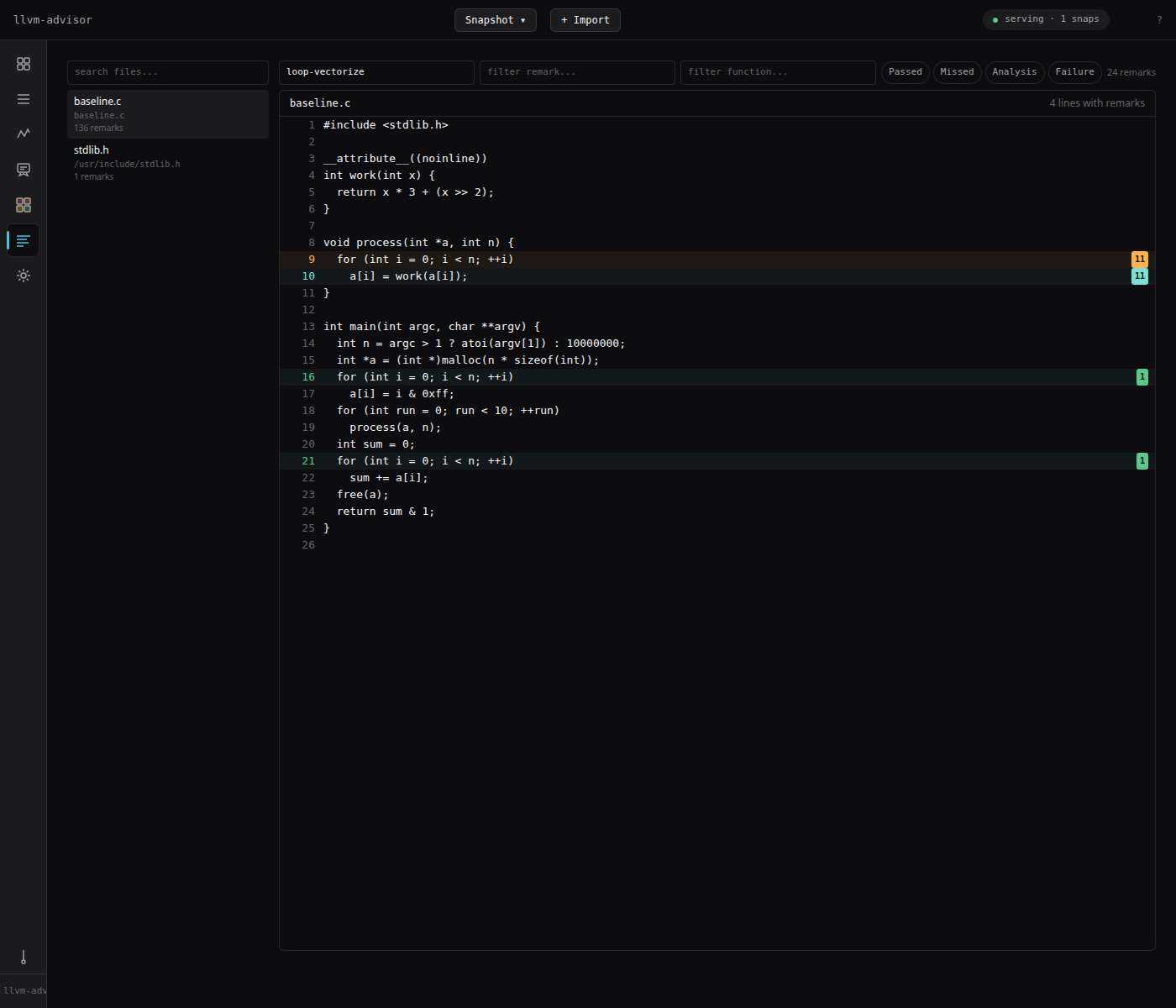
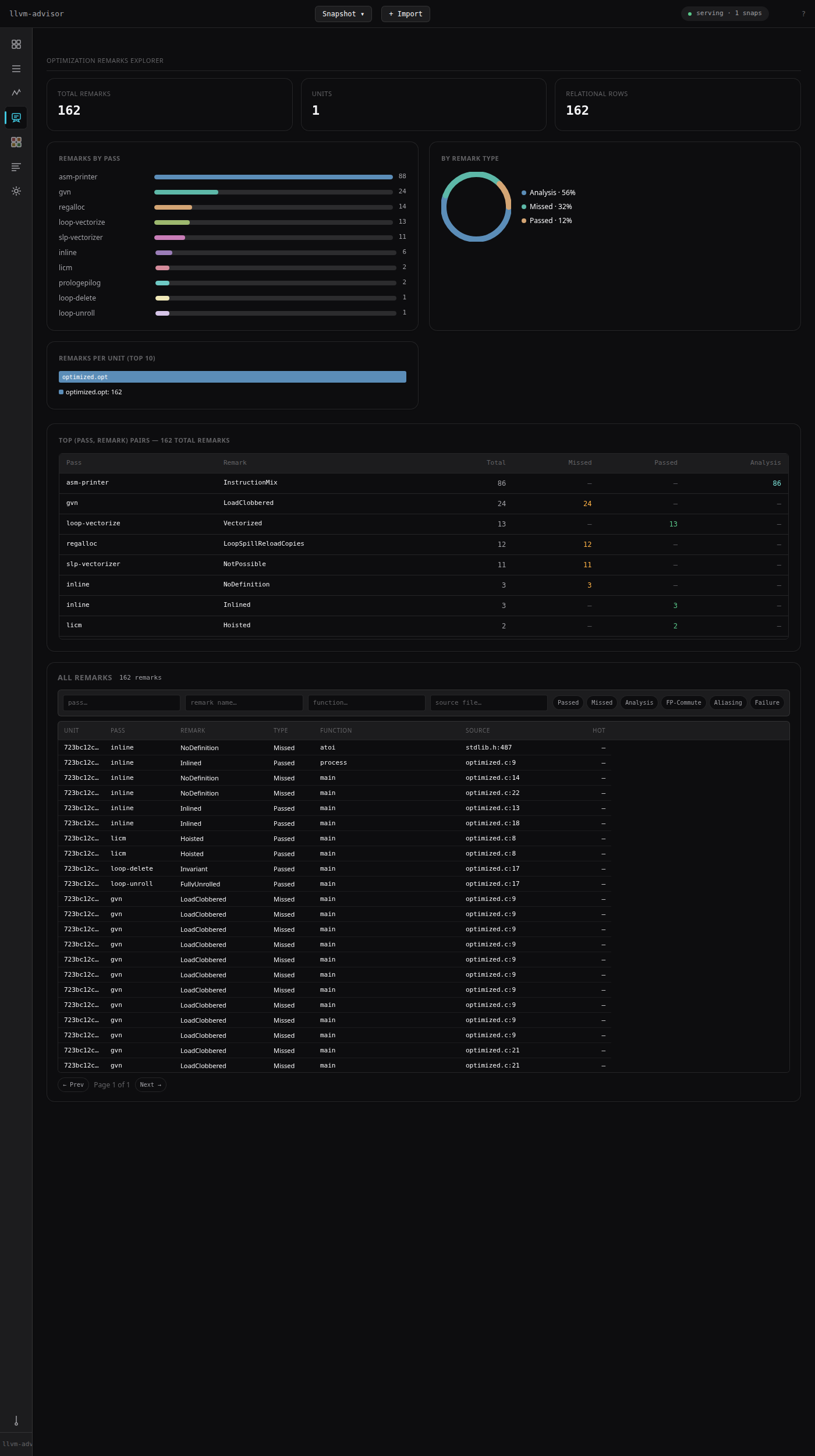


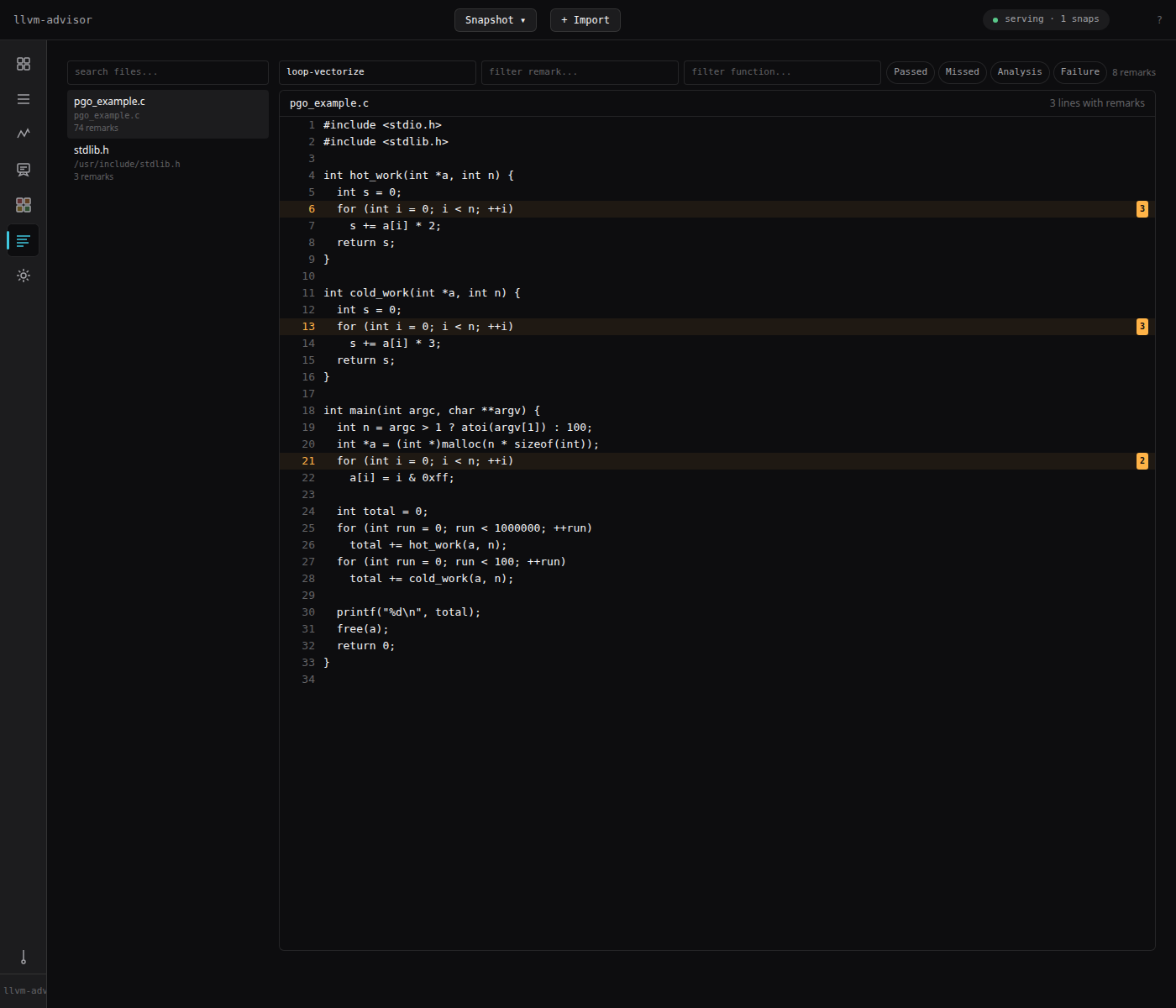
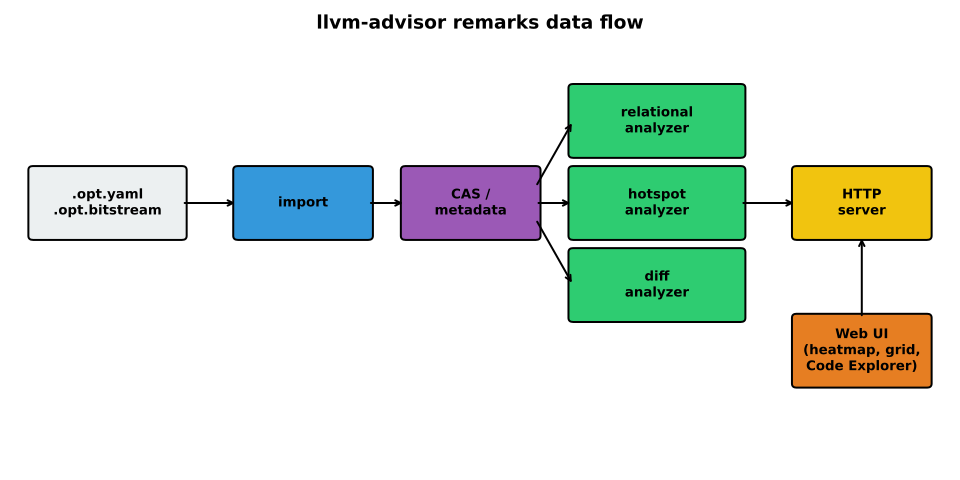
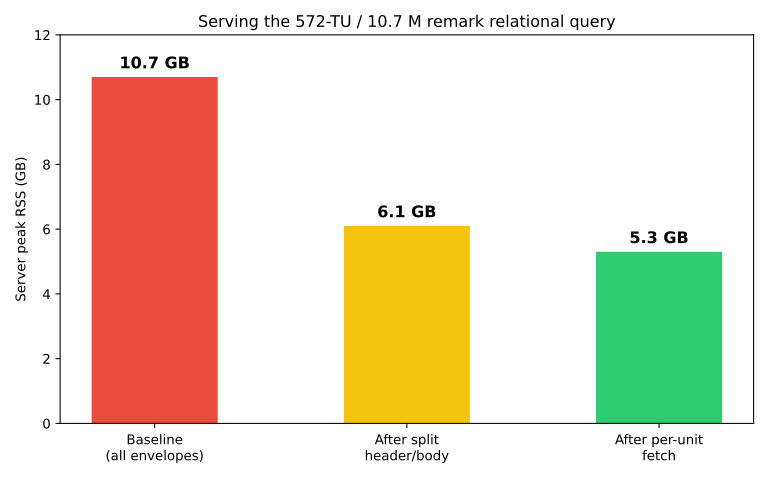
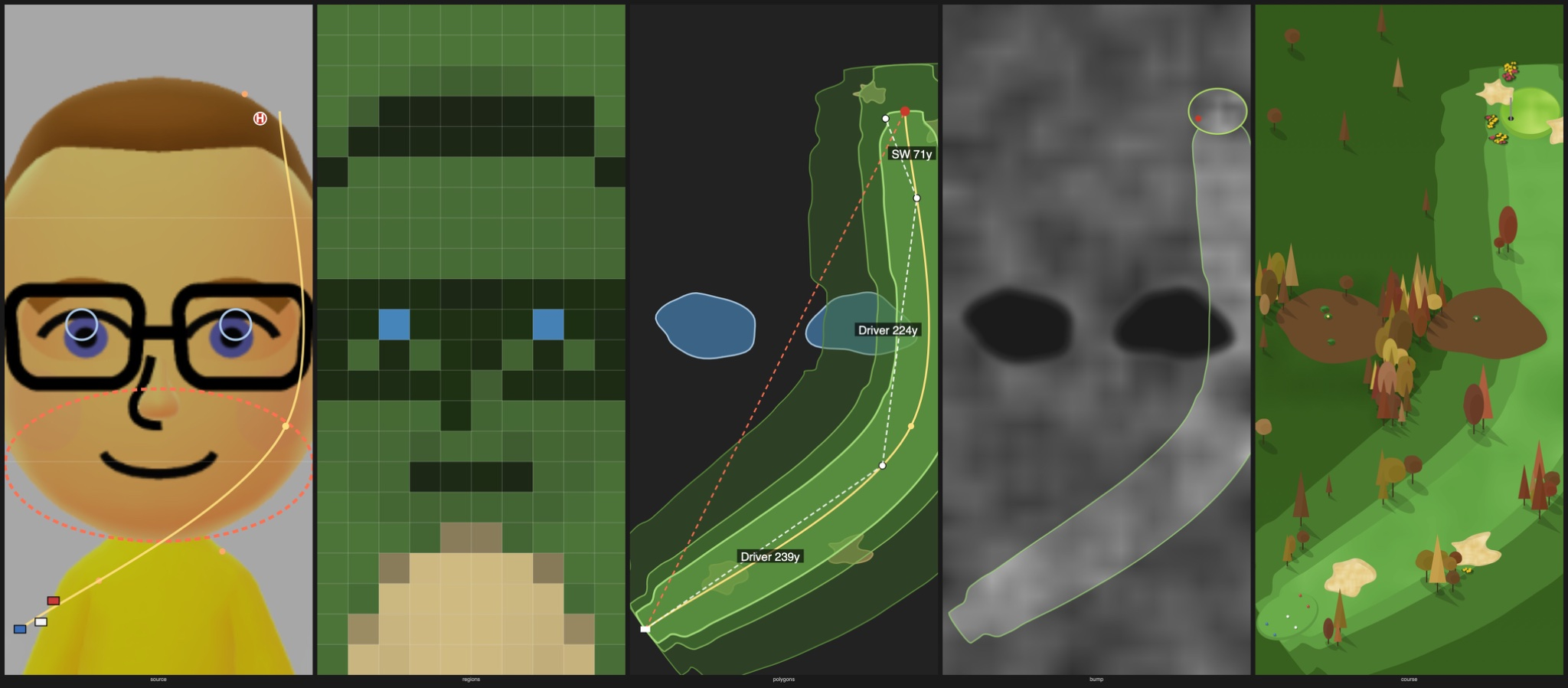

 A friend asks what's the deal with the dog. Once a very long time ago, when I was living in Silicon Valley, I had a


 Also, learned that Claude Code can forget to do things when it rebuilds an app for distribution. I found this when I, as a user, did an update and the desktop icon for BonBon was blank. I figured it would take a few hours before the OS straightened it out, but it didn't. We then discovered this flaw. People who think AI tools are perfection are in for a rude awakening. They always forget stuff. It's really irritating, after all it's a freaking computer -- we expect computers to have perfect memory. Maybe someday. So you may not realize that the beautiful Black Lab I've been including in the right margins of posts is also the identity of the product. If you've ever had a Black Lab, as I have, you know that you're getting an extremely loyal, friendly and fun-loving best friend, who demands basically all your time, esp when they're young. What does that portend? Probably nothing, but it makes me smile when I see it.


 Hope to see you at the hangout!

















 We're doing a demo site for BonBon, as part of the docs, and as I was planning it out I remembered we did one for a "newly hired senior evangelist" at a ficitious Silicon Valley startup. This is what I love about AI tools. I couldn't remember her name or the name of the company but i remembered it was funny. So I


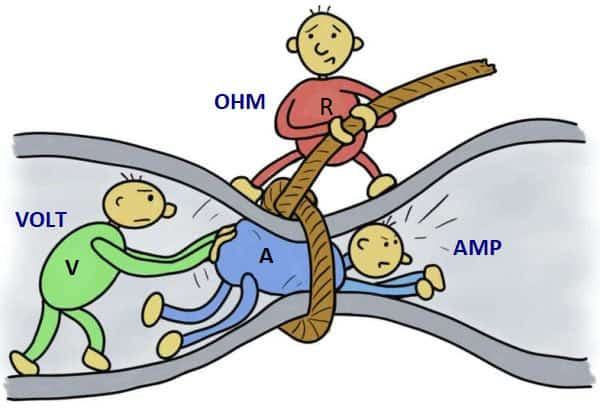








 Now in BonBonWeb, the content has no say in how the text is displayed, that belongs to the reader. You can play with that with the A icon next to the address box. When you click the A, a dialog pops up with three choices: Basic, Book, Classic, Mono and Newsprint. I had Claude on the web work with me on this set, for some reason it's better at graphic design than Claude code is. As a writer, I want control of the words, and to be able to use italic and bold, include links, lists with bullets and numbers, etc -- basically the features of web writing that were excluded from Twitter-like systems. I want those back. But I am a writer, and don't have an opinion on how CSS should be used. We all have different moods and preferences. There's a simple version of this in my iPad using iOS, and I use it all the time to filter out all the nonsense websites try to add to my reading experience. In BonBonWeb, we do all the filtering. Same with JavaScript. The content is meant to be read, not to be the user interface of an app.


 When working with Claude I learn more about the way my mind works. I am building a demo for a new product and see some quirky behavior. Should I pause and tell Claude, or just keep going and assume I'll see it again and can report it then. If I switch over to Claude and report it, pretty good chance it will write me a multipart document that i have to at least skim to see if there was anything in there I needed to know. The real answer I was looking for, "yes i can fix that, say go if you want me to do it now." Boom. That's how I want my machine to work. I explain to it that it must be more concise. This might be the real frustration of all writers in every medium. You can't write down your thought process, it has to be in your brain before you can write it. To an outside observer you look interruptible. And Claude doesn't even understand the concept of being interrupted and losing your train of thought. No doubt it could define it, but it doesn't get it. Kind of like the great speech